
Arctic Cat 1000 problems: a practical owner guide to engine, belt, cooling, clutch and electrical faults
Arctic Cat 1000 problems is a broad search because Arctic Cat has used the 1000 idea across different machines: high-output side-by-sides such as the Wildcat XX with a 998cc EFI triple-cylinder engine, older 1000-class ATV platforms, and snowmobile models around the 998cc or 1049cc range. The right answer depends on which machine is in front of you, but the diagnostic pattern is similar: heat, belt life, clutching, electrical supply, driveline load, suspension wear and maintenance history tell most of the story.
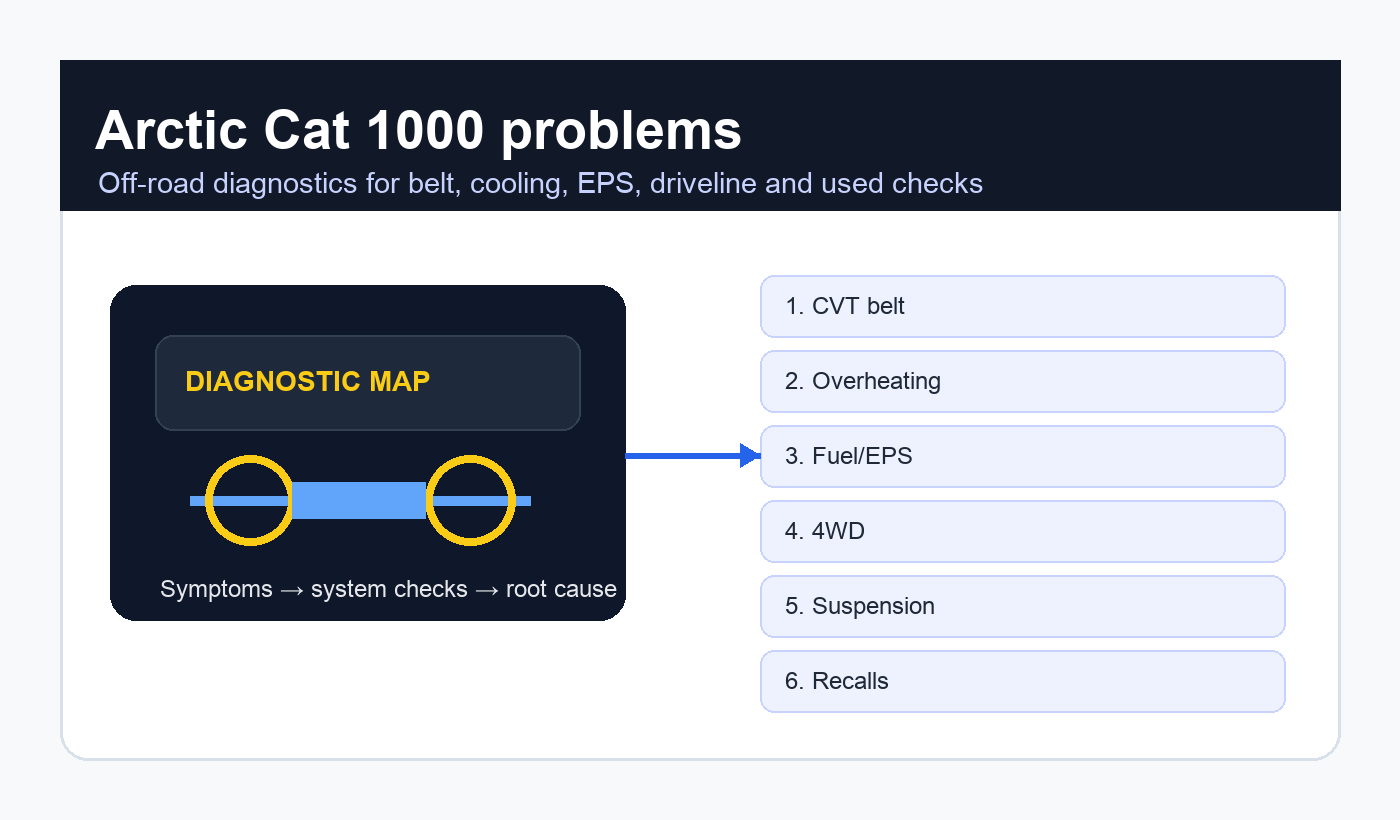
A powerful off-road or snow machine rarely fails in isolation. A belt that burns may be reacting to clutch alignment, oversized tires, mud load or aggressive throttle. A hot engine may be reacting to a packed radiator, weak fan, low coolant or slow technical riding. A warning light may be caused by battery voltage rather than the expensive sensor everyone wants to blame. This article is written as a field guide for owners, buyers and workshops who want evidence before parts.
What owners need to know first
This guide is written for owners, buyers and technicians dealing with Arctic Cat 1000 problems in the real world. It focuses on symptoms, checks, realistic repair decisions, legal limits where relevant, and the points worth confirming before buying parts or trusting a seller’s claim.
Common related topics include Arctic Cat Wildcat XX problems, Arctic Cat 1000 ATV problems, Arctic Cat Thundercat problems, Arctic Cat 1000 overheating, Arctic Cat belt problems, Arctic Cat clutch problems, Wildcat XX belt life, Arctic Cat EPS problems, Arctic Cat electrical problems, Arctic Cat starter issues, Arctic Cat fuel pump problems, Arctic Cat radiator cleaning, Arctic Cat 4×4 actuator, Arctic Cat front differential, Arctic Cat transmission noise, Arctic Cat suspension bushings, Arctic Cat wheel bearings, Arctic Cat CVT maintenance, Arctic Cat recalls, Arctic Cat 998 engine, Arctic Cat 1049 engine, Arctic Cat snowmobile overheating and Arctic Cat side-by-side troubleshooting.
The best way to handle Arctic Cat 1000 problems is to separate model families. A Wildcat XX owner with a belt smell after dune riding does not have the same problem as an older utility ATV with 4WD actuator trouble or a snowmobile that runs hot on hardpack. The topic is one phrase, but the repair path starts with exact model identification.
| Likely vehicle | Common owner concern | First diagnostic direction |
|---|---|---|
| Wildcat XX / ROV | Belt, clutch, suspension, EPS, wiring | Inspect CVT, cooling airflow, battery and terrain use. |
| Older 1000 ATV | 4WD, overheating, hard starting, driveline noise | Check actuator, radiator, fuel delivery and fluids. |
| 1000-class snowmobile | Heat, turbo/4-stroke issues, track/drive wear | Check snow conditions, cooling, belt and drivetrain. |
| Used purchase | Reliability and hidden abuse | Review service records, recalls, wear points and test ride. |
Official baseline: what Arctic Cat says
Arctic Cat 1000 problems should be judged against the official machine, not only forum stories. Arctic Cat’s current Wildcat XX page lists a 998cc EFI 3-cylinder engine, electronic power steering, electric 2WD/4WD actuation with selectable front differential lock, 18 inches of front and rear travel, large tires and an off-road safety warning that stresses helmets, seat belts, protective clothing, proper age, terrain judgment and reading the operator’s manual.
That baseline tells us the Wildcat XX is a high-performance recreational side-by-side, not a farm ATV and not a sealed road car. Heat, belt load, suspension service and driveline wear are part of the operating environment. Arctic Cat also maintains an official recalls page, which matters because any used machine should be checked by VIN before the owner assumes a symptom is just wear.
Use Arctic Cat’s official Wildcat XX page for specification and safety context, and Arctic Cat’s official recalls page before buying or diagnosing any specific vehicle.
Belt heat and CVT trouble
The most common Arctic Cat 1000 problems discussion on high-output off-road machines is belt life. A belt that smells, slips, frays, breaks or leaves black dust is not always a bad belt. CVT temperature rises when the machine is overloaded, driven slowly in high range, fitted with heavy tires, used in deep mud or sand, or run with clutch faces that are dirty, glazed or misaligned.
Start with the basics: correct belt part number, belt break-in, clean clutch sheaves, intake and exhaust duct condition, clutch alignment, engine mounts, tire size and riding range. Owners often install larger tires and then wonder why belt life gets shorter. The belt is simply reporting the load.
On older ATV platforms, clutch wear can also create poor backshift, jerky engagement or weak engine braking. Measure rather than guess. Look for flat-spotted rollers, worn buttons, cracked sheaves, stuck secondary movement and contaminated surfaces.
| Belt symptom | Likely cause | Useful first action |
|---|---|---|
| Burning smell | Slippage from load, wrong range or clutch heat | Inspect ducts, belt, clutch faces and tire size. |
| Frayed belt edge | Misalignment or damaged sheave | Check alignment and sheave condition. |
| Jerky takeoff | Glazed belt, dirty clutch, worn rollers | Clean and inspect CVT before replacing parts. |
| Repeated failures | Setup or driving pattern problem | Review gearing, tires, load and cooling airflow. |
Overheating and cooling system complaints
Arctic Cat 1000 problems often show up after mud, slow trail riding, towing, dune work or hardpack snow. Cooling systems need airflow. Radiators packed with mud, grass, snow dust or debris cannot reject heat. A fan that works in the garage may still struggle under real load if the radiator core is blocked or coolant flow is poor.
Check coolant level cold, radiator cap condition, fan operation, thermostat behavior, water pump leakage, hose condition and whether the radiator fins are physically clean. On snowmobiles, snow conditions matter: ice and marginal snow can reduce cooling compared with loose snow contacting heat exchangers. On side-by-sides, slow technical climbs can produce heat without much airflow.
Do not keep riding through a true temperature warning. Aluminum engines, head gaskets, sensors and coolant seals can be damaged by repeated overheating. A single temporary warm condition is different from a machine that pushes coolant or overheats every ride.
Hard starting, stalling and fuel delivery
Some Arctic Cat 1000 problems involve hard starts, hot restart trouble, weak idle, hesitation or stalling under throttle. EFI machines depend on clean fuel, stable battery voltage, correct sensor data and healthy grounds. A weak battery can create misleading symptoms because voltage drops while cranking or when fans, EPS and accessories are active.
Start with fuel age, battery load test, air filter, spark plugs, fuel pump pressure, injector condition and diagnostic codes. Mud, dust and water crossings add risk to air intake and electrical connectors. A machine that sits for months can suffer fuel varnish, weak battery and rodent damage before it ever reaches the trail.
| Symptom | Possible source | Check |
|---|---|---|
| Cranks but will not start | Battery, fuel pump, ignition, sensor data | Load-test battery, listen for pump, scan codes. |
| Stalls hot | Heat soak, fuel pressure, sensor fault | Check codes, fan operation and pressure. |
| Hesitates under load | Fuel filter, plug, belt slip, dirty air filter | Separate engine stumble from CVT slip. |
| Rough idle | Air leak, dirty injector, voltage issue | Inspect intake boots, grounds and fuel quality. |
Electrical, EPS and accessory wiring
Electrical Arctic Cat 1000 problems can be maddening because off-road machines live around vibration, water, dust and aftermarket accessories. EPS warnings, intermittent gauges, charging issues, dead batteries, blown fuses and starting trouble can all come from corroded connectors, weak grounds, loose battery terminals or poorly installed light bars and winches.
Inspect the battery first. Then inspect ground points, fuse box, relays, stator or charging output, winch wiring, accessory circuits and connectors near heat or splash zones. A side-by-side with multiple accessories should have clean fused wiring, not random taps into factory harnesses.
EPS problems deserve respect because steering assist affects control. If assist cuts in and out, stop treating it as an annoyance and diagnose voltage, connectors, fault codes and steering components.
4WD, differential and driveline noise
Another cluster of Arctic Cat 1000 problems involves 2WD/4WD actuation, selectable front differential lock, clicking axles, grinding, vibration and driveline backlash. Off-road load is severe: tires grab, suspension articulates, mud adds resistance and drivers sometimes apply throttle while components are bound.
Check front differential fluid, rear gearcase fluid, actuator operation, axle boots, u-joints, wheel bearings and engine/transmission mounts. Engage and disengage 4WD according to the manual, and avoid forcing lock modes while tires are loaded or spinning. A simple torn CV boot can become a costly axle problem if ignored.
| Noise or fault | Likely area | Field clue |
|---|---|---|
| Clicking on turns | CV joint or axle | Worse under throttle and steering angle. |
| 4WD will not engage | Actuator, switch, wiring, differential | Check power, codes and actuator movement. |
| Grinding | Gearcase, bearing, driveline | Stop and inspect fluid/metal before riding. |
| Vibration at speed | Tires, bearings, driveline balance | Inspect wheels, bearings and axles. |
Suspension, steering and wheel bearing wear
Many Arctic Cat 1000 problems on Wildcat-style machines are really chassis wear. Long-travel suspension is built to work, but bushings, ball joints, wheel bearings, tie rods and shock components are wear items. A machine that has been jumped, raced, run in mud or driven at high speed on rough terrain can feel loose long before the engine complains.
Jack the vehicle safely and check play at each wheel. Inspect radius rods, A-arms, shock leaks, spring preload, bent wheels and tire wear patterns. Steering wander or clunks are not normal personality; they are inspection prompts.
Snowmobile-specific 1000-class concerns
Arctic Cat 1000 problems may also refer to 1000-class Arctic Cat snowmobiles such as turbocharged 998cc four-stroke or 1049cc trail/touring models. Those machines add snow-specific concerns: marginal snow cooling, track tension, hyfax wear, turbo plumbing where equipped, chaincase service, clutch calibration and belt temperature.
A sled that overheats on icy trails may not have a failed engine; it may be starved of snow spray. Scratchers, correct riding conditions and heat exchanger inspection matter. A sled that eats belts may need clutch alignment, engine mount inspection or calibration for the rider’s altitude and load.
Used buyer checklist
A used-machine inspection is the best prevention for Arctic Cat 1000 problems. Ask for service records, recall completion, belt history, clutch work, coolant service, gearcase fluid changes, accessory installation details and whether the machine was used in mud, dunes, snow, racing or rental work. The odometer is only part of the story; hours and terrain matter more.
Look underneath. Skid plates, rock sliders, A-arms, trailing arms, belly pans and suspension mounts tell the truth about use. A clean plastic panel can hide a hard life. Also inspect the air filter housing; dust past the filter is one of the worst signs on any off-road engine.
A short, careful test drive should include low-speed steering, gentle acceleration, braking, 4WD engagement where appropriate and a post-ride check for heat, leaks, odors and new noises.
| Inspection item | Why it matters | Red flag |
|---|---|---|
| Airbox | Shows dust protection | Dust downstream of filter. |
| CVT cover | Shows belt heat and maintenance | Heavy dust, melted smell, damaged cover. |
| Fluids | Shows care and contamination | Milky oil, metal flakes, burnt smell. |
| Frame/suspension | Shows impacts | Bent arms, cracked mounts, uneven wheels. |
| Recall status | Shows factory safety updates | Seller cannot confirm VIN check. |
Symptom notes for owners in the field
When Arctic Cat 1000 problems appear after a tire upgrade, calculate the load change before blaming the engine. Taller and heavier tires change clutch demand, heat, steering effort and axle stress.
When Arctic Cat 1000 problems appear after a water crossing, inspect connectors, breathers, airbox sealing, fluids and belt housing before the next ride. Water creates delayed failures.
When Arctic Cat 1000 problems appear after adding a winch or light bar, inspect the battery, charging output, relays, fuse size and ground routing. Electrical load has to be planned.
When Arctic Cat 1000 problems appear only while towing or hauling, compare the load against the vehicle’s rating and terrain. The CVT and cooling system may be responding to work, not defect.
When Arctic Cat 1000 problems appear after storage, start with fuel quality, battery health, rodent damage, tire flat spots and stuck brakes. Storage faults are often simple but misleading.
When Arctic Cat 1000 problems appear after a dealer service, check what was touched: belt cover, fluids, air filter, wheels, brakes, software, accessories or battery. A timeline narrows the search.
When Arctic Cat 1000 problems appear only at high speed, inspect tire balance, wheel bearings, suspension joints, steering components and driveline vibration. Do not keep testing at speed until the cause is known.
When Arctic Cat 1000 problems appear as repeated warning lights, record the exact light, speed, temperature, terrain and accessory use. That information helps a technician reproduce the problem.
When Arctic Cat 1000 problems appear on a machine you just bought, perform a full baseline service before judging reliability. Unknown maintenance history is not a fair test of the brand.
Internal guides for comparison
If you are researching Arctic Cat 1000 problems, compare the pattern with other powersports problem guides already on Xmotoparts. The CFMoto ZForce 1000 problems guide is the closest side-by-side comparison. The Kymco MXU 500 problems article is useful for ATV-style driveline and maintenance thinking. The Fantic Caballero 500 problems guide shows how symptom-first diagnosis prevents random parts replacement on recreational machines.
FAQ
Are Arctic Cat 1000 problems mostly engine problems?
No. Many complaints are actually belt, clutch, cooling, electrical, suspension or maintenance issues. The engine should not be blamed until airflow, fuel, voltage and driveline load are checked.
What is the first check for Arctic Cat 1000 problems after a belt failure?
Check belt part number, break-in, clutch cleanliness, duct airflow, tire size, load, driving range and clutch alignment. Replacing the belt alone may not solve the cause.
Can mud cause Arctic Cat 1000 problems?
Yes. Mud packs radiators, adds driveline load, damages wheel bearings, contaminates connectors and forces the CVT to work harder.
Should recalls be checked when diagnosing Arctic Cat 1000 problems?
Yes. Always check the official Arctic Cat recalls page by VIN or contact a dealer before assuming a symptom is only wear or abuse.
Are electrical Arctic Cat 1000 problems usually caused by accessories?
Accessories are a common cause, especially light bars, winches, radios and chargers installed without clean fused wiring and good grounds. Factory faults are possible, but inspect added wiring early.
Final verdict
Arctic Cat 1000 problems should be diagnosed by vehicle family, use case and symptom. A Wildcat XX, an older 1000 ATV and a 1000-class snowmobile can all produce similar owner language while needing different checks. The smartest path is to identify the machine, check recalls, document the symptom, inspect belt and cooling systems, verify battery and wiring, then move into drivetrain and suspension inspection.
One practical habit helps more than most upgrades: create a baseline log. Write down belt brand and mileage, tire size, fluid dates, battery age, accessory wiring changes, coolant service, clutch cleaning, terrain type and any warning lights. After every hard weekend, inspect the same points in the same order. That routine makes small changes visible before they become expensive failures, and it gives a technician real evidence instead of a vague memory from the last ride.
Owners should also separate emergency symptoms from maintenance symptoms. A hot smell after a slow muddy climb asks for a cool-down and inspection. A grinding gearcase, sudden steering loss, flashing warning light, coolant loss or heavy vibration asks for stopping the ride. Continuing to test a machine while it is clearly unhappy usually turns a simple repair into a larger one.
The owner who avoids most Arctic Cat 1000 problems is not the one who never rides hard; it is the one who services after hard rides, cleans radiators and CVT ducts, respects belt heat, watches fluids, protects wiring, checks bearings and refuses to ignore warnings. These machines are built for serious terrain, but serious terrain always sends a bill if maintenance lags behind the fun.