Category: Motorcycle Tuning Guides

English motorcycle tuning guides covering derestriction, chip modules, setup checks and model-specific performance upgrades for riders who want clear fitment information before buying parts.

  • Husqvarna Svartpilen 125 derestriction: Legal Tuning Guide

    Husqvarna Svartpilen 125 derestriction: Legal Tuning Guide

    Husqvarna Svartpilen 125 derestriction: Legal Tuning, Real Limits and What Owners Should Know

    Husqvarna Svartpilen 125 derestriction is a tempting search because the bike looks far more serious than many learner-class motorcycles. The Svartpilen has the style of a larger naked scrambler, the branding of a premium motorcycle family and the attitude of a machine that seems to invite modification. But a 125cc road bike is also governed by licensing, emissions, insurance and type-approval rules. That makes derestriction a legal and technical subject, not just a question of “how do I make it faster?”

    The first truth is simple: many modern 125cc four-stroke motorcycles are already built close to the legal A1-class performance limit in Europe and the UK. If a rider expects a hidden switch that turns the bike into a 250, disappointment is likely. The second truth is more useful: careful maintenance, legal setup, gearing choices, intake health, exhaust compliance, tire pressure, chain condition and rider position can make a small bike feel cleaner and stronger without turning it into an illegal road machine.

    This guide treats Husqvarna Svartpilen 125 derestriction as a responsible owner topic. It explains reader need, related topics, what derestriction can and cannot mean, what modifications are risky, what improvements are legal, and how to evaluate any shop or tuning claim before spending money.

    Husqvarna Svartpilen 125 derestriction

    What owners need to know first

    This guide is written for owners, buyers and technicians dealing with Husqvarna Svartpilen 125 derestriction in the real world. It focuses on symptoms, checks, realistic repair decisions, legal limits where relevant, and the points worth confirming before buying parts or trusting a seller’s claim.

    Associated terms include Svartpilen 125 tuning, Svartpilen 125 stage 1, Husqvarna 125 remap, 125cc derestriction, A1 licence motorcycle, Euro 5 motorcycle tuning, ECU remap, piggyback module, exhaust homologation, catalytic converter, air filter, sprocket change, final drive gearing, 125cc top speed, KTM Duke 125 engine, fuel injection, throttle response, insurance declaration, road legal exhaust, dyno tuning, learner motorcycle and motorcycle type approval.

    Reader needRider questionResponsible answer
    SpeedCan it go much faster?Only limited gains are realistic on a legal 125
    LegalityCan I derestrict it on the road?Check licence, insurance and local type-approval law
    PartsWill exhaust or ECU help?Only if matched, legal and properly mapped
    BuyingShould I buy a modified bike?Inspect documentation, emissions parts and service history

    The bike behind the question

    The Svartpilen 125 is a stylish learner-class naked bike with Husqvarna design language and KTM-family engineering influence. Official product information is the starting point for any modification decision; see the Husqvarna Svartpilen 125 official model page. The bike is designed to sit in a regulated 125cc category, so expectations must follow the class.

    Husqvarna Svartpilen 125 derestriction often becomes confusing because riders compare the 125 with larger Svartpilen models. The family styling is similar, but the engine, licence class and performance ceiling are not. A 125 can feel sharp and fun, but it cannot ignore displacement, power limits, gearing and emissions calibration.

    What derestriction can mean

    In older two-stroke 50cc and 125cc machines, derestriction often meant removing obvious physical or electronic limits. On modern four-stroke fuel-injected 125cc motorcycles, Husqvarna Svartpilen 125 derestriction is usually different. It may refer to ECU changes, fuel modules, exhaust swaps, intake changes, sprocket changes or simply removing poor maintenance that is holding the bike back.

    Some shops use the word derestriction loosely because it attracts buyers. A responsible owner should ask exactly what is being changed, whether the part is road legal, whether emissions equipment remains present, whether the bike needs mapping, whether insurance must be informed and whether the result remains compliant for the rider’s licence.

    Legal limits come first

    Husqvarna Svartpilen 125 derestriction must begin with the law. In many markets, 125cc learner motorcycles are tied to power and licence categories. For UK licence context, the official government page on motorcycle entitlement and CBT is a useful reference: GOV.UK motorcycle CBT and licence guidance. Other countries have their own rules, but the principle is the same: a road bike must match licence, insurance and technical regulations.

    Insurance is part of legality. A modified motorcycle that is not declared can create serious problems after a crash, theft or police inspection. Even a part that feels minor to the rider can matter to an insurer if it changes performance, exhaust, emissions or security.

    Realistic performance expectations

    The realistic promise of Husqvarna Svartpilen 125 derestriction is not huge horsepower. A healthy 125 may gain sharper throttle response, cleaner acceleration, smoother running or slightly better gearing for the rider’s roads. It will not become a middleweight motorcycle. Aerodynamics, rider weight, wind, hills, chain condition and tire pressure can change top-speed early signals more than many expensive parts.

    ChangeWhat it may improveLegal riskBest use
    Full maintenanceRestores lost performanceLowAlways first
    Road-legal exhaustSound, weight, sometimes responseLow-to-mediumOnly with homologation and correct setup
    ECU remap or moduleFueling and throttle feelMedium-to-highOnly with legal and insurance clarity
    Sprocket changeAcceleration or cruising rpmMediumRider-specific gearing preference
    Removing emissions partsUsually not worth it for road useHighAvoid on road motorcycles

    Maintenance is the first derestriction

    Many riders searching Husqvarna Svartpilen 125 derestriction are actually riding a bike that is not performing as well as stock. A dirty air filter, worn chain, tight chain, old spark plug, low tire pressure, dragging brake, tired battery, poor fuel, blocked injector or badly adjusted controls can make a 125 feel slow. Fixing those basics can feel like a tune without changing legal status.

    Start with service records. Check oil, filter, air filter, spark plug, coolant, chain slack, sprocket wear, brake drag, tire age, wheel bearings and throttle free play. Then verify that the bike reaches normal operating temperature and has no warning lights or stored faults. A weak bike should be diagnosed before it is modified.

    Pre-tuning diagnostic checklist

    Before paying for any performance work, the owner should know whether the motorcycle is already healthy. A compression issue, dragging rear brake, tired clutch, dirty injector or old fuel can make a small bike feel restricted even when nothing is electronically limited. A workshop that sells tuning before checking the basics may be solving the wrong problem.

    A careful pre-tuning inspection should include battery voltage, charging voltage, fault-code scan, throttle adaptation where applicable, intake leaks, exhaust leaks, cooling fan operation, chain alignment, wheel bearing play and brake drag. On a 125cc engine, friction and poor setup are not small details. They can be the difference between a bike that feels lively and one that feels flat.

    It also helps to establish a baseline. Record top speed only in safe and legal conditions, note rpm at cruising speed, check fuel consumption and describe the exact complaint. “It feels slow” is vague. “It hesitates from 5,000 to 7,000 rpm after fitting an exhaust” is useful. Good information makes good tuning possible.

    ECU remaps and piggyback modules

    Husqvarna Svartpilen 125 derestriction often leads riders to ECU remap claims. On a modern 125, fueling is controlled tightly for emissions and reliability. A remap or piggyback fuel module can change throttle feel, fueling with an exhaust, or response in certain rpm zones. But gains are limited by engine size, cam design, compression, valve area and legal power limits.

    The main questions are practical. Who wrote the map? Was the bike tested on a dyno? Does the map preserve cold starts, fan control, emissions behavior and diagnostic functions? Is the modification legal for road use? Will the insurer accept it? A cheap black-box promise is not the same as documented calibration.

    Exhaust systems and homologation

    A road-legal exhaust can be a good ownership upgrade, but Husqvarna Svartpilen 125 derestriction should not mean removing the catalyst or fitting a race-only pipe on a street bike. A louder exhaust does not automatically make more power. In some cases it can reduce torque, create fueling issues, attract enforcement attention or fail inspection.

    Look for homologation markings, supplied documentation, dB killer rules, catalyst compatibility and whether the manufacturer recommends fuel mapping. If the exhaust is sold for closed-course use only, treat that language seriously. It usually means road legality is not promised.

    Air filters and intake changes

    High-flow filters are often marketed as part of Husqvarna Svartpilen 125 derestriction, but intake changes on small engines can be overestimated. A filter may help if the original is dirty or if it is part of a properly mapped setup. It can hurt if it allows poor filtration, changes fueling too much or creates intake noise without useful flow improvement.

    For daily road use, reliability matters more than a tiny theoretical gain. The engine needs clean air more than it needs marketing. If the bike is ridden in dust or rain, filter quality and sealing are not optional.

    Gearing changes: the honest tradeoff

    Husqvarna Svartpilen 125 derestriction sometimes means changing sprockets. Shorter gearing can make the bike pull harder at low speed but may reduce relaxed cruising or top speed. Taller gearing can reduce rpm at a given speed but may make acceleration worse, especially into wind or uphill. There is no free speed.

    Gearing choiceLikely feelTradeoff
    Shorter gearingStronger launch and easier city responseHigher rpm and possible lower top speed
    Taller gearingCalmer cruising if the engine can pull itWeaker acceleration and more downshifts
    Stock gearingBalanced for general useMay not match every rider or road

    Weight, aerodynamics and rider technique

    On a 125, small details matter. Husqvarna Svartpilen 125 derestriction can be less effective than reducing unnecessary luggage, wearing less flapping clothing, maintaining tire pressure, lubricating the chain and choosing a better body position on faster roads. Wind resistance grows quickly, and a small engine has limited power to fight it.

    This does not mean the rider should ride unsafely or tuck everywhere. It means top-speed arguments on 125cc bikes are often distorted by conditions. The same bike can feel very different with a headwind, backpack, cold engine or underinflated tires.

    Stage 1 claims

    The phrase stage 1 appears frequently near Husqvarna Svartpilen 125 derestriction. It usually suggests mild bolt-on tuning such as exhaust, filter and fuel adjustment. The problem is that “stage 1” is not a regulated technical standard. One seller’s stage 1 may be a legal road setup; another may be a noisy package with no dyno proof and questionable legality.

    Ask for before-and-after data, not adjectives. Ask whether the map is designed for the exact exhaust and intake. Ask whether the bike remains road legal. Ask whether a warranty or diagnostic support remains. If a seller cannot answer, the package is mostly marketing.

    Used bike warning signs

    A used bike advertised with Husqvarna Svartpilen 125 derestriction deserves careful inspection. Look for missing catalyst parts, cut wiring, error lights, race-only exhausts, poor fueling, rough idle, melted plastics, non-standard sprockets, loud intake modifications and no paperwork. A clean, documented legal upgrade is different from a bike that has been randomly altered by several owners.

    Used-bike clueGood signWarning sign
    ExhaustHomologation docs and original parts includedRace-only pipe and no catalyst proof
    ECU/moduleInvoice and map detailsUnknown box with cut wires
    GearingSeller explains sprocket choiceOdd speedometer behavior or chain wear
    RunningCold start and idle are cleanStalling, popping, warning light
    Insurance/legalDeclared modificationsSeller says “no one checks”

    Best legal upgrade path

    The best approach to Husqvarna Svartpilen 125 derestriction is boring but effective. Service the bike first. Fit good tires. Set chain and tire pressures correctly. Use quality fuel. Keep brakes free. If you still want more character, choose a road-legal exhaust with paperwork. If fueling changes are needed, use a reputable tuner who understands the exact model and local law.

    For many owners, the best money is not engine tuning. It is tires, brake pads, suspension setup, lighting, luggage or rider training. Those changes can make the bike faster point-to-point because the rider is more confident, not because the engine number changed.

    What to avoid

    Avoid advice that treats derestriction as a secret illegal recipe. Avoid catalyst removal for road use. Avoid fake “unlimited ECU” claims with no data. Avoid exhausts with no road approval. Avoid air filters that compromise sealing. Avoid any modification that the insurer would reject. Avoid shops that promise big power without dyno sheets or legal explanation.

    Also avoid comparing a tuned 125 with larger bikes. If the rider has the licence and budget for significantly more performance, the cleanest upgrade is often a 250, 300 or 400cc motorcycle rather than forcing a 125 to do a job it was not built to do.

    How to choose a reputable tuner

    A reputable tuner talks about evidence before parts. They ask about the exhaust, intake, fuel, mileage, fault lights, service history and legal use. They explain what can be measured, what cannot be promised and what must be declared to insurance. They do not guarantee fantasy horsepower from a learner-class engine.

    Ask whether the shop has worked on the exact engine family, whether it can provide before-and-after data, whether the setup is road legal, whether the original map can be restored and whether any warning lights or diagnostic functions are affected. The best answer may be “do not tune this bike yet; service it first.” That kind of honesty saves money.

    Paperwork matters. Keep invoices, homologation sheets, dyno graphs if supplied, insurance notes and original parts. If the bike is later sold, those documents make the difference between a clean modified motorcycle and a suspicious one.

    That documentation also protects the next owner. A small-displacement motorcycle often changes hands quickly as riders move from learner licences to larger machines. Clear records make the bike easier to value, easier to insure and easier to return to standard if regulations, inspections or buyer preferences require it.

    Related internal reading

    For more 125cc tuning context, read our Svartpilen 125 tuning guide, Zontes G1 125 tuning guide, and Honda Varadero 125 tuning guide. These related guides help compare different 125cc platforms and the realistic limits of small-displacement tuning.

    FAQ

    Can the Svartpilen 125 be derestricted legally?

    It depends on country, licence class, insurance and the exact modification. Husqvarna Svartpilen 125 derestriction should always be checked against local law before any road use.

    Will an exhaust make it much faster?

    Usually no. A legal exhaust may change sound, weight and response, but Husqvarna Svartpilen 125 derestriction with exhaust alone rarely produces dramatic power on a modern four-stroke 125.

    Is an ECU remap worth it?

    It can improve fueling or throttle feel when done properly, but it should be documented, legal, insured and based on the exact bike setup.

    What is the safest first step?

    Full maintenance, tire pressure, chain condition and brake drag checks should come before performance parts.

    Final practical verdict

    The honest verdict on Husqvarna Svartpilen 125 derestriction is that the best gains are usually refinement, not transformation. A well-serviced, legally set up Svartpilen 125 can feel sharper and more enjoyable, but it remains a 125cc learner-class motorcycle with real legal boundaries.

    Husqvarna Svartpilen 125 derestriction should start with licence and insurance checks.

    Husqvarna Svartpilen 125 derestriction should continue with maintenance before parts.

    Husqvarna Svartpilen 125 derestriction with an exhaust should keep road legality and documentation.

    Husqvarna Svartpilen 125 derestriction with ECU changes should require proof, not promises.

    Husqvarna Svartpilen 125 derestriction with sprocket changes should accept the acceleration/top-speed tradeoff.

    Husqvarna Svartpilen 125 derestriction on a used bike should trigger a careful inspection for bad modifications.

    Husqvarna Svartpilen 125 derestriction is not a shortcut around displacement and legal power limits.

    Husqvarna Svartpilen 125 derestriction is best approached as a legal setup and rideability project.

    Husqvarna Svartpilen 125 derestriction makes sense only when the result remains safe, insured and usable every day.
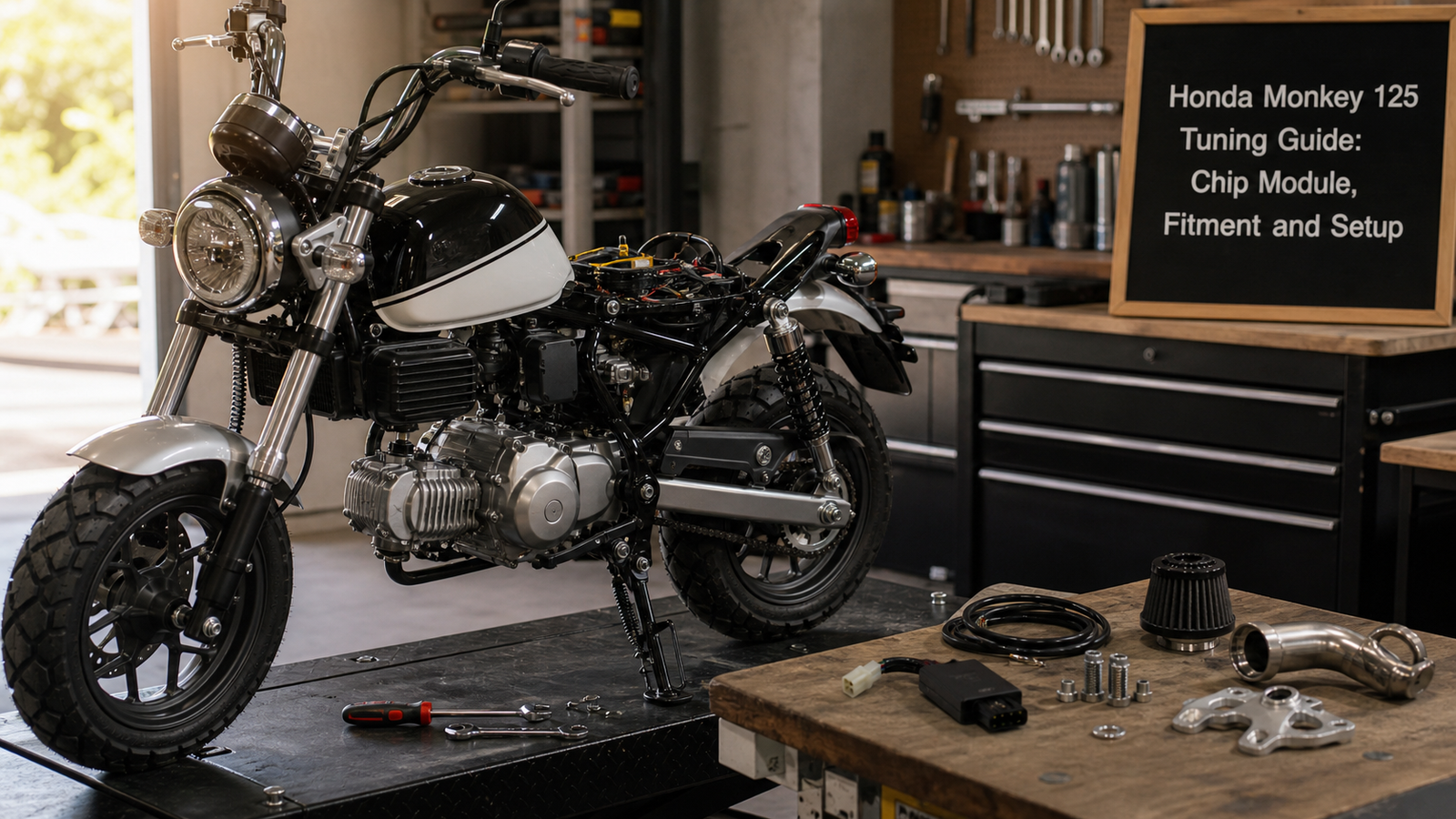

  • Honda Monkey 125 Tuning Guide: Chip Module, Fitment and Setup

    Honda Monkey 125 Tuning Guide: Chip Module, Fitment and Setup

    Honda Monkey 125 Tuning Guide: Chip Module, Fitment and Setup

    Honda Monkey 125 tuning should be approached differently from tuning a big motorcycle. The Monkey is light, simple, air-cooled, fuel-injected and built around charm as much as speed. A chip tuning module can make sense for riders who want a cleaner throttle feel, a little more urgency after exhaust or intake changes, or a reversible way to fine-tune the engine signal. It should not be treated as a magic box that turns a 125 into a highway machine.

    Honda Monkey 125 Tuning Guide: Chip Module, Fitment and Setup

    This guide is written for the owner standing next to the bike with the seat off, trying to understand where a module fits, what has to be checked before ordering and how to set it up without creating poor running. The goal is practical: confirm compatibility, install cleanly, start conservatively and judge the result like a mechanic, not like a brochure.

    If you are researching a reversible module, use this page together with the Honda Monkey 125 chip tuning module product page and the more general Honda Monkey 125 derestriction guide. The product page helps with ordering and fitment, while the derestriction guide explains the wider legal and mechanical picture.

    What the Monkey 125 is before you tune it

    The modern Monkey 125 is not an old carburettor minibike with a few wires and a simple jet change. It is a modern fuel-injected 125 based around Honda’s small horizontal single-cylinder platform. Depending on model year and market, it may use different emissions equipment, mapping strategy, connector layout and transmission generation. That is why Honda Monkey 125 tuning starts with identification, not parts.

    The Monkey’s strength is not peak horsepower. It is low-speed fun, light weight, easy maintenance and a riding position that makes every short trip feel special. Any tuning work should protect that character. A module that makes the bike snatchy in traffic, hard to start or annoying on steady throttle has missed the point, even if it feels sharper during one hard acceleration run.

    Before making changes, check Honda’s official model information for your market. Honda’s current Monkey pages, such as Honda Powersports Monkey, are useful for confirming the broad engine family and equipment, but your exact year and country still matter. A 2019 bike, a later five-speed version and a market-specific emissions version should not be treated as identical without checking connectors.

    What a chip module can and cannot do

    A tuning module for a small fuel-injected motorcycle generally works by altering a sensor signal within a safe operating range. On bikes like the Monkey, the most common approach is connected around the intake air temperature sensor circuit or a related signal used by the ECU to calculate fueling. The module does not rewrite the ECU like a full remap. It is reversible, external and usually adjusted with simple settings.

    That simplicity is useful, but it also sets the limit. Honda Monkey 125 tuning with a chip module may improve throttle response, support a freer-flowing exhaust or intake, and make the engine feel less flat in certain conditions. It will not change displacement, cam timing, valve size, compression ratio or gearbox ratios. If the bike is struggling because of gearing, tyre drag, poor maintenance or unrealistic expectations, a module alone will not solve it.

    Rider expectationRealistic outcomeWorkshop note
    Cleaner throttle responsePossible when the bike is healthy and the module is set mildlyTest warm engine response, not only cold starts
    More pull after exhaustPossible if the exhaust changed fueling demandCheck for lean hesitation and hot running
    Higher top speedUsually limited by power, gearing, rider size and windDo not judge only by indicated speed
    Big horsepower gainNot realistic from a simple external moduleUse honest expectations on a 125 cc engine

    Compatibility checklist before ordering

    Most fitment problems happen before the box is opened. The owner assumes “Monkey 125” is enough information, but a supplier may need model year, market, connector photos and whether the bike is stock. A careful Honda Monkey 125 tuning order should include a few minutes of inspection.

    Start with the registration year, but do not rely on it alone. The manufacturing year and model year can differ. Check the VIN plate, service documents and engine configuration. If the bike has already been modified with an exhaust, intake, big-bore kit or previous electronics, say so before ordering. A module selected for a stock motorcycle may not be ideal for a heavily modified one.

    Check the sensor area

    Remove the seat and inspect the intake area with good light. Look for the intake air temperature sensor or the connector specified by the module supplier. Do not pull wiring by the cable. Release the connector lock properly and check whether the plug shape matches the module harness. Photos are valuable here. A clear photo of the connector often prevents the wrong part being sent.

    Check previous modifications

    A Monkey with a slip-on exhaust, open intake, velocity stack or altered gearing behaves differently from a stock bike. That does not mean a module will not work. It means setup must be more careful. Honda Monkey 125 tuning is best when parts are matched: exhaust, intake, fueling and gearing should not fight each other.

    Check the bike’s health first

    Do not install a module to hide a fault. If the engine has old fuel, a dirty air filter, tight valves, weak battery, damaged wiring, poor earths or stored fault codes, fix those first. A healthy small engine responds to fine adjustment. An unhealthy one becomes harder to diagnose after extra electronics are added.

    Before orderingWhat to confirmWhy it matters
    Model yearYear, market and engine generationConnector and ECU strategy can vary
    Connector photoClear picture of the sensor plugPrevents wrong harness selection
    Bike conditionService status, filter, plug, valves and batteryBad maintenance can mimic tuning problems
    Current upgradesExhaust, intake, gearing, big-bore workSetup depends on the full package
    Use caseTown riding, hills, commuting or private-area useThe best setting depends on how the bike is ridden

    How to install the module cleanly

    Installation should be tidy enough that another mechanic can understand it later. Start with the ignition off and the key removed. Let the engine cool if you have just ridden. Work in good light, keep the harness away from the cylinder, exhaust, chain, steering movement and sharp frame edges. A good Honda Monkey 125 tuning installation should look almost factory when finished.

    Connect the module only to the intended sensor circuit. Do not force plugs. If the connector does not lock easily, stop and re-check fitment. Secure the module body where it is protected from water spray, heat and vibration. Use cable ties, but do not crush wiring. Leave enough slack for normal engine movement and steering movement, especially if the harness runs near the frame or under the tank area.

    First start after installation

    Start from the lowest or most conservative setting. Turn the ignition on and watch for warning lights. Start the engine and let it idle without touching the throttle. Listen for unstable idle, misfire, fuel smell or abnormal engine note. If anything feels wrong, switch off and re-check the connector before riding.

    Warm-engine testing

    Do not judge the module after thirty seconds on a cold engine. Let the Monkey reach normal temperature. Ride gently at first, then test steady throttle, low-speed roll-on and a short hill. The useful part of Honda Monkey 125 tuning is not the loudest moment; it is the way the bike responds when you use it normally.

    How to choose the right setting

    Small engines make it tempting to turn every adjustment to the maximum. Resist that. The highest setting is not automatically the best setting. If the module changes fueling influence, too much correction can make the engine feel heavy, rich, uneven or inconsistent. The best setting is the one that gives clean response without side effects.

    Use a repeatable test route. Include a cold start, a warm restart, slow town riding, a steady 40-60 km/h section, a hill and a short full-throttle pull where legal and safe. Change one setting at a time and write down the result. If a setting feels better for the first minute but worse after heat builds, it is not the correct setup.

    Symptom after fittingLikely meaningWhat to do
    Sharper response with no warning lightsSetting may be suitableKeep testing through heat cycles
    Flat or heavy throttleCorrection may be too strongReduce setting and retest
    Hesitation after exhaust changeFueling may need careful adjustmentTry mild changes and inspect for leaks
    Engine light appearsSignal or connector issue possibleStop, scan if possible, re-check installation
    Poor hot restartSetup may be too aggressive or fault existsReturn to conservative setting and diagnose

    Exhaust and intake combinations

    Many riders look at a module because they have fitted, or plan to fit, an exhaust. That is understandable. A lighter silencer can improve sound and styling, and the Monkey responds well to tasteful parts. But exhaust work on a 125 should be judged by rideability. If a pipe removes too much low-rpm strength, the bike can sound faster while feeling weaker where you ride most.

    For mild Honda Monkey 125 tuning, a quality road-legal exhaust, clean air filter and conservative module setting are usually more sensible than an open intake and maximum correction. If the intake is changed, filtration and water protection matter. The Monkey is often used in town, rain, back roads and short trips. A setup that only works on a dry test ride is not a good road setup.

    Gearing and tyre pressure matter too

    A chip module is not the only way to improve the feel of a Monkey. Final-drive gearing can change acceleration and cruising feel. Tyre pressure, chain condition, brake drag and rider position also affect performance more than many owners expect. Before blaming the ECU, make sure the motorcycle rolls freely and the chain is not tight or worn.

    If the goal is better hill climbing, a small gearing change may be more noticeable than electronic correction. If the goal is a cleaner engine response after an exhaust, the module becomes more relevant. The best Honda Monkey 125 tuning plan asks what problem you are solving before choosing parts.

    Road legality and responsible use

    Performance products can be restricted to private roads, competition use or markets where the modification is legal. Always check local rules before using any tuning part on public roads. In Europe, 125 cc motorcycles are tied closely to licence and type-approval limits, and the EU framework for two- and three-wheel vehicles is set out in Regulation (EU) No 168/2013.

    That does not mean every owner should be frightened of tuning. It means the owner should be honest. Keep the original parts, keep installation reversible, save product information and ask a qualified workshop if you are not comfortable with sensor wiring. Responsible Honda Monkey 125 tuning is easier to live with and easier to undo if inspection rules or riding needs change.

    Common installation mistakes

    The most common mistake is fitting the module to the wrong connector because the plug looks close enough. The second is routing the harness near heat. The third is setting the module too high immediately. The fourth is blaming the module for a pre-existing service problem. The fifth is forgetting to test hot restart and steady throttle.

    Another mistake is comparing a Monkey to the wrong motorcycle. A tuned 125 sport bike, a big-bore Grom and a stock Monkey are different machines. Use the right comparison. A good result is a Monkey that feels cleaner, livelier and still easy to ride. It does not need to become aggressive to be improved.

    When a workshop should do the job

    If you are unsure which connector is correct, if the bike already has electrical faults, if a warning light is present, or if the harness has been previously modified, use a workshop. Sensor circuits are not a place for rough work. A mechanic can also check for exhaust leaks, intake leaks, battery condition and fault codes before the module is blamed for everything.

    A workshop is also useful after several modifications. Exhaust, intake, gearing and electronics interact. The more parts you add, the more important it becomes to test the whole motorcycle rather than one component. For owners comparing Honda 125 tuning ideas, the Honda CB125R power increase guide and Honda CB125R ECU remap guide show the difference between small external changes and deeper ECU work.

    Monkey, Dax and Grom-style 125 tuning

    The Monkey shares the small-Honda tuning world with bikes like the Dax, Grom and Super Cub, but each one is used differently. The Monkey is often bought for style and short-distance fun. The Dax has its own retro utility feel. The Grom is often modified more aggressively. If you own both a Monkey and Dax, the Honda Dax 125 derestriction guide is a useful companion because it explains similar 125 cc limits from another small-Honda angle.

    For the Monkey, keep tuning friendly. It should start easily, idle calmly, pull cleanly from low rpm and remain enjoyable in traffic. The best Honda Monkey 125 tuning does not remove the reason people love the bike in the first place.

    How to judge the result after a week

    The first ride only tells you whether the bike is basically happy. The better judgement comes after several normal rides: one cold morning start, one hot restart after fuel, one slow town journey, one hill and one longer steady section. A Monkey can feel exciting for ten minutes with a sharper setting, then become tiring if the throttle is too abrupt or if the engine feels loaded once fully hot.

    Keep notes like a mechanic would. Write down the module setting, weather, fuel used, whether the exhaust is stock, whether the air filter is stock, and what the bike did at low, mid and full throttle. If you change gearing or exhaust later, do not assume the old setting is still correct. Retest from a conservative point. That slow method is less dramatic than turning a dial to maximum, but it usually gives a better motorcycle.

    Signs the setup is working

    A good setup is calm. The engine starts without extra throttle, idle settles normally, the throttle opens cleanly from small inputs, and the bike feels consistent after heat builds. On a small air-cooled 125, consistency matters more than one strong pull. If the Monkey feels the same on the third ride as it did on the first, you are closer to a usable setup.

    Signs you should step back

    Reduce the setting or return to stock for diagnosis if the engine light appears, hot restart becomes poor, fuel smell increases, idle hunts, the bike feels flat at steady speed, or the harness has moved near heat. Also step back if the only improvement appears at full throttle but town riding gets worse. A road Monkey spends much of its life at partial throttle, so that is where the setup has to be clean.

    After one weekGood signWarning signNext action
    Cold startStarts normally and settles quicklyNeeds throttle or stallsLower setting and check connector
    Hot restartRestarts cleanly after a fuel stopCranks longer or smells richReturn to mild setting and retest
    Town ridingSmooth small throttle openingsSnatchy or uneven responseCheck chain slack, throttle free play and setting
    Hill pullCleaner drive without hesitationNo improvement or worse heat feelInspect intake/exhaust leaks and gearing
    Harness checkDry, secure and clear of heatLoose ties or rub marksReroute before riding again

    Maintenance that changes the tuning result

    Small motorcycles react strongly to basic maintenance. A tight chain can make the bike feel lazy. Low tyre pressure can remove the crispness you expected from the module. A dirty air filter can make one setting feel rich. Old fuel can make starting poor. Valve clearance that has drifted tight can make a hot engine hard to restart. Before changing the module again and again, bring the motorcycle back to a known healthy baseline.

    The same applies after washing the bike or riding in heavy rain. Check that connectors are seated, the module body is protected, and water has not collected where the harness was mounted. The Monkey is simple, but simple machines still punish careless wiring. A reversible tuning part should remain reversible in practice: no cut wires, no crushed cables, no hidden joins and no installation that requires guessing when the next mechanic opens the seat.

    FAQ

    Will a chip module make the Honda Monkey 125 much faster?

    No simple module should be expected to make the Monkey dramatically faster. It may improve response and support light intake or exhaust changes, but displacement, gearing and wind resistance still limit the result.

    Can I install the module myself?

    Many owners can install it if the connector is correct and they work carefully. If you are uncomfortable around sensor wiring, use a workshop. Clean installation is more important than fast installation.

    Should I use the highest setting?

    No. Start low and increase only if the engine runs cleanly. The highest setting can be worse than a mild setting if it makes the bike rich, flat or inconsistent.

    Do I need an exhaust first?

    No. A module can be used on a stock bike if compatible, but it often makes the most sense when the owner wants to refine response or support a mild exhaust/intake package.

    What should I check after the first ride?

    Check that the harness has not moved, no warning light is present, the engine restarts hot, idle is stable and throttle response is clean at steady speed. Recheck cable ties after the first few rides.

    Final setup advice

    Honda Monkey 125 tuning is best when it stays reversible, tidy and realistic. Confirm the exact model, inspect the connector, start with a conservative setting and test the bike in the conditions you actually ride. If the Monkey becomes smoother, cleaner and more responsive without losing reliability, the setup is doing its job.

    Use the module as one part of a balanced package, not as a shortcut around maintenance. A fresh filter, correct tyre pressure, healthy chain, clean wiring and careful installation will do more for the riding experience than a rushed maximum setting. That is how a small 125 remains fun, dependable and genuinely better to ride.

  • Yamaha X-Max 300 tuning: chip module, CVT setup, exhaust choices and real-world scooter performance

    Yamaha X-Max 300 tuning: chip module, CVT setup, exhaust choices and real-world scooter performance

    Yamaha X-Max 300 tuning: chip module, CVT setup, exhaust choices and real-world scooter performance

    Yamaha X-Max 300 tuning should begin with a realistic idea of what the scooter already is. The XMAX 300 is not a slow commuter that needs saving; it is a 292cc liquid-cooled, fuel-injected, SOHC four-valve single with automatic V-belt transmission, ABS brakes and enough midrange torque to make daily riding easy. Official Yamaha specifications list 20.6 kW at 7,250 rpm and around 28.9 Nm at 5,750 rpm, so the best tuning work is not about chasing fantasy horsepower. It is about making the scooter sharper, healthier and better matched to the rider.

    Owners normally look for Yamaha X-Max 300 tuning because they want stronger pull away from traffic lights, cleaner throttle response, better overtaking feel, a sportier exhaust note, a chip module, lower roller weight, smoother CVT behaviour or a setup that copes better with hills, passenger weight and motorway use. Those are sensible goals when approached like a mechanic: measure the baseline, service the transmission, check the engine, then decide whether electronic or exhaust changes are actually needed.

    Yamaha X-Max 300 tuning

    What tuning can and cannot change

    The XMAX 300 uses a modern fuel-injection system and a continuously variable transmission. That means Yamaha X-Max 300 tuning is not the same as changing jets on an old carbureted scooter. The ECU, throttle body, sensors, variator, clutch, belt, exhaust and final transmission oil all work together. A small change in one area can feel good, bad or pointless depending on the condition of the rest of the scooter.

    A chip module or fueling device can help refine response when the scooter has a clear fueling reason for adjustment, especially after intake or exhaust changes. It cannot repair a worn V-belt, glazed clutch shoes, blocked air filter, dragging brake, underinflated tyre, old spark plug or poor maintenance history. The most expensive tuning part is still weaker than a properly serviced transmission.

    The owner should also separate sound from speed. A louder exhaust makes the scooter feel more aggressive, but the stopwatch and the rider’s hands tell the truth. Good Yamaha X-Max 300 tuning keeps the scooter smooth in traffic, stable at speed and reliable on hot days.

    Start with the service baseline

    Before changing parts, put the scooter into known-good condition. Yamaha owner information for XMAX models emphasizes periodic maintenance, including engine oil, final transmission oil, coolant, air filter, V-belt checks, brake condition and throttle free play. Those items matter because scooter performance is very sensitive to drag and transmission condition.

    AreaWhy it mattersWorkshop check
    V-belt and variatorA worn belt changes effective gearing and makes acceleration lazy.Inspect belt width, cracks, dust, pulley faces and roller wear.
    Clutch and bellGlazing causes shudder, heat and poor takeoff.Check shoe surface, bell discoloration and engagement rpm.
    Air filterRestricted airflow makes the engine feel flat.Replace dirty filters before touching fueling.
    Tyres and brakesRolling resistance steals performance from a mid-size scooter.Set cold pressures and confirm both brakes release cleanly.
    Cooling systemHeat changes power, reliability and rider confidence.Check coolant level, fan operation and radiator cleanliness.

    This first stage of Yamaha X-Max 300 tuning is not glamorous, but it is where many scooters are fixed. A fresh belt, clean variator, correct tyre pressure and clean filters can make the XMAX feel as if it gained power because the engine is no longer fighting preventable losses.

    CVT tuning: rollers, sliders, belt and clutch

    The CVT is the heart of XMAX performance. A conventional motorcycle has fixed gears; the XMAX uses belt ratio changes to keep the engine near a useful rpm range. That is why Yamaha X-Max 300 tuning often starts with rollers or sliders rather than the ECU.

    Lighter rollers can let the engine rev higher before the ratio shifts, which can improve launch and midrange response. Too light, however, makes the scooter noisy, busy and sometimes slower at real road speeds. Heavy rollers can feel calm at cruise but lazy in traffic. The best setup depends on rider weight, route, hills, passenger use and whether the scooter is stock or fitted with an exhaust.

    Use quality parts and change one variable at a time. If you replace rollers, belt and clutch springs all at once, you may not know which part created the improvement or the problem. A methodical mechanic tests launch, 40-80 km/h pull, hot traffic behaviour, vibration and belt smell after each change.

    CVT changeLikely benefitPossible downside
    Slightly lighter rollers/slidersSharper launch and better midrange.More rpm and noise if overdone.
    Fresh OEM-quality beltRestores correct ratio and smoothness.No dramatic gain if old belt was already healthy.
    Clean clutch and bellReduces shudder and heat.Needs careful inspection, not just sanding everything blindly.
    Stiffer clutch springsCan raise engagement rpm for sportier takeoff.Can make city riding jerky and unpleasant.

    For riders comparing Yamaha scooter setups, our Yamaha XMAX 300 power increase guide goes deeper into realistic gains, while the Yamaha Tricity 300 tuning guide shows how similar engine and CVT thinking changes when the scooter carries a different front-end layout and more weight.

    Chip module and electronic tuning

    A chip module is one of the most searched parts around Yamaha X-Max 300 tuning. The idea is attractive: plug in a device, adjust response and enjoy a stronger scooter. In the real workshop, the answer is more careful. Electronic tuning should come after the mechanical baseline, not before it.

    The XMAX 300 uses fuel injection and sensors to manage mixture, starting, idle and response. If the scooter is standard and healthy, a conservative module may improve throttle feel for some riders, but it should not be sold as a miracle. If the scooter has an exhaust, intake changes or altitude/temperature conditions that expose a flat spot, electronic refinement can make more sense.

    Install any module with the ignition off, connectors fully seated and wiring secured away from heat, steering movement and sharp edges. Start from the mildest setting. Warm the engine fully. Test low-speed response, midrange pull, hot restart, idle stability and fuel smell. If the scooter becomes rough, rich, hesitant or less economical, reduce the setting or remove the device and diagnose the baseline again.

    Good Yamaha X-Max 300 tuning never hides a problem under more fuel. A weak battery, dirty air filter, old plug or intake leak can mimic a fueling issue. Fix the cause before changing the signal.

    Exhaust upgrades without losing torque

    A sport exhaust is popular because the XMAX is quiet in standard form. The right exhaust can reduce weight, improve sound and make the scooter feel more alive. The wrong exhaust makes noise, loses low-speed pull and attracts legal trouble. For Yamaha X-Max 300 tuning, exhaust choice should be based on fitment, sealing, road legality, baffle design and how the scooter behaves at normal rpm.

    Check whether the system is homologated for your market. Keep the baffle if the exhaust was designed to use one. Inspect the header joint and gasket after heat cycles. A small leak near the head or slip joint can cause popping, false lean symptoms and annoying vibration. Do not judge the exhaust only on the first ride, because new packing, heat cycles and rider excitement can mislead.

    If the scooter feels weaker after an exhaust, do not immediately blame the ECU. First check installation tension, leaks, bracket alignment and whether the pipe is simply too open for the engine’s torque curve.

    Air intake and filter choices

    The standard airbox is usually the best base for a road-going XMAX 300. It gives stable airflow, protects the engine from water and dirt, and keeps intake noise civil. Many disappointing Yamaha X-Max 300 tuning projects start with an open filter fitted before the owner understands how the scooter is used.

    A high-quality replacement filter can be useful when the original is dirty or when the scooter has supporting exhaust and fueling work. But an open pod-style intake on a daily scooter can create wet-weather problems, uneven airflow and more noise than performance. If reliability matters, keep the intake protected.

    Brakes, tyres and chassis setup

    Performance is not only acceleration. The XMAX 300 carries useful speed, luggage and sometimes a passenger. Yamaha lists ABS disc brakes, a 15-inch front wheel and a 14-inch rear wheel on current XMAX specifications, and those parts deserve the same attention as the engine. Stronger response without tyre and brake confidence is not an upgrade.

    Use tyres suited to your weather and riding style. Old scooter tyres can feel hard and nervous even if tread depth looks acceptable. Brake fluid, pad condition and caliper movement should be checked before chasing more speed. A dragging brake can make the scooter feel restricted; a weak brake can make a faster scooter less safe.

    SymptomLikely areaFirst check
    Lazy launchCVT wear, belt, rollers or clutch glazing.Open and inspect the transmission before buying electronics.
    Flat after exhaustLeak, poor pipe choice or fueling mismatch.Check joints, baffle and sensor wiring.
    High rpm but little speedBelt slip, wrong roller setup or worn clutch.Measure belt and inspect pulley faces.
    Rough hot idleAir leak, dirty filter, plug or fueling setting.Return module to mild setting and inspect basics.
    Feels slow with passengerLoad, tyre pressure, CVT setup and wind drag.Test solo and two-up on the same route.

    Road legality and reliability

    Road legality matters with Yamaha X-Max 300 tuning. Exhaust noise, emissions equipment, insurance declaration and local inspection rules can all turn a simple modification into a problem. Keep original parts, save receipts and use reversible changes where possible.

    Reliability is also part of tuning. The XMAX is valued because it starts, commutes, stores luggage and covers distance with little drama. A setup that is slightly sharper but still cool, quiet enough, economical and easy to service is usually better than a setup that wins one short acceleration run and becomes irritating every day.

    A practical tuning order

    The best order for Yamaha X-Max 300 tuning is simple. First, service the scooter: oil, filter, plug, coolant, air filter, final transmission oil, brakes, tyres and battery. Second, inspect the CVT and fit a fresh belt if required. Third, choose rollers or sliders carefully for the route. Fourth, consider exhaust only if you want sound and fitment quality, not magic. Fifth, consider a chip module only when the mechanical setup is already correct.

    For smaller Yamaha scooter context, read the Yamaha XMAX 125 chip tuning article and the Yamaha NMAX 125 power increase guide. They are different machines, but they teach the same lesson: scooter performance comes from the engine, transmission and maintenance working together.

    Useful official references

    For current European specifications, Yamaha’s official XMAX 300 page lists the 292cc liquid-cooled single-cylinder engine, fuel injection, V-belt automatic transmission, 20.6 kW output and fuel-consumption data: Yamaha Motor Europe XMAX 300 specifications. For a USA specification sheet with brake, tyre, weight and chassis details, see Yamaha Motorsports XMAX specifications.

    FAQ

    Is Yamaha X-Max 300 tuning worth it?

    Yamaha X-Max 300 tuning is worth it when the goal is sharper response, cleaner CVT behaviour and better daily performance. It is not worth it if the owner expects a completely different scooter from one part.

    Should I fit a chip module first?

    No. Service the scooter and inspect the CVT first. A chip module should refine a healthy setup, not compensate for a worn belt, dirty filter or dragging brake.

    Do lighter rollers make the XMAX faster?

    Lighter rollers can improve launch and midrange if chosen correctly. Too light can make the scooter noisy and slower in real conditions.

    Does an exhaust add power?

    A quality exhaust can change sound and may improve response, but it must fit properly and preserve torque. Very open systems can make the scooter worse.

    What is the safest setup?

    The safest setup is a serviced engine, clean CVT, fresh belt when needed, sensible roller choice, legal exhaust, correct tyres, strong brakes and conservative electronic tuning.

    Final mechanic advice

    Yamaha X-Max 300 tuning works best when the scooter is treated as a complete machine. The engine has enough power to be useful, the CVT decides how that power reaches the road, and the chassis decides whether the rider can use it confidently. Start with maintenance, tune the transmission carefully, choose exhaust and electronics with restraint, and keep the XMAX reliable enough to do what made it popular in the first place: ride every day without drama.

    Long-distance and motorway use

    Yamaha X-Max 300 tuning is often judged in town, but many owners buy the XMAX because it can also handle faster roads. That changes the setup priorities. A roller choice that feels exciting from traffic lights may be tiring at steady speed if it keeps the engine too busy. A very loud exhaust may be fun for ten minutes and annoying on a long commute. A tall screen, top box and passenger can also change wind load enough to make the scooter feel slower. When testing motorway behaviour, check whether the scooter holds speed without constant throttle correction, whether the CVT feels settled, whether the engine temperature remains normal and whether fuel consumption stays reasonable.

    For touring-style owners, the best upgrade may be service quality rather than more aggressive parts: fresh belt, clean pulleys, correct tyre pressures, good brake fluid, healthy wheel bearings and a quiet exhaust that does not drone. If a chip module or exhaust change makes the scooter sharper in town but worse at cruise, it is not the right setup for that rider.

    Used XMAX 300 tuning checks before buying parts

    Used scooters need a different approach. Before spending money, inspect whether the previous owner already changed roller weights, fitted an unknown belt, removed baffles or installed a cheap universal silencer. Look for rounded transmission-cover bolts, missing clips, damaged clamps and soot around joints. Ask for service history. A used XMAX with unknown CVT parts should be returned to a known baseline before serious tuning decisions are made.

  • Piaggio Medley 125 tuning: chip module, CVT setup and realistic scooter response

    Piaggio Medley 125 tuning: chip module, CVT setup and realistic scooter response

    Piaggio Medley 125 tuning: chip module, CVT setup and realistic scooter response

    Piaggio Medley 125 tuning starts with a simple truth: the Medley is a practical high-wheel city scooter, not a blank racing engine waiting for one magic part. It has a modern i-get 125 engine, electronic fuel injection, CVT automatic transmission, Stop&Start technology and safety equipment that make it easy to use every day. The best tuning approach respects that design and improves response without damaging reliability, comfort or legality.

    This guide is written for owners comparing a reversible chip tuning module, a variator setup, exhaust changes or a general power increase. It explains what is worth checking, what is likely to help, and what should be fixed before spending money on performance parts.

    Piaggio Medley 125 tuning

    What makes the Medley 125 different from older scooters

    The current Piaggio Medley S 125 is described by Piaggio as using a Euro5+ four-stroke single-cylinder i-get engine with liquid cooling, electronic fuel injection, four-valve distribution and Stop&Start. Piaggio lists output around 11 kW with 12 Nm of torque, plus dual-channel ABS, large wheels and practical storage. You can check the current factory context on the official Piaggio Medley S 125 specifications page.

    That matters because modern scooter tuning is not the same as swapping jets on an old carbureted engine. The ECU, sensors, injection, CVT and emissions system are all part of the ride feel. A smart upgrade plan looks at the whole scooter first.

    The realistic goal of a chip module

    A reversible chip module is usually chosen by riders who want cleaner throttle response, slightly stronger pickup feel and a setup that can be removed later without permanent ECU flashing. It should not be sold or judged as a guaranteed top-speed solution. Top speed on a 125 scooter depends on gearing, rider weight, wind, road gradient, belt condition and how the CVT reaches its final ratio.

    Piaggio Medley 125 tuning with a module is most sensible when the scooter is mechanically healthy and the owner wants to refine how the engine responds in normal city riding. If the scooter hesitates, starts poorly, has a warning light or feels weak from a stop, diagnose those problems before adding performance parts.

    Before spending money: inspect the basics

    The Medley 125 is sensitive to basic maintenance because it is a small-capacity scooter working in traffic, heat, stop-start use and short journeys. A dirty air filter, weak battery, old spark plug or worn CVT belt can make the scooter feel slow even when the engine is standard and healthy.

    Area to inspectWhy it affects performanceOwner action
    Air filterRestricted airflow can soften responseCheck and replace if dirty before tuning
    Spark plugWeak ignition shows up as hesitationService before judging a module
    BatteryStop&Start and injection need stable voltageTest if starts are slow or inconsistent
    CVT belt and rollersTransmission wear changes acceleration more than many riders expectInspect at service intervals or if take-off is uneven
    Tyre pressureLow pressure makes a 125 feel heavySet pressures before any road test

    Chip module fitment checklist

    Before ordering a module, confirm the exact year, market version and connector layout. Medley 125 versions can vary across Euro 4, Euro 5 and Euro 5+ generations, and some markets use different equipment or calibration. Never force a connector because the product name looks right.

    1. Confirm the exact model: Medley, Medley S, production year and market.
    2. Check whether the scooter is stock or already has exhaust, intake or CVT parts.
    3. Inspect the sensor area and connector shape before installation.
    4. Install with the ignition off and the engine cool.
    5. Route wiring away from heat, sharp edges and moving parts.
    6. Start from the lowest setting and test gradually.

    CVT setup matters as much as electronics

    The Medley uses a CVT automatic transmission, so engine feel and transmission behavior are mixed together in everyday riding. A rider may describe the scooter as “flat” when the real cause is roller weight, belt wear, clutch glazing or a variator setup that does not match the engine’s useful range.

    A variator can change how quickly the engine reaches the rpm range where it pulls cleanly. Lighter rollers may improve pickup but can increase rpm, noise and fuel use. Heavier rollers may feel smoother but slower from a stop. The right setup depends on the rider’s route, weight, hills and whether the scooter is used mainly in city traffic or faster roads.

    SymptomLikely areaWhat to check first
    Hesitation when opening throttleInjection, plug, module settingService basics and lower the setting
    Judder leaving traffic lightsClutch or CVTInspect clutch bell, shoes, belt and rollers
    High rpm but little speedCVT setup or belt wearCheck belt width and roller condition
    Feels heavy after tyre changeTyres or pressureCheck pressure and tyre size
    Warning light after fittingConnector or ECU faultReturn to stock and diagnose before riding

    How to road test after a change

    Piaggio Medley 125 tuning should be tested like a mechanic would test it: same route, same warm-up, one change at a time. Use a route with low-speed take-off, steady 30-50 km/h riding, a short uphill and a faster open stretch if legal. Do not judge the result from one cold start around the block.

    Warm the engine fully, ride gently first, then compare roll-on response. Pay attention to idle quality, hot restart behavior, Stop&Start operation, warning lights and whether the scooter remains smooth in traffic. A setting that feels sharp for two minutes but rough after ten minutes is not a good setup.

    Exhaust upgrades: sound versus performance

    An exhaust can change sound, weight and appearance, but a 125 scooter rarely gains dramatic power from an exhaust alone. Road-legal systems are usually designed to stay within noise and emissions rules, while race-only systems may not be legal on public roads. If the scooter is used for commuting, comfort and legality matter as much as volume.

    For Medley exhaust context, read our Piaggio Medley 125 S exhaust guide. If you are buying an electronic module, also see the Piaggio Medley 125 chip tuning module product page. For broader parts browsing, use the X Moto Parts shop.

    Stop&Start, ABS and ASR considerations

    Modern Medley models include comfort and safety systems that should remain predictable. Stop&Start depends on battery condition and normal idle behavior. ABS and ASR are safety systems, not tuning tools. If the scooter shows warnings or inconsistent electrical behavior, solve that first.

    Piaggio Group’s own product coverage has highlighted the Medley’s i-get engine family, liquid cooling, four-valve distribution, injection, Start&Stop and two-channel ABS equipment. The Piaggio Group Wide Magazine Medley overview is useful background for understanding how the scooter developed as a practical, high-wheel city model.

    When a tuning module is the wrong answer

    A tuning module is the wrong first step if the scooter is overdue for service, has a weak battery, has a check-engine light, starts poorly, stalls, has a slipping belt or has a noisy clutch. It is also the wrong answer if the rider wants a guaranteed legal derestriction result without checking local regulations.

    The Medley responds best when the owner separates problems from upgrades. Fix faults first. Then choose upgrades based on a clear goal: better response, improved take-off feel, lower noise, lighter exhaust, or better commuting comfort.

    How a workshop would separate tuning from a fault

    A good mechanic does not start by fitting parts. They start by reproducing the complaint. If the scooter feels lazy, they ask when it happens: cold start, hot traffic, full throttle, uphill, with a passenger, after refuelling, or only after several minutes. The answer changes the direction of the diagnosis.

    If the Medley feels weak from the first metre, the CVT and clutch deserve attention. If it hesitates when the throttle is opened after cruising, fuel injection, sensor reading and spark quality become more important. If the scooter is fine cold but rough hot, the problem may be electrical, sensor-related or simply a setting that is too aggressive. This is why one change at a time matters.

    Before and after testing should be boring and repeatable. Use the same fuel, same tyre pressures, same rider, same route and the same warm-up. Do not compare a tuned ride on a cool evening with a stock ride in hot traffic and call it a result. Small 125 scooters are affected by heat, wind and road gradient more than many riders expect.

    Test conditionWhat it revealsWhy it matters
    Cold start and first idleBattery strength, idle stability and sensor baselineA rough start should be fixed before tuning
    Warm city ridingThrottle smoothness and Stop&Start behaviorThis is where most Medley owners actually ride
    Uphill roll-onMidrange load responseShows whether a setting is clean under real load
    After ten minutes in trafficHeat-related consistencyA good setup stays predictable when hot

    City rider, commuter or hilly-route setup

    A flat-city commuter usually wants clean take-off, predictable throttle and low running cost. A rider in a hilly town may care more about midrange pull and CVT condition. A rider using faster suburban roads may notice wind, rider weight and top-end CVT ratio more than a rider who never leaves traffic. The same product can feel different in each case because the scooter is being asked to do different work.

    For city use, keep the setup conservative and focus on smoothness. For hills, service the CVT before blaming the engine. For longer roads, check tyre pressure, screen choice, luggage weight and belt condition. A chip module can be part of the setup, but it is not the only part of the scooter that decides how lively the Medley feels.

    Common mistakes owners make

    The first mistake is fitting a module to a scooter that already has a fault. The second is changing several things together: module setting, rollers, exhaust and air filter all at once. The third is judging performance by noise. A louder scooter can feel faster because the rider hears more engine, but the stopwatch and road feel may not agree.

    The fourth mistake is ignoring legality. A daily scooter should remain insurable, inspectable and pleasant to use. If a part is marked for competition or private-area use, take that seriously. Reliability and legal clarity matter more on a commuter scooter than a tiny improvement that creates problems later.

    Suggested upgrade order

    For most owners, the cleanest order is maintenance, tyres, CVT inspection, then electronic response tuning. If the scooter is used every day, reliability beats maximum adjustment. If the scooter is used on hilly routes, CVT condition may matter more than any electronic module. If the scooter is used mostly in flat city traffic, throttle smoothness and Stop&Start behavior may be the priority.

    PriorityUpgrade or checkReason
    1Service baselinePrevents misdiagnosing maintenance issues as tuning needs
    2Tyres and pressuresImproves safety and reduces heavy feel
    3CVT inspectionDirectly affects acceleration and smoothness
    4Reversible moduleRefines response once the scooter is healthy
    5Exhaust or comfort partsChosen based on sound, weight, comfort and legality

    FAQ

    Will a chip module make the Medley 125 much faster?

    No. The realistic aim is cleaner response and better feel. Top speed is limited by engine output, CVT ratio, wind, rider weight and road conditions.

    Should I tune the CVT before electronics?

    If the scooter has high mileage or rough take-off, inspect the CVT first. A worn belt or clutch can hide any benefit from electronic tuning.

    Can I use a module with a sport exhaust?

    Possibly, but the complete setup matters. Tell the supplier what exhaust, variator and intake parts are fitted before ordering.

    Is this suitable for daily commuting?

    Yes, if installed conservatively and legally. Daily riders should prioritize smoothness, reliability and predictable starting over aggressive settings.

    Final practical advice

    Piaggio Medley 125 tuning is at its best when it improves the scooter you already like: smoother in traffic, cleaner from a stop and still reliable enough for everyday use. Start with maintenance, respect the CVT, use reversible parts carefully and avoid claims that ignore what a modern 125 scooter can realistically do.

  • Honda ADV350 tuning: chip module fitment, CVT setup and reliable performance

    Honda ADV350 tuning: chip module fitment, CVT setup and reliable performance

    Honda ADV350 tuning: chip module fitment, CVT setup, exhaust choices and reliable adventure-scooter performance

    Honda ADV350 tuning should start with the scooter’s real strengths. The ADV350 is not a fragile commuter scooter; it is a 330cc liquid-cooled eSP+ single with PGM-FI fuel injection, CVT belt transmission, 37 mm upside-down forks, twin rear shocks, ABS disc brakes, TFT display, Smart Key and a practical adventure-style riding position. Official Honda specifications list 21.5 kW at 7,500 rpm and 31.5 Nm at 5,250 rpm, so the tuning goal is not to invent power from nowhere. The goal is to make the scooter pull cleanly, respond consistently and stay reliable.

    Most riders searching for Honda ADV350 tuning want one of five things: better throttle response, stronger overtaking feel, a chip module, a sport exhaust, CVT improvement or a setup that feels better with luggage and passenger weight. Those are reasonable goals, but the ADV350 must be treated as a complete machine. Engine, CVT, tyres, brakes, suspension and electronics all affect how fast and confident it feels.

    Honda ADV350 tuning

    Start with the baseline before fitting parts

    A chip module or exhaust is not the first answer if the scooter is overdue for service. Before any Honda ADV350 tuning work, check engine oil, air filter, spark plug condition, coolant level, final-drive area, belt condition, tyre pressure, brake drag and battery health. Small losses matter even on a 330cc scooter.

    AreaWhy it mattersFirst check
    CVT belt and rollersThe transmission decides how quickly the engine reaches its useful range.Inspect belt wear, pulley dust and roller flat spots.
    Air filterA dirty filter makes the engine feel flat and can confuse tuning decisions.Replace or inspect before adjusting fueling.
    TyresThe ADV runs a 15-inch front and 14-inch rear tyre; pressure affects feel.Set cold pressure for solo or loaded riding.
    BrakesA dragging brake steals acceleration and heats the scooter.Check front and rear caliper release.
    Battery and chargingModern electronics dislike weak voltage.Test battery condition before blaming sensors.

    Chip module fitment and electronic tuning

    Honda ADV350 tuning with a chip module should be conservative. A module can refine throttle feel, especially when the scooter has an exhaust or intake change, but it cannot fix mechanical drag, old belt behaviour or a poor service baseline. Install with the ignition off, route wiring away from heat and steering movement, and make sure every connector seats positively.

    Start from the mildest setting. Warm the engine fully before judging the result. Test low-speed traffic, 40-90 km/h pull, hot restart, idle quality, fuel smell and dashboard warnings. If the scooter becomes rough, smells rich or loses fuel economy without gaining useful response, reduce the setting or remove the module and recheck the basics.

    How to judge a clean electronic setup

    A clean setup is boring in the best possible way. The scooter starts normally, idles without hunting, pulls away without hesitation and does not show warning lights after a hot ride. On a road test, roll the throttle open from steady cruising rather than only testing full acceleration from a stop. That tells you whether the module has made the middle of the rev range cleaner or only changed the first sensation at the grip.

    Do not chase the strongest setting simply because it exists. The ADV350 is used by many owners as everyday transport, so repeatability matters more than a single hard pull. If two settings feel close, choose the calmer one. It will usually be kinder to fuel economy, plug colour, belt heat and long-term drivability.

    CVT tuning and road feel

    The ADV350 uses a belt automatic transmission, so CVT condition is central to performance. Roller or slider changes can alter how quickly the engine rises into the torque range. Too aggressive a setup can make the scooter noisy and busy; too heavy a setup can feel calm but lazy. Good Honda ADV350 tuning matches the CVT to rider weight, route and load.

    If you ride city streets, you may prefer a slightly sharper launch. If you ride longer roads, smooth midrange and relaxed cruising matter more. If you ride with a top box, screen and passenger, test that exact load before deciding the setup is finished.

    Symptom after CVT workLikely directionMechanic’s next step
    Engine revs higher but road speed does not improveSetup may be too light or the belt is slipping.Inspect belt width, pulley faces and roller weight choice.
    Launch feels lazy but cruising is calmTransmission may be holding the engine too low.Check roller wear and compare with a mild slider setup.
    Vibration appears at takeoffClutch bell glazing or uneven shoe contact is possible.Inspect clutch dust, bell surface and mount condition.
    Performance fades after repeated hard pullsHeat is building in the transmission or brakes.Let it cool, check brake drag and verify CVT ventilation.

    Exhaust and intake choices

    A sport exhaust can make the ADV350 more enjoyable, but it should not ruin torque or legality. Choose a system for fitment, road approval, bracket quality, heat shielding and noise control. A very open exhaust can make the scooter louder while making low-rpm response worse.

    The original airbox is usually the safest intake foundation. It protects the engine from rain and dirt and keeps airflow stable. For a daily ADV350, a clean quality filter is normally better than an exposed intake that adds noise and weather risk.

    Why louder is not always quicker

    Many scooters feel faster after an exhaust because the sound is sharper. That does not always mean the wheel is receiving more usable torque. On the ADV350, the most valuable exhaust upgrade is one that keeps midrange response, avoids harsh cabin-like resonance around the rider and does not create extra heat near panels, luggage or passenger foot areas. Good brackets and correct gasket seating matter as much as the silencer itself.

    After any exhaust work, look for leaks at the header and joints, listen for rattles when the engine returns to idle, and recheck fasteners after the first heat cycles. If the exhaust has a removable dB killer, keep it fitted for road use unless local rules and the product approval clearly say otherwise.

    Loaded riding and suspension setup

    Because the ADV350 is adventure-styled, many riders use it with luggage or a passenger. That changes the tuning conversation. Suspension preload, tyre pressure and brake confidence become just as important as throttle response. A scooter that feels strong solo can feel lazy when loaded if the CVT and tyres are not right.

    Use caseBest tuning focusAvoid
    City commutingSmooth launch, clean clutch engagement, mild throttle response.Jerky clutch springs or loud exhaust drone.
    Fast roadsStable midrange, healthy belt, legal exhaust and good tyres.Rollers that make rpm too high at cruise.
    Passenger and luggageTyre pressure, rear suspension setting, brake condition and CVT health.Judging setup from solo rides only.
    Occasional rough roadsSuspension control, clearance awareness and reliable cooling.Low-hanging exhaust parts or loose wiring.

    Brakes, tyres and the performance you can actually use

    The ADV350 already has enough power to make poor tyres or tired brakes obvious. A rider who improves throttle response but ignores old tyres may end up with a scooter that feels nervous rather than faster. Use tyres in the correct sizes, keep the pressures matched to the load and check that ABS rings and sensors are clean when wheels have been removed.

    Brake feel is part of tuning because it decides how confidently you can carry speed. Fresh fluid, clean caliper movement and pads suited to road use often make the scooter feel more composed than another engine part. If the rear brake drags even slightly, the scooter may feel dull, run hotter and consume more fuel. Fix that before judging any power change.

    Road-test method after Honda ADV350 tuning work

    A proper road test is controlled and repeatable. Use the same fuel level, same tyre pressures and the same route when comparing changes. Start with a cold-start check, then a gentle warm-up, then urban stop-start riding, then a steady cruise, then a few midrange overtakes. The point is not to ride recklessly; it is to notice whether the scooter is easier to use in the real situations that made you want tuning in the first place.

    Write down what changed. Did takeoff improve? Did the engine sound busier? Did fuel smell increase? Did the scooter feel better with a passenger or only solo? This is where Honda ADV350 tuning becomes mechanical work instead of guessing. One careful test ride teaches more than ten internet opinions.

    TestWhat good feels likeWarning sign
    Cold startStarts normally and settles without stumbling.Long crank, rough idle or immediate warning light.
    Urban launchSmooth clutch engagement and predictable throttle.Snatchy response, vibration or delayed drive.
    Midrange roll-onClean pull without flat spots.Noise increases but acceleration does not.
    Hot restartStarts as easily as before tuning.Fuel smell, idle hunting or hesitation.

    Internal guides worth comparing

    If you are working on a Honda scooter, compare this guide with our Honda Forza 350 tuning article, because the engine and CVT logic are close but the riding style is different. The Honda Forza 125 chip tuning guide is useful for understanding smaller Honda scooter electronics. For another 300-class scooter comparison, read the Yamaha X-Max 300 tuning guide.

    Official reference points

    For current specification data, Honda’s official ADV350 pages list the 330cc liquid-cooled single-cylinder engine, PGM-FI fuel injection, 21.5 kW output, 31.5 Nm torque, CVT transmission, 186 kg kerb weight, 795 mm seat height and 11.7 litre fuel tank: Honda Germany ADV350 specifications. Honda’s Netherlands specification page also confirms the 330cc eSP+ engine, 77 mm x 70.8 mm bore and stroke, tyre sizes, brake layout and chassis data: Honda Netherlands ADV350 specifications.

    FAQ

    Is Honda ADV350 tuning worth it?

    Honda ADV350 tuning is worth it when the scooter is healthy and the goal is sharper response, better CVT behaviour or a more enjoyable exhaust. It is not worth it if the baseline is neglected.

    Should I fit a chip module first?

    No. Check the belt, rollers, air filter, tyres, brakes and battery first. Electronic tuning should refine a known-good scooter.

    Can an exhaust make it faster?

    A good exhaust can improve sound and sometimes response, but fitment and legality matter. A poor exhaust can reduce low-rpm torque.

    What is the safest setup?

    The safest setup is a serviced engine, healthy CVT, clean air filter, legal exhaust, correct tyres, strong brakes and conservative electronic adjustment.

    Final mechanic advice

    Keep the final setup simple enough that another mechanic can understand it in five minutes. Note the module setting, belt mileage, roller or slider weight, exhaust model, filter condition and tyre pressures. That record makes the next service easier and prevents the common mistake of changing three parts at once with no memory of what actually improved the scooter.

    For a rider who uses the scooter every day, the best result is a machine that starts, idles, accelerates, brakes and cruises better than before without becoming tiring. That is the difference between useful Honda ADV350 tuning and parts fitted only because they looked good on a shopping list.

    Honda ADV350 tuning works best when it respects what the scooter is: a practical 330cc adventure-style machine with enough power for real roads and enough electronics to dislike careless modifications. Service it first, tune the CVT carefully, use electronics conservatively and keep the scooter comfortable enough to ride every day.