
Daelim S3 125 tuning
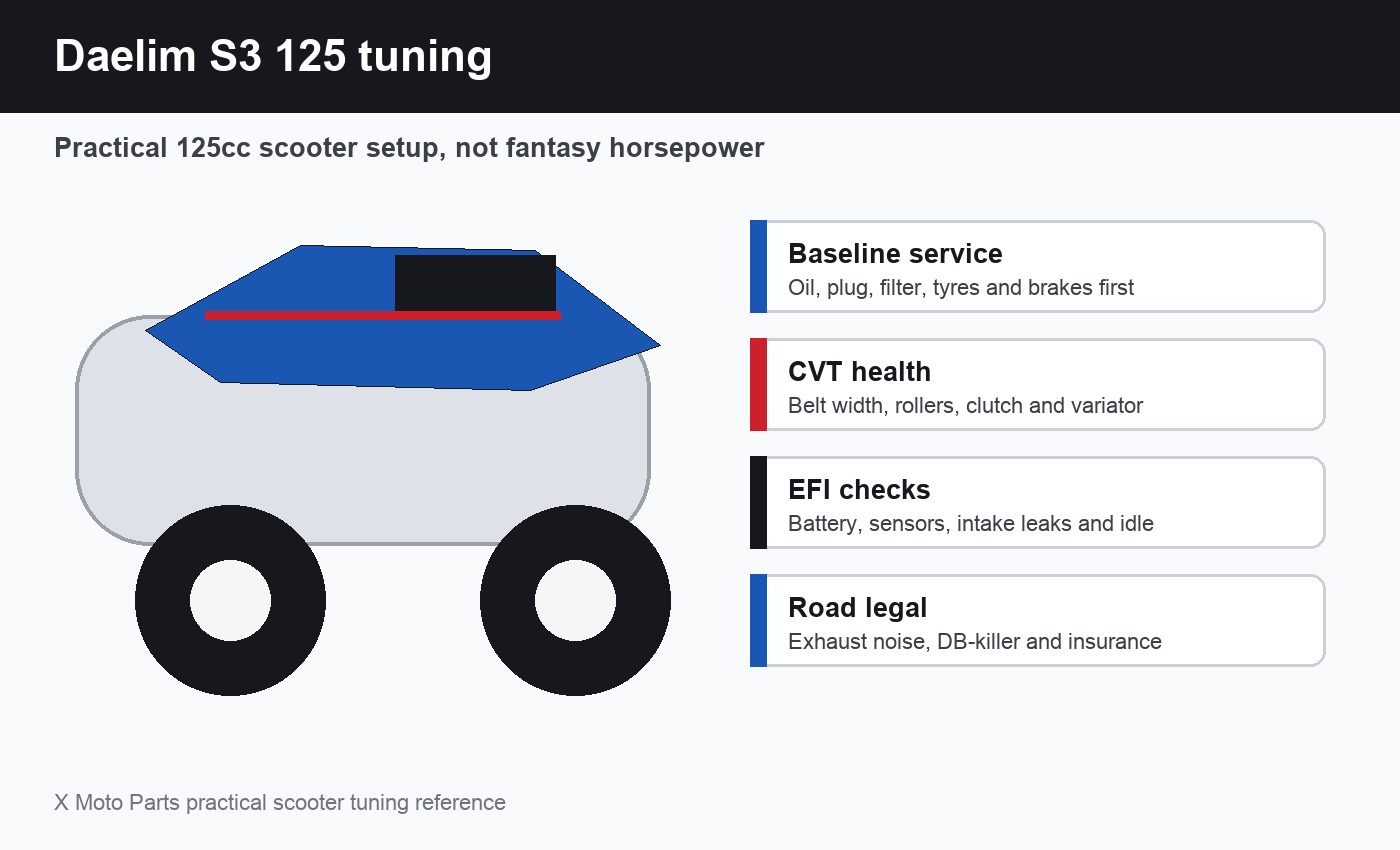
Daelim S3 125 tuning should be approached like a careful workshop job, not like a race promise. The S3 125 is a practical fuel-injected scooter, so the useful gains are usually smoother pull-away, cleaner throttle response, better hill recovery, less CVT hesitation and a setup that feels stronger in daily traffic. If the scooter is tired, poorly serviced or fitted with mismatched parts, tuning can make it louder without making it better.
Owners usually search for this topic because the scooter feels slow from a stop, struggles with a passenger, loses speed on climbs or feels flat after fitting an exhaust. Those complaints are real, but the cause is not always lack of power. A worn belt, flat-spotted rollers, glazed clutch, dirty air filter, weak battery, dragging brake or intake leak can steal enough performance to make a 125 feel restricted.
A strong result comes from restoring the baseline first and tuning second. That means measuring, inspecting and testing before buying parts. The best 125cc scooter setup is rarely extreme; it is balanced, repeatable and easy to live with.
What realistic tuning can improve on the S3 125
Daelim S3 125 tuning is mainly about how the available power is delivered. A 125cc scooter has limited torque, but a clean CVT can keep the engine in the right rpm range and make the scooter feel much more willing. Good tuning improves launch, mid-range response, hill pull and consistency when hot. It does not turn the bike into a 300cc maxi-scooter.
The S3 125 is often used for commuting, so many examples have lived through short journeys, stop-start traffic, neglected CVT cleaning and long periods parked outside. That matters because a scooter used this way may have transmission wear before it has engine trouble. When the belt narrows, the variator loses range. When rollers flatten, the shift becomes uneven. When the clutch glazes, take-off becomes rough and hot.
A practical Daelim S3 125 tuning plan answers the rider’s real question: why does this scooter feel weaker than it should, and what change will make it better without hurting reliability? Sometimes the answer is a variator refresh. Sometimes it is a correct belt. Sometimes it is an exhaust fitted properly with no leaks. Sometimes it is simply maintenance.
| Symptom | First area to inspect | Why it matters |
|---|---|---|
| Slow pull-away | Clutch, belt and roller condition | The CVT controls how quickly torque reaches the rear wheel. |
| Flat mid-range | Variator travel and air filter | A small engine needs clean airflow and the right rpm band. |
| Loss of speed uphill | Belt width, tyre pressure and brake drag | Minor drag is very obvious on a 125. |
| Rough running after parts | EFI sensors and intake leaks | Electronic injection depends on stable sensor readings. |
| Louder but not quicker | Exhaust fitment and fueling behaviour | A mismatched pipe can reduce low-rpm pull. |
Baseline checks before buying parts
Daelim S3 125 tuning should begin with a cold inspection and a warm test ride. Check engine oil, coolant if applicable to your exact version, air filter, spark plug, battery voltage, charging output, throttle movement, tyre pressure, brake drag, wheel bearings and any warning lights. A small scooter has little spare power, so hidden resistance makes a big difference.
Ride the scooter on the same road before changing anything. Notice how the clutch engages, whether the engine flares without road speed, whether vibration appears at take-off and whether performance fades after ten minutes. If the scooter is better cold than hot, look closely at the clutch, belt and CVT cooling. If it hesitates from idle, inspect intake sealing and EFI connectors before blaming the variator. A measured Daelim S3 125 tuning baseline makes each later change easier to judge.
A careful Daelim S3 125 tuning baseline also records the rider’s real use. A commuter in heavy traffic needs clean engagement and reliability. A heavier rider in hilly roads may need a CVT setup that holds rpm a little better. Someone doing faster suburban routes may want smoother cruising and better braking before any louder exhaust.
Service parts that restore performance
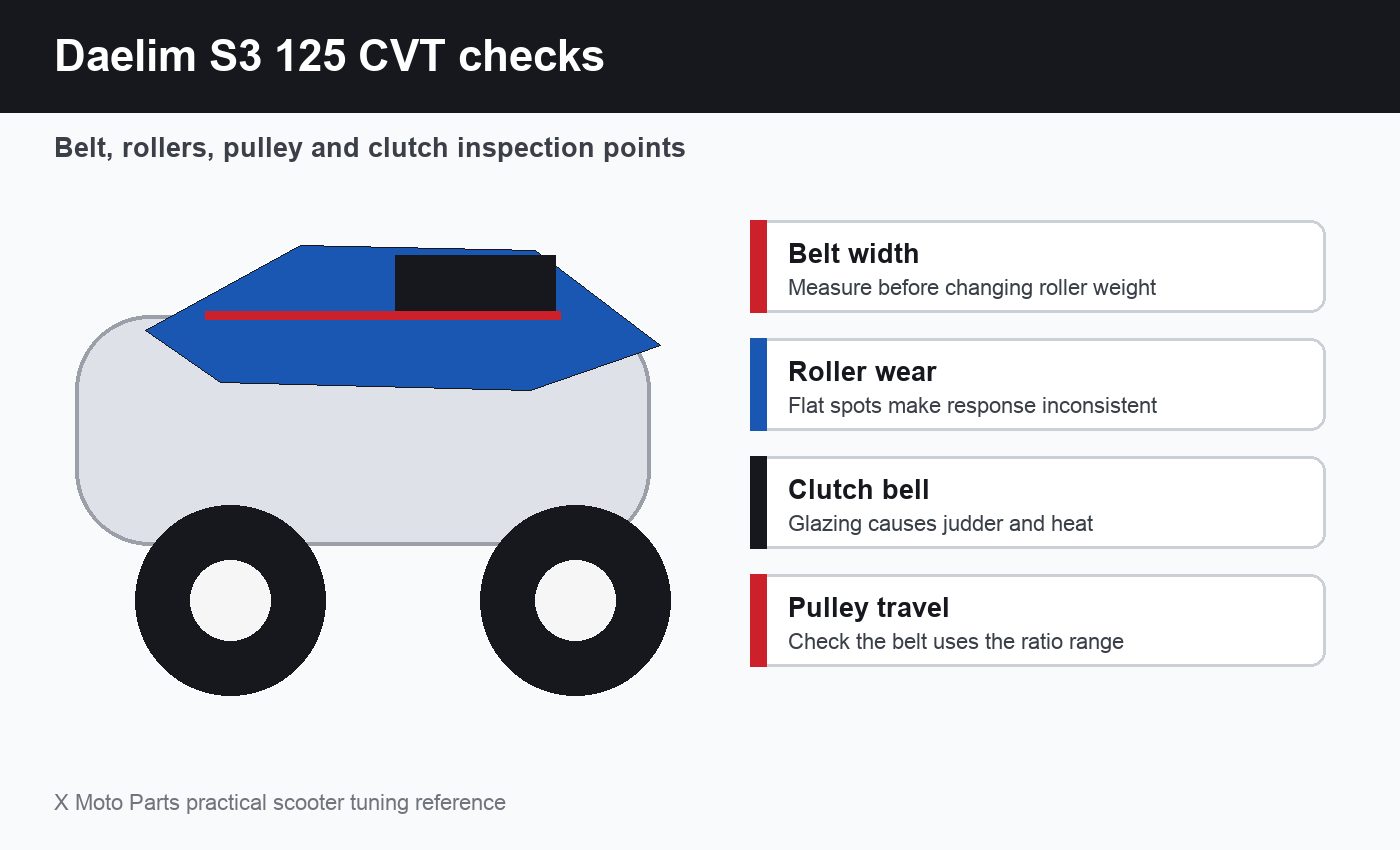
A fresh plug, clean filter, correct oil, healthy battery and properly inflated tyres can restore a surprising amount of response. If the scooter has unknown service history, assume the CVT needs inspection. Belt dust, flat rollers, worn guides and a glazed clutch bell are common reasons a scooter feels slow.
Daelim S3 125 tuning becomes far more predictable after those basics are right. A new performance part fitted over a worn belt only hides the real problem. A fuel module fitted over an intake leak only adds another variable. A sports exhaust fitted to a scooter with dragging brakes will not cure the lost speed.
CVT, variator, belt and clutch setup
The CVT is usually the most important part of Daelim S3 125 tuning. The engine can only do its job if the belt drive lets it sit in the useful rpm range. A standard scooter that has lost belt width may feel slow because it is no longer reaching the intended ratio. Rollers with flat spots can make acceleration uneven. A dirty variator can shift poorly. A glazed clutch can make take-off harsh and waste heat.
Start with measurement. Confirm belt length and width for your exact model year and market version. Check roller or slider dimensions before ordering. Inspect pulley faces for grooves and heat marks. Make sure the variator moves freely and that guides are not worn. If the clutch bell is blue or polished, clean and inspect carefully because heat can make the scooter feel worse as the ride continues.
For balanced Daelim S3 125 tuning, do not jump to the lightest rollers. Slightly lighter rollers can improve launch and hill response, but too light makes the engine rev without speed. Too heavy can make the scooter labour below its useful power band. The correct choice depends on rider weight, road gradient, belt condition and whether the scooter carries a top box or passenger. In practice, Daelim S3 125 tuning is controlled adjustment, not a single magic roller weight.
| CVT option | Main advantage | Possible disadvantage | Best use |
|---|---|---|---|
| Stock refresh | Restores smooth original response | Limited change in character | Unknown history or worn transmission |
| Slightly lighter rollers | Sharper pull-away | More revs if overdone | Urban use and mild hills |
| Performance variator | Can improve ratio behaviour | Needs correct setup and testing | Owners willing to tune methodically |
| Clutch service | Reduces judder and heat | May reveal other worn parts | Rough starts or hot clutch smell |
| Final drive changes | Can alter cruising feel | May weaken acceleration | Rarely a first step on a 125 scooter |
How to road-test the CVT
A useful Daelim S3 125 tuning road test uses the same route every time. Warm the engine, use the same rider load and test one hill, one urban launch and one steady cruising section. If revs rise but speed does not follow, the setup may be too light or the belt may be slipping. If the scooter feels lazy and low in the revs, the rollers may be too heavy or the variator may be dirty.
The best setup sounds calm but eager. It should not scream, judder, smell hot or lose consistency in traffic. After any CVT work, recheck fasteners, listen for new noises and inspect for belt dust after a few rides. A small scooter rewards patience.
Fuel injection, intake and exhaust choices
Daelim S3 125 tuning can include EFI support, intake work and exhaust changes, but each part has to solve a real problem. The standard airbox is often better for commuting than an exposed cone filter because it protects against rain, road dirt and hot air. A clean panel filter and sealed airbox usually give more consistent everyday running.
Before fitting electronics, inspect the intake air temperature sensor area, throttle body, manifold rubber, battery terminals and sensor plugs. A weak battery or intake leak can create hesitation that looks like a fueling problem. If there is a warning light, diagnose it first. A compatible module should be reversible, securely routed and set conservatively.
Exhaust upgrades need the same care. A sport silencer can reduce weight and make the scooter sound more pleasant, but pipe diameter, bracket alignment, gasket sealing, DB-killer and approval status all matter. Anyone comparing exhaust parts should read the universal motorcycle exhaust buying guide before assuming a universal part will fit correctly.
When a chip module makes sense
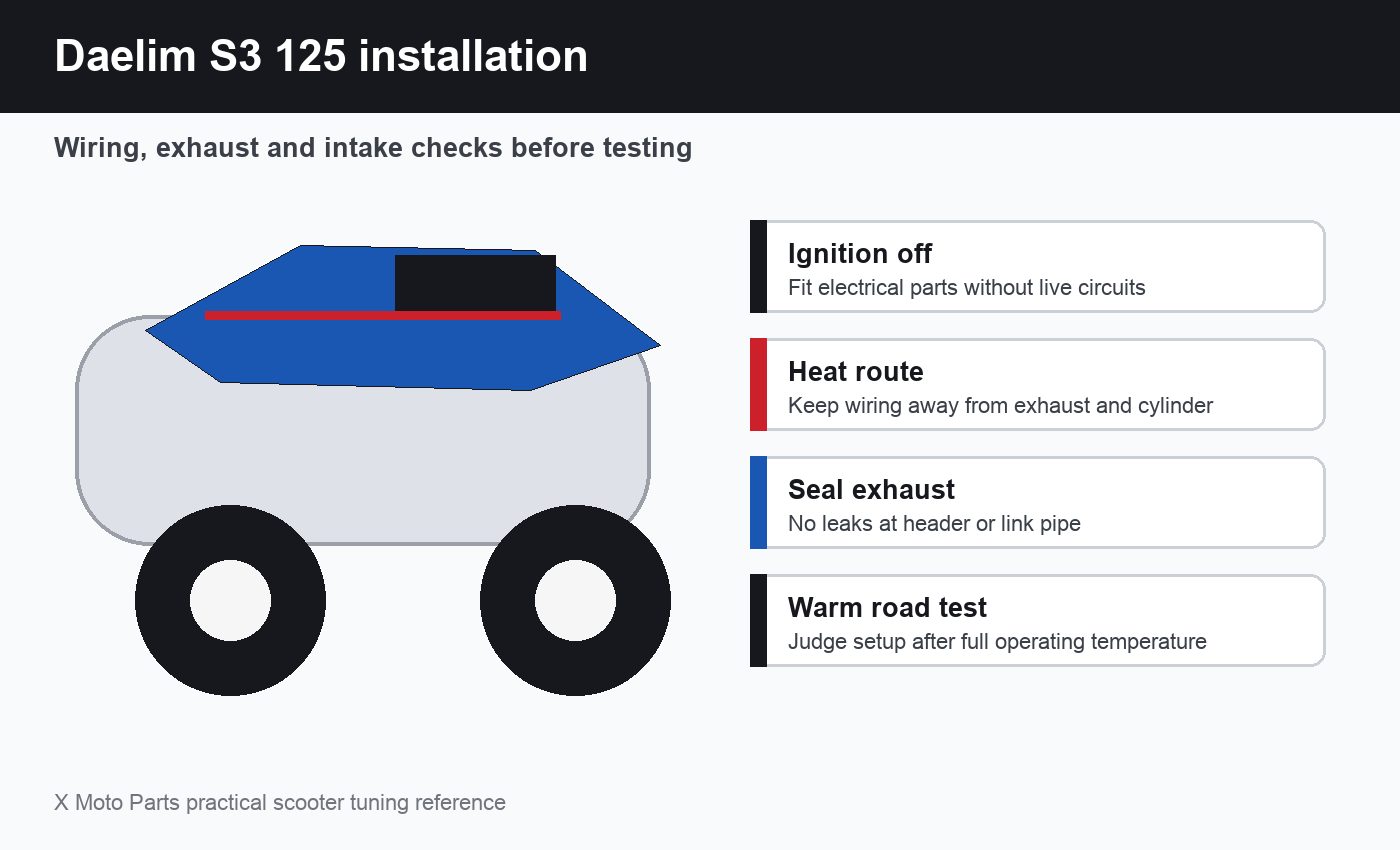
A chip or fuel module only makes sense after the scooter is healthy. For Daelim S3 125 tuning, electronics should be treated as a fine adjustment, not a cure for worn rollers or a blocked filter. Start from the lowest setting, warm the engine fully and judge throttle response under normal riding, not only on a short blast.
Reduce the setting or return to stock if the scooter smells rich, starts worse, idles roughly, loses fuel economy or shows a warning light. Good tuning makes the engine easier to use, not more fragile. If wiring is unclear, a mechanic should handle the installation.
Compatibility checks for Daelim S3 125 parts
Compatibility is critical because model names, years and market versions can be confusing. Daelim S3 125 tuning should always begin by confirming the exact model, production year, engine version, CVT dimensions, exhaust route and sensor connector layout. A product listing that looks right may still be wrong if it was built for another Daelim model or a different market.
| Part or vehicle area | Compatibility | Important note |
|---|---|---|
| Daelim S3 125 scooter | Yes, when year and market are confirmed | Check exact model name, engine version and existing modifications. |
| CVT belt and rollers | Dimension-specific | Measure belt width and confirm roller/sliders size before ordering. |
| Aftermarket exhaust | Depends on bracket and pipe route | Check gasket, hanger, pipe diameter, DB-killer, clearance and approval. |
| Fuel or chip module | Only with matching connectors | Inspect sensor location and wiring before installation. |
| Universal scooter parts | Often possible with adaptation | Universal does not mean plug-and-play; bodywork clearance matters. |
For related scooter setup examples, the Daelim Otello 125 FI tuning guide is useful because it explains similar EFI and CVT decisions on another Daelim scooter. The Peugeot Tweet 125 tuning guide helps compare lightweight 125 scooter behaviour, while the Suzuki Address 110 tuning guide shows why belt and roller condition often matter more than loud parts.
UK road legality, MOT and insurance
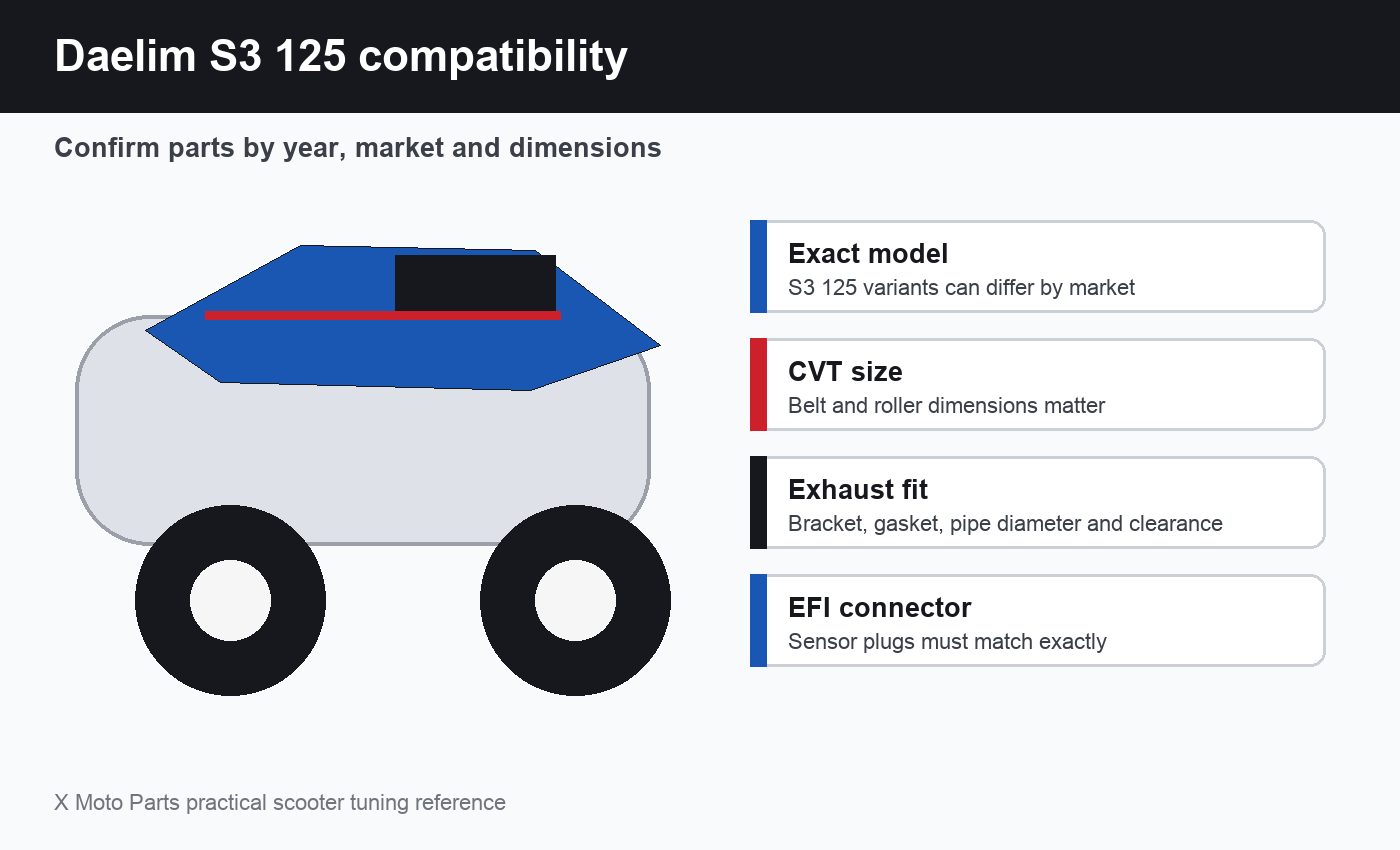
Daelim S3 125 tuning for road use must respect the rules where the scooter is ridden. In the UK, exhaust condition and noise are part of the motorcycle MOT inspection. A silencer that is clearly unreasonably louder than a similar standard machine can be a problem, and a product marked for track use only is not suitable for normal road use.
Road riders should check E-mark information where relevant, keep any DB-killer fitted if the exhaust was approved with it, avoid removing emissions equipment and disclose modifications to insurance. An insurer may treat exhaust, intake, fueling or performance changes as material modifications even if the rider sees them as small. Legal Daelim S3 125 tuning should keep the scooter usable, insurable and suitable for the roads it actually uses.
For authoritative UK context, the GOV.UK motorcycle MOT exhaust noise section explains the inspection position on exhaust noise. Riders outside the UK should check local rules; the NHTSA motorcycle safety resource is a useful high-level safety reference for the United States, though road legality and emissions rules still vary by state.
Road use versus private-area tuning
Road-focused Daelim S3 125 tuning should keep the scooter quiet enough, dependable, insured and suitable for inspection. Private-area or track-only setups can be more experimental, but they still need safe exhaust mounting, reliable brakes, secure wiring and predictable throttle response. A loose bracket or hot wire routing is not acceptable anywhere.
Common mistakes that make the S3 worse
The biggest mistake is buying parts before diagnosing the scooter. Owners fit a pipe when the clutch is glazed, fit light rollers when the belt is worn, or add electronics when the intake rubber is leaking. The result is a scooter with more variables and less clarity.
Daelim S3 125 tuning should not be based only on sound, looks or someone else’s roller weight. Check dimensions, road use, service condition and the job the scooter actually has to do. A delivery rider, commuter and weekend rider may need different compromises.
| Mistake | What happens | Better approach |
|---|---|---|
| Ignoring belt wear | Poor ratio range and weak acceleration | Measure and refresh before tuning roller weight. |
| Choosing very light rollers | High revs with little road speed | Change gradually and test the same route. |
| Fitting an exhaust by appearance | Leaks, drone or legal trouble | Check pipe diameter, bracket, DB-killer and E-mark. |
| Using electronics to mask faults | Rough running and wasted money | Fix service, intake and sensor issues first. |
| Skipping insurance checks | Risk after a claim | Declare meaningful modifications before road use. |
Workshop sequence for a clean setup
A reliable Daelim S3 125 tuning sequence is straightforward: service the scooter, inspect brakes and tyres, clean the CVT, measure the belt, refresh worn parts, road-test warm, then change one performance variable at a time. If the scooter gets worse, return to the last known good setup.
After installation, check for exhaust leaks, rubbing bodywork, loose brackets, warning lights, belt dust, clutch heat and changes in fuel economy. Recheck fasteners after the first heat cycle. If the job involves wiring, make sure the harness cannot touch the cylinder, exhaust or moving suspension parts. If torque settings or connector identification are unclear, use a mechanic.
For owners ready to compare parts after doing those checks, the performance parts category is a sensible next step. Choose based on exact fitment and support, not only price.
FAQ about Daelim S3 125 scooter tuning
Is Daelim S3 125 tuning worth it?
Daelim S3 125 tuning is worth it if the scooter is mechanically healthy and the goal is better response, smoother launch and stronger hill pull. It is not worth it if the expectation is a dramatic top-speed transformation.
What should I tune first on a Daelim S3 125?
Start with service condition and the CVT. Check belt width, rollers, clutch, variator guides, air filter, plug, tyres and brakes before buying performance parts.
Will lighter rollers make the S3 125 faster?
Lighter rollers can improve launch and hill response, but too light can make the engine rev without useful acceleration. Test in small steps.
Can an aftermarket exhaust improve performance?
A suitable exhaust can change sound, weight and response, but poor fitment can reduce low-speed torque, create leaks or cause legal problems.
Do I need a fuel module after fitting an exhaust?
Not automatically. Mild changes may not need fueling support. Use a compatible module only when there is a clear reason and the scooter is already healthy.
Is a universal exhaust plug-and-play?
No. Universal parts still need the right pipe diameter, bracket position, gasket seal, bodywork clearance and road-use status.
Can tuning affect UK insurance?
Yes. Exhaust, intake, fueling and performance modifications should be disclosed to the insurer before using the scooter on public roads.
Why does my scooter feel slower after tuning?
Common causes include wrong roller weight, belt slip, clutch heat, intake leaks, exhaust mismatch, poor wiring or judging performance before the engine is fully warm.
Final verdict
Daelim S3 125 tuning is best when it makes a practical scooter feel healthier, smoother and more confident. Start with service condition, measure the CVT, avoid extreme roller choices, choose exhaust parts by fitment and legal status, and use electronics only when there is a clear need. The strongest setup is usually the one that still starts easily, runs quietly enough, pulls cleanly and stays reliable in traffic.
Before ordering anything, confirm model year, CVT dimensions, belt condition, exhaust bracket layout, sensor connectors, road legality and insurance implications. A tidy, measured Daelim S3 125 tuning build will always beat a noisy collection of parts fitted without diagnosis.