
Honda SH 300 tuning
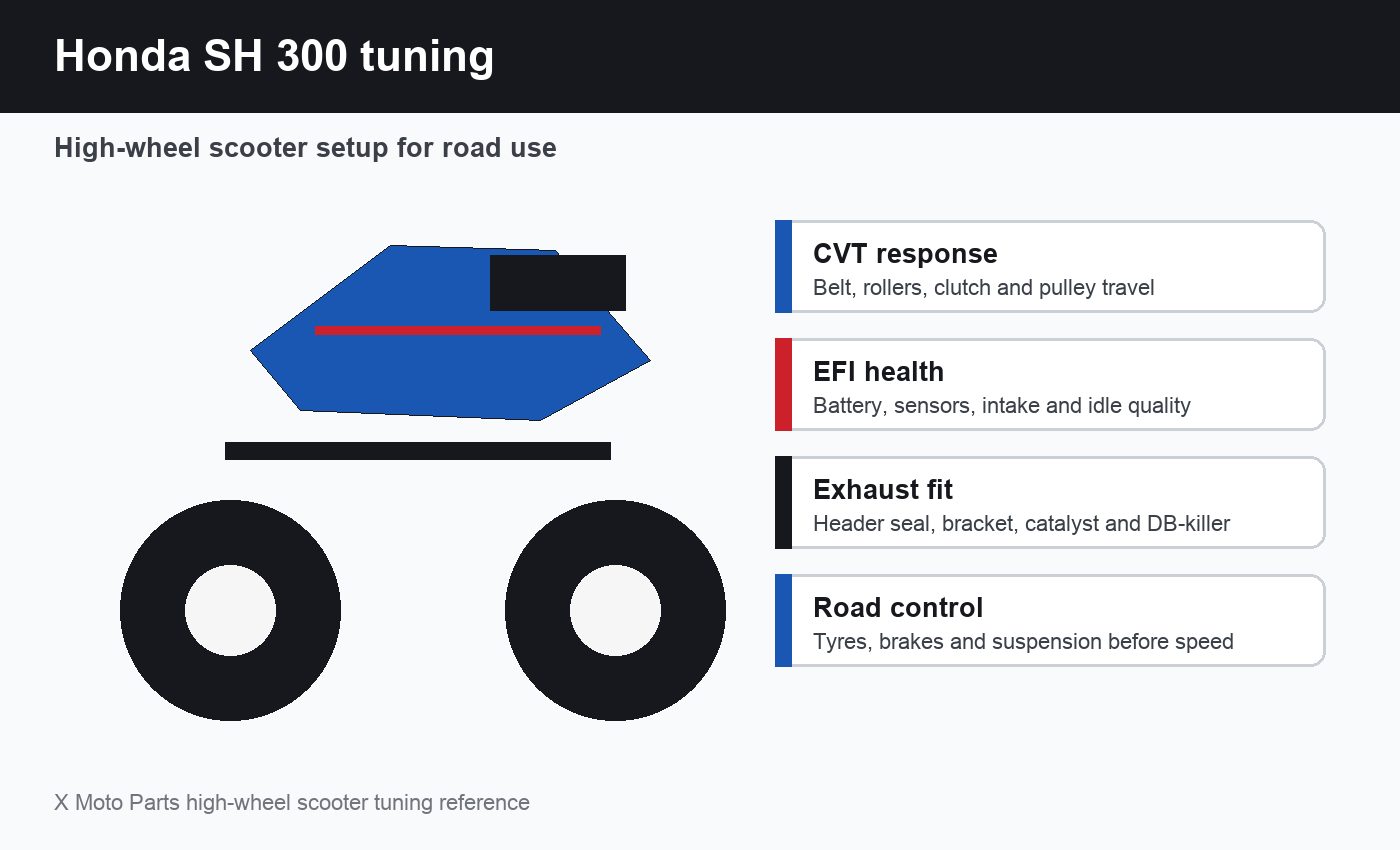
Honda SH 300 tuning should make a quick, practical high-wheel scooter feel sharper, smoother and more controlled, not merely louder. The SH300i already has useful torque, stable road manners and enough performance for commuting and fast urban riding, so the best tuning work is usually about restoring lost response, improving the CVT setup, choosing an exhaust carefully and making sure the scooter remains reliable on real roads.
Owners often look for tuning because the scooter feels flat from a stop, vibrates on take-off, loses confidence when overtaking, sounds restricted or feels less lively than expected. Sometimes the engine needs help, but very often the real cause is transmission wear, belt slip, flat-spotted rollers, clutch glazing, a dirty air filter, old tyres, brake drag or an exhaust that was fitted without proper sealing. A strong setup begins with diagnosis.
This guide is written for riders who want a useful Honda SH300i setup rather than fantasy horsepower claims. It covers CVT checks, variator choices, intake and exhaust decisions, fuel-injection behaviour, UK road-use rules, compatibility and the common mistakes that turn a good scooter into a noisy compromise.
What realistic SH300i tuning can improve
Honda SH 300 tuning is best judged by rideability. A high-wheel scooter is used differently from a sports motorcycle: it filters traffic, crosses rough city surfaces, carries luggage, starts and stops often, and may run warm in town before opening up on faster roads. That means the most valuable improvements are clean pull-away, predictable throttle, stronger mid-range, less CVT hesitation and better control under braking.
Honda’s official SH300i information over the years has described a liquid-cooled fuel-injected single-cylinder scooter with automatic transmission, large wheels and practical road equipment. Exact specifications vary by model year and market, so owners should confirm their own version before buying parts. The general lesson is consistent: the SH300i has a strong engine for a scooter, but the belt drive and chassis condition decide how well that strength reaches the road.
A well-planned Honda SH 300 tuning result should feel tidy. The scooter should pull away without judder, hold speed more confidently, respond cleanly after a roundabout and cruise without harsh vibration. It should not need excessive revs, smell hot from the clutch or drone painfully through a sports exhaust.
Riders comparing nearby Honda scooter setups can use the Honda SH 350 tuning guide for the later larger model, the Honda SH 150 tuning guide for smaller-capacity logic and the Honda SH 125 chip tuning guide for conservative electronics and connector checks.
| Rider goal | Most likely tuning area | First thing to inspect |
|---|---|---|
| Sharper pull-away | CVT and clutch | Belt width, roller wear, clutch glazing and pulley cleanliness |
| Better mid-range | Variator setup and engine health | Roller/sliders, air filter, plug, tyre pressure and brake drag |
| Improved sound | Exhaust system | Header gasket, bracket alignment, DB-killer, catalyst notes and approval |
| Cleaner throttle | EFI and sensors | Battery voltage, intake sealing, sensor plugs and warning lights |
| Safer faster riding | Tyres, brakes and suspension | Tyre age, brake condition, wheel bearings and rear shock condition |
Baseline checks before fitting tuning parts
Honda SH 300 tuning should begin with the unglamorous checks. Put the scooter on the centre stand and inspect it cold. Check oil, coolant level where applicable, air filter, spark plug, battery voltage, charging behaviour, throttle movement, brake drag, tyre pressures, wheel bearings and any engine warning lights. A 300cc scooter has more performance than a 125, but it still loses response quickly when wear and drag build up.
Then ride the scooter warm on the same route you will use later for testing. Notice clutch engagement, vibration, acceleration from 20 to 50 mph, engine smoothness, braking feel and whether performance fades after the CVT heats up. If the scooter feels strong at first and weaker after traffic, inspect clutch heat and belt condition before touching fuel or exhaust parts. A measured Honda SH 300 tuning baseline makes each upgrade easier to judge.
A careful Honda SH 300 tuning baseline should include notes on rider weight, passenger use, top box or screen, road type and current modifications. A scooter used for city commuting needs a different compromise from one used for longer dual carriageway journeys. The best setup matches the job the bike does every week.
Service restoration comes before performance parts
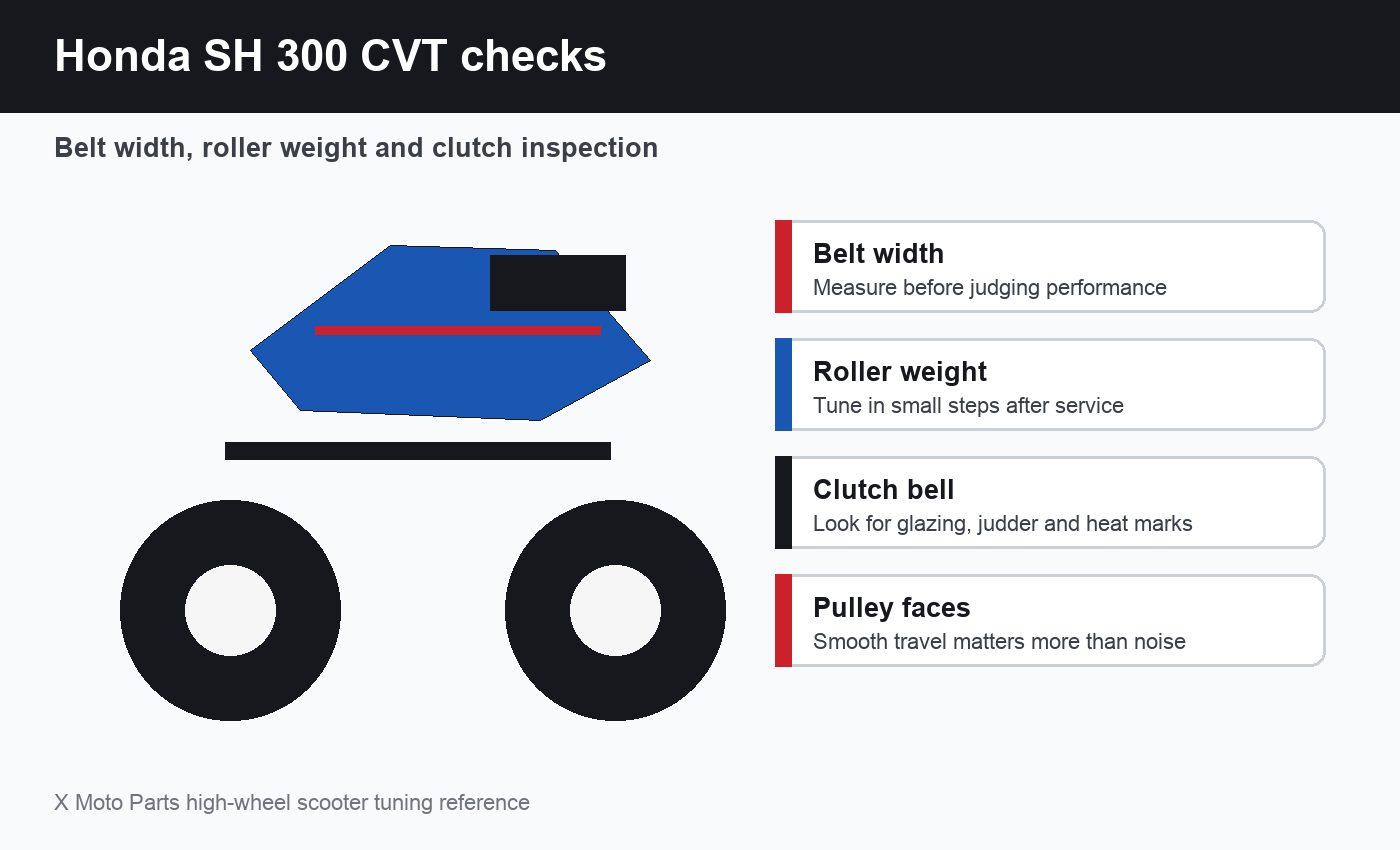
A fresh belt of the right dimension, clean variator, good rollers, healthy clutch, clean filter and correct tyre pressure can restore performance that the owner may think has disappeared forever. Many scooters feel transformed after basic maintenance because the CVT was no longer allowing the engine to work properly.
Honda SH 300 tuning becomes predictable only after the scooter is healthy. If the rear brake drags, the belt is narrow or the clutch bell is glazed, a sports exhaust will not fix the problem. If the battery is weak or a sensor plug is corroded, a fuel module can make diagnosis harder. Start with the known faults.
CVT, variator, belt and clutch setup
The CVT is the centre of Honda SH 300 tuning. The engine produces torque, but the automatic belt drive decides where the engine sits in the rev range. A worn or poorly matched CVT makes a strong scooter feel dull. A good CVT setup makes the same engine feel cleaner, quicker and easier to control.
Inspect the belt for width, cracks, glazing and age. Check the variator guides and pulley faces. Look at rollers or sliders for flat spots. Inspect the clutch bell for blue heat marks and the shoes for uneven contact. Clean the CVT cover and cooling paths. If the scooter has been used heavily in stop-start traffic, clutch heat can be a bigger issue than engine power.
For Honda SH 300 tuning, roller or slider changes should be moderate. Slightly lighter weights can improve response, but too light makes the scooter rev more than it accelerates. Too heavy can make the engine labour and feel slow after corners. A performance variator can help, but only when installed with the right weights for the rider’s roads. In workshop terms, Honda SH 300 tuning is a set of measured adjustments, not one universal recipe.
| CVT option | Main advantage | Possible disadvantage | Best use |
|---|---|---|---|
| OEM-style refresh | Restores smooth factory response | Limited change in character | High-mileage scooters or unknown history |
| Lighter rollers/sliders | Sharper launch and recovery | Can cause excessive revs if overdone | Urban riding, hills and heavier load |
| Performance variator | Can improve ratio behaviour | Needs setup, testing and correct torque | Owners who want a controlled upgrade |
| Clutch service | Reduces judder and heat fade | May reveal worn bell or shoes | Rough starts, vibration or hot smell |
| Final drive changes | Can alter cruising rpm | May hurt acceleration | Specific touring builds, not a first step |
How to test a CVT change
A proper Honda SH 300 tuning CVT test uses the same hill, the same rider load and a fully warm scooter. If revs rise sharply but speed does not follow, the setup may be too light or the belt may be slipping. If the scooter feels heavy and slow to recover, the setup may be too tall or the variator may be worn.
Do not judge the result only by sound. The better question is whether the scooter reaches speed with less strain and repeats the result after traffic. If it feels good for two minutes and then becomes inconsistent, investigate heat, clutch condition and belt slip.
Fuel injection, intake and exhaust choices
Honda SH 300 tuning can include intake, exhaust and electronic work, but those parts must be chosen carefully. The standard airbox is often a better road component than an exposed filter because it protects the engine from rain, grit and hot air. A clean filter and sealed intake usually beat a noisy intake that upsets low-speed running.
Before fitting any module, check battery voltage, intake boots, throttle body cleanliness, sensor connectors and warning lights. A fuel-injected Honda relies on stable readings. If there is an intake leak or electrical fault, the scooter may hesitate no matter what tuning part is fitted.
Exhaust choice is more than sound. A sports silencer can save weight and make the SH feel livelier, but poor fitment can cause leaks, bracket stress, bodywork clearance problems and loss of low-rpm response. Anyone considering a universal pipe should read the universal motorcycle exhaust buying guide before assuming pipe diameter and mounting points will match.
When electronics are useful
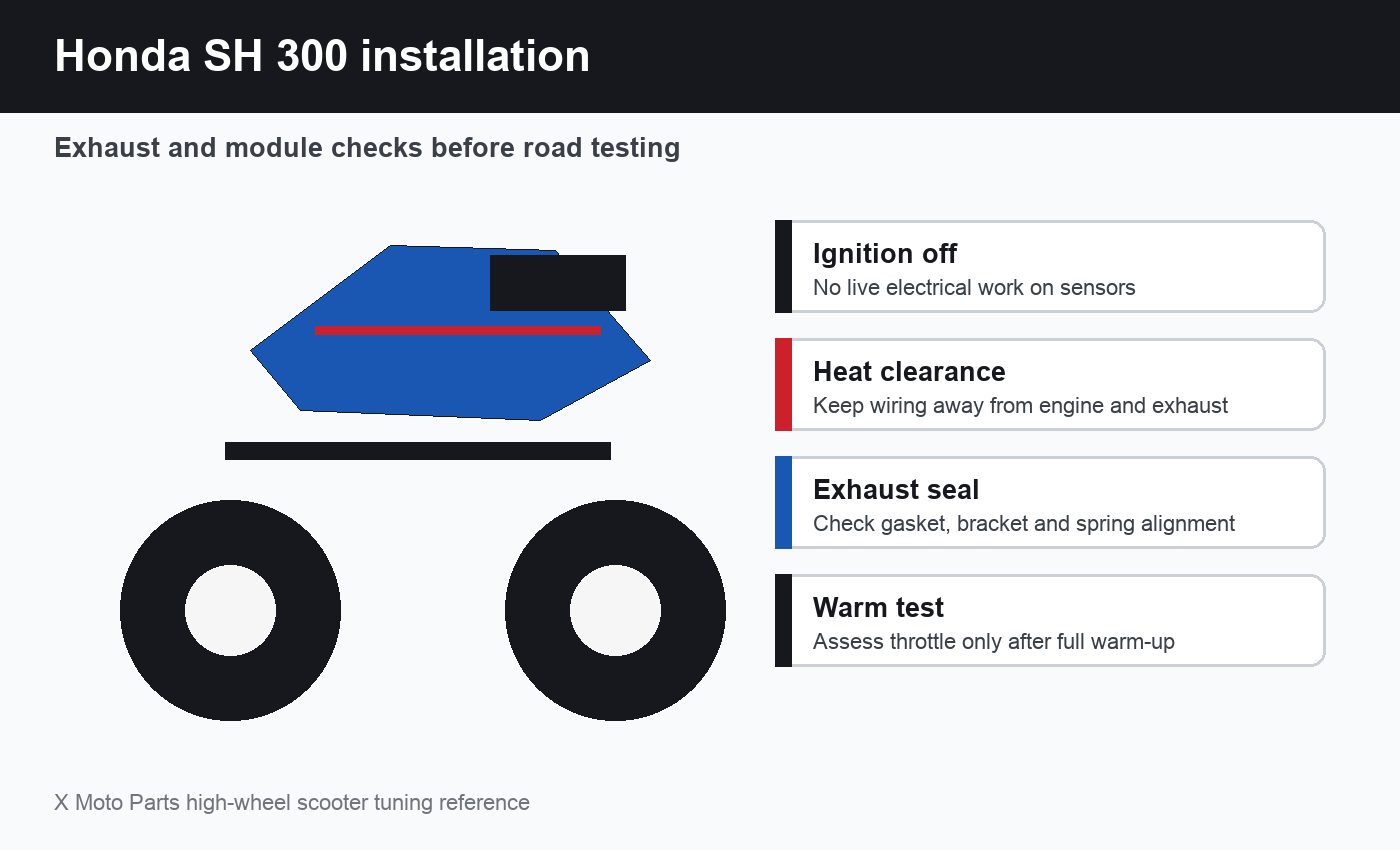
A compatible module may help when the scooter has a clear fueling need after intake or exhaust changes, but Honda SH 300 tuning should not begin with electronics. Fit any module with the ignition off, route the harness away from heat and start with conservative settings. If the scooter smells rich, starts worse, hesitates or shows a warning light, return to a safer setting or stock.
Good electronic tuning should be reversible and tidy. Twisted wires, loose connectors and cables running close to the exhaust are not acceptable. If the sensor layout is unclear, use a mechanic rather than guessing.
Compatibility checks for SH300i parts
Compatibility is especially important because SH300i years and markets can differ. Honda SH 300 tuning should always start by confirming exact model year, engine version, emissions equipment, CVT dimensions, exhaust route, sensor connector layout and existing modifications. A part that physically looks close may still be wrong for your scooter.
| Part or vehicle area | Compatibility | Important note |
|---|---|---|
| Honda SH300i scooter | Yes, when exact year is confirmed | Check generation, market version and engine/emissions layout. |
| CVT belt and rollers | Dimension-specific | Confirm belt size, roller/sliders dimensions and service limits. |
| Aftermarket exhaust | Depends on header, bracket and clearance | Check gasket, catalyst notes, DB-killer, E-mark and bodywork clearance. |
| Fuel or chip module | Only with matching connectors | Inspect sensor layout and wiring before ordering. |
| Universal scooter parts | Often possible with adaptation | Universal does not mean plug-and-play; professional fitting may be required. |
When the fitment checks are complete, the performance parts category is a useful place to compare upgrade types. For exhaust-focused decisions, the motorcycle exhausts category should be used only after confirming pipe diameter, bracket position and road-use status.
UK road legality, MOT and insurance
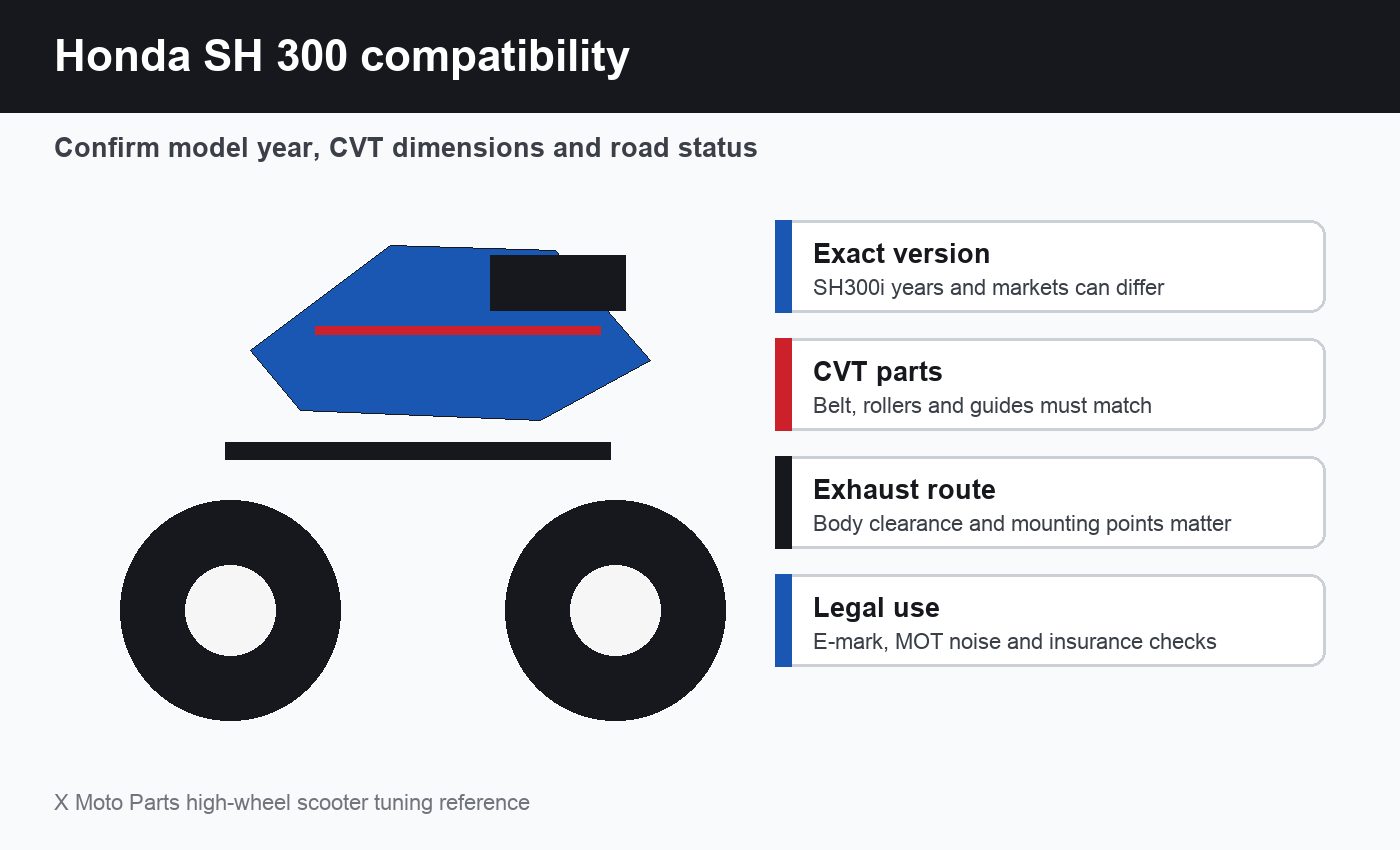
Honda SH 300 tuning for public roads needs legal context. In the UK, motorcycle MOT inspection includes exhaust condition and noise. A silencer that is clearly unreasonably louder than a similar motorcycle with a standard silencer can be a problem, and parts marked for track use only are not road parts. This matters for sports exhausts, removed DB-killers and poorly sealed systems.
Road riders should check E-mark or approval information where relevant, keep catalytic converter and emissions equipment in place where required, retain the DB-killer if the exhaust approval depends on it and disclose modifications to insurance. In the United States, Canada, Australia, Ireland and New Zealand, rules vary by state, province or national framework. Do not mix those rules together. Responsible Honda SH 300 tuning keeps the scooter legal for the roads where it is actually used.
For UK reference, the GOV.UK motorcycle MOT exhaust noise section explains how exhaust noise is assessed. For official Honda model context, use Honda’s owner information and model pages where available; the Honda UK owner manuals resource is a sensible starting point for checking model-specific documentation.
Road use versus private-area setup
Road-focused Honda SH 300 tuning should keep the scooter civil, safe and insurable. Private-area or track-only work can be more aggressive, but installation quality still matters. Exhaust leaks, loose brackets, overheated CVT parts and bad wiring are not acceptable just because the scooter is not on the public road.
Common mistakes that make the SH300i worse
The most common mistake is tuning before measuring. Owners fit an exhaust while the clutch is glazed, change roller weight while the belt is worn, or fit electronics while the battery is weak. The scooter then has more parts but no clear improvement.
Honda SH 300 tuning should not be based only on noise or appearance. A high-wheel scooter depends on balance. If the front tyre is old, the rear shock is tired or the brakes need service, extra response can make the bike feel less safe. Performance work should include the chassis.
| Mistake | Road result | Better workshop method |
|---|---|---|
| Ignoring belt wear | Poor acceleration and inconsistent ratio range | Measure belt width before changing rollers. |
| Fitting very light rollers | More revs, heat and little extra speed | Adjust gradually and test warm. |
| Buying exhaust by sound only | Drone, leaks or legal trouble | Check approval, DB-killer, bracket and gasket seal. |
| Skipping tyre and brake checks | More speed without control | Service chassis items before chasing response. |
| Using electronics to hide faults | Rough running and confusing diagnosis | Fix intake, battery and sensor issues first. |
Workshop sequence for a clean SH300i setup
A reliable Honda SH 300 tuning sequence is simple: service the scooter, inspect tyres and brakes, clean and measure the CVT, replace worn transmission parts, test the bike warm, then adjust one variable at a time. Exhaust and electronics come after the scooter proves that the basic drivetrain is healthy.
After any installation, check for exhaust leaks, rubbing bodywork, loose brackets, abnormal belt dust, hot clutch smell, warning lights and changes in fuel economy. Recheck fasteners after the first heat cycle. If the job involves CVT torque settings, sensor wiring or exhaust fitment you are unsure about, use a professional mechanic. A tidy Honda SH 300 tuning build is worth more than a fast-looking mistake.
FAQ about SH300i tuning
Is Honda SH 300 tuning worth it?
Honda SH 300 tuning is worth it when the scooter is healthy and the goal is better response, smoother launch and stronger mid-range. It is not worth it if the rider expects sportbike performance from a practical scooter.
What should I tune first on a Honda SH300i?
Start with the CVT and service condition: belt width, rollers, clutch, air filter, plug, tyres, brakes and battery voltage. Those checks often restore lost performance.
Will lighter rollers make the SH300i faster?
Lighter rollers can improve response if chosen carefully, but too light can make the engine rev without adding useful road speed. Test in small steps.
Can an aftermarket exhaust improve the SH300i?
A suitable exhaust can improve sound and feel, but fitment, sealing, catalyst notes, DB-killer, E-mark and low-speed torque all need checking.
Do I need a fuel module after fitting an exhaust?
Not automatically. Use fueling support only when compatible and when intake or exhaust changes create a clear need. Start conservatively.
Is a universal exhaust plug-and-play on the SH300i?
No. Universal exhausts still need correct pipe diameter, hanger alignment, gasket sealing, bodywork clearance and road-use approval.
Can tuning affect UK insurance?
Yes. Exhaust, intake, electronic and performance modifications should be declared to the insurer before road use.
Why does my SH300i feel slower after tuning?
The usual causes are wrong roller weight, belt slip, clutch heat, exhaust mismatch, intake leaks, weak battery, poor wiring or testing before the scooter is fully warm.
Final verdict
Honda SH 300 tuning works best when it respects what the scooter is: a fast, practical, high-wheel commuter that rewards clean setup. Restore the CVT, service the engine, choose exhaust parts by fitment and legality, keep electronics conservative and never forget tyres, brakes and suspension. The result should be a scooter that feels sharper without becoming fragile.
Before ordering parts, confirm year, SH300i version, CVT dimensions, belt condition, exhaust route, sensor connectors, road-use approval and insurance position. A measured Honda SH 300 tuning plan will always beat random parts fitted because they looked quick online.