
Piaggio X10 125 tuning
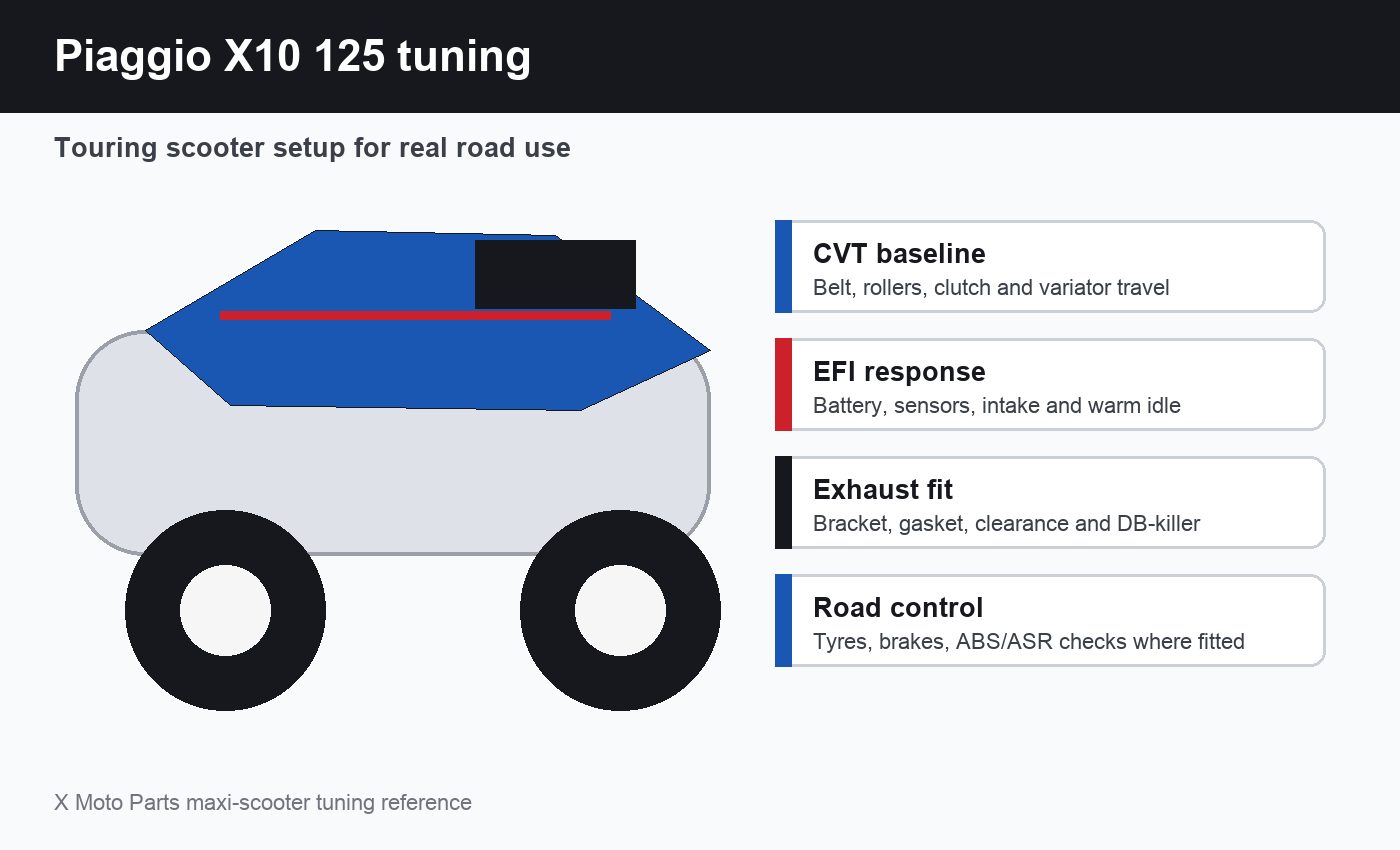
Piaggio X10 125 tuning should make a comfortable touring-style 125 scooter feel cleaner, smoother and more confident, not louder and more fragile. The X10 125 is not a lightweight sports scooter. It is a relatively substantial machine with wind protection, storage, commuting comfort and, on some versions, equipment such as ABS or traction-related systems. That means the best tuning work is practical: restore the CVT, keep the fuel injection healthy, choose exhaust parts carefully and make sure the scooter remains safe for daily road use.
Owners usually start looking for tuning because the scooter feels slow away from traffic lights, weak on hills, lazy with a passenger or unwilling to recover speed after a roundabout. Those complaints do not automatically mean the engine needs aggressive parts. A 125cc scooter can lose a lot of performance through a worn belt, flat-spotted rollers, a glazed clutch, blocked air filter, old tyres, brake drag or an exhaust leak. The right first move is inspection.
This guide explains how to approach the X10 like a mechanic would: baseline checks, CVT measurement, variator decisions, intake and exhaust choices, electronic compatibility, UK road-use rules, common mistakes and the questions riders normally ask before buying parts.
What realistic X10 125 tuning can improve
Piaggio X10 125 tuning is mostly about delivery rather than headline power. A 125cc engine has limited torque, and the X10 body is designed for comfort and road presence rather than minimum weight. That makes CVT condition especially important. If the belt is narrow or the variator is dirty, the scooter may feel as if the engine has lost power even when the engine itself is healthy.
Real improvement is felt in normal riding: smoother take-off, less clutch judder, better recovery from 20 to 50 mph, steadier hill climbing, more predictable throttle and less strain when carrying luggage. It should not feel like excessive revs, harsh vibration or a hot clutch smell after every traffic queue.
A sensible Piaggio X10 125 tuning target is a scooter that feels easier to ride. It should leave junctions cleanly, hold urban speeds without fuss and cruise at its realistic limit without sounding tortured. If the owner expects a dramatic top-speed jump, the project is already aimed in the wrong direction.
For riders comparing similar Piaggio scooter logic, the Piaggio Liberty 125 tuning guide explains lighter 125cc CVT behaviour, while the Piaggio MP3 300 power increase guide shows how heavier scooters need realistic expectations around weight, transmission and road use.
| Owner complaint | Likely area to inspect | Why it matters |
|---|---|---|
| Slow launch | Clutch, rollers and belt width | The CVT controls how quickly engine torque reaches the rear wheel. |
| Poor hill speed | Variator travel, tyre pressure and brake drag | Small drag losses are obvious on a comfortable 125 scooter. |
| Flat throttle | Air filter, EFI sensors and intake sealing | Fuel injection needs clean airflow and stable sensor readings. |
| Loud but not faster | Exhaust fitment and fueling behaviour | A poor pipe can reduce low-rpm pull and create leaks. |
| Unstable braking or handling | Tyres, brakes, suspension and wheel bearings | More response is useless if the chassis is tired. |
Baseline checks before tuning parts
Piaggio X10 125 tuning starts with service condition. Put the scooter on the centre stand and inspect oil, coolant if applicable to your version, air filter, spark plug, battery voltage, charging output, throttle movement, brake drag, tyre pressures, tyre age, wheel bearings and any warning lights. On versions equipped with ABS or ASR-related systems, warning lights and sensor condition should be treated seriously before performance work.
Ride the scooter warm before making changes. Notice clutch engagement, vibration, engine response, braking feel and whether performance fades after traffic. If the scooter is stronger when cold and weaker when hot, the CVT or clutch may be building heat. If it hesitates from idle, inspect intake sealing and sensor connectors before changing the variator. A measured Piaggio X10 125 tuning baseline makes the final result much easier to judge.
A careful Piaggio X10 125 tuning baseline should record rider weight, passenger use, luggage, screen position, tyre pressure and current modifications. A touring-style scooter carrying a top box and rider through hills needs a different setup from a lightly loaded city machine. The road test has to match real use.
Service restoration is often the cheapest gain
A new belt of the correct dimension, fresh rollers, clean variator, good spark plug, clean filter and correct tyre pressures may restore the response the owner was trying to buy with tuning parts. If the scooter has unknown history, assume the CVT needs inspection before buying performance parts.
Piaggio X10 125 tuning becomes predictable only after worn basics are fixed. A fuel module will not cure a slipping belt. A sports exhaust will not fix brake drag. Lighter rollers will not hide a clutch that judders because the bell is glazed. Diagnosis saves money.
CVT, variator, belt and clutch setup
The CVT is the most important part of Piaggio X10 125 tuning. The engine has limited displacement, so the transmission has to keep it in the useful rpm range. When the variator shifts too early, the scooter feels lazy. When rollers are too light, it revs without useful speed. When the belt is worn, the scooter may never use the full ratio range.
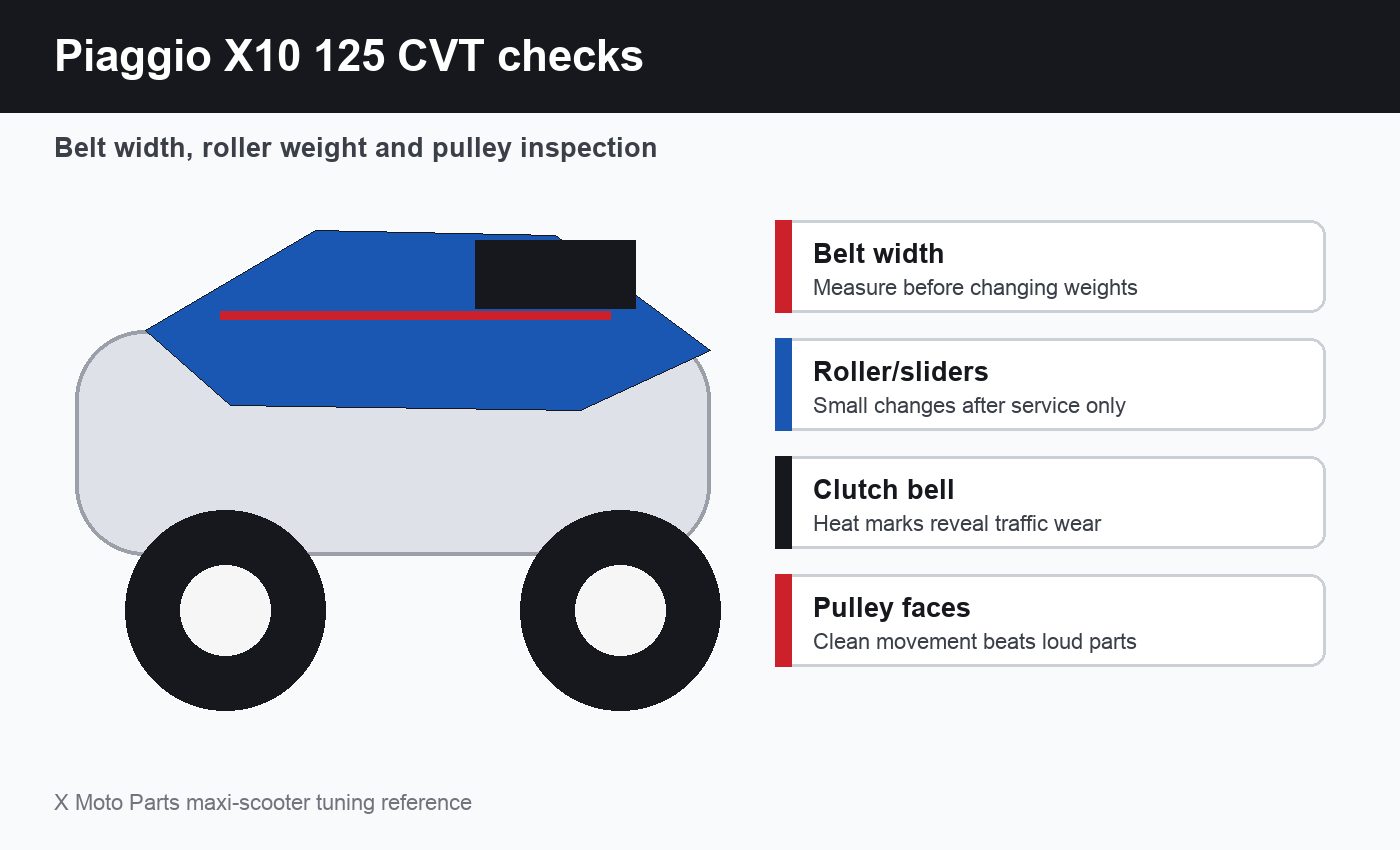
Remove the CVT cover and inspect before ordering. Look for belt dust, heat marks, grooves on pulley faces, flat-spotted rollers, worn guides and glazing on the clutch bell. Clean the cover and cooling paths. Measure belt width with a caliper if possible, and compare it with the appropriate service information for your exact model year.
For Piaggio X10 125 tuning, roller or slider changes should be moderate. Slightly lighter weights can improve launch and hill recovery, but very light weights can make the engine busy without making the scooter faster. A performance variator can help only if the belt, clutch and chosen weights work together. In practice, Piaggio X10 125 tuning is controlled setup work, not a one-part miracle.
| CVT solution | Main advantage | Possible disadvantage | Best use |
|---|---|---|---|
| OEM-style refresh | Restores smooth original operation | Does not change the character much | Unknown history or high-mileage scooter |
| Slightly lighter rollers/sliders | Sharper launch and hill recovery | Can create excessive revs if overdone | Urban riding and heavier loads |
| Performance variator | Can improve ratio behaviour | Needs correct weights and testing | Owners prepared for measured setup work |
| Clutch service | Reduces judder and heat fade | May reveal worn shoes or bell | Rough take-off or hot clutch smell |
| Final drive changes | Can alter cruising feel | May weaken acceleration | Rarely the first choice on a 125 X10 |
How to test the CVT on the road
A useful Piaggio X10 125 tuning test uses the same hill, same rider load and a warm scooter. If the engine revs high but speed does not follow, the setup may be too light or the belt may be slipping. If the engine feels loaded and slow after corners, the rollers may be too heavy or the variator may not be moving freely.
The best CVT setup feels calm but willing. It should not judder, smell hot, make the engine scream or become inconsistent after a few minutes in traffic. Recheck the cover and belt dust after the first rides.
EFI, intake and exhaust choices
Piaggio X10 125 tuning can include intake, exhaust and electronic work, but only after the scooter is healthy. The standard airbox is often better for road use than an exposed filter because it protects against rain, road dirt and hot air. A clean air filter and sealed intake usually help more than a noisy intake that upsets low-speed behaviour.
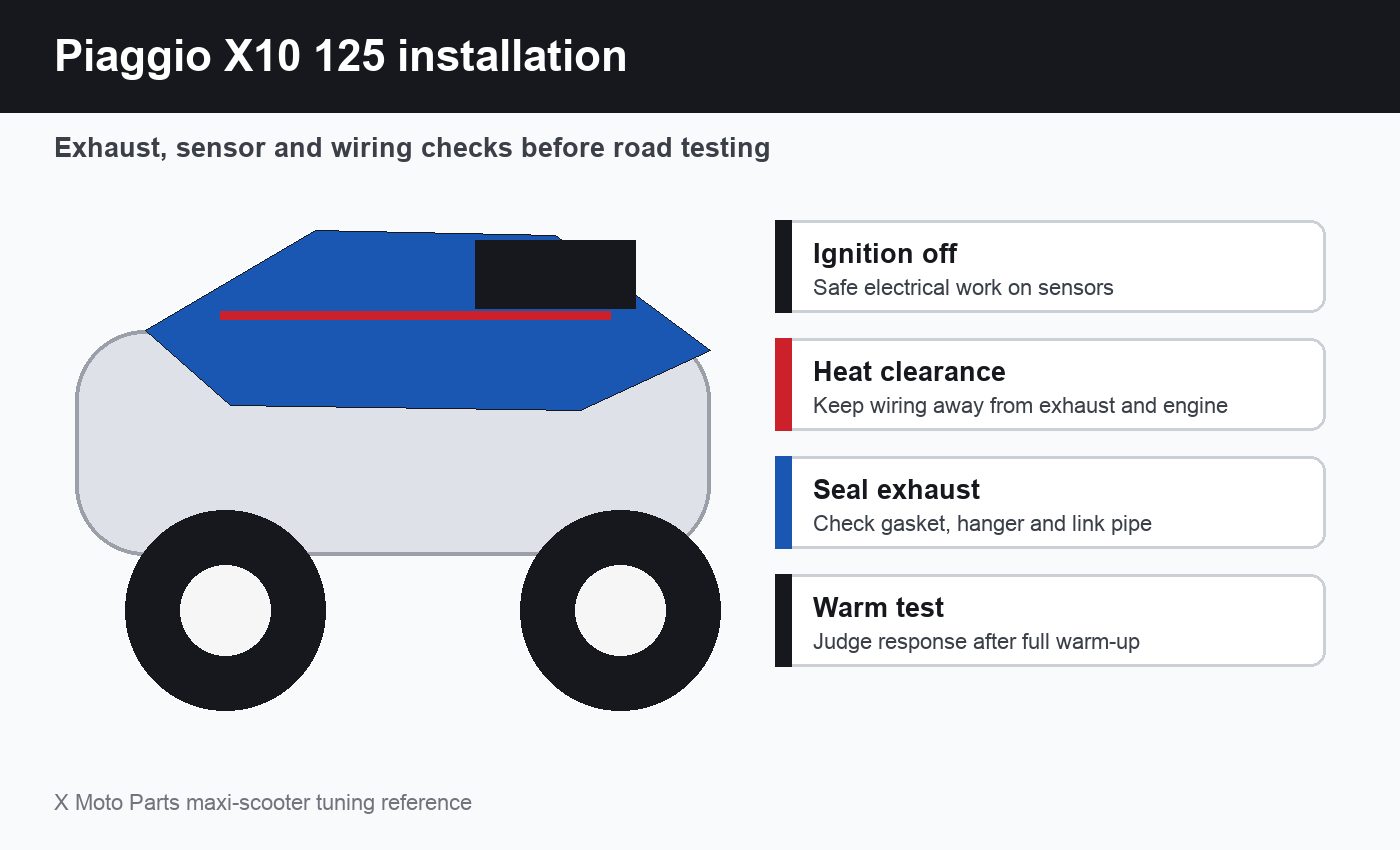
Before fitting a module, inspect battery voltage, intake boots, sensor connectors, throttle body condition and any stored warning lights. EFI tuning should be reversible and conservative. If the scooter starts worse, smells rich, loses fuel economy or hesitates when warm, the setting or installation needs correction.
Exhaust choice deserves careful measurement. A sport silencer can change sound and reduce weight, but pipe diameter, header gasket, bracket alignment, bodywork clearance, DB-killer and road approval matter. Anyone considering a universal exhaust should first read the universal motorcycle exhaust buying guide and compare it with the motorcycle exhausts category only after fitment details are known.
When electronics are useful
A compatible module may help when intake or exhaust changes create a real fueling need, but Piaggio X10 125 tuning should not start with electronics. Start from the lowest setting, warm the engine fully and judge normal riding. A 125 scooter used every day needs reliable starts and steady idle more than a dramatic throttle feel.
If the connector layout is unclear, stop and identify the sensor correctly. Poor wiring can create intermittent faults that are much harder to trace than the original performance complaint. Use a mechanic for unclear wiring, CVT torque settings or exhaust fabrication.
Compatibility checks for Piaggio X10 125 parts
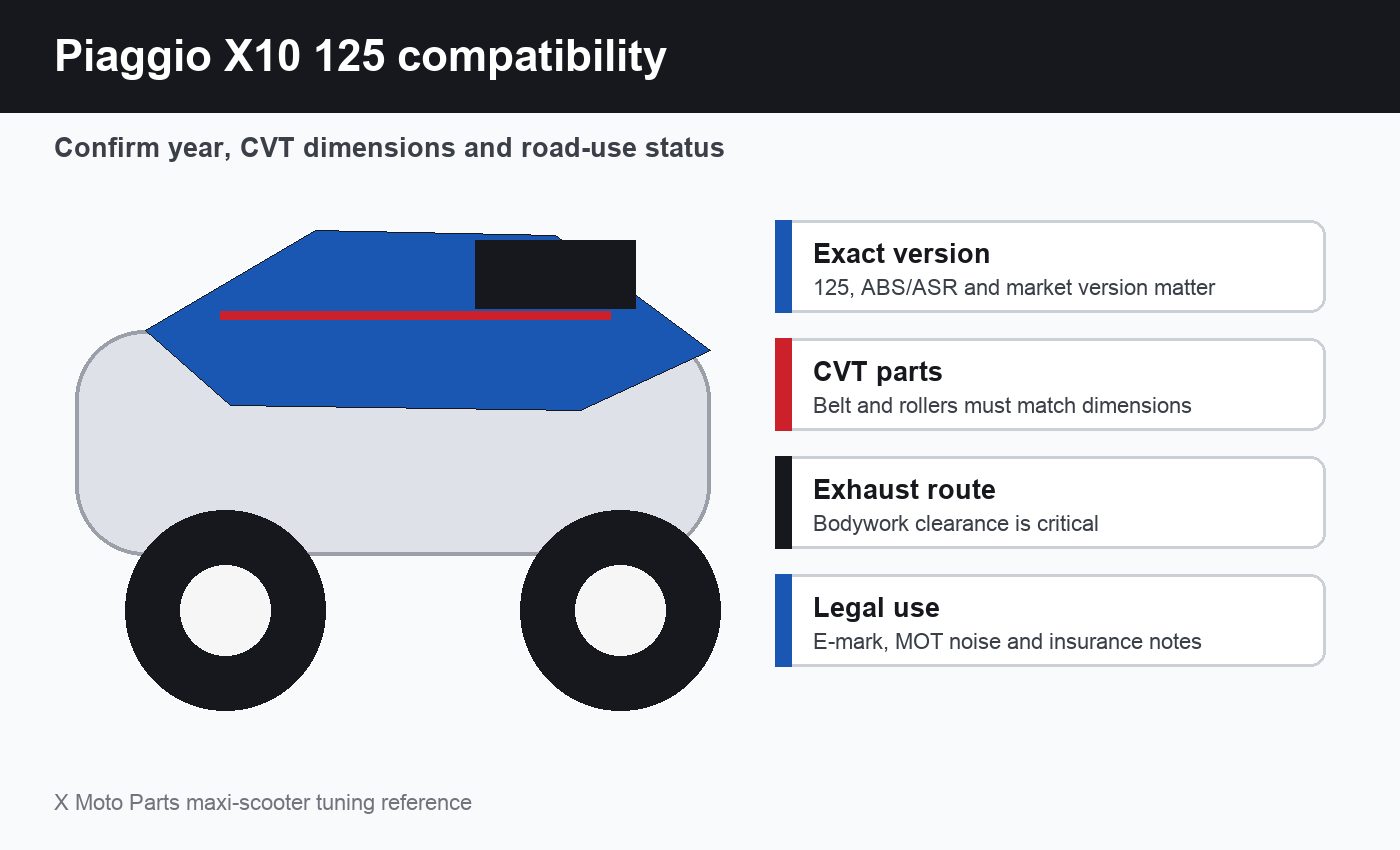
Compatibility matters because the X10 family includes different engine sizes and market versions. Piaggio X10 125 tuning should begin by confirming exact model year, engine version, ABS/ASR equipment if fitted, CVT belt and roller dimensions, exhaust route, sensor connectors and existing modifications. Do not buy parts for an X10 350 or 500 and assume they suit the 125.
| Part or vehicle area | Compatibility | Important note |
|---|---|---|
| Piaggio X10 125 scooter | Yes, when exact version is confirmed | Check model year, engine version and ABS/ASR equipment where fitted. |
| CVT belt and rollers | Dimension-specific | Confirm belt length, width, roller/sliders size and service limits. |
| Aftermarket exhaust | Depends on pipe route and brackets | Check gasket, hanger, clearance, catalyst notes, DB-killer and E-mark. |
| Fuel or chip module | Only with matching connectors | Inspect sensor layout before ordering or installation. |
| Universal scooter parts | Often possible with adaptation | Universal does not mean plug-and-play; bodywork clearance is critical. |
For related scooter comparisons, the Peugeot Pulsion 125 tuning guide is useful because it covers another comfortable 125 scooter where CVT condition, weight and road use affect the result. The Yamaha Majesty 400 tuning guide is helpful for understanding the same maxi-scooter logic on a larger engine.
UK road legality, MOT and insurance
Piaggio X10 125 tuning for public roads needs clear legal thinking. In the UK, motorcycle MOT inspection includes exhaust condition and noise. A silencer that is clearly unreasonably louder than a similar machine with a standard silencer can be a problem, and a product marked for track use only is not suitable for public roads.
Road riders should check E-mark or approval information, keep the DB-killer fitted when the exhaust approval depends on it, avoid removing emissions equipment and disclose modifications to insurance. In the United States, Canada, Australia, Ireland and New Zealand, rules vary by state, province or national framework. A part that physically fits is not automatically road legal. Responsible Piaggio X10 125 tuning keeps the scooter usable on public roads.
For UK context, the GOV.UK motorcycle MOT exhaust noise section explains how exhaust noise is assessed. For broader rider safety context, the NHTSA motorcycle safety resource is useful, especially when changes affect acceleration, braking or control.
Road setup versus private-area experimentation
Road-focused Piaggio X10 125 tuning should keep the scooter quiet enough, reliable, insured and suitable for inspection. Private-area or track-only work can be more experimental, but installation quality still matters. Exhaust leaks, loose brackets, poor wiring and overheated CVT parts are not acceptable anywhere.
Common mistakes that make the X10 worse
The biggest mistake is treating the X10 125 like a tiny lightweight scooter. It is comfortable and substantial, so transmission condition and load matter a lot. Fitting aggressive rollers without measuring the belt can make it louder but slower. Fitting an exhaust without checking brackets can create leaks and bodywork clearance issues. Adding electronics before fixing intake leaks can make diagnosis worse.
Piaggio X10 125 tuning should always be guided by what the scooter actually does on the road. If it shudders from a stop, inspect clutch and belt. If it struggles only with a passenger, choose a CVT setup for load. If it handles poorly, check tyres and suspension before asking for more response.
| Mistake | What happens | Better approach |
|---|---|---|
| Ignoring belt wear | Poor acceleration and weak ratio range | Measure the belt before tuning roller weight. |
| Choosing extreme roller weights | High revs or lazy response | Change gradually and test warm. |
| Buying exhaust by appearance | Leaks, drone or legal trouble | Check pipe route, hanger, DB-killer and approval. |
| Ignoring ABS/ASR warnings | Possible safety-system issues | Diagnose warnings before performance work. |
| Skipping insurance checks | Risk after a claim | Declare meaningful modifications before road use. |
Workshop sequence for a clean X10 125 setup
A reliable Piaggio X10 125 tuning sequence is straightforward: service the scooter, inspect tyres and brakes, diagnose warning lights, clean the CVT, measure the belt, refresh worn transmission parts, test the bike warm, then change one variable at a time. Exhaust and electronics should come after the scooter proves that the basic drivetrain is healthy.
After installation, check for exhaust leaks, rubbing bodywork, loose brackets, abnormal belt dust, hot clutch smell, warning lights and fuel-economy changes. Recheck fasteners after the first heat cycle. If the work involves CVT torque settings, sensor wiring or exhaust fabrication, use a professional mechanic. A tidy Piaggio X10 125 tuning installation should feel boringly reliable after the first ride.
FAQ about X10 125 scooter tuning
Is Piaggio X10 125 tuning worth it?
Piaggio X10 125 tuning is worth it when the scooter is healthy and the goal is better response, smoother launch and stronger hill recovery. It is not worth it if the owner expects a 125 to behave like a larger maxi-scooter.
What should I tune first on a Piaggio X10 125?
Start with service and CVT condition: belt width, rollers, variator guides, clutch, air filter, tyres, brakes and battery voltage. Those checks often restore lost performance.
Will lighter rollers make the X10 125 faster?
Lighter rollers can improve pull-away, but too light can make the engine rev without useful speed. The right weight depends on rider load, roads and belt condition.
Can an aftermarket exhaust improve the X10 125?
A suitable exhaust can improve sound and reduce weight, but fitment, sealing, DB-killer, approval and low-rpm response must be checked carefully.
Do I need a fuel module after fitting an exhaust?
Not automatically. Use a compatible module only when intake or exhaust changes create a clear fueling need and the scooter is already mechanically healthy.
Are X10 350 or X10 500 parts compatible with the X10 125?
Not by assumption. Engine, exhaust, CVT and chassis parts can differ between capacities. Always verify exact dimensions and part application.
Can tuning affect ABS or ASR systems?
Mechanical tuning should not create warning lights. If ABS or ASR warnings appear, diagnose wheel sensors, wiring, battery voltage and related systems before further modification.
Can tuning affect UK insurance?
Yes. Exhaust, intake, fuel and performance changes should be declared to the insurer before public road use.
Final verdict
Piaggio X10 125 tuning works best when it respects the scooter’s touring character. Service it properly, measure the CVT, choose moderate transmission changes, keep exhaust fitment legal and use electronics only when there is a clear reason. A good X10 125 should leave traffic smoothly, pull hills more consistently and remain dependable every day.
Before ordering parts, confirm model year, engine version, CVT dimensions, belt condition, exhaust route, sensor connectors, ABS/ASR status where fitted, road-use approval and insurance implications. A measured Piaggio X10 125 tuning plan will always beat random parts fitted without diagnosis.