
Derbi Terra 125 tuning
Derbi Terra 125 tuning should be approached like the setup of a light adventure 125, not like a shortcut to big-bike power. The Terra 125 is most enjoyable when the engine is healthy, the gearing suits the rider, the exhaust is fitted correctly, the chain is adjusted properly and the tyres match the mix of road and light trail use. Good tuning makes the motorcycle easier to ride, cleaner through the mid-range and more predictable over distance. Poor tuning just makes a small engine louder and less reliable.
This guide is for owners comparing exhausts, sprockets, chain kits, air filters, carburettor or fuelling work, CDI or ignition parts, tyres and practical adventure-bike upgrades. It is also for riders buying a used Terra 125 and wondering whether slow acceleration is a performance problem or simply old service condition. In a real workshop, Derbi Terra 125 tuning begins with chain slack, sprocket wear, exhaust leaks, plug condition, air-filter condition, valve-clearance history and tyre pressure before any performance part is fitted.
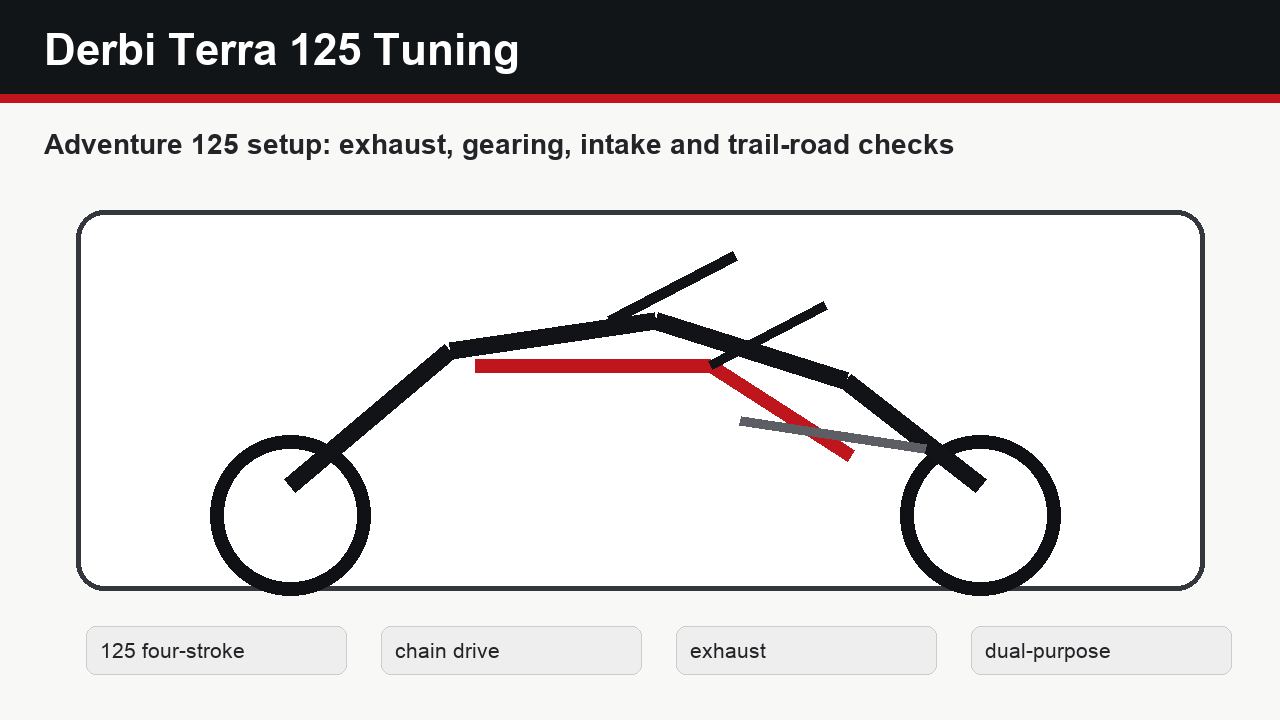
What tuning can realistically improve
Derbi Terra 125 tuning can improve throttle response, hill climbing, gear choice, sound, comfort and confidence, but it will not turn a 125cc four-stroke trail-style motorcycle into a high-powered enduro. The Terra’s charm is that it is light, approachable and practical. The best improvements are usually small and cumulative: a healthy chain, correct sprocket choice, clean air filter, leak-free exhaust, fresh plug, good tyres and suspension set for the rider’s weight.
Owners often search for Derbi Terra 125 tuning because the bike feels slow into headwinds, weak on hills, noisy without much acceleration, or awkward when moving between road and gravel tracks. Those symptoms do not always mean the engine needs a tuning module. They can come from a worn chain, hooked sprocket teeth, brake drag, underinflated tyres, a clogged filter, an exhaust leak, stale petrol or poor carburettor adjustment depending on the exact version and market.
The realistic target is a motorcycle that starts cleanly, idles steadily, pulls through the gears without hesitation, holds speed as well as a healthy 125 can and remains civil on the road. Good Derbi Terra 125 tuning should make the bike feel sharper and better matched to its use, not fragile or noisy. If the rider expects motorway performance from a learner-legal 125, the problem is expectation rather than parts.
For comparison within the same 125cc adventure and supermoto world, the SWM SM 125 R derestriction guide, the Malaguti XSM 125 tuning guide and the KTM Duke 125 chip tuning guide show how similar decisions change depending on chassis, engine layout and legal use.
Mechanical baseline before tuning
Derbi Terra 125 tuning should begin with maintenance because small engines are sensitive to basic condition. Check engine oil, coolant if applicable, air filter, spark plug, plug cap, battery voltage, throttle cable, clutch adjustment, chain slack, sprocket wear, brake drag, wheel bearings, tyre pressure and exhaust sealing. A 125 that is carrying friction or poor ignition will feel slow even with expensive parts.
The chain is especially important on a light adventure-style motorcycle. Too tight and it stresses bearings and suspension movement. Too loose and it snatches, wears sprockets and can feel like poor throttle response. A tight spot in the chain can make Derbi Terra 125 tuning feel inconsistent because the rear wheel load changes as the chain rotates. Before changing sprockets, inspect the existing drive kit carefully.
| Baseline check | Why it matters | Workshop note |
|---|---|---|
| Chain slack and tight spots | Affects response, wear and safety | Measure at the tightest point with the bike loaded as recommended |
| Sprocket wear | Hooked teeth reduce smooth drive | Replace chain and sprockets as a matched set when worn |
| Air filter | Dirt or poor sealing changes fuelling | Clean or replace before judging performance |
| Exhaust joints | Leaks cause noise, popping and weak low-speed response | Check gaskets, clamps, brackets and heat shields |
| Brake drag | Makes a 125 feel underpowered | Lift wheels and check free rotation before blaming the engine |
| Tyres and pressure | Road/trail tyres change acceleration and stability | Match tyre choice to actual use, not only appearance |
Compatibility and fitment checks
Parts must be matched to the exact version, production year, engine type and current equipment. The Terra name can appear in different markets and listings, and owners may also confuse Terra, Terra Adventure and related Derbi 125 models. A part that suits one year or version may not clear another exhaust bracket, heat shield, frame detail or airbox layout.
Before ordering parts, photograph the original exhaust, measure the pipe diameter, inspect hanger points, count electrical connector pins and identify whether any previous owner has modified the bike. If the motorcycle already has a non-standard exhaust, filter or sprocket set, the next step in Derbi Terra 125 tuning must account for that existing setup. Compatibility is not proven by model name alone.
Compatibility table for common Terra 125 upgrades
| Upgrade type | Compatibility | Important note |
|---|---|---|
| Slip-on exhaust | Depends on pipe diameter and hanger line | Check gasket style, heat shield position and DB-killer status |
| Universal silencer | Possible with adaptation | May require reducer sleeves, bracket work or professional fitting |
| Sprocket gearing | Usually possible | Chain length and clearance must be checked after ratio changes |
| Air filter | Usually straightforward | Keep the airbox sealed for reliable road and wet-weather use |
| CDI or ignition module | Connector-specific | Confirm plug shape and wiring before buying |
| Trail tyres | Depends on rim size and clearance | Check road rating, mudguard clearance and intended terrain |
Anyone planning Derbi Terra 125 tuning should keep measurements next to the product listing. The performance parts category is useful for comparing options, but the motorcycle itself has the final word on fitment.
Exhaust, silencer and DB-killer choices
Derbi Terra 125 tuning often includes an exhaust because sound and appearance change immediately. On a small four-stroke 125, an exhaust can make the bike feel more lively if the old system is restricted, rusty or leaking, but it rarely creates dramatic power by itself. The best result comes when the pipe diameter, silencer volume, bracket support, gasket seal and fuelling behaviour all agree.
Measure before buying. Check the outside diameter at the joint, the angle of the link pipe, the hanger position, rear brake clearance, heat shield mounting and whether the silencer will sit safely away from luggage or soft panniers. With Derbi Terra 125 tuning, off-road styling can tempt owners into choosing parts only by look. Fitment and heat management matter more than a catalogue photo.
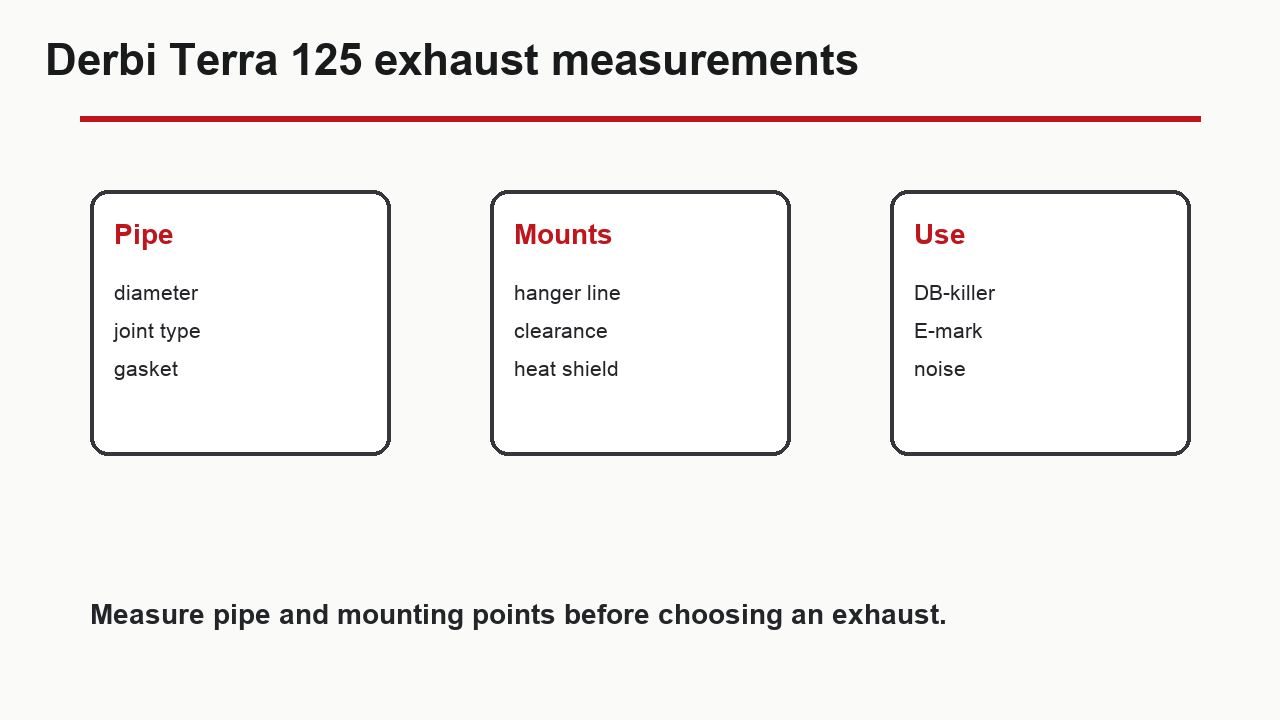
Sports exhaust versus universal silencer
A model-specific sports exhaust is usually easier if the listing is accurate. A universal silencer can work, but may need sleeves, brackets or cutting. Poor support can crack welds or loosen fasteners during vibration on rough roads. Good workshop practice keeps the exhaust secure enough for potholes, gravel tracks and heat cycles, not just a short idle test in the garage.
Riders comparing exhaust options can start with the motorcycle exhausts category. The right choice should include road-use status, DB-killer design, acceptable noise, correct diameter and realistic installation effort.
| Exhaust solution | Main advantage | Possible disadvantage | Best use case |
|---|---|---|---|
| Original exhaust | Usually quiet and road-friendly | May be corroded or heavy with age | Reliable commuting and MOT confidence |
| Road-approved sports exhaust | Better tone and appearance | Fitment and paperwork must be checked | Road riders wanting a controlled upgrade |
| Universal silencer | Flexible and often affordable | May need adaptation | Custom projects with measurement and fitting skill |
| Track-use-only exhaust | More sound and freer flow | Not suitable for normal road use | Private or closed-course use only |
| Repairing leaks | Restores lost response cheaply | Less exciting than a new part | Older bikes with gasket or clamp problems |
Chain, sprockets and gearing
Derbi Terra 125 tuning has a useful advantage over shaft-driven or CVT machines: gearing can be adjusted with sprockets. But this is also where owners often make mistakes. A shorter final drive can help hills and low-speed trail work, but it may raise cruising revs and reduce relaxed road speed. Taller gearing can reduce revs on open roads, but it may make the bike feel flat in headwinds or with a heavier rider.
Decide how the motorcycle is used. If it spends most of its life on urban roads and lanes, a slightly shorter setup may feel more responsive. If it is used for longer A-road journeys, standard-like gearing may be better. If it carries camping gear or spends time on dirt tracks, low-speed control matters. Proper Derbi Terra 125 tuning should match terrain, rider weight and the engine’s real torque, not just chase top speed, and Derbi Terra 125 tuning should always be tested on the route the bike actually rides.
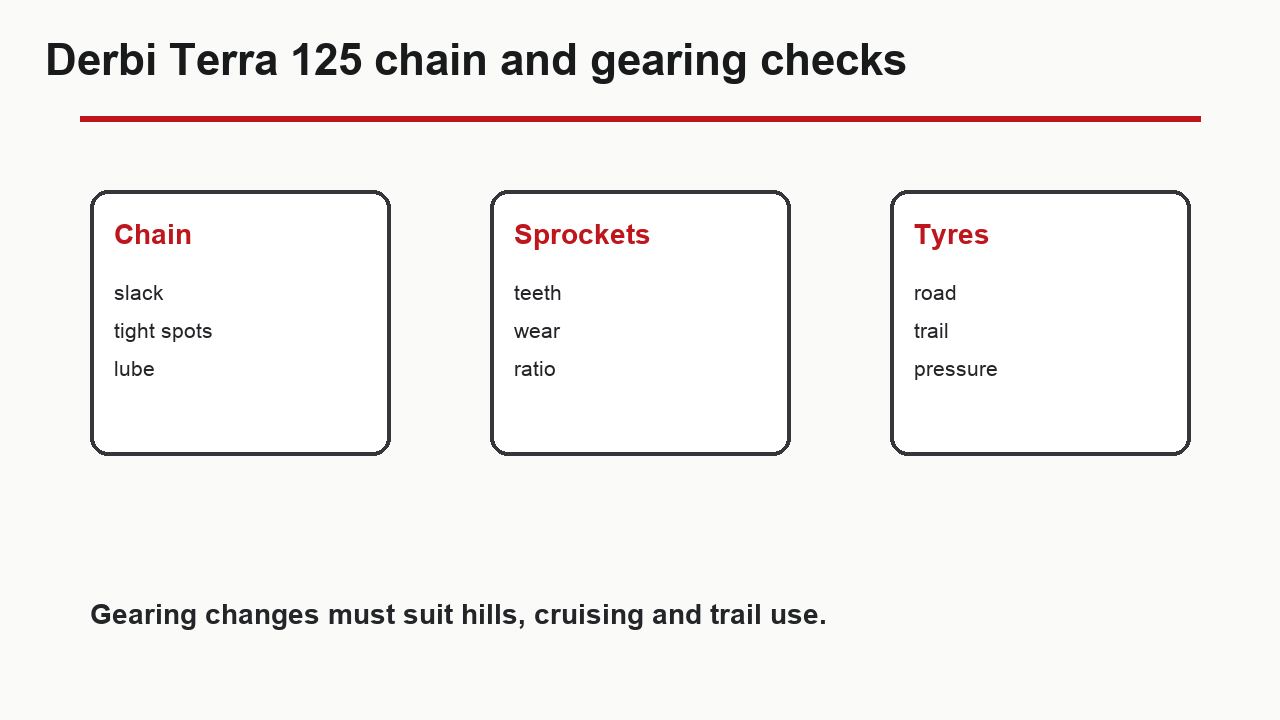
Chain adjustment after changing sprockets
After a sprocket change, check chain length, axle position, rear-wheel alignment and clearance through suspension movement. Do not judge chain slack only with the rear wheel hanging. Adventure-style suspension travel can change chain tension as the swingarm moves. A careful test ride and a second check after the first miles matter because new chains settle.
Intake, fuelling and ignition
Derbi Terra 125 tuning may involve air filters, carburettor adjustment, fuelling modules or ignition parts depending on the exact version. The safest route is to confirm what system is on the bike before ordering. A carburettor-fed model needs different thinking from a fuel-injected model. A universal CDI or module can be wrong even if the listing includes the model name.
Start with service condition. Make sure the airbox is sealed, the filter is clean, the intake boot is not cracked, the throttle operates smoothly and the spark plug shows normal colour. Open filters can make more noise but may draw hot air, water and dirt in real use. For road and light-trail riding, a good standard-style airbox setup is often better than a loud intake. Sensible setup keeps reliability and weather protection in mind.
When professional setup is worth it
If the bike has exhaust, intake and fuelling changes together, a mechanic or tuner can save money by preventing guesswork. Symptoms such as hanging idle, hesitation, popping, hard hot starting or poor plug colour need diagnosis. Derbi Terra 125 tuning should not use a module or jet change to hide an air leak, weak spark or dirty carburettor.
UK and anglophone legal considerations
Derbi Terra 125 tuning for public roads must be separated from private land, track use and off-road-only use. In the UK, an exhaust must be secure, in suitable condition and not excessively noisy. The official MOT guidance is the right place to check the inspection logic: GOV.UK motorcycle MOT exhaust noise guidance. A competition-marked or extremely loud exhaust can create inspection, insurance and police problems.
Rules differ across English-speaking markets. The United States, Canada, Australia, New Zealand and Ireland may treat noise, emissions equipment, road approval, learner restrictions and off-road-use-only parts differently. For rider safety context, the NHTSA motorcycle safety information is a useful high-authority resource. Responsible modification means checking local rules before changing exhaust noise, emissions equipment, lighting, tyres or engine management.
| Use case | Suitable approach | Important note |
|---|---|---|
| UK road commuting | Road-appropriate exhaust, sensible gearing and legal tyres | Check MOT noise, insurance and secure mounting |
| Light trail riding | Tyres, gearing and protection before loud exhausts | Respect land access rules and road legality when returning to public roads |
| Private land | More freedom to test setup | Still check heat, brackets and safe control |
| Closed-course use | Track-use parts may be acceptable | Not automatically legal for normal road use |
| Daily learner use | Reliability, moderate sound and easy maintenance | Avoid modifications that risk insurance or licence issues |
Common mistakes during Terra 125 tuning
Derbi Terra 125 tuning often goes wrong when owners chase one part instead of setting up the whole bike. The first mistake is fitting a loud exhaust without fixing chain wear or brake drag. The second is choosing sprocket ratios from a forum without thinking about rider weight, hills and cruising speed. The third is fitting an open filter without checking fuelling. The fourth is assuming a universal silencer is plug-and-play.
Other mistakes include ignoring tyre pressure, fitting tyres that look adventurous but perform badly on wet roads, overtightening exhaust studs, leaving wiring near heat, skipping a leak check, forgetting the DB-killer, failing to declare modifications to insurance, and expecting a 125 to gain big-bike power from bolt-on parts. If the motorcycle becomes louder but less pleasant to ride, the setup needs to be reviewed.
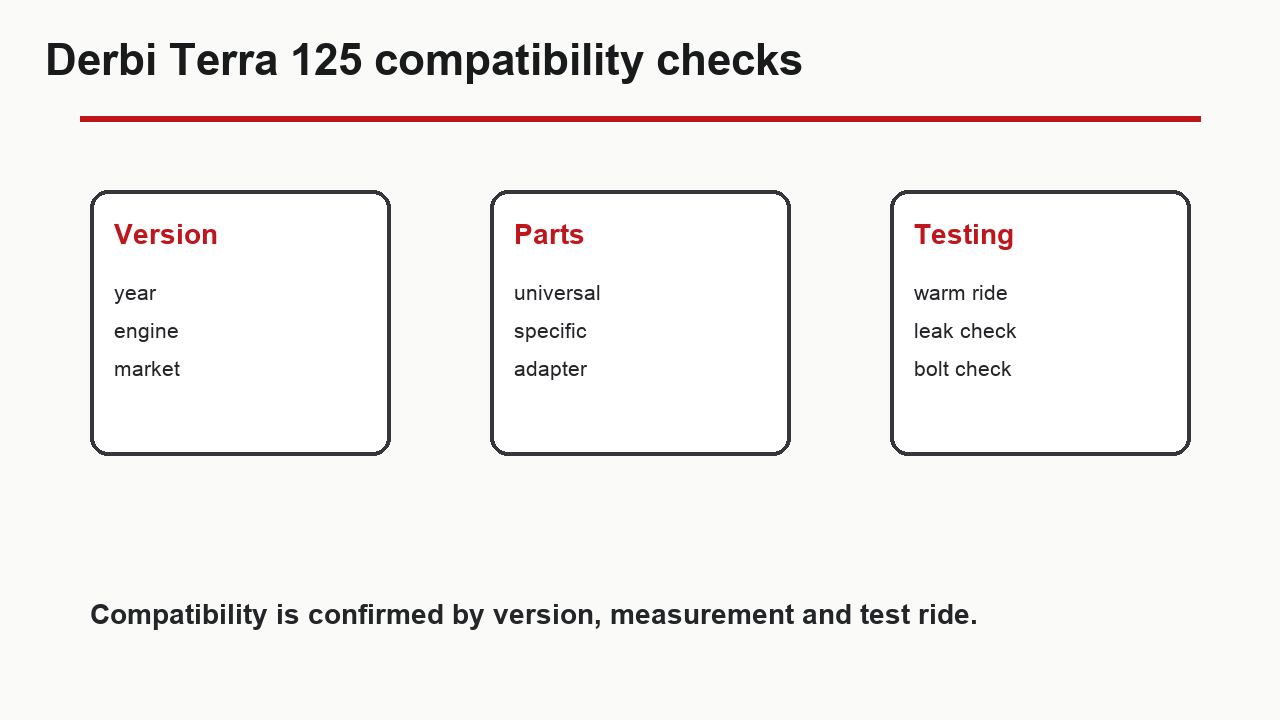
Post-installation checks
After any Derbi Terra 125 tuning work, warm the engine fully, check idle quality, throttle return, exhaust leaks, chain slack, rear-wheel alignment, brake feel and all fasteners. Take a short test ride before a long one. Listen for rattles and watch for heat near plastics or luggage. Recheck bolts and chain adjustment after the first ride because new parts settle.
Practical upgrade paths
Path one: reliable road and trail refresh
For many owners, the best path is a refresh: clean filter, fresh plug, correct chain slack, healthy sprockets, leak-free exhaust, correct tyres and brakes that do not drag. This can restore lost performance without making the bike less dependable.
Path two: hill and trail response
If the bike is used on hills, lanes or light trails, consider gearing before chasing engine parts. A carefully chosen rear sprocket can make the bike easier to ride at low speed, but it must be matched with chain length and road use. Derbi Terra 125 tuning should always consider the route the bike actually rides.
Path three: road-friendly sound and style
A road-friendly exhaust can improve tone and appearance, especially when the original system is tired. Keep the DB-killer, check approval where relevant and avoid excessive noise. This approach suits daily riders who want character without making the bike difficult to live with.
FAQ
Is Derbi Terra 125 tuning worth doing?
Derbi Terra 125 tuning is worth doing when the goal is realistic: better response, improved gearing, cleaner sound and a more confident road/trail setup. It is not worth expecting major power gains from a small 125cc engine.
What should I upgrade first on a Derbi Terra 125?
The first upgrade is usually a proper inspection. Check chain slack, sprockets, air filter, plug condition, exhaust leaks, brakes and tyres before buying performance parts.
Can I fit a universal exhaust to a Derbi Terra 125?
A universal exhaust may fit, but pipe diameter, hanger position, heat shield clearance and road-use status must be checked. Derbi Terra 125 tuning should never assume universal means plug-and-play.
Will sprocket changes make the Terra 125 faster?
Sprocket changes alter acceleration feel and cruising revs rather than creating engine power. Shorter gearing can help hills, while taller gearing may feel flat. Derbi Terra 125 tuning should match gearing to the rider and route.
Do I need to rejet or remap after an exhaust?
It depends on the bike’s fuelling system and the exhaust change. A mild road exhaust may need only checks, while freer exhaust and intake changes may need fuelling work. Derbi Terra 125 tuning should be tested for idle, throttle response and plug condition.
Is a louder exhaust legal in the UK?
A louder exhaust is not automatically legal. It must be secure, not excessively noisy and suitable for road use. Derbi Terra 125 tuning for UK roads should consider MOT guidance, insurance and approval markings.
Can tuning help off-road riding?
For light trail use, tyres, gearing, chain condition and control matter more than peak power. A well-planned setup can help off-road confidence when it improves low-speed response and reliability.
Should I choose engine tuning or tyres first?
If the motorcycle is used on mixed surfaces, tyres and chain setup may improve the ride more than engine parts. Start with the part of the bike limiting control, not the part that sounds most exciting.
Final buying advice
Derbi Terra 125 tuning should leave the motorcycle easier to ride, not harder to live with. Start with condition: chain, sprockets, tyres, brakes, filter, plug, exhaust sealing and controls. Then decide whether the bike needs road-friendly sound, better hill response, trail gearing, improved tyres or a clean fuelling setup. Measure before ordering and avoid parts that only look compatible.
If the bike is mainly used on roads, keep noise moderate, gearing sensible and tyres road-safe. If it is used on lanes and gravel, focus on tyre choice, chain control, protection and low-speed response. For practical comparison, use the X Moto Parts shop and relevant categories, but always match the product to the exact Terra version before buying.
Derbi Terra 125 tuning works best when the owner respects the bike’s lightweight adventure character. It is not about pretending a 125 is a 450. It is about making a small motorcycle start cleanly, pull predictably, cope with real roads and trails, and stay reliable after the upgrade is fitted.
{
“@context”: “https://schema.org”,
“@type”: “Article”,
“headline”: “Derbi Terra 125 adventure motorcycle tuning guide”,
“description”: “A practical guide to exhaust fitment, sprocket gearing, chain checks, intake setup, compatibility, UK road legality and common mistakes for a 125 adventure motorcycle.”,
“image”: “https://xmotoparts.com/wp-content/uploads/2026/07/derbi-terra-125-tuning.jpg”,
“author”: {“@type”: “Organization”, “name”: “X Moto Parts”},
“publisher”: {“@type”: “Organization”, “name”: “X Moto Parts”},
“mainEntityOfPage”: “https://xmotoparts.com/derbi-terra-125-tuning/”
}
{
“@context”: “https://schema.org”,
“@type”: “FAQPage”,
“mainEntity”: [
{“@type”: “Question”, “name”: “Is tuning worth doing on a Derbi Terra 125?”, “acceptedAnswer”: {“@type”: “Answer”, “text”: “It is worth doing when the goal is realistic: better response, improved gearing, cleaner sound and a more confident road and trail setup.”}},
{“@type”: “Question”, “name”: “Can a universal exhaust fit a Derbi Terra 125?”, “acceptedAnswer”: {“@type”: “Answer”, “text”: “A universal exhaust may fit with adaptation, but pipe diameter, hanger position, heat shield clearance and road-use status must be checked first.”}},
{“@type”: “Question”, “name”: “Do sprocket changes add power?”, “acceptedAnswer”: {“@type”: “Answer”, “text”: “Sprocket changes do not add engine power, but they can change acceleration feel, hill response and cruising revs.”}}
]
}