
Kymco UXV 500 problems
Kymco UXV 500 problems are usually easier to solve when the owner starts with symptoms instead of guessing parts. A UXV 500 that will not start, overheats, loses drive, refuses to engage 4×4, stalls when hot or makes driveline noise may have a simple maintenance fault, a worn CVT belt, a weak battery, a dirty connector, poor cooling airflow or a fuel-delivery issue. The important thing is to diagnose in order, because replacing random parts on a utility ATV can become expensive very quickly.
This guide is written for owners using the Kymco UXV 500 for farm work, estate jobs, trail riding, hunting, towing, property maintenance or weekend off-road use. It explains the common fault areas, how to separate engine issues from CVT and driveline issues, what to inspect before ordering parts and when a workshop should take over. Many Kymco UXV 500 problems are not dramatic failures. They are the result of age, mud, heat, poor battery condition, worn belts, blocked radiators, neglected fluids or connectors that have spent too much time wet.
First checks before replacing parts
Kymco UXV 500 problems should always be checked from the outside in. Before buying a starter motor, fuel pump, CDI, actuator or clutch part, inspect the simple things that fail in real off-road use. Check battery voltage at rest and under load, clean the terminals, inspect fuses, confirm the kill switch position, look at earth straps, examine the air filter, check coolant level, clean the radiator face, inspect CVT vents and look for water or mud inside covers.
Utility vehicles live a harder life than road motorcycles. They idle slowly, tow, crawl, sit for weeks, run in mud, cross water, collect dust and often get pressure-washed around connectors. That is why faults can look electrical one day and mechanical the next. A weak battery may crank slowly in cold weather. A dirty radiator may only overheat when towing. A worn belt may feel fine unloaded and slip as soon as the machine climbs.
| Symptom | Likely first checks | What not to do first |
|---|---|---|
| No crank | Battery load test, terminals, fuses, starter relay, brake/neutral safety switch | Do not order a starter before checking voltage drop |
| Cranks but will not start | Spark, fuel delivery, kill switch, plug, injector or carb condition depending on version | Do not assume the ECU or CDI is bad immediately |
| Slips under load | CVT belt, clutch faces, belt dust, water in cover, engine mounts | Do not blame engine power before checking the belt |
| Overheats | Radiator blockage, fan operation, coolant, cap, thermostat, air pockets | Do not keep riding until the warning light stays on |
| 4×4 not engaging | Switch, actuator, wiring, front differential, connectors | Do not force the drivetrain while loaded |
| Vibration or knocking | CV joints, wheel bearings, engine mounts, clutch, loose guards | Do not keep using it until the noise is identified |
Owners comparing other ATV issue guides can use the Kymco MXU 500 problems guide, the Yamaha Grizzly 700 problems guide and the broader CFMoto problems guide as useful internal references. The machines differ, but the diagnostic discipline is similar.
Starting and electrical faults
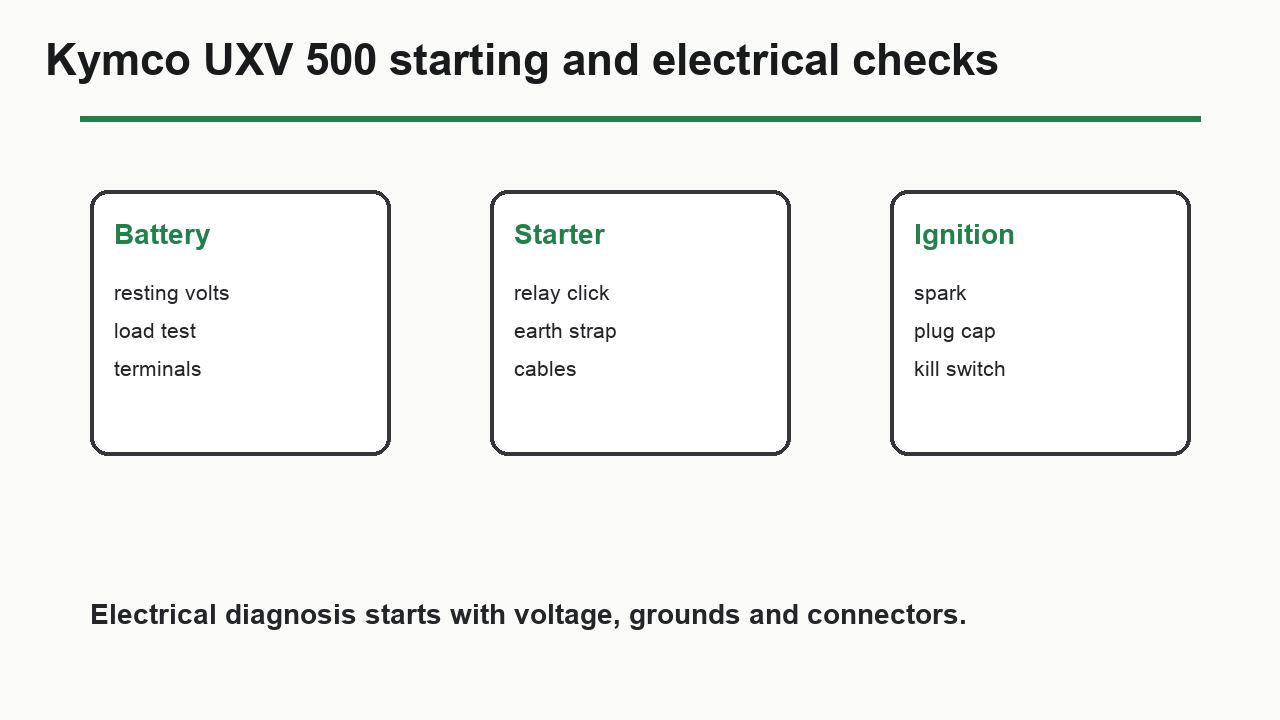
Kymco UXV 500 problems often begin with starting complaints: the starter clicks, the engine cranks slowly, the dash behaves strangely, the machine starts cold but not hot or it dies as soon as a load is added. Start with the battery. A battery can show a reasonable voltage with no load and still collapse when the starter draws current. Load testing matters more than looking at a charger light.
Clean the terminals, check the main earth, inspect the starter relay, examine fuses and look for green corrosion inside connectors. Utility ATVs often suffer from water and mud around wiring. Pressure washing can drive water into places that were not meant to be soaked. Many Kymco UXV 500 problems that look like expensive electronics are actually poor connections, weak grounds or tired switches.
No crank, slow crank and intermittent crank
If the machine does not crank, listen carefully. A single click points towards relay, battery or high-resistance cable checks. No click may point towards switch, fuse, interlock or wiring checks. Slow cranking may be battery, cable resistance, starter wear or engine drag. Do not overlook simple safety interlocks: neutral position, brake input, kill switch and seat or harness-related switches where fitted.
Cranks but will not start
If the engine cranks but will not fire, separate spark and fuel. Check plug condition, spark strength, fuel pump sound if fitted, fuel quality, blocked filter, injector or carburettor condition depending on version, and whether the air filter is soaked or clogged. Old petrol can create starting trouble after storage. A blocked tank vent can also mimic fuel starvation. Kymco UXV 500 problems after winter storage often come from fuel and battery condition together.
Stalling, rough running and fuel issues
Kymco UXV 500 problems related to rough running usually need patient observation. Does it stall only hot, only cold, only under load, only on hills or only after water crossings? A hot stall can point to ignition breakdown, fuel delivery, fan/cooling trouble or a sensor issue. A cold hesitation may involve choke/enrichment, idle setting, old fuel or intake leaks. A loaded bog can be fuel starvation, clutch slip or belt trouble rather than engine failure.
Inspect the intake path. A dirty air filter reduces airflow. A poorly sealed airbox can let dust into the engine. A cracked intake boot can create a lean condition. Mud or water ingestion can turn a small problem into a major one. For Kymco UXV 500 problems, the airbox and intake tract deserve more attention than many owners give them because these machines work in dust, grass, rain and mud.
Fuel pump, filter and tank vent checks
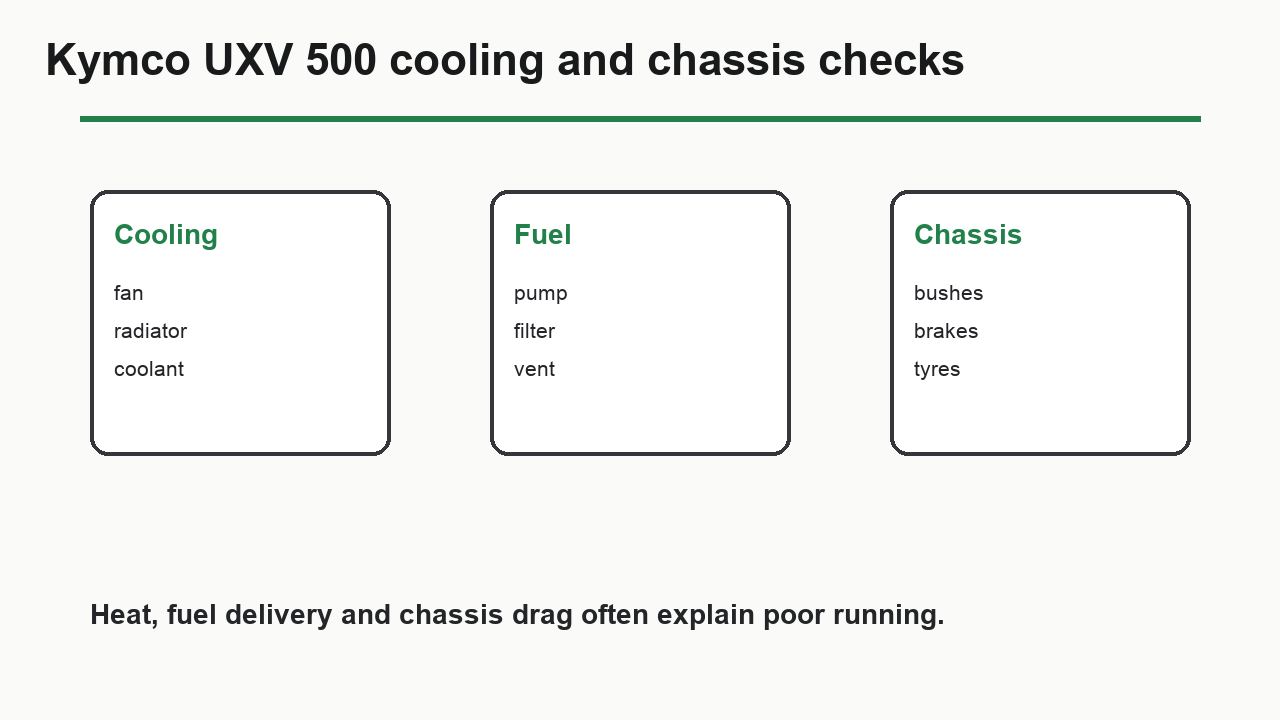
Fuel delivery should be checked before expensive electrical parts are ordered. Listen for pump operation if the model uses one, check fuel flow, inspect filters and make sure the tank vent is not blocked. A blocked vent may allow the vehicle to run for a while, then stumble as vacuum builds in the tank. Remove uncertainty one step at a time: fresh fuel, clean filter, clear vent, confirmed spark and then deeper testing.
CVT belt, clutch and driveline symptoms
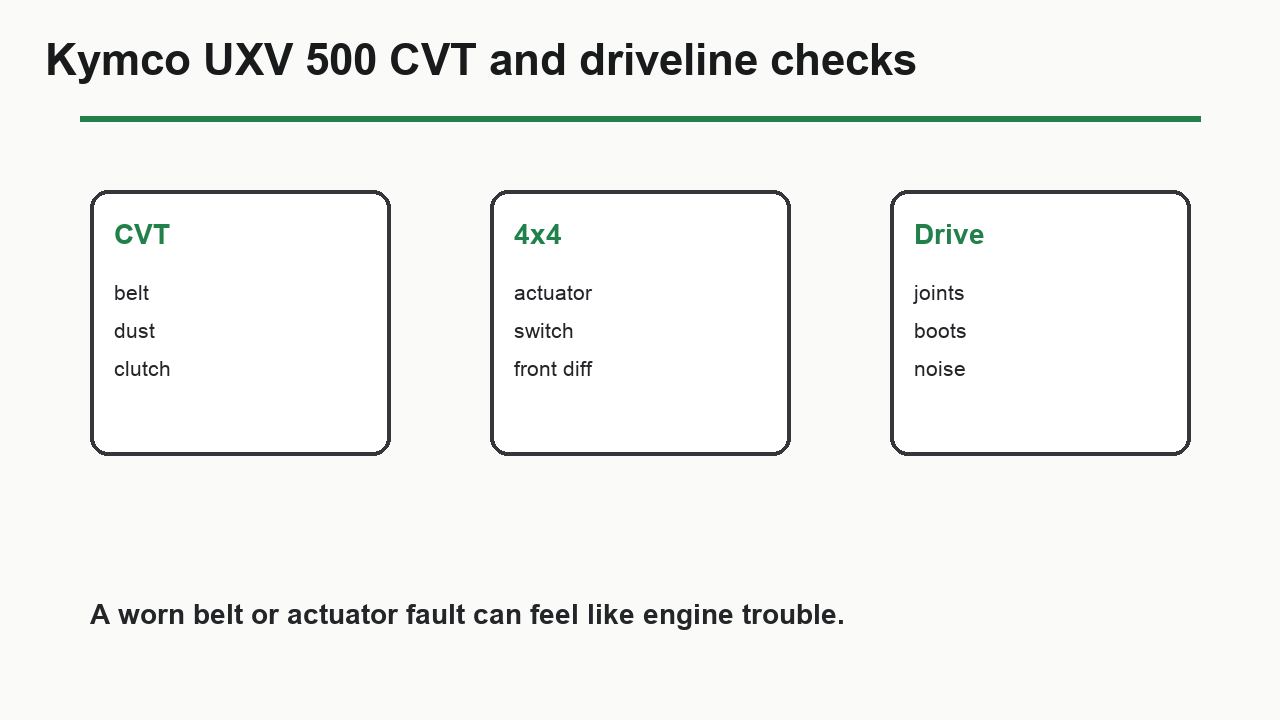
Kymco UXV 500 problems are often blamed on the engine when the real issue is inside the CVT or driveline. A worn belt can slip under load, smell hot, squeal, leave black dust or make the machine feel weak on climbs. Water inside the CVT cover can cause sudden slipping after a crossing. Clutch wear can create harsh engagement, judder or poor low-speed control.
Remove the cover and inspect, rather than guessing. Look for belt width, cracks, glazing, missing cogs, dust build-up, clutch-face wear and signs of water entry. Check vents and seals. A utility UTV that tows or crawls slowly generates heat in the transmission. Good diagnosis of Kymco UXV 500 problems asks what the vehicle was doing when the symptom appeared: towing, climbing, idling, crossing water, carrying load or running flat out.
Noise, vibration and knocking
Knocking or vibration should not be ignored. Check CV joints, boots, prop shaft, wheel bearings, engine mounts, loose guards, exhaust brackets and skid plates. A torn CV boot can quickly become an expensive joint failure if grit enters. Some driveline faults begin as a small clicking sound on turns and become a drivetrain repair because the vehicle keeps working while damaged.
| Driveline symptom | Likely area | Practical check |
|---|---|---|
| Slipping smell under load | CVT belt or clutch | Inspect belt width, glazing, dust and heat marks |
| Clicking on turns | CV joint or boot | Check boots, grease loss and play before the joint fails |
| Heavy vibration | Mounts, driveshaft, wheels or clutch | Inspect looseness, mud-packed wheels and clutch faces |
| Hard gear selection | Idle speed, linkage or belt drag | Do not force the selector; check adjustment and idle |
| No drive after water | Wet CVT belt | Dry and inspect the CVT; find the entry point |
4×4 and differential engagement problems
Kymco UXV 500 problems with 4×4 engagement need calm diagnosis because forcing the system under load can make things worse. Check the switch, indicator behaviour, actuator, wiring, connectors and front differential operation. If the machine is stuck or the drivetrain is bound up, unload the system before repeatedly switching modes. Binding can happen when different tyres, uneven pressure or hard-surface use loads the drivetrain.
Tyres are part of the system. Different rolling circumference front to rear can confuse driveline feel and stress components. Mud-packed wheels can create vibration that feels mechanical. A weak connection to an actuator can be intermittent. With Kymco UXV 500 problems, a wiring wiggle test and connector inspection can save a lot of unnecessary part buying.
Overheating and cooling system checks
Kymco UXV 500 problems involving overheating should be taken seriously. Stop before the warning becomes engine damage. Utility vehicles often overheat because the radiator is packed with mud, grass seed or dust. Fan operation, coolant level, radiator cap condition, thermostat behaviour, water pump function and trapped air all matter. A machine that runs fine on open ground may overheat while towing slowly because airflow is low and load is high.
Clean the radiator carefully from the correct direction, avoiding bent fins. Confirm the fan switches on. Check coolant condition and level only when safe. Inspect hoses for collapse, leaks or chafing. If overheating returns after cleaning and bleeding, pressure testing and deeper inspection may be needed. Many heat faults are worsened because the owner keeps driving “just to finish the job”. That can turn a cooling issue into head-gasket or engine damage.
Compatibility and replacement parts
Kymco UXV 500 problems should be solved with parts that match the exact model, year and market version. Do not assume that a part listed for MXU, UXV 500i, UXV 450, UXV 700 or a different year will fit. Bodywork, electrical connectors, CVT covers, belt sizes, actuator layouts and cooling parts can vary. Photograph the original part, note connector shape, measure belt size and compare mounting points before ordering.
For general upgrade and maintenance comparisons, owners can browse the X Moto Parts shop and the performance parts category, but fitment must be checked at the vehicle. Solving these issues is not about the part that looks closest online; it is about the part that matches the machine in front of you.
| Part area | Compatibility risk | Important note |
|---|---|---|
| CVT belt | High if ordered by guesswork | Confirm belt dimensions or exact part reference |
| Starter relay | Connector and rating differences | Match terminals and amperage correctly |
| 4×4 actuator | Model and wiring dependent | Confirm plug, mounting and differential type |
| Cooling fan | Size and connector dependent | Check shroud, fuse rating and switch control |
| Brake parts | Caliper and year differences | Match pads, seals and discs to the exact version |
| Universal accessories | Fitment may require fabrication | Check clearance, wiring load and mounting strength |
UK and anglophone road/off-road considerations
Kymco UXV 500 problems are often discussed by owners who use the vehicle on private land, farms, forestry tracks or sometimes public roads where legal. Rules vary by country and registration status. In the UK, road use depends on registration, insurance, lighting, tyres, number plates, MOT requirements where applicable and whether the vehicle is approved for road use. Off-road or agricultural use is not the same as unrestricted public-road use.
For safety and recall awareness, owners should use authoritative sources. The United States Consumer Product Safety Commission posts recall and product-safety information for off-road vehicles: CPSC recalls database. The ATV Safety Institute also provides rider-safety guidance for ATV operation: ATV Safety Institute. Responsible handling includes checking whether a fault affects safe braking, steering, throttle return, fuel leakage, fire risk or rollover safety before continuing to use the vehicle.
| Use case | Priority checks | Important note |
|---|---|---|
| Farm or estate work | Cooling, CVT belt, brakes, tyres and load limits | Towing and slow work create heat and belt wear |
| Trail riding | CV boots, cooling, 4×4 engagement and steering | Water and mud increase connector and belt risk |
| Public-road use where legal | Lights, tyres, brakes, insurance and registration | Rules vary by country and vehicle approval |
| Winter storage | Battery, fuel quality, rodents, corrosion and brakes | Many faults appear after standing unused |
| Heavy towing | CVT heat, belt condition, coolant and brakes | Stop if belt smell or overheating appears |
Common mistakes when diagnosing UXV 500 faults
Kymco UXV 500 problems become expensive when owners skip simple checks. The first mistake is fitting a battery without cleaning terminals and earths. The second is replacing a fuel pump before checking fuel quality and tank venting. The third is blaming engine power when a CVT belt is worn. The fourth is pressure-washing connectors and then wondering why electrical faults appear.
Other mistakes include ignoring overheating, forcing 4×4 engagement under load, continuing to drive with CV joint clicking, using mismatched tyres, fitting universal electrical accessories without fuses, installing the wrong belt, ignoring brake drag and assuming every intermittent fault is a control module. Good diagnosis of Kymco UXV 500 problems is patient, not dramatic.
When to stop and call a mechanic
Stop using the machine if there is fuel leakage, strong burning smell, severe overheating, sudden loss of braking, steering play, heavy driveline knocking, smoke, coolant loss or repeated electrical fuse failure. Some Kymco UXV 500 problems are safe to inspect in a home workshop. Others need proper lifting equipment, pressure testing, electrical load testing or drivetrain disassembly.
FAQ
What are the most common Kymco UXV 500 problems?
Kymco UXV 500 problems commonly involve weak batteries, corroded connectors, starting faults, fuel delivery, dirty air filters, CVT belt wear, overheating, 4×4 actuator issues, CV joint wear, brake drag and faults caused by mud or water exposure.
Why will my Kymco UXV 500 not start?
Start with battery load, terminals, fuses, relay, safety switches, spark and fuel delivery. Many Kymco UXV 500 problems after storage come from weak batteries and stale fuel rather than a failed control unit.
Why does my UXV 500 slip or smell hot under load?
Slipping or a hot belt smell often points to CVT belt wear, clutch heat, water in the CVT cover or heavy towing load. Kymco UXV 500 problems under load should always include belt and clutch inspection.
Why does my Kymco UXV 500 overheat?
Overheating can be caused by a blocked radiator, failed fan, low coolant, trapped air, bad cap, thermostat trouble or heavy slow work. Kymco UXV 500 problems involving heat should be fixed before the machine is used hard again.
Why is the 4×4 not engaging?
Check the switch, actuator, wiring, connectors, front differential and whether the drivetrain is bound under load. A 4×4 engagement fault should not be forced repeatedly because that can worsen the problem.
Can I use parts from a Kymco MXU 500?
Some parts may look similar, but UXV and MXU fitment should never be assumed. Kymco UXV 500 problems should be repaired with parts matched by model, year, connector, dimensions and mounting points.
Is it safe to keep driving with a clicking CV joint?
No, not for long. Clicking can mean CV joint or boot damage, and continued use can destroy the joint. Kymco UXV 500 problems involving driveline noise should be inspected before work use continues.
What should I check after riding through water?
Check the CVT cover, belt, airbox, breathers, connectors, brakes and fluids if the crossing was deep. Kymco UXV 500 problems after water exposure often come from belt slip, wet connectors or contaminated intake areas.
Final diagnostic advice
Kymco UXV 500 problems should be handled with a checklist, not guesswork. Start with the symptom, then check battery, fuel, air, spark, CVT, cooling, 4×4 engagement, brakes and chassis drag in a logical order. Keep notes on when the fault appears: cold, hot, wet, loaded, towing, climbing, idling or after storage. That pattern often points to the correct system.
Before ordering parts, confirm model year, part number, connector shape, belt dimensions and mounting points. Use related diagnostic guides on X Moto Parts to compare similar ATV failure patterns, especially Kymco MXU and Yamaha Grizzly content, but make the final repair decision from the UXV 500 in front of you. If the fault affects braking, steering, overheating, fuel leakage or driveline safety, stop using the machine and involve a qualified mechanic.
Kymco UXV 500 problems are frustrating when the vehicle is needed for work, but most repairs become clearer once the machine is inspected patiently. A good fix restores dependable starting, steady cooling, predictable drive and safe handling; that matters more than replacing the most expensive part first.
{
“@context”: “https://schema.org”,
“@type”: “Article”,
“headline”: “Kymco UXV 500 utility ATV diagnostic guide”,
“description”: “A practical guide to starting faults, CVT belt wear, overheating, 4×4 engagement, fuel issues, driveline noise, compatibility and safe repair decisions.”,
“image”: “https://xmotoparts.com/wp-content/uploads/2026/07/kymco-uxv-500-problems.jpg”,
“author”: {“@type”: “Organization”, “name”: “X Moto Parts”},
“publisher”: {“@type”: “Organization”, “name”: “X Moto Parts”},
“mainEntityOfPage”: “https://xmotoparts.com/kymco-uxv-500-problems/”
}
{
“@context”: “https://schema.org”,
“@type”: “FAQPage”,
“mainEntity”: [
{“@type”: “Question”, “name”: “What are common UXV 500 faults?”, “acceptedAnswer”: {“@type”: “Answer”, “text”: “Common faults include weak batteries, corroded connectors, starting problems, fuel delivery issues, CVT belt wear, overheating, 4×4 actuator issues and driveline noise.”}},
{“@type”: “Question”, “name”: “Why does a UXV 500 slip under load?”, “acceptedAnswer”: {“@type”: “Answer”, “text”: “Slipping under load often points to CVT belt wear, clutch heat, water inside the CVT cover or heavy towing load.”}},
{“@type”: “Question”, “name”: “Should overheating be ignored?”, “acceptedAnswer”: {“@type”: “Answer”, “text”: “No. Overheating should be fixed before hard use continues because cooling faults can lead to expensive engine damage.”}}
]
}