Honda Deauville 650 tuning
Honda Deauville 650 tuning should be treated as careful touring-motorcycle setup, not as an attempt to turn a dependable middleweight tourer into a superbike. The NT650V Deauville is loved because it is practical, protective, shaft-driven and comfortable over distance. The best improvements normally come from restoring lost condition first, then choosing sensible exhaust, intake, carburation, suspension and braking upgrades that suit the way the bike is actually ridden.
This guide is for owners comparing performance parts, exhaust systems, carburettor work, air-filter options, touring suspension, brake upgrades and road-use legality. It is also for riders who have bought a used Deauville and are unsure whether the bike feels flat because it needs tuning or because it needs service work. In many workshops, Honda Deauville 650 tuning starts with valve-clearance history, carb balance, plug condition, airbox sealing, exhaust corrosion and tyre condition before anyone talks about extra power.
What tuning can realistically improve
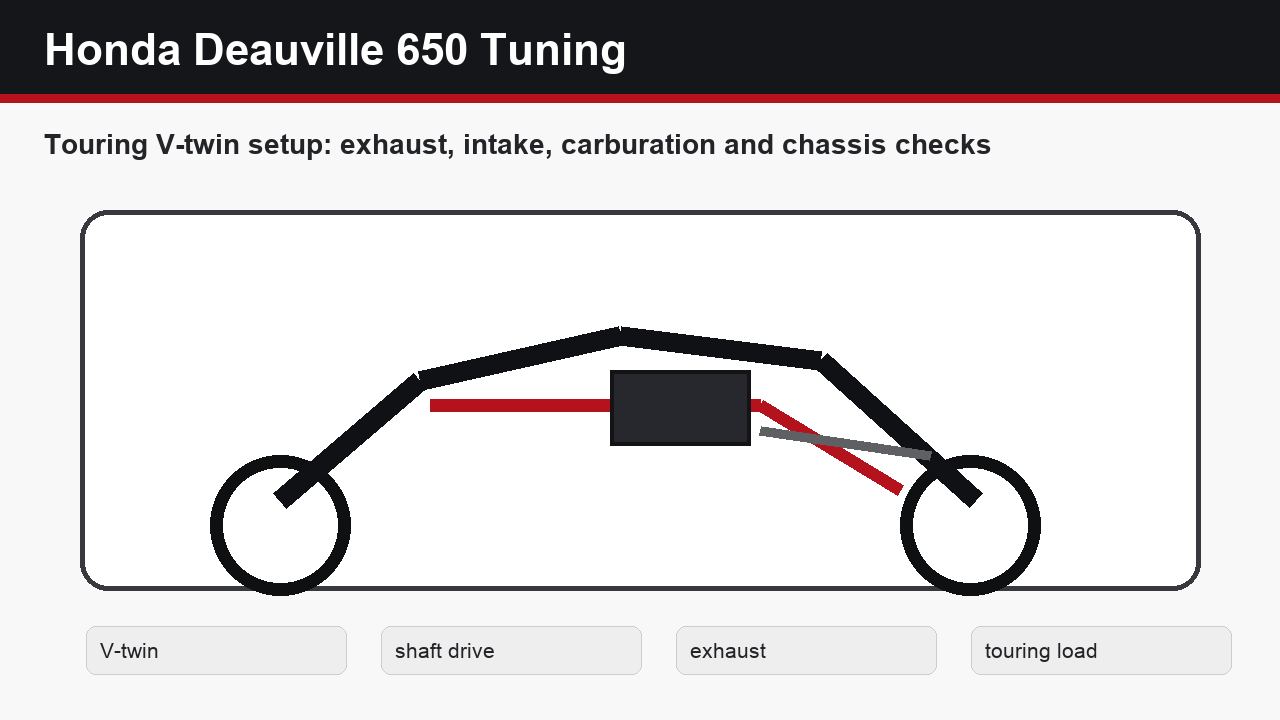
Honda Deauville 650 tuning can improve throttle response, mid-range cleanliness, sound, comfort, stability and confidence when the work is matched to the machine. The Deauville is a V-twin touring motorcycle with shaft drive and practical bodywork, so the most satisfying changes are usually the ones that make it easier to ride well: smoother carburation, a sound exhaust system, healthy ignition, firmer suspension control, fresh tyres and brakes that feel positive when the bike is loaded.
Owners often search for Honda Deauville 650 tuning because the bike feels dull, heavy, slow two-up, too quiet, unstable with luggage or reluctant to pull cleanly from low revs. Those symptoms can come from age as much as design. A weak battery, old spark plugs, split intake rubbers, unbalanced carburettors, dragging brakes, squared-off tyres or a corroded exhaust joint can make a good engine feel tired.
The important point is expectation. A Deauville 650 will never feel like a supersport machine, and chasing that result is how owners waste money. Good Honda Deauville 650 tuning makes the motorcycle feel healthier, more composed and more responsive in the real world. That includes overtaking confidence, less vibration from poor carb balance, better control with panniers and a sound that suits the bike without becoming antisocial.
If you are comparing similar middleweight touring upgrades, the Kawasaki Versys 650 power increase guide and the Aprilia Pegaso 650 tuning guide are useful comparison points. Different engines, different chassis, same principle: fix the baseline before buying parts.
Mechanical baseline before tuning
Honda Deauville 650 tuning should begin with the service record. On an older touring motorcycle, condition matters more than catalogue claims. Check oil and coolant condition, charging voltage, plug caps, spark plugs, air filter, carburettor balance, valve-clearance history, throttle-cable free play, clutch adjustment, exhaust leaks, brake drag, wheel bearings, head bearings and final-drive oil. Any one of these can change the way the bike feels.
The Deauville is often used for commuting and touring, which means many examples have high mileage, winter corrosion or long periods of steady running. That is not a problem if the maintenance is honest. It becomes a problem when owners buy tuning parts to solve symptoms that are really service faults. A corroded collector, leaking gasket or airbox leak can make Honda Deauville 650 tuning look ineffective because the engine is not starting from a clean baseline.
| Baseline check | Why it matters | Workshop note |
|---|---|---|
| Carburettor balance | Unbalanced carbs cause vibration, poor pick-up and uneven idle | Balance when the engine is warm and after air leaks are ruled out |
| Air filter and airbox | Leaks or dirty filtration change fuelling behaviour | Keep the airbox sealed unless a complete fuelling plan exists |
| Exhaust joints | Leaks can cause popping, soot marks and weak response | Inspect gaskets, studs, collector corrosion and silencer mounts |
| Ignition parts | Old plugs, caps or leads can mimic carb problems | Check hot starting, plug colour and cap resistance |
| Brakes and tyres | Drag and squared tyres make the bike feel heavy | Lift wheels, check free rotation and inspect tyre profile |
| Final drive | Shaft-drive condition affects smoothness and reliability | Check oil condition, leaks and rear hub play |
Compatibility and parts fitment
Parts must be matched to the NT650V, the production year and the bike’s current condition. Do not assume that parts for the later Deauville 700 fit the 650. Do not assume that an exhaust listed for a related Honda V-twin will clear the Deauville’s bodywork or pannier structure. The bike’s built-in luggage, lower fairing, centre stand, collector layout and shaft-drive packaging all affect fitment.
Before ordering, photograph the original exhaust, measure pipe diameter where relevant, inspect hanger positions and note whether crash bars, pannier hardware or aftermarket screens are fitted. For electrical accessories, check routing, fuse capacity and waterproofing. A touring bike often carries heated grips, USB chargers, auxiliary lights or luggage wiring, so Honda Deauville 650 tuning should include electrical tidiness as well as engine work.
Compatibility table for common upgrades
| Upgrade type | Compatibility | Important note |
|---|---|---|
| Slip-on silencer | Depends on pipe and hanger layout | Check pannier clearance, centre stand clearance and road approval |
| Full exhaust or collector repair | Model-specific | Corrosion around joints and studs can complicate removal |
| Air filter | Usually straightforward | Keep fuelling in mind and avoid poorly sealed intake changes |
| Carburettor jetting | Possible when justified | Best done with intake and exhaust changes understood together |
| Suspension upgrade | Highly useful for touring | Match spring rate and preload to rider, passenger and luggage |
| Brake lines and pads | Usually practical | Use quality parts and bleed the system carefully |
For owners still comparing upgrade categories, the performance parts category is a sensible starting point. Anyone planning Honda Deauville 650 tuning should still confirm exact fitment before ordering, especially when buying universal exhaust or touring accessories, because Honda Deauville 650 tuning has to work around the bike’s fairing, panniers and shaft-drive layout.
Exhaust, silencer and sound choices
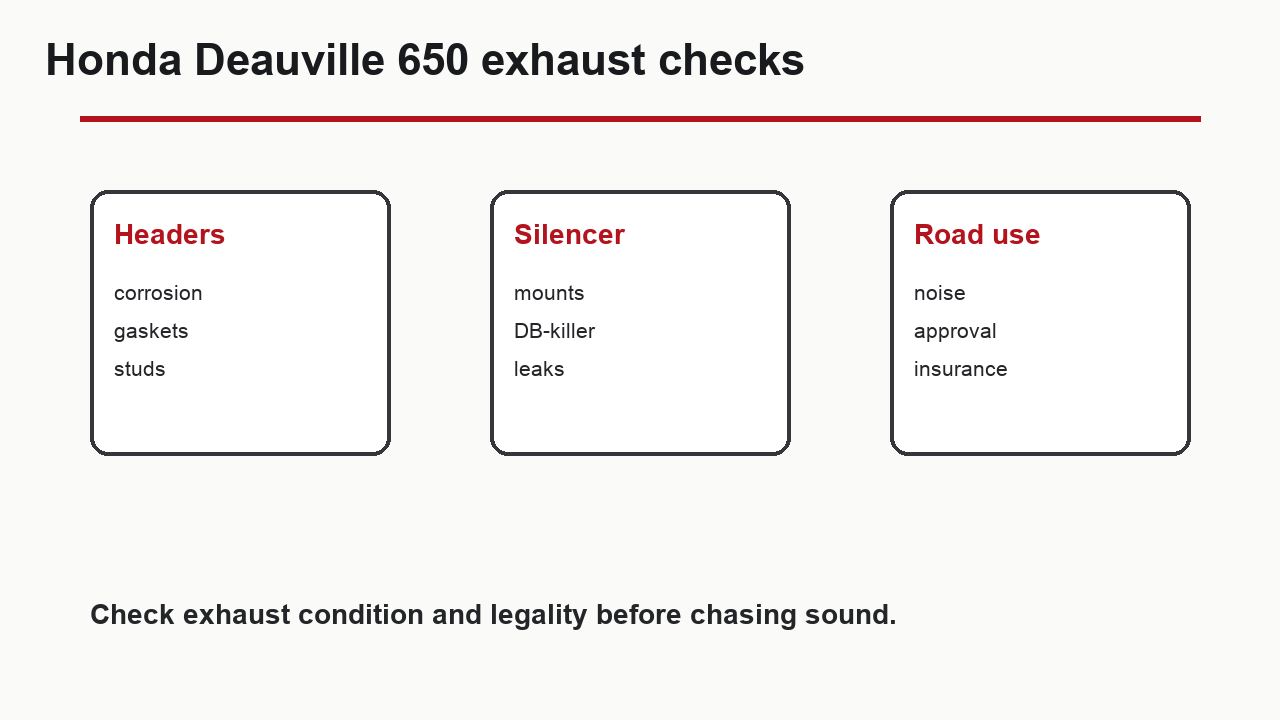
Honda Deauville 650 tuning often includes exhaust work because many older examples suffer from corrosion, tired gaskets or worn mounting hardware. A sound exhaust system can improve confidence, reduce leaks and give the V-twin a more satisfying tone. But the Deauville’s touring purpose matters. A very loud exhaust may become tiring on long journeys, unpleasant for a passenger and problematic during inspections.
Inspect before removing anything. Exhaust studs on older motorcycles can seize, collectors can be thin with corrosion and hangers may hide stress cracks. Soak fasteners, support the system properly and avoid forcing rusty hardware. If a silencer is replaced, check the joint, clamp, hanger angle, rubber mounts, pannier clearance and whether the centre stand touches the pipe. Good workshop practice does not trade one noise for a cracked bracket.
Universal exhaust versus model-specific exhaust
A universal silencer can work on a custom project, but it may need sleeves, link-pipe adjustment or a bracket. A model-specific system is usually easier, but still needs confirmation. In Honda Deauville 650 tuning, pannier clearance is especially important because the built-in luggage defines much of the rear layout. A silencer that looks fine with the bike unloaded may run too close to plastic panels or luggage after heat builds on a long ride.
Riders comparing exhaust options can browse the motorcycle exhausts category, but the decision should be based on diameter, hanger line, approval status and the owner’s use. Touring comfort matters. A deep, controlled tone is usually better than a harsh drone at motorway speed.
| Exhaust solution | Main advantage | Possible disadvantage | Best for |
|---|---|---|---|
| Healthy original system | Quiet, civil and usually road-friendly | Can be corroded with age | Commuting, touring and MOT confidence |
| Road-approved sports silencer | Better tone and appearance | Fitment and paperwork must be checked | Owners wanting sound without drama |
| Universal silencer | Flexible and often affordable | May require fabrication | Custom projects and confident installers |
| Collector repair or replacement | Fixes leaks and corrosion at the source | Rusty fasteners can make the job difficult | Older bikes with exhaust leaks |
| Track-use-only exhaust | More sound and freer flow | Not suitable for normal road use | Private or closed-course use only |
Carburation, airbox and ignition checks
Honda Deauville 650 tuning has to respect the carburettor-fed nature of the 650. Unlike later fuel-injected motorcycles, carb changes are mechanical and should be approached carefully. If the airbox is opened up or a freer exhaust is fitted, fuelling may need attention. But random jet changes can make the bike worse, especially if the original problem was dirty carbs, cracked intake rubbers or an unbalanced setup.
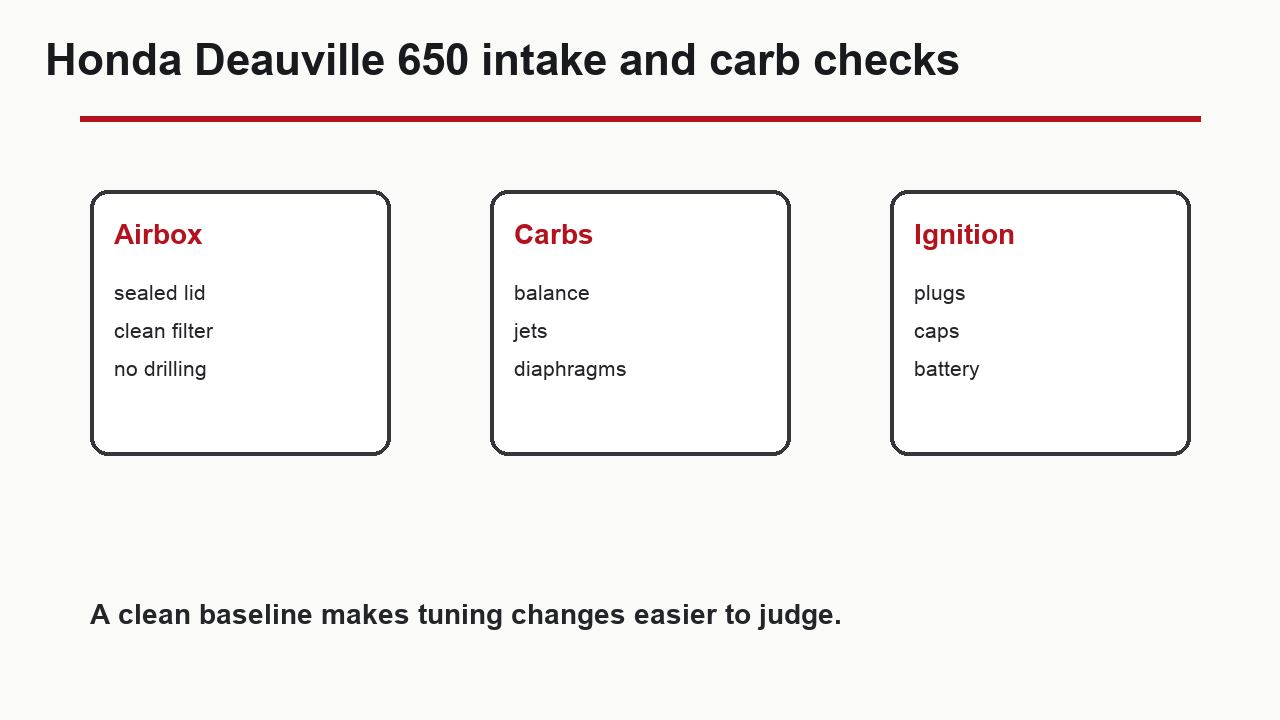
Start with the basics. Make sure the air filter is clean and seated, the airbox lid seals correctly, vacuum hoses are sound, carb diaphragms are healthy, float bowls are clean and throttle cables move freely. Then balance the carburettors when the engine is warm. Many owners looking for Honda Deauville 650 tuning are actually feeling the roughness of old ignition parts or unbalanced carbs rather than a lack of performance hardware.
Air filter changes and jetting decisions
Aftermarket air filters can be useful when they are high quality and correctly maintained, but removing restriction without checking fuelling can create hesitation, lean running or poor wet-weather behaviour. For a touring motorcycle, reliability matters more than intake noise. Sensible setup keeps the airbox stable unless the owner has a clear plan to test and correct fuelling.
If the bike has a sports exhaust and intake changes, read the plugs, listen for flat spots, check hot starting and consider professional carb setup. A road test is useful, but it should not replace inspection. A Deauville that feels crisp on one short ride can still run poorly when loaded, hot or climbing hills.
Suspension, brakes and touring load
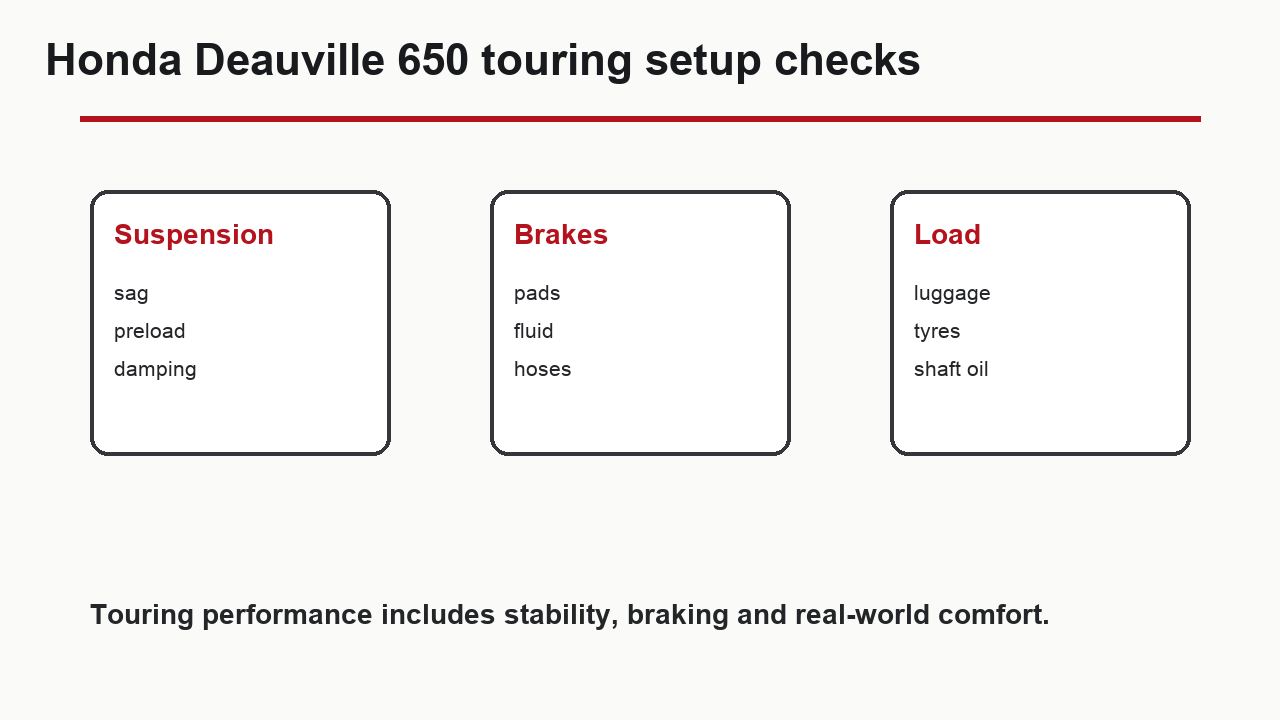
Honda Deauville 650 tuning should not focus only on the engine. Many owners would get a bigger real-world improvement from suspension and brakes than from chasing small power gains. The Deauville carries fairing weight, luggage, passenger load and touring equipment. If the rear shock is tired or preload is wrong, the bike can feel vague, wallowy or slow to turn even when the engine is running well.
Check sag with the usual load: rider, passenger if common, panniers and top box if fitted. Inspect fork seals, fork oil condition, head bearings, wheel bearings and tyre profile. Brakes deserve equal attention. Fresh pads, clean calipers, good fluid and quality hoses can make a touring bike feel far more confident. A motorcycle that stops and steers properly is faster in the real world than one with a noisy exhaust and tired chassis.
Shaft drive and gearing expectations
Because the Deauville uses shaft drive, sprocket gearing changes are not part of normal tuning in the way they are on chain-driven bikes. That is important. Do not copy advice meant for chain-drive 650s. Instead, focus on smooth engine response, final-drive oil condition, tyre size correctness and the way the bike carries load. If the owner wants dramatic acceleration changes, the Deauville may simply be the wrong platform.
UK and anglophone legal considerations
Honda Deauville 650 tuning for road use must be separated from private-area or track-use work. In the UK, MOT inspection includes exhaust condition and excessive noise. The official motorcycle MOT inspection manual is the right reference for this topic: GOV.UK motorcycle MOT exhaust noise guidance. If an exhaust is insecure, leaking, excessively noisy or clearly marked for competition use, it can create inspection and enforcement problems.
Insurance also matters. If the bike has a modified exhaust, carburettor work, performance intake, suspension upgrade or other non-standard equipment, declare it where required. In the United States, Canada, Australia, New Zealand and Ireland, rules vary by state, province or national authority. Some areas focus more on noise, others on emissions equipment or inspection status. For rider safety context beyond UK law, the NHTSA motorcycle safety information is a useful high-authority reference. Responsible Honda Deauville 650 tuning keeps legality and insurance in mind before parts are fitted.
| Use case | Suitable approach | Important note |
|---|---|---|
| UK road touring | Road-appropriate exhaust, conservative carb setup and documented parts | Check MOT noise, insurance and secure mounting |
| Commuting | Smooth fuelling, quiet exhaust and reliable electrics | Daily comfort matters more than peak output |
| Two-up travel | Suspension, brakes and tyres before engine changes | Load control changes the bike more than small power gains |
| Private land or closed course | More freedom on noise and setup | Not automatically legal for public roads |
| Custom project | Universal parts may be used carefully | Professional fabrication may be needed around panniers and bodywork |
Common mistakes during Deauville 650 tuning
Honda Deauville 650 tuning often goes wrong when owners copy advice from sportier motorcycles. The Deauville is not a chain-drive naked bike with easy gearing changes and exposed access. It is a covered, practical, shaft-driven tourer. The first mistake is buying a loud exhaust before checking corrosion and leaks. The second is drilling the airbox or fitting a freer filter without understanding carburation. The third is ignoring suspension because engine parts look more exciting.
Other mistakes include overtightening exhaust studs, leaving a silencer unsupported, routing electrical accessories badly, ignoring carb balance, assuming Deauville 700 parts fit the 650, forgetting insurance declarations and judging performance with old tyres or dragging brakes. If the bike is louder but no smoother, go back to the baseline checks.
Post-installation checks
After any Honda Deauville 650 tuning work, let the bike warm fully, check idle stability, throttle return, exhaust leaks, coolant behaviour, charging voltage and brake feel. Take a short test ride first. Listen for rattles around fairing panels and pannier areas. Recheck fasteners after the first heat cycle. If the bike is used two-up or loaded, test it that way before deciding the setup is finished.
Practical upgrade paths
Path one: reliable touring refresh
For many owners, the best path is a refresh: service fluids, clean air filter, balanced carbs, new plugs, sound exhaust joints, fresh brake fluid, correct tyres and suspension preload set for the rider. This can make the bike feel more responsive without adding a single dramatic part.
Path two: road-friendly sound and response
A road-friendly setup can include a well-fitted exhaust, clean intake, careful carb balance and mild suspension improvement. The goal is better tone, cleaner pick-up and more confidence on longer rides. This kind of Honda Deauville 650 tuning suits UK roads because it respects MOT expectations and everyday comfort.
Path three: loaded touring setup
If the bike carries a passenger and luggage, prioritise suspension, brakes and tyres. Engine upgrades are less useful if the rear shock is tired or the front end dives under braking. A loaded Deauville needs balance and control. Good Honda Deauville 650 tuning for touring is as much about chassis confidence as throttle response.
FAQ
Is Honda Deauville 650 tuning worth doing?
Honda Deauville 650 tuning is worth doing if the goal is realistic: smoother response, better sound, improved comfort and stronger touring confidence. It is not worth chasing superbike power from a dependable middleweight tourer.
What is the best first upgrade for a Deauville 650?
The best first upgrade is usually a proper service baseline. Check carb balance, plugs, air filter, exhaust leaks, brakes, tyres and suspension condition before buying performance parts.
Can I fit a universal exhaust to a Honda Deauville 650?
A universal exhaust may fit with adaptation, but pannier clearance, hanger position, pipe diameter, heat management and road-use approval must be checked. Physical fitment is only one part of the decision.
Does the Deauville 650 need rejetting after an exhaust?
Not always, but the carburation should be checked if the exhaust is much freer-flowing or the airbox has been modified. Honda Deauville 650 tuning works best when exhaust and intake changes are tested together.
Can I change gearing on a Honda Deauville 650?
Normal sprocket gearing changes do not apply because the Deauville uses shaft drive. Focus on engine condition, fuelling, exhaust, tyres, suspension and final-drive maintenance instead.
Is a louder exhaust legal in the UK?
A louder exhaust is not automatically legal. It must be secure, not excessively noisy and appropriate for road use. Honda Deauville 650 tuning for UK roads should consider MOT guidance, insurance and local enforcement.
Why does my Deauville feel flat?
A flat-feeling Deauville may have unbalanced carbs, old plugs, a dirty filter, exhaust leaks, brake drag, squared tyres or weak charging voltage. Honda Deauville 650 tuning should begin by finding the cause rather than guessing.
Should I tune the engine or suspension first?
If the bike is used for touring, suspension and brakes may give the biggest real-world improvement. Two-up touring, commuting and weekend riding all need different priorities.
Final buying advice
Honda Deauville 650 tuning should leave the bike better at being a Deauville: smooth, dependable, comfortable, stable and capable of covering distance. Start with condition. Confirm the carbs are balanced, the airbox is sealed, the ignition is healthy, the exhaust is not leaking, the brakes are free and the suspension is suitable for the load. Then decide whether the next step should be exhaust, intake, carb setup, suspension, brakes or touring equipment.
If the bike is mainly used for commuting, choose civil sound, clean fuelling and reliability. If it is used two-up, prioritise preload, brake feel and tyres. If the owner wants more character, a well-fitted road-appropriate silencer can make the V-twin more enjoyable without making long journeys unpleasant. For product comparison, use the X Moto Parts shop and relevant categories, but keep the bike’s exact model, year, load and legal use at the centre of the decision.
Honda Deauville 650 tuning works best when the owner respects what the motorcycle is. It is a practical V-twin tourer, not a race replica. Tune it for cleaner response, safer control, better comfort and parts that fit properly, and the result will be far more satisfying than chasing numbers that do not suit the machine.
{
“@context”: “https://schema.org”,
“@type”: “Article”,
“headline”: “Honda Deauville 650 touring motorcycle tuning guide”,
“description”: “A practical guide to exhaust fitment, carburation, airbox checks, suspension, brakes, compatibility and road legality for a Honda V-twin tourer.”,
“image”: “https://xmotoparts.com/wp-content/uploads/2026/07/honda-deauville-650-tuning.jpg”,
“author”: {“@type”: “Organization”, “name”: “X Moto Parts”},
“publisher”: {“@type”: “Organization”, “name”: “X Moto Parts”},
“mainEntityOfPage”: “https://xmotoparts.com/honda-deauville-650-tuning/”
}
{
“@context”: “https://schema.org”,
“@type”: “FAQPage”,
“mainEntity”: [
{“@type”: “Question”, “name”: “Is tuning worth doing on a Honda Deauville 650?”, “acceptedAnswer”: {“@type”: “Answer”, “text”: “It is worth doing when the goal is realistic: smoother response, better touring comfort, cleaner sound and improved stability rather than superbike performance.”}},
{“@type”: “Question”, “name”: “Can a universal exhaust fit the Deauville 650?”, “acceptedAnswer”: {“@type”: “Answer”, “text”: “A universal exhaust may fit with adaptation, but pipe diameter, hanger position, pannier clearance, heat management and road-use status must be checked.”}},
{“@type”: “Question”, “name”: “Does the Deauville 650 use shaft drive?”, “acceptedAnswer”: {“@type”: “Answer”, “text”: “Yes. Because it uses shaft drive, normal sprocket gearing changes are not part of usual Deauville tuning.”}}
]
}