
Gilera Nexus 125 tuning
Gilera Nexus 125 tuning is most successful when it is treated as a complete scooter setup rather than a quick search for the loudest exhaust or the lightest variator rollers. The Nexus 125 is a sporty-looking 125cc maxi-scooter, but the engine, CVT transmission, exhaust, cooling system and road-use requirements all have to work together. A good setup can make the scooter feel cleaner from traffic lights, stronger through the mid-range and more settled at cruising speed. A bad setup can make it noisy, hot, unreliable or simply no faster than before.
This guide is written for owners comparing exhausts, variator kits, roller weights, CDI or fuelling parts, air filters and general performance upgrades. It is also for riders who have bought a used Nexus 125 and are not sure whether weak acceleration is a tuning problem or a maintenance problem. In many cases, Gilera Nexus 125 tuning starts with a belt measurement, a roller inspection and a leak check before any new performance part is ordered.
What tuning can realistically improve
Gilera Nexus 125 tuning can improve response, acceleration feel, sound and usability, but it should not be sold to yourself as a magic horsepower shortcut. A 125cc four-stroke scooter has limited spare power, so the best gains usually come from recovering lost efficiency and then fine-tuning the way the transmission lets the engine work. If the belt is worn, the rollers are flat or the clutch is glazed, the scooter may feel restricted even when the engine is healthy.
A well-sorted Nexus 125 should pull away without clutch judder, accelerate without a long flat spot, hold a steady cruising speed and restart easily when hot. Owners often search for Gilera Nexus 125 tuning because the scooter feels lazy on hills, struggles two-up, makes more noise than speed or no longer reaches the speed it used to. Those symptoms are not always cured by a sports exhaust. They can come from CVT wear, poor tyre pressure, brake drag, a blocked air filter, old fuel, a weak spark plug, a tired battery or an exhaust leak.
The right mindset is simple: restore the scooter first, then tune it. A fresh belt with the correct width can bring back ratio range. Clean rollers can restore smooth shifting. A sealed exhaust gasket can sharpen low-speed response. A clean air filter can remove hesitation. After that, Gilera Nexus 125 tuning becomes more predictable because the upgrades are working on a known baseline.
Riders comparing similar scooter setup work may also find the Piaggio X10 125 tuning guide and the Peugeot Pulsion 125 tuning guide useful, because both cover the same practical questions around CVT behaviour, exhaust choices and commuter reliability.
Compatibility checks before buying Nexus 125 parts
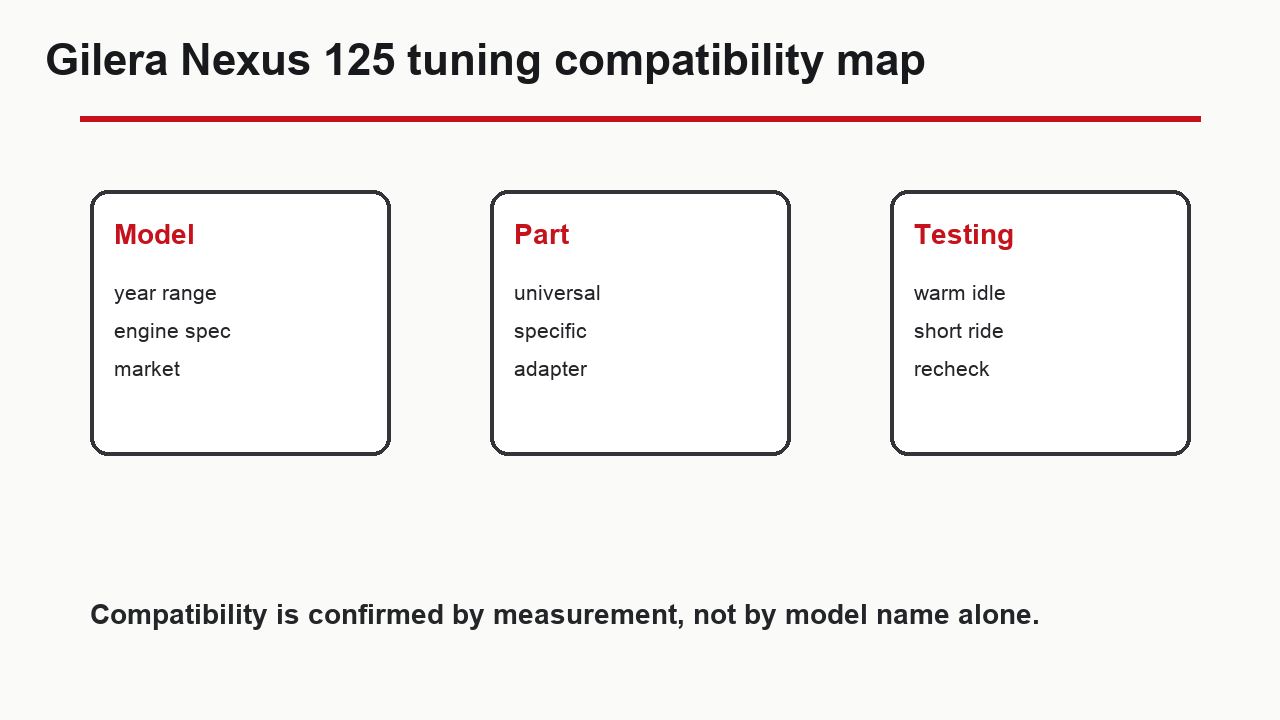
Parts must be matched by more than the model name. The Nexus family includes different engine sizes and market versions, so a listing for a Nexus 300 or Nexus 500 is not automatically relevant to a 125. Even within the same model family, exhaust angle, hanger position, pipe diameter, emissions equipment and electrical connector layout can change the job. Buying from a photo alone is how owners end up with a silencer that almost fits but touches the bodywork or cannot be supported safely.
Start with the scooter itself. Confirm the registration year, engine size, engine code if available, current exhaust type, CVT condition and whether any previous owner has fitted non-standard parts. On used scooters, the original airbox may have been drilled, the rollers may have been changed, the belt may be the wrong size or the exhaust may already be adapted. That history matters because Gilera Nexus 125 tuning depends on the condition of the whole machine.
| Check before ordering | Why it matters | What to do in the workshop |
|---|---|---|
| Exact model and year | Parts may be listed by engine size and production range | Use the registration document and frame plate, not only online photos |
| Exhaust pipe diameter | Universal silencers need the correct reducer or link pipe | Measure the outside diameter at the joint with calipers |
| Mounting points | A poor hanger line can crack brackets or stress studs | Compare the original bracket position before buying |
| CVT belt width | A worn belt changes acceleration and top-speed behaviour | Measure the belt and compare it with the service specification |
| Roller size and weight | The wrong rollers can make the scooter noisy or flat | Inspect the fitted variator rather than guessing from forums |
| Electrical connectors | CDI or module fitment depends on plug layout | Photograph connectors and count pins before ordering |
Compatibility table for common tuning choices
| Upgrade type | Compatibility | Important note |
|---|---|---|
| Drive belt | Model-specific | Correct length and width are essential for safe CVT operation |
| Variator rollers | Usually possible | Size and weight must match the installed variator |
| Performance variator | Depends on engine and CVT cover layout | Check supplied guides, ramp plate and belt travel |
| Sports exhaust | Depends on pipe diameter and hanger alignment | Approval, gasket fit and clearance are as important as sound |
| Universal silencer | Possible with adaptation | May need sleeves, brackets or professional fabrication |
| CDI or fuelling module | Connector-specific | Confirm plug shape and sensor layout before buying |
Anyone planning Gilera Nexus 125 tuning should keep measurements beside them while shopping. The performance parts category is useful for comparison, but the scooter still decides what fits.
CVT, variator, belt and roller setup
Gilera Nexus 125 tuning often starts inside the CVT because the automatic transmission determines how the engine uses its limited power. A scooter engine may be healthy, but if the variator shifts too early the engine drops below its useful rev range. If the rollers are too light, the engine may rev loudly without road speed increasing. If the belt is worn narrow, the scooter can lose both acceleration consistency and top-end ratio.
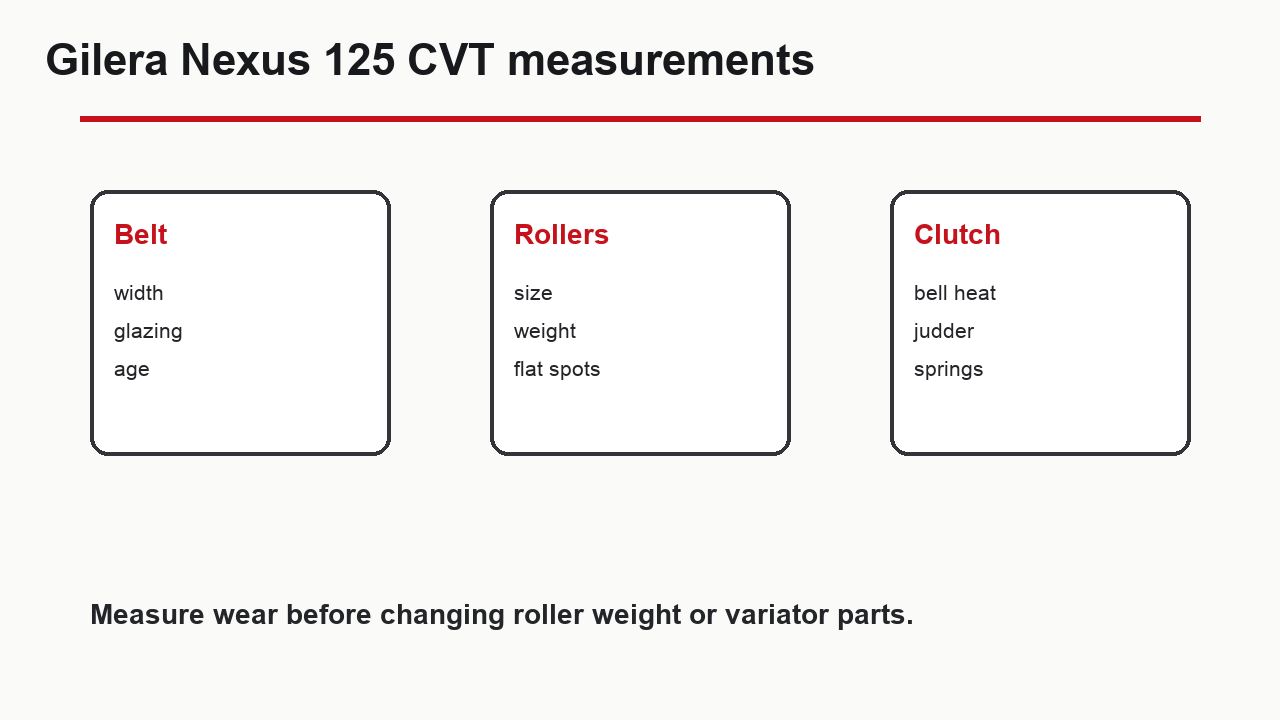
Remove the CVT cover and inspect before changing parts. Look for belt dust, cracking, glazing, flat-spotted rollers, worn slider guides, clutch bell heat marks and signs of oil contamination. Check that the rear pulley opens and closes smoothly. A seized or sticky torque driver can make the setup feel impossible because the transmission will not react correctly even when the new parts are theoretically right.
Choosing roller weight without ruining rideability
Lighter rollers can help the Nexus hold revs during acceleration, which can make the scooter feel more eager from a stop or on hills. Too light, and the engine sounds strained while speed builds slowly. Heavier rollers can reduce cruising revs, but too heavy can create a dull launch. Good Gilera Nexus 125 tuning finds the balance between take-off, hill climbing, heat, noise and fuel use.
Change one part at a time where possible. If you fit a new variator, belt, rollers, clutch springs and exhaust together, you may get a result you like, but you will not know which part caused it. A better workshop method is to record the old setup, replace worn service items, test, then change roller weight or variator specification in a controlled way. That makes Gilera Nexus 125 tuning much easier to judge on the road.
| CVT solution | Main advantage | Possible disadvantage | Best use case |
|---|---|---|---|
| Fresh standard belt and rollers | Restores original smoothness | May not feel sportier | Unknown service history or tired scooter |
| Slightly lighter rollers | Sharper acceleration feel | Can raise cruising revs | City riding, hills and heavier riders |
| Performance variator | Broader tuning range | Needs careful matching | Owners willing to test and maintain |
| Stiffer clutch springs | Later engagement and stronger launch | Can feel harsh in traffic | Sportier use rather than stop-start commuting |
| Unmatched mixed kit | Looks simple online | Can create heat, noise and poor shifting | Best avoided unless specifications are clear |
Exhaust and silencer choices
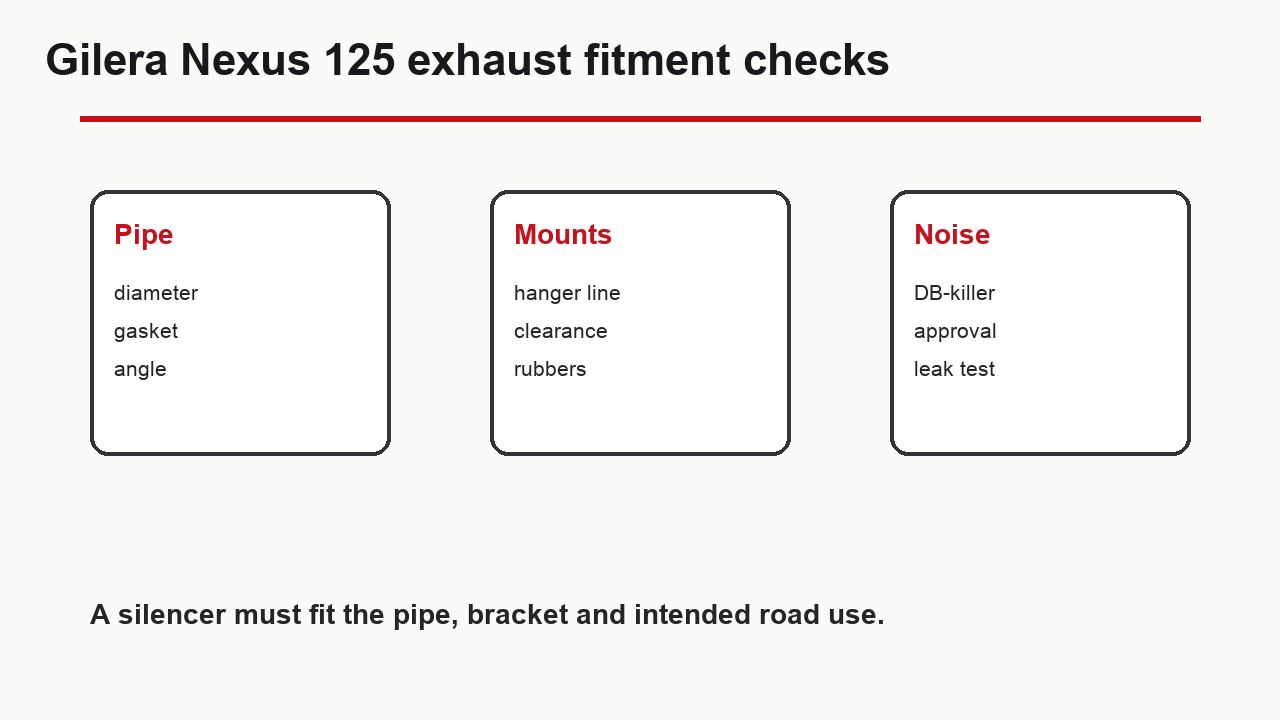
Gilera Nexus 125 tuning often includes an exhaust because it changes the look and sound of the scooter immediately. It can also improve throttle feel when the original exhaust is corroded, blocked or leaking. But a sports silencer is not a universal cure. The pipe diameter, gasket, bracket angle, rear bodywork clearance, centre stand clearance and legal status all matter. A silencer that sits under stress can crack or loosen, and a small exhaust leak can make the scooter pop, run poorly and mark surrounding parts with soot.
Universal silencers can be attractive because they are flexible and affordable, but “universal” does not mean “no measuring required”. A universal exhaust may need a reducer sleeve, a link pipe, a modified hanger or fabrication. Model-specific systems are easier when available, but even then it is sensible to compare the supplied hardware with the original layout. Riders shopping for exhaust options can start with the motorcycle exhausts category, then confirm the measurements before ordering.
Sound, DB-killer and small-engine reality
With Gilera Nexus 125 tuning, a louder exhaust can make the scooter feel more dramatic, but it may not make it meaningfully faster. On a small engine, too little back pressure or a poorly matched silencer can reduce low-speed response. Removing a DB-killer may also create excessive noise, affect fuelling behaviour and cause road-use problems. For a daily 125, controlled sound is usually better than maximum noise.
After fitting an exhaust, run the scooter until warm, then check for leaks at the cylinder head, link pipe and silencer joint. Recheck bolts after the first heat cycles because exhaust parts expand, settle and sometimes loosen. Sensible workshop practice includes this second check; many failures happen because a part was fitted and forgotten.
Fuelling, CDI and electrical checks
Gilera Nexus 125 tuning can include CDI, ECU or fuelling-related parts depending on the specific scooter and market version, but this area deserves caution. Sellers sometimes use terms such as chip tuning, CDI, ECU module or power unit loosely. Before buying anything electrical, inspect the actual connector, count pins, check wire condition and confirm whether the scooter has previous repairs. A module that fits one Nexus variant may not fit another.
Electrical health is especially important on an older scooter. A weak battery, poor earth, corroded connector, damaged plug cap or failing regulator can cause hesitation that looks like a fuelling problem. If the scooter cuts out when hot, starts badly or has an uneven idle, do not assume a tuning module will solve it. Good setup work starts with voltage checks, ignition checks and a clean baseline.
Air filter and intake changes
Open air filters are often suggested for cheap performance, but they can be a poor match for a road scooter. They may draw hot air from inside the bodywork, increase intake noise, reduce wet-weather protection and upset low-throttle fuelling. A clean standard airbox with the correct filter is often better for a commuter. If Gilera Nexus 125 tuning includes intake changes, the owner should be prepared to check fuelling behaviour carefully, not just enjoy the extra noise.
UK road legality and anglophone markets
Gilera Nexus 125 tuning for UK road use must be separated from private-area, track-use or off-road-only work. In the UK, MOT inspection includes exhaust condition and noise. The official MOT motorcycle inspection guidance is clear enough to be worth reading directly: GOV.UK motorcycle MOT exhaust noise guidance. If an exhaust is excessively noisy, leaking, insecure or marked for competition use, it can create problems even if it physically fits.
E-marking, British Standards, emissions equipment, DB-killers, catalytic converters and insurance declaration all matter according to the part and the market. The United States, Canada, Australia, New Zealand and Ireland do not all apply the same rules. Some regions focus on inspection status, others on emissions equipment or noise enforcement. For broader rider safety context, owners can also consult NHTSA motorcycle safety information. Practical planning keeps road legality, insurance and inspection in mind from the start.
| Use case | Suitable part choice | Legal or practical note |
|---|---|---|
| Daily UK road use | Quiet, secure, road-appropriate exhaust and conservative CVT setup | Check MOT, insurance and noise expectations |
| Private land | More freedom to test sound and setup | Still check heat, bracket safety and engine behaviour |
| Track or closed-course use | Track-use-only parts may be suitable | Not automatically legal for public roads |
| Urban commuting | Smooth CVT, reliable starting and civil noise | Comfort and reliability usually matter more than peak speed |
| Custom project | Universal parts may work with fabrication | Professional fitting may be needed for brackets and pipe alignment |
Common mistakes during Nexus 125 tuning
Gilera Nexus 125 tuning usually disappoints when owners skip diagnosis. The first mistake is fitting a loud exhaust to a scooter with a worn belt. The second is changing roller weight without knowing what is already inside the variator. The third is buying a universal exhaust without checking pipe diameter, hanger line and bodywork clearance. The fourth is assuming parts for bigger Nexus models fit the 125.
Other mistakes are more subtle: ignoring brake drag, running old tyres at the wrong pressure, removing the DB-killer for road use, overtightening exhaust studs, routing wiring near heat, fitting an open filter without fuelling checks or expecting a performance module to fix a tired engine. If the work creates more noise but no smoother acceleration, something in the basic setup is probably wrong.
Workshop checks after fitting parts
After any Gilera Nexus 125 tuning work, check warm idle, hot restart, exhaust leaks, belt dust, unusual CVT smell, bracket tightness, brake feel and coolant temperature. Take a short test ride first, not a long full-throttle run. Listen for rattles and watch for changes in throttle response. Let the scooter cool, then recheck fasteners. This simple habit catches many problems before they become expensive.
Practical setup paths
Gilera Nexus 125 tuning should follow the rider’s real use. A commuter wants reliability, clean starting, smooth pull-away and controlled noise. A weekend rider may accept a slightly sportier CVT setup and a more noticeable exhaust note. A custom builder may use universal parts, but must allow time for brackets, reducers and testing. The same part can be sensible for one owner and wrong for another.
Path one: restore first
If the scooter has unknown history, restore the service baseline. Change old fluids, inspect coolant condition, fit the correct spark plug, clean or replace the air filter, measure the belt and inspect the rollers. This is the cheapest route to meaningful improvement on many used scooters. Before spending money on upgrades, make sure the engine is not fighting worn service parts.
Path two: road-friendly performance
For a road-friendly setup, use a healthy standard or mildly uprated CVT, a well-supported exhaust with controlled noise, clean intake filtration and conservative electrical changes only when compatibility is confirmed. This approach suits UK commuting because it keeps the scooter civil. A good road setup should feel smoother every day, not exciting for ten minutes and irritating afterwards.
Path three: custom or private-area setup
For private-area use or a custom project, the owner may choose a louder silencer, more aggressive roller weights or bespoke fabrication. That can be enjoyable, but it demands more testing. Heat, vibration, fuel use and clutch wear become more important. Even away from the road, safe mounting and predictable throttle response should not be ignored.
How to decide what to buy
Gilera Nexus 125 tuning purchases should be driven by symptoms. If the scooter is slow from a stop but cruises acceptably, inspect the clutch and roller weight. If it revs but does not gain speed, inspect belt condition and pulley movement. If it sounds rough, leaks or rattles, inspect the exhaust before buying a new silencer. If it hesitates under throttle, inspect plug, filter, intake leaks and voltage before blaming the ECU.
Once the fault or goal is clear, choose parts that match the scooter and the market. For broad comparison, the X Moto Parts shop can help owners compare upgrade categories, while the Aprilia Leonardo 125 tuning guide offers a useful comparison point for another older Italian 125 scooter with similar CVT and exhaust decision-making.
FAQ
Is Gilera Nexus 125 tuning worth it?
Gilera Nexus 125 tuning is worth it when the scooter is mechanically healthy and the owner wants realistic improvements in response, smoothness or sound. It is not worth throwing random parts at a scooter with a worn belt, dragging brakes or poor ignition condition.
What should I upgrade first on a Gilera Nexus 125?
The first upgrade is usually a proper inspection. Belt width, roller condition, clutch engagement, air filter condition, spark quality and exhaust sealing should be checked before buying performance parts.
Can I fit a universal exhaust to a Gilera Nexus 125?
A universal exhaust may fit, but it can require a reducer, link pipe, bracket work or professional fitting. With Gilera Nexus 125 tuning, pipe diameter and hanger position are as important as the silencer’s appearance.
Will lighter rollers make the Nexus 125 faster?
Lighter rollers can improve acceleration feel, especially on hills, but they do not guarantee higher top speed. If they are too light, the scooter can rev loudly without going faster. The transmission needs balance, not the lightest possible rollers.
Do I need to remap after fitting an exhaust?
A mild road exhaust may not require a remap, but fuelling behaviour should still be checked. If Gilera Nexus 125 tuning includes freer exhaust flow, intake changes or electrical modules, monitor idle, plug colour, hot starting and throttle response.
Is a sports exhaust legal on the road in the UK?
A sports exhaust can be road-appropriate if it is secure, not excessively noisy and suitable for road use. A competition-only or very noisy exhaust can create MOT, police and insurance problems. Gilera Nexus 125 tuning for public roads should be kept legal and documented.
Can tuning fix poor acceleration?
It can, but only if the cause is known. Poor acceleration may be caused by a worn belt, flat rollers, clutch glazing, tyre pressure, brake drag or a leaking exhaust. Gilera Nexus 125 tuning works best after diagnosis.
Should I choose a variator kit or exhaust first?
If the scooter is mechanically sound and the goal is acceleration, start with CVT setup. If the original exhaust is rusty, leaking or the owner wants sound and appearance, focus there. The first purchase should solve the real riding problem.
Final buying advice
Gilera Nexus 125 tuning is at its best when the owner measures first and buys second. Check the belt, rollers, clutch, exhaust diameter, hanger points, air filter, battery voltage and connector layout. Decide whether the scooter needs restoration, a road-friendly performance setup or a custom project. Then choose parts that match the exact model, the intended use and the local road rules.
For most riders, the best setup is not extreme. It is a clean CVT, a correctly fitted exhaust, healthy ignition, good tyres, no brake drag and conservative tuning choices that make the scooter more enjoyable without sacrificing reliability. If a part needs fabrication, wiring changes or legal judgement, involve a competent mechanic before turning a simple upgrade into a problem.
Gilera Nexus 125 tuning should leave the scooter easier to live with: smoother from a stop, steadier at speed, secure in its brackets, reasonable in its noise and predictable in traffic. That is the standard worth aiming for before any claim about extra performance, and it is why Gilera Nexus 125 tuning should always begin with condition checks.
{
“@context”: “https://schema.org”,
“@type”: “Article”,
“headline”: “Nexus 125 scooter tuning guide”,
“description”: “A practical guide to CVT setup, exhaust fitment, fuelling checks, compatibility, road legality and common setup mistakes for a sporty 125 scooter.”,
“image”: “https://xmotoparts.com/wp-content/uploads/2026/07/gilera-nexus-125-tuning.jpg”,
“author”: {“@type”: “Organization”, “name”: “X Moto Parts”},
“publisher”: {“@type”: “Organization”, “name”: “X Moto Parts”},
“mainEntityOfPage”: “https://xmotoparts.com/gilera-nexus-125-tuning/”
}
{
“@context”: “https://schema.org”,
“@type”: “FAQPage”,
“mainEntity”: [
{“@type”: “Question”, “name”: “Is tuning worth it on a Gilera Nexus 125?”, “acceptedAnswer”: {“@type”: “Answer”, “text”: “It is worth it when the scooter is mechanically healthy and the owner wants realistic improvements in response, smoothness or sound.”}},
{“@type”: “Question”, “name”: “Can a universal exhaust fit the Nexus 125?”, “acceptedAnswer”: {“@type”: “Answer”, “text”: “A universal exhaust may fit with adaptation, but pipe diameter, hanger position, clearance and road-use status must be checked first.”}},
{“@type”: “Question”, “name”: “What should be checked before changing roller weight?”, “acceptedAnswer”: {“@type”: “Answer”, “text”: “Belt width, roller condition, clutch wear, pulley movement and the current roller size should be checked before changing the CVT setup.”}}
]
}