
Aprilia Leonardo 125 tuning
Aprilia Leonardo 125 tuning is best approached as a careful scooter setup, not as a promise of miracle power from one bolt-on part. The Leonardo 125 is an older, practical, liquid-cooled commuter scooter, and the biggest difference usually comes from restoring lost performance first: a healthy CVT, correct belt condition, clean fuelling, good ignition, a leak-free exhaust and sensible setup choices. Once those basics are right, tuning can make the scooter feel sharper, smoother and more willing without turning it into something unreliable.
This guide is written for owners who are trying to decide what to buy, what to check before ordering and how to avoid the usual mistakes around exhaust fitment, variator parts, CDI or fuelling modules and road legality. It is also for riders looking at a used Leonardo and wondering whether performance parts will fix a tired engine. In many cases, Aprilia Leonardo 125 tuning starts with measurement, maintenance and diagnosis before money is spent on upgrades.
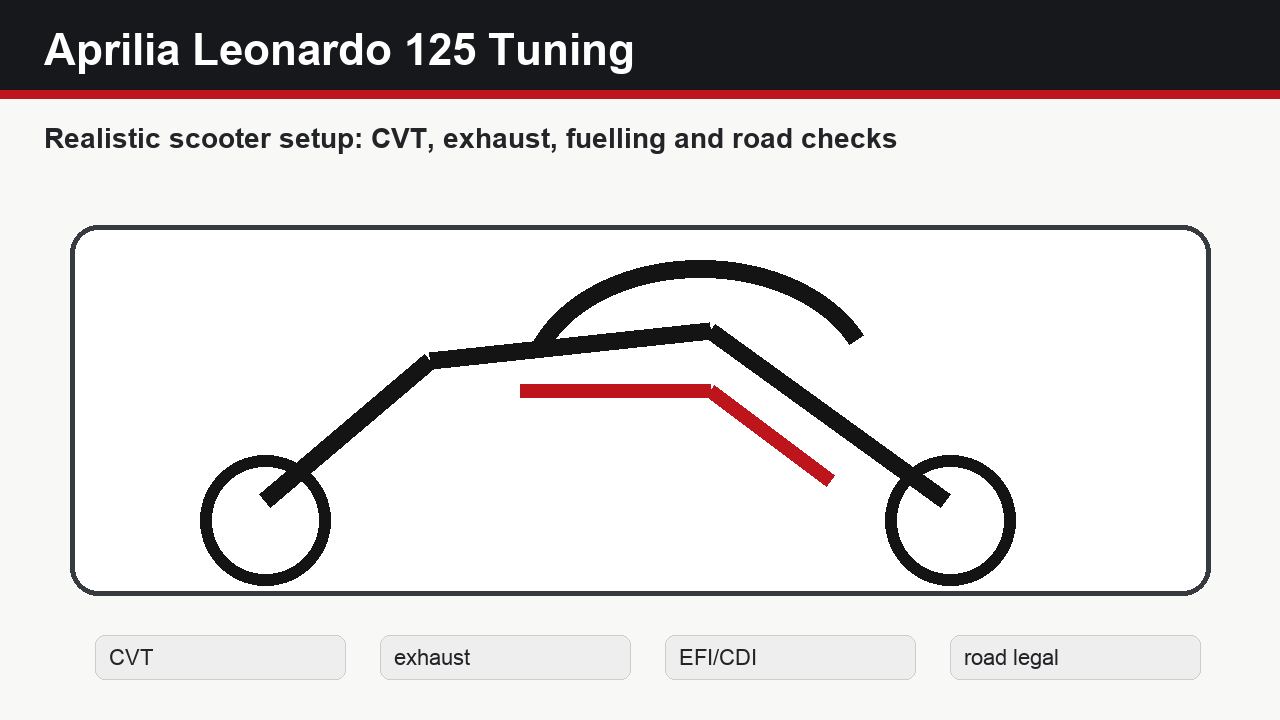
What tuning actually means on the Leonardo 125
Aprilia Leonardo 125 tuning should be understood as a complete setup of a small automatic scooter. A 125cc four-stroke engine has limited headroom, so the most satisfying gains normally come from making the transmission hold the engine in its useful rev range, improving throttle response, reducing exhaust restriction where legal and ensuring every service item is in good order. If the belt is worn narrow, the rollers are flat, the plug is tired or the exhaust joint leaks, a new performance part may only hide the real problem for a short time.
Owners often search for Aprilia Leonardo 125 tuning after noticing slow pull-away, a flat mid-range, poor hill climbing or lower top speed than expected. Those symptoms can be caused by wear as much as by factory restriction. A mechanic would normally check belt width, roller condition, clutch engagement, air filter cleanliness, spark quality, charging voltage, coolant temperature and exhaust sealing before recommending a sports exhaust or tuning module. That order matters because the Leonardo is old enough now that condition varies more than brochure specifications.
The right target is not a fantasy horsepower number. The right target is a scooter that starts cleanly, idles evenly, pulls away without judder, accelerates without an empty pause, holds road speed on moderate climbs and does not run hot or noisy after fitting parts. Good Aprilia Leonardo 125 tuning feels tidy and repeatable. Bad tuning feels loud, inconsistent and expensive.
If you are comparing parts, it helps to read related scooter setup guides before choosing. The principles are similar to modern maxi-scooter work such as the Piaggio X10 125 tuning guide and lighter urban scooter guides such as the Daelim S3 125 tuning guide, even though the exact fitment and engine layout are different.
Compatibility checks before ordering parts
Parts for this scooter are not all interchangeable across every Leonardo version, market or production year. The name on the fairing is only the first clue. Before ordering, confirm the engine type, year range, exhaust pipe diameter, mounting points, sensor layout and whether the scooter has already been modified. A used scooter may have a replacement exhaust, a non-standard variator, missing airbox pieces or wiring repairs that change the installation work completely.
| Area to check | Why it matters | Practical note |
|---|---|---|
| Model year and market | Parts listings may separate early and later Leonardo versions | Use the registration document and frame plate rather than a guess from photos |
| Engine condition | A tired engine will not respond well to upgrades | Check compression, oil use, coolant behaviour and warm idle quality |
| CVT belt and rollers | Transmission wear can feel like lack of power | Measure belt width and inspect rollers before changing weights |
| Exhaust diameter | A universal silencer may need an adapter or fabrication | Measure the pipe at the joint and confirm hanger alignment |
| Electrical connectors | CDI or module fitment depends on plug type and wiring layout | Inspect the connector before buying any plug-in unit |
| Road use | Noise and emissions rules vary by country | Check whether the part is road-approved, track-only or off-road-only |
The safest buying process is simple: identify the scooter, photograph the original part, measure the relevant dimension and only then compare product listings. Anyone considering Aprilia Leonardo 125 tuning should treat “fits Leonardo” as a starting claim, not final proof. For general upgrade browsing, the performance parts category is useful only after these measurements are known, especially when Aprilia Leonardo 125 tuning involves parts sold for more than one engine size.
Compatibility table for typical Leonardo 125 upgrades
| Upgrade type | Compatibility | Important note |
|---|---|---|
| Variator rollers | Usually possible | Weight and size must match the installed variator, not just the scooter name |
| Drive belt | Model-specific | Correct length and width are essential for ratio and reliability |
| Sports exhaust | Depends on pipe and hanger layout | Check diameter, bracket position, gasket type and road approval |
| Universal silencer | Possible with adaptation | May need reducer sleeves, welding or a custom hanger |
| CDI or fuelling module | Connector-specific | Do not assume plug-and-play without checking wiring and sensor layout |
| Air filter changes | Possible but easy to overdo | Open filters can worsen fuelling and weather protection on a commuter scooter |
CVT, variator and belt setup
Aprilia Leonardo 125 tuning often begins inside the CVT cover because the automatic transmission controls how the engine uses its modest power. If the scooter revs too low during acceleration, it feels lazy. If it revs too high without road speed rising, it feels noisy and inefficient. The aim is to keep the engine in a useful band while the belt moves cleanly across the variator faces.
Start by checking the belt. A belt worn below service width sits differently in the pulleys and can reduce top speed or make the scooter sluggish off the line. Then inspect rollers for flat spots. Flat rollers do not move smoothly, so the transmission can hang between ratios. Clutch shoes, bell glazing and weak springs can also create judder or delayed engagement. Many riders blame the engine, when the problem is actually transmission wear.
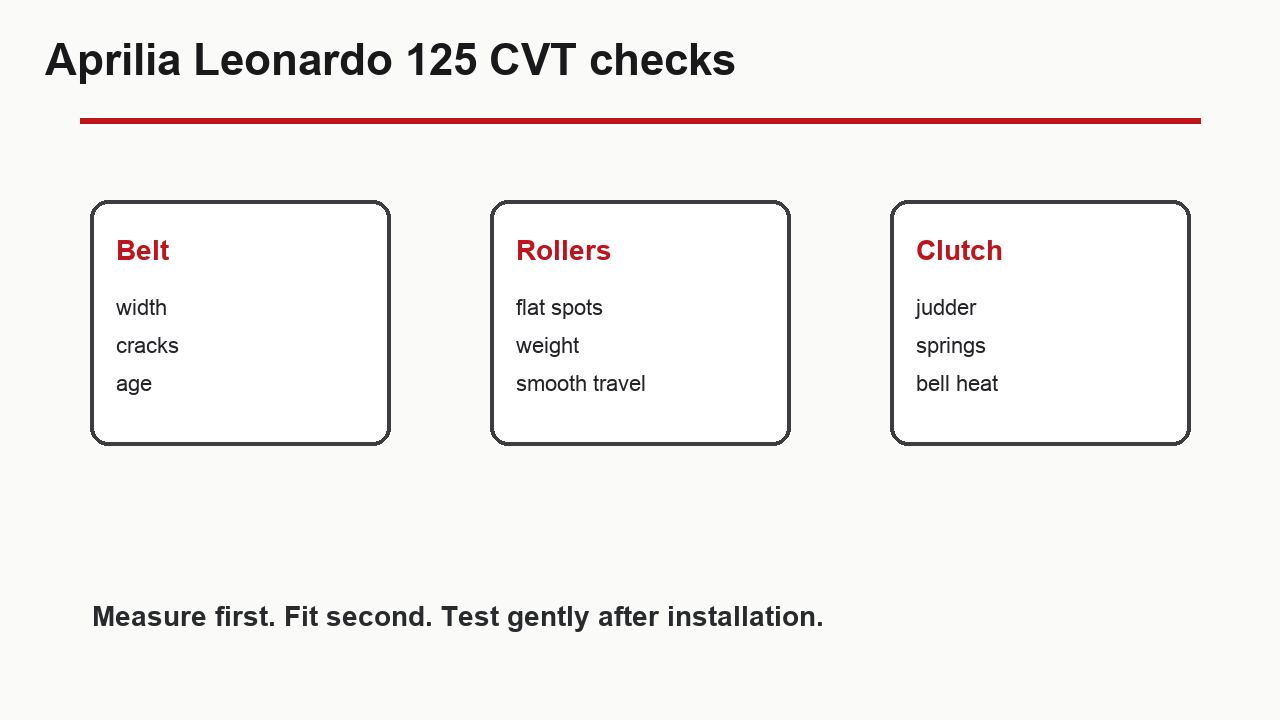
Roller weight choice
For Aprilia Leonardo 125 tuning, lighter rollers can improve pick-up by allowing the engine to rev higher before the transmission shifts. Too light, however, and the scooter sounds busy without gaining speed. Heavier rollers may calm cruising revs, but too heavy can make acceleration flat. The correct answer depends on rider weight, hills, exhaust setup, belt condition and whether the scooter is used in city traffic or open roads.
A practical workshop method is to record the current setup first: belt width, roller weight, roller size, variator condition and maximum indicated speed on the same route. Change one thing at a time. If the owner fits a sports exhaust, a fresh belt and different rollers on the same afternoon, it becomes hard to know which part improved the scooter and which one introduced a new problem.
| CVT choice | Main advantage | Possible disadvantage | Best use case |
|---|---|---|---|
| Fresh standard belt and rollers | Restores original smoothness | May not feel sportier | Unknown service history or tired scooter |
| Slightly lighter rollers | Sharper take-off and hill response | Can increase cruising revs | Urban riding and heavier riders |
| Performance variator | Broader ratio control when well matched | Needs careful setup | Owners willing to test and maintain |
| Stiffer clutch springs | Later clutch engagement | Can make low-speed riding less smooth | Sportier starts, not heavy stop-start commuting |
| Random mixed kit | Looks cheap online | Often creates poor matching | Best avoided unless specifications are clear |
Exhaust, silencer and sound choices
Aprilia Leonardo 125 tuning often includes an exhaust because it changes sound, appearance and sometimes throttle response. On a small four-stroke scooter, an exhaust alone rarely transforms performance. The best result comes when the silencer, header, gasket, mounting bracket and fuelling are all compatible. A leaking joint can cause popping, weak response and heat marks. A badly supported silencer can crack brackets or stress the cylinder head studs.
Before buying a motorcycle exhaust or scooter silencer, measure the pipe diameter and compare the hanger position. Universal exhausts can work well on custom projects, but they are not automatically plug-and-play. Model-specific systems are easier when available, while universal parts need more care. Riders looking for compatible options can start from the motorcycle exhausts category, but measurement still comes first.
DB-killer, catalyst and noise
A removable DB-killer can make a scooter sound more aggressive, but road use is a different question from private-area or track use. If a silencer was designed with a baffle, removing it can increase noise, alter back pressure and attract attention during inspection. Some systems may also affect catalyst presence or emissions equipment. For a road-going Leonardo, the mature choice is to keep the scooter civil enough for daily riding unless it is genuinely used away from public roads.
The UK MOT inspection manual includes checks for exhaust noise and condition, and the official motorcycle MOT guidance is a better reference than internet hearsay: GOV.UK motorcycle MOT exhaust noise guidance. For broader rider safety context, the United States NHTSA motorcycle safety material is useful for owners comparing road behaviour and risk: NHTSA motorcycle safety information.
| Exhaust solution | Main advantage | Possible disadvantage | What to check |
|---|---|---|---|
| Original exhaust | Usually quiet and compliant | May be corroded or restrictive with age | Rust, leaks, internal rattles and mounting rubbers |
| Road-approved sports exhaust | Better appearance and controlled sound | May cost more | Approval markings, supplied hardware and gasket fit |
| Universal silencer | Flexible and affordable | May need adaptation | Diameter, sleeve, bracket line and rear wheel clearance |
| Track-use-only exhaust | More sound and freer flow | Not suitable for normal road use | Legal status, insurance implications and noise limits |
| Used exhaust | Lower purchase cost | Unknown history | Hidden cracks, missing baffle and damaged threads |
CDI, fuelling modules and electrical reality
Aprilia Leonardo 125 tuning can involve CDI or fuelling changes, but this area needs more caution than a simple cosmetic part. Some listings use broad words such as chip, ECU, CDI or power unit, while the scooter may have a connector layout that differs by year or market. A plug that looks similar in a photo can still have different pin positions. Before any electrical part is ordered, photograph the original connector, count pins, inspect wire colours and check whether the scooter has previous repairs.
A small tuning module can only work correctly if the engine is mechanically healthy. If the intake manifold is cracked, the automatic choke is faulty, the battery voltage is weak or the charging system is unstable, fuelling changes may make the symptoms worse. Clean electrical basics matter: battery resting voltage, charging voltage, earth points, plug cap resistance, ignition lead condition and dry connector routing.
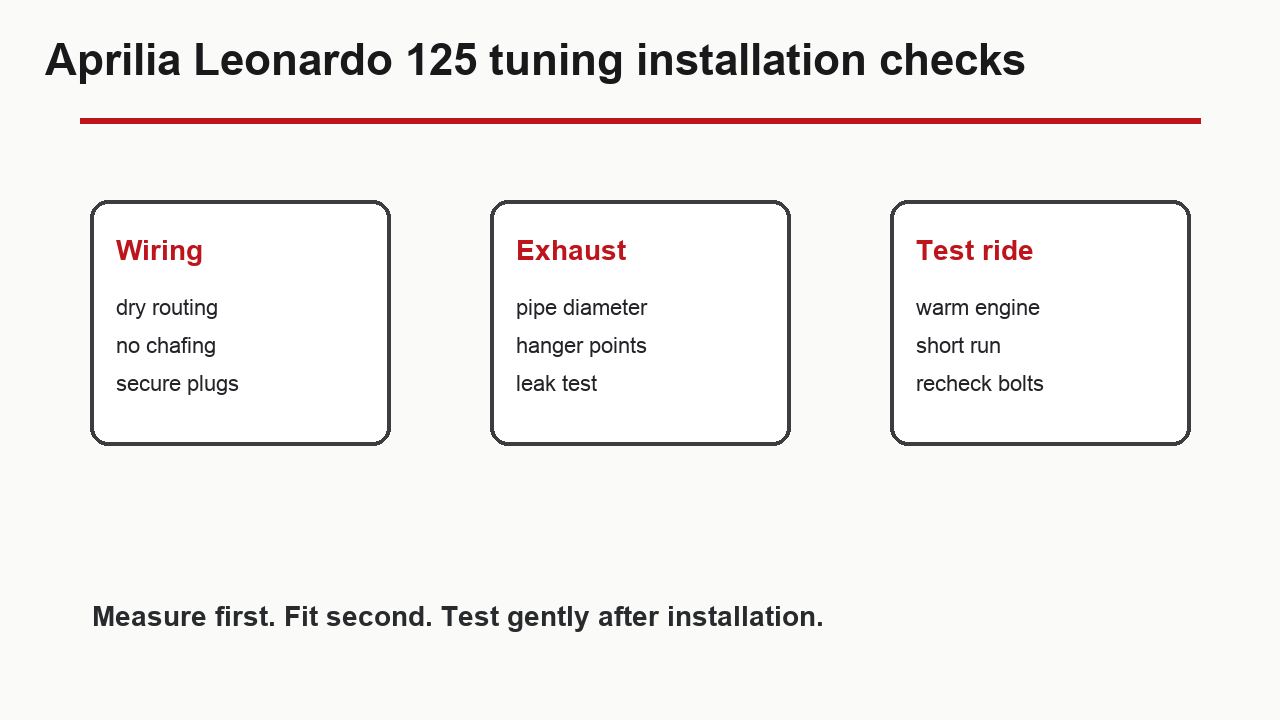
What a mechanic checks before fitting a module
Before fitting any module during Aprilia Leonardo 125 tuning, check warm idle, throttle return, air filter condition, plug colour, cooling fan operation and whether the scooter restarts easily when hot. A module should not be used to cover a fault. If the scooter hesitates because of old fuel, dirty carburation or an intake leak, tuning will not be a clean fix. On an older Leonardo, a careful service can feel like a performance upgrade because it brings back response that slowly disappeared over years.
UK and anglophone road legality
Aprilia Leonardo 125 tuning has to be separated into road use, private land use, track use and off-road use. In the UK, an exhaust that is excessively noisy or clearly marked for competition use can create MOT, police and insurance problems. A part may fit physically and still be unsuitable for road use. In the European context, E-marking can matter for certain components, but it is not a magic answer for every installation because the whole vehicle condition, noise level and emissions equipment still matter.
In the United States, Canada, Australia, New Zealand and Ireland, rules vary by state, province or national road authority. Some areas focus heavily on noise. Others focus on emissions equipment, inspection status or whether a vehicle remains as approved for road use. The practical advice is to confirm local rules before buying parts that change exhaust noise, emissions equipment, lighting, speed restriction or engine management. Sensible scooter modification keeps documentation, receipts and installation notes because those details can help with insurance and inspection questions later.
Insurance is often forgotten. If a modification changes sound, power delivery, engine management or fitted equipment, declare it where required. A small scooter part may look minor to the owner, but insurers can treat undeclared modifications seriously after an accident. This does not mean every owner should avoid upgrades. It means upgrades should be chosen with the same care as tyres and brakes.
Common mistakes that make Leonardo tuning disappointing
Aprilia Leonardo 125 tuning goes wrong when the owner buys parts before understanding the scooter. The most common mistake is fitting a loud exhaust to a worn CVT and then expecting better acceleration. The second is choosing roller weights from a forum without checking the existing variator. The third is buying a universal silencer without measuring pipe diameter, bracket alignment or rear bodywork clearance.
Other mistakes are less obvious. Some owners remove the DB-killer, then wonder why the scooter feels rough at low throttle. Some fit an open air filter and expose the intake to rain, dirt and hot air from inside the bodywork. Some ignore a weak battery and then blame a CDI. Some tighten exhaust studs too hard and damage threads in the cylinder head. Some assume that a part for Leonardo 150 or 250 will fit a Leonardo 125 because the body looks similar.
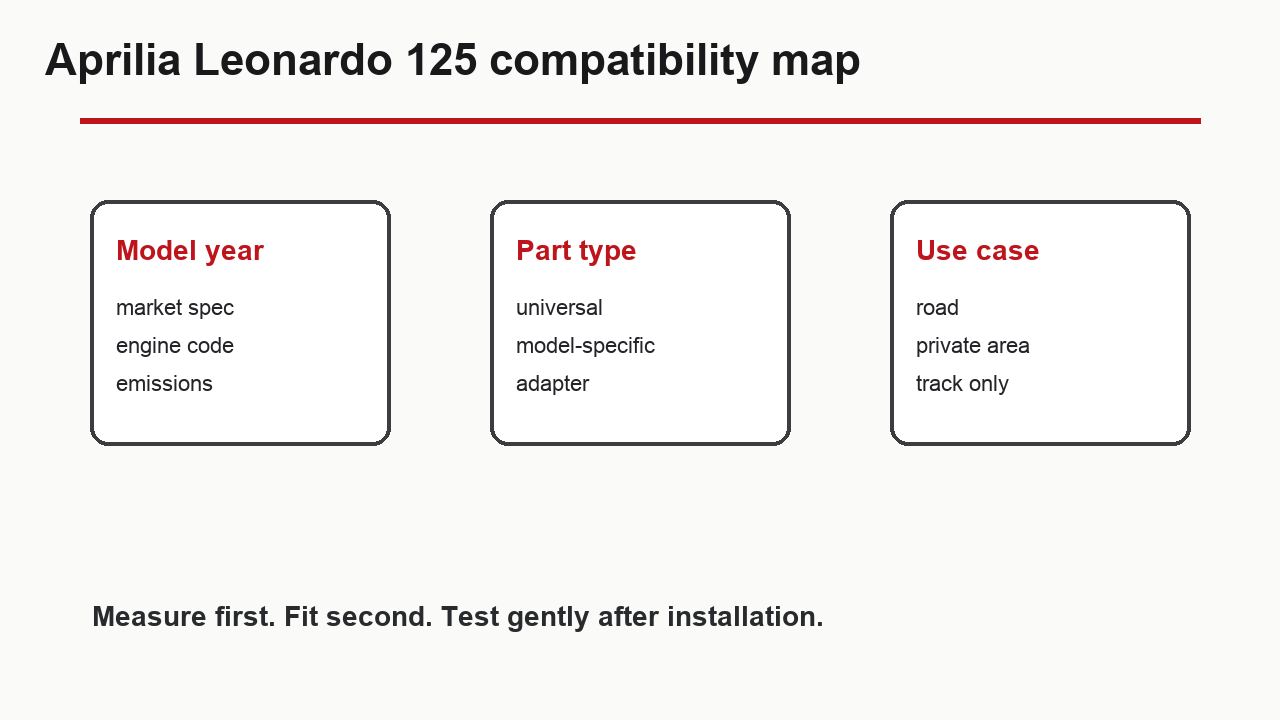
Symptoms after a poor setup
After a poor setup, the scooter may bog from a stop, rev without acceleration, pop on overrun, run hotter than before, vibrate through the exhaust bracket or use more fuel. These symptoms do not always mean the part is bad. They often mean the part is mismatched, badly installed or fitted to a scooter that needed maintenance first. A short test ride is not enough. Recheck bolts, belt dust, exhaust leaks and plug condition after the first heat cycles.
Workshop-style setup process
Aprilia Leonardo 125 tuning should follow a disciplined order. First, service the scooter: oil, coolant condition, air filter, spark plug, tyre pressures and brake drag. Second, inspect the CVT: belt, rollers, guides, clutch shoes and variator faces. Third, decide whether the owner wants better commuting smoothness, stronger pull-away, more sound or a visual refresh. Fourth, choose parts that match that goal. Fifth, install one area at a time and test after each change.
This is where experience matters. A scooter that spends its life in city traffic may benefit from a slightly more responsive CVT setup but become annoying if it revs too high on every journey. A scooter used on A-roads may need a healthier belt and standard-like gearing more than aggressive roller changes. A rider carrying luggage or a passenger should avoid chasing a sharp launch at the cost of heat and clutch wear. Good Aprilia Leonardo 125 tuning respects the way the scooter is actually used.
Useful measurements before buying
- Drive belt width, length code and visible cracking.
- Roller size and weight from the fitted variator.
- Exhaust pipe outside diameter at the joint.
- Distance between exhaust hanger points and body clearance.
- Battery voltage before start and charging voltage at idle and raised rpm.
- Connector shape and pin count before buying any electrical module.
- Tyre size, tyre age and whether the brakes drag when the wheel is lifted.
If those checks sound too involved, that is the point at which a mechanic becomes good value. This job is not difficult for a competent workshop, but it becomes frustrating when guesswork replaces measurement.
Buying advice for owners
Aprilia Leonardo 125 tuning parts should be chosen according to the problem you are solving. If the scooter is slow away from traffic lights, inspect CVT wear first. If it sounds tired or leaks from the exhaust, focus on gasket, corrosion and bracket condition. If the rider wants a sportier look and sound, choose an exhaust with clear fitment information and road-use status. If throttle response is weak, do not ignore air leaks, old fuel, spark condition and battery voltage.
There is also a difference between a universal solution and a model-specific solution. Universal parts can be perfectly usable, especially for owners comfortable with adaptation. Model-specific parts reduce fabrication work when the listing is accurate. A cheap universal part can become expensive if it needs sleeves, hangers, cutting, welding or repeated garage time. A more expensive part can be better value if it fits cleanly and arrives with the right hardware.
For riders still comparing categories, use X Moto Parts as a starting point rather than guessing from generic photos. Compare exhaust options in the motorcycle exhaust section, then compare broader upgrade ideas in the X Moto Parts shop. Always match the product to the exact scooter before ordering.
FAQ
Is Aprilia Leonardo 125 tuning worth doing?
Aprilia Leonardo 125 tuning is worth doing when the scooter is healthy and the goal is realistic. It can improve response, smoothness, sound and usability, but it will not turn a 125cc commuter scooter into a high-performance motorcycle. Start with service condition and CVT health.
What is the best first upgrade for an Aprilia Leonardo 125?
The best first upgrade is often not a new part but a proper inspection. A fresh belt, correct rollers, clean air filter, good spark plug and leak-free exhaust may improve the scooter more than a random performance part.
Can I fit a universal exhaust to an Aprilia Leonardo 125?
A universal exhaust may be possible, but it is not automatically plug-and-play. Measure pipe diameter, hanger position, bodywork clearance and gasket style. For Aprilia Leonardo 125 tuning, poor exhaust support can cause cracks, leaks and vibration.
Do I need to remap after changing the exhaust?
On many small scooters, a mild road exhaust may not require a full remap, but fuelling behaviour still needs to be checked. If Aprilia Leonardo 125 tuning includes a very free-flowing exhaust, intake changes or electrical modules, monitor plug colour, starting, idle and throttle response carefully.
Will lighter rollers increase top speed?
Lighter rollers usually improve acceleration feel rather than guaranteed top speed. If they are too light, the scooter may rev more but travel no faster. In Aprilia Leonardo 125 tuning, roller choice must match belt condition, rider weight, route and variator design.
Is a louder exhaust legal in the UK?
A louder exhaust is not automatically legal. The UK MOT includes exhaust noise and condition checks, and an excessively noisy or competition-marked exhaust can cause problems. Any Aprilia Leonardo 125 tuning for road use should respect MOT, insurance and local enforcement expectations.
Can tuning fix a slow Leonardo 125?
Sometimes, but only after diagnosis. A slow Leonardo may have a worn belt, flat rollers, dragging brakes, low compression, old fuel, blocked filter or exhaust leak. Aprilia Leonardo 125 tuning works best after these faults are corrected.
Should I choose a chip, exhaust or CVT kit first?
Choose according to symptoms. For weak launch, inspect CVT first. For corrosion or sound, inspect the exhaust. For throttle response, check electrical and fuelling basics. Aprilia Leonardo 125 tuning is most reliable when each part solves a confirmed issue.
Practical conclusion
Aprilia Leonardo 125 tuning should finish with a clear choice, not a basket full of uncertain parts. If the scooter is tired, restore the CVT, ignition, intake and exhaust sealing first. If it is healthy and you want stronger city response, consider a measured CVT setup. If you want better sound, check pipe diameter, hanger points, DB-killer status and road approval before buying an exhaust. If you want an electrical module, confirm the connector and make sure the scooter has no underlying fault.
The best Leonardo setups are modest, measured and reliable. They start easily on a cold morning, pull cleanly through traffic, hold speed without screaming and pass inspection without drama. For a daily scooter, that is far more valuable than a noisy part fitted without thought. When you are ready to compare practical parts, begin with the relevant X Moto Parts categories and keep the measurements beside you while ordering.
Aprilia Leonardo 125 tuning works when the owner treats the scooter as a complete machine: engine, CVT, exhaust, electrics, tyres, brakes and legal use all have to agree. That is the difference between a scooter that only sounds modified and one that genuinely rides better.
{
“@context”: “https://schema.org”,
“@type”: “Article”,
“headline”: “Leonardo 125 scooter tuning guide”,
“description”: “A practical guide for CVT setup, exhaust fitment, fuelling checks, compatibility, UK road legality and common installation mistakes.”,
“image”: “https://xmotoparts.com/wp-content/uploads/2026/07/aprilia-leonardo-125-tuning.jpg”,
“author”: {“@type”: “Organization”, “name”: “X Moto Parts”},
“publisher”: {“@type”: “Organization”, “name”: “X Moto Parts”},
“mainEntityOfPage”: “https://xmotoparts.com/aprilia-leonardo-125-tuning/”
}
{
“@context”: “https://schema.org”,
“@type”: “FAQPage”,
“mainEntity”: [
{“@type”: “Question”, “name”: “Is tuning worth doing on this scooter?”, “acceptedAnswer”: {“@type”: “Answer”, “text”: “It is worth doing when the scooter is mechanically healthy and the owner wants realistic improvements in response, smoothness, sound or usability.”}},
{“@type”: “Question”, “name”: “Can I fit a universal exhaust to an Aprilia Leonardo 125?”, “acceptedAnswer”: {“@type”: “Answer”, “text”: “A universal exhaust may fit with adaptation, but pipe diameter, hanger alignment, clearance and road-use approval must be checked before ordering.”}},
{“@type”: “Question”, “name”: “Do I need to remap after changing the exhaust?”, “acceptedAnswer”: {“@type”: “Answer”, “text”: “A mild road exhaust may not require a full remap, but fuelling, starting, idle quality and throttle response should always be checked after installation.”}}
]
}