
Honda ADV 350 tuning chip: realistic gains, fitment checks and installation advice
Honda ADV 350 tuning chip research usually starts with a simple hope: make the ADV350 feel a little sharper without ruining the smooth, reliable character that makes it such a good all-round scooter. That is a sensible goal, but it has to be approached carefully. The ADV350 is not an old carburetted scooter where one screw changes the whole personality. It is a modern Honda with PGM-FI fuel injection, CVT transmission, HSTC traction control, emissions equipment, sensors and a factory calibration designed for road use.
This guide explains what a chip or plug-in fuelling module can and cannot do, how to check compatibility, what to inspect before installation, how exhaust and CVT condition affect the result, and what UK riders need to remember about road legality, insurance and warranty expectations. If you are considering a Honda ADV 350 tuning chip, think of it as one part of a measured setup, not a magic box that replaces maintenance or careful fitment.
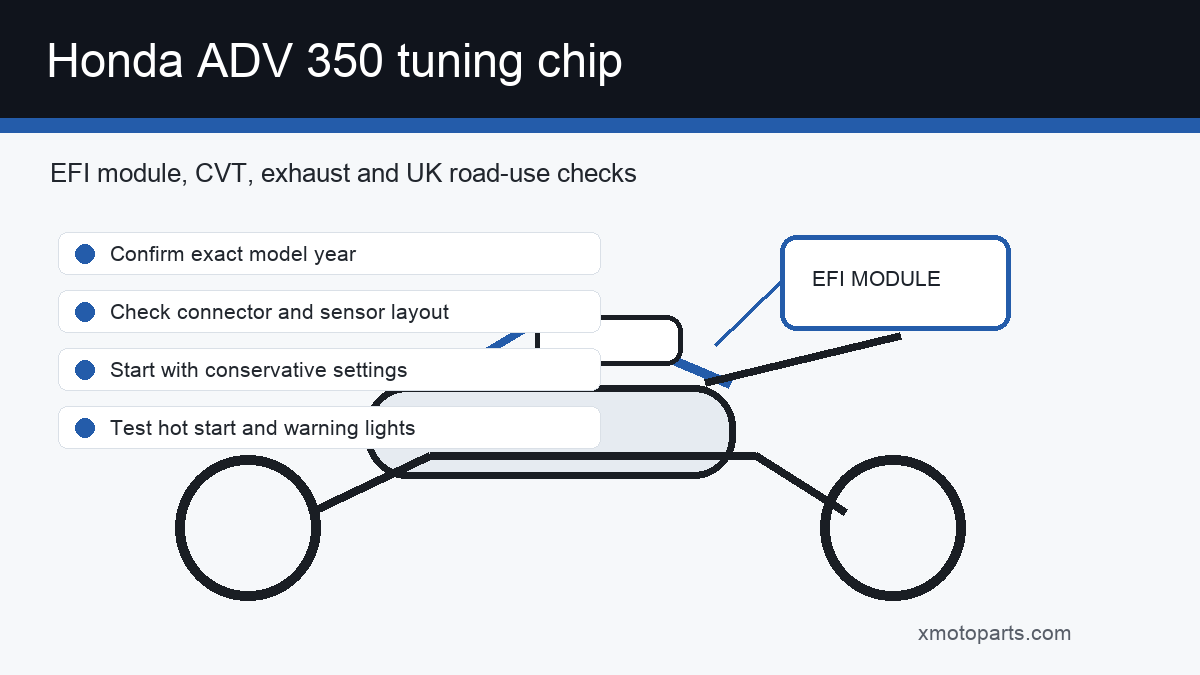
What this ADV350 module can realistically do
A Honda ADV 350 tuning chip is usually sold to alter fuelling behaviour or sensor interpretation so the engine response feels stronger or cleaner in certain throttle areas. On a scooter like the ADV350, the most useful improvement is normally feel: smoother pickup, less flatness after an exhaust change, a slightly stronger roll-on impression or a cleaner response when the engine is loaded.
It is important to keep expectations honest. A chip cannot change the displacement, the CVT ratio range, the condition of the drive belt, the clutch engagement, the tyre grip or the rider’s weight. It cannot fix a blocked air filter, weak battery, dirty connector, exhaust leak or worn variator parts. A Honda ADV 350 tuning chip works best when the scooter is already healthy and the module is compatible with the exact sensor layout.
Most riders searching for this upgrade also wonder whether it affects warranty, MOT, emissions, fuel economy and insurance. Those are not side issues. They are part of the decision. If the scooter is used daily, smooth reliability is more valuable than a small, unverified increase that creates warning lights or poor hot starting.
| Owner goal | What to check first | Can a chip help? | Important limitation |
|---|---|---|---|
| Sharper throttle feel | Air filter, spark plug, fuel quality and sensor connectors | Possibly, if compatible and adjusted conservatively | CVT behaviour may still limit acceleration feel |
| Better response after exhaust change | Exhaust leaks, oxygen sensor position and DB-killer status | Possibly, if the module suits the setup | Illegal or excessive exhaust changes remain a separate issue |
| Higher top speed | Belt condition, wind, road gradient and rider weight | Usually limited | CVT gearing and power output are major constraints |
| Smoother commuting | Service condition, tyres, brakes and battery | Sometimes | Do not use electronics to hide maintenance faults |
| Matched tuning kit setup | Exact model year and all supporting parts | Yes, when the whole package is compatible | Install one change at a time and test properly |
ADV350 engine, fuel injection and CVT basics
A plug-in fuelling module has to work with the scooter Honda actually built. Honda UK lists the ADV350 as a 330 cc liquid-cooled, four-stroke, four-valve SOHC single using PGM-FI fuel injection, CVT transmission and V-belt final drive, with HSTC traction control and official output figures for the UK model range: Honda ADV350 official specifications.
Those details matter because fuelling is only one part of the riding feel. The CVT decides how revs become road speed. The drive belt and variator condition decide how smoothly the scooter holds the engine in its useful range. HSTC can influence power delivery if rear-wheel slip is detected. A Honda ADV 350 tuning chip cannot be judged properly if the belt is worn, rollers are tired, tyres are wrong or the scooter is overdue for service.
Honda’s own overview describes the ADV350 as a crossover scooter with strong urban and light-adventure ability, long-travel suspension, HSTC and practical storage. In other words, this is a balanced machine. Tuning should preserve that balance rather than making the scooter snatchy, noisy or awkward in traffic.
Compatibility checks before ordering
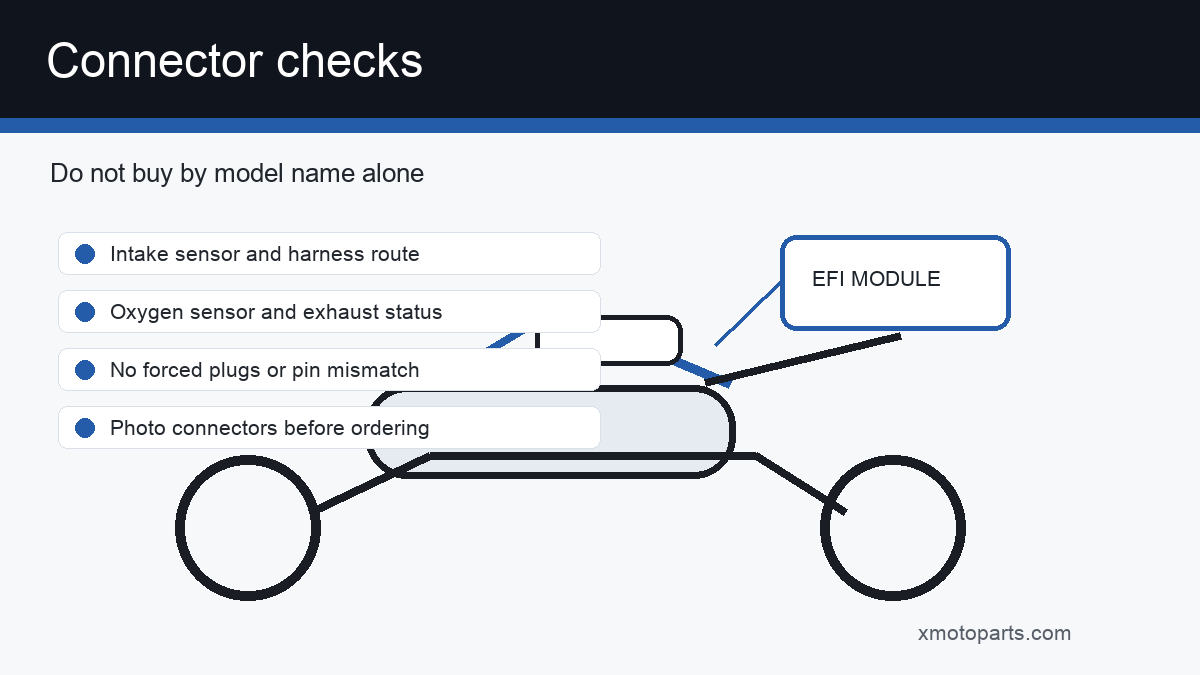
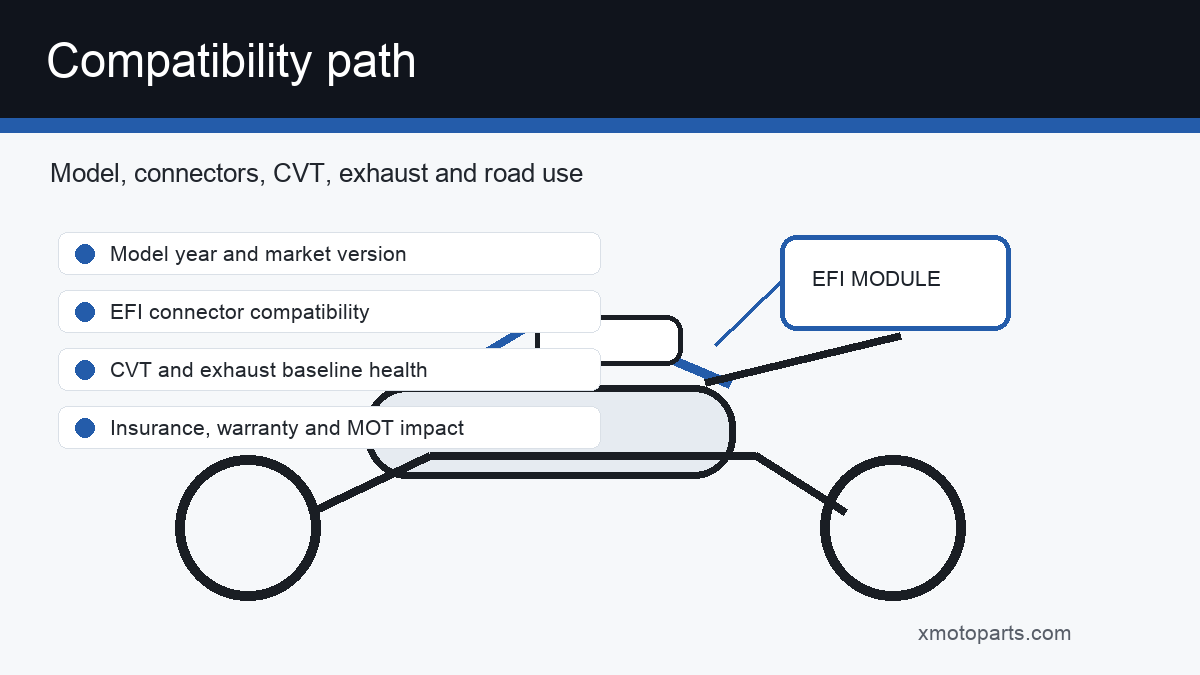
The most important part of choosing this upgrade is compatibility. Do not buy by model name alone. Check the production year, market version, connector style, sensor position and whether the scooter is standard or already modified. A plug that looks similar in a product photo can still be wrong if the pin layout, sensor logic or harness routing differs.
Look at the area around the intake air temperature sensor, oxygen sensor wiring, injector harness and any product-specific connection point. Take clear photos before ordering. If the seller cannot confirm connector compatibility from those photos, do not force the part. Anyone comparing chip options should also read the broader Honda ADV 350 tuning kit guide so the chip is understood as part of a wider setup rather than an isolated purchase.
| Vehicle or setup | Compatibility | Important note |
|---|---|---|
| Honda ADV350 standard scooter | Possible with exact connector checks | Confirm model year, market and sensor layout before ordering |
| ADV350 with aftermarket exhaust | Depends on exhaust and sensor retention | Check leaks, DB-killer, catalyst and oxygen sensor position |
| ADV350 with CVT modifications | Chip may still fit | CVT changes affect acceleration feel separately from fuelling |
| Honda X-ADV or Forza models | Not automatically compatible | Different engines, ECUs and harnesses can change fitment |
| Track or private-area setup | May allow wider changes | Road legality and insurance still matter if used on public roads |
Installation checks from the workshop floor
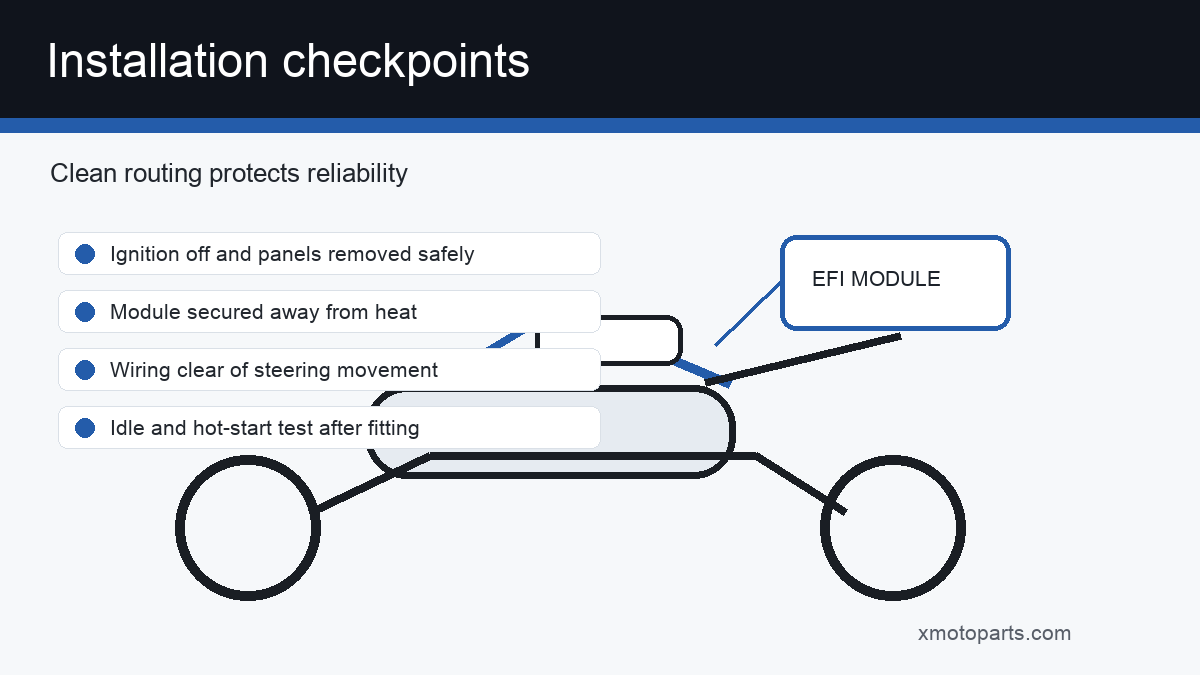
A Honda ADV 350 tuning chip should be installed with the ignition off, the scooter stable and the bodywork removed carefully. On a modern scooter, rushing panel removal can break clips, pinch wiring or leave water paths open. Lay the module, harness and cable ties out before touching the bike. Compare every plug with the original connector before applying pressure.
Route wiring away from heat, moving suspension parts, steering movement, sharp edges and wet collection points. Do not trap wires under panels. Do not let a module hang loose where vibration can damage it. After installation, check that the throttle returns cleanly, no warning lights appear and the scooter starts normally. A Honda ADV 350 tuning chip should not create rough idle, hard starting or a permanent dash warning.
If the product has adjustable settings, start low. Warm the scooter fully before judging. Ride the same route before and after. Test low-speed pickup, midrange roll-on, hot restart and steady cruising. If the scooter smells rich, feels heavy, surges or loses smoothness, reduce the setting or return to baseline.
Exhaust, CVT and fuelling interaction
Many riders consider a Honda ADV 350 tuning chip after fitting an exhaust. That can make sense, but only after the exhaust itself is checked. A leak at a joint, a missing DB-killer, incorrect oxygen sensor position or excessive noise will not be fixed by a module. If the exhaust is the main upgrade, the universal motorcycle exhaust buying guide is useful for understanding diameter, mounting and DB-killer checks before buying parts.
The CVT also changes how performance feels. If the belt is worn or the variator is not shifting smoothly, a module may appear to do very little. If roller weight, clutch condition and belt width are correct, small fuelling improvements can be easier to feel. For riders comparing Honda’s mid-size scooter family, the Honda Forza 350 sport exhaust guide is a useful related read because the same engine-family logic often comes up in exhaust and fuelling discussions.
| Upgrade path | Main advantage | Possible disadvantage | Best order |
|---|---|---|---|
| Service first | Restores the scooter to a fair baseline | Less exciting than buying parts | Always first |
| Chip only | May improve response if compatible | Limited if CVT or exhaust has issues | After confirming standard health |
| Exhaust plus chip | Can help match response after airflow change | Legality and fuelling must be checked together | Exhaust fitment first, tuning second |
| CVT plus chip | Can improve acceleration feel and throttle pickup | Hard to diagnose if both are changed at once | CVT refresh, then module test |
| Full tuning kit | Most coherent when parts are matched | Higher cost and more warranty/insurance questions | Plan as a complete package |
UK road legality, MOT, insurance and warranty
A plug-in fuelling module is not checked in the MOT in the same simple visual way as a tyre or light, but the scooter still has to remain roadworthy, safe and compliant. If tuning work affects emissions equipment, exhaust noise, warning lights or reliability, it can create real problems. GOV.UK’s motorcycle MOT guidance explains that exhaust noise must not be clearly unreasonable compared with a similar motorcycle using a standard silencer, and insecure exhaust parts are defects: GOV.UK motorcycle MOT exhaust noise guidance.
Tell your insurer about a Honda ADV 350 tuning chip. Even a reversible plug-in module can count as a performance modification. If a claim happens and the scooter has undeclared performance parts, the conversation becomes harder. Warranty is also important. A dealer or manufacturer may take a different view of engine, ECU or emissions complaints if aftermarket electronics have been fitted.
Rules vary between the UK, United States, Canada, Australia, New Zealand and Ireland. A product sold for off-road or private-area use in one market should not be assumed road-legal in another. If the ADV350 is used on public roads, keep the setup conservative, reversible and documented.
How to road-test the result without fooling yourself
The fairest test is the one most riders skip. Before fitting anything, ride the scooter on the same route you will use afterwards. Choose a route with a cold start, a slow town section, a steady 40-50 mph cruise, a hill or loaded acceleration point and a short motorway-style roll-on if local roads allow it. Do not rely on one dramatic full-throttle run. The ADV350 is a practical scooter, so the best improvements are often found in pickup, smoothness and confidence when joining faster traffic.
Make one change at a time. If you fit an exhaust, variator weights, new belt and module on the same weekend, you will not know which part changed the feel. A workshop-style approach is slower, but it saves money. Fit the part, warm the engine, check for warning lights, listen for leaks, ride gently, then evaluate. If the response is worse when hot than cold, or if the scooter surges at small throttle openings, the setting may be too aggressive or the underlying setup may need attention.
What to check after the first ride
After the first ride, remove only the panels needed to inspect the work. Check that no cable tie has moved, no harness is rubbing on a bracket, no connector has collected moisture and the module is not sitting against a hot surface. Look again after the scooter cools down, because plastic panels and wiring can settle differently once heat has passed through the engine bay. A clean installation should look boring: no stretched cables, no crushed insulation, no improvised joints and no component left loose under the bodywork.
Also pay attention to the rider’s own expectations. A healthy ADV350 should still start easily, idle cleanly, pull away smoothly and feel predictable in traffic. If the scooter becomes difficult to ride slowly, louder than intended or less refined at cruising speed, the setup is moving away from what makes the model useful. Performance work should improve the machine for the way it is actually used, not turn every commute into a troubleshooting session.
Common mistakes
The most common mistake with a Honda ADV 350 tuning chip is buying before checking connectors. The second is expecting the module to fix unrelated problems. A worn belt, poor exhaust seal, old air filter, weak battery or binding brake can all make the scooter feel flat. Electronics should not be used as a plaster over basic faults.
Other mistakes include installing with the ignition on, forcing plugs, routing wires near heat, changing settings too aggressively, fitting exhaust and chip on the same day without baseline testing, ignoring HSTC behaviour, failing to tell the insurer, expecting large top-speed gains and not keeping the original parts. Good Honda ADV 350 tuning chip installation is calm, reversible and measured.
How to choose the right chip or tuning kit
Choose a Honda ADV 350 tuning chip only when the seller can confirm compatibility with your exact scooter. Look for clear instructions, connector photos, conservative adjustment range and sensible claims. Avoid any product promising impossible speed gains or claiming to bypass every factory system without trade-offs.
If you want the most relevant next step, compare the dedicated Honda ADV350 chip tuning module with the broader tuning kit guide and inspect your scooter before ordering. A rider who checks the model year, connector layout, exhaust condition and CVT health first is much more likely to be satisfied.
FAQ about ADV350 chip modules
Is a Honda ADV 350 tuning chip worth it?
A Honda ADV 350 tuning chip can be worth it if the goal is smoother response or a better match after compatible intake or exhaust changes. It is not worth it if the rider expects a dramatic transformation or wants to hide maintenance problems.
Will a tuning chip increase top speed?
Top speed gains are usually limited because the ADV350 still depends on engine output, CVT ratio, belt condition, wind, rider weight and road gradient. A module may improve feel more than actual maximum speed.
Can I install the chip myself?
Some owners can install a module if they are comfortable removing panels and identifying connectors. If the wiring route, connector type or instructions are unclear, use a qualified mechanic.
Does a Honda ADV 350 tuning chip affect warranty?
A Honda ADV 350 tuning chip may affect warranty discussions if a related engine, ECU, fuelling or emissions issue appears. Keep the installation reversible and ask the dealer before fitting if the scooter is still under warranty.
Do I need an exhaust before fitting a chip?
No. A chip can be considered on a standard scooter if compatible, but many riders look at fuelling modules after exhaust changes. The exhaust should be leak-free, road-suitable and correctly fitted before tuning is judged.
Will the chip cause warning lights?
It should not if compatible and installed correctly, but wrong connectors, sensor errors, poor wiring or unsuitable settings can trigger warning lights. Stop and diagnose rather than continuing to ride hard.
Is a tuning chip legal in the UK?
Legality depends on how the part affects emissions, roadworthiness, insurance and any connected exhaust or performance changes. A road scooter should remain safe, insured, not excessively noisy and compliant with relevant equipment requirements.
What should I check after installation?
After fitting a Honda ADV 350 tuning chip, check idle, hot starting, throttle response, warning lights, wiring security, module placement, exhaust leaks and CVT behaviour. Recheck after the first ride and again after the scooter cools.
Final verdict
A Honda ADV 350 tuning chip is worth considering only as part of a sensible, measured setup. Start with service condition, belt health, clean air intake, correct exhaust fitment and confirmed connector compatibility. Then install conservatively, test on the same route and keep the original configuration available.
The best Honda ADV 350 tuning chip result is not a scooter that becomes difficult or noisy. It is an ADV350 that keeps Honda’s smooth reliability while feeling a little more responsive and better matched to the rider’s exhaust, CVT and road-use needs.