Fantic Caballero 500 tuning: practical exhaust, ECU, gearing and fitment guide
Fantic Caballero 500 tuning should start with respect for what the Caballero already is: a light, stylish single-cylinder scrambler with real road presence, enough torque to be entertaining and enough off-road attitude to tempt owners into upgrades. The smartest changes do not try to erase that character. They make the throttle cleaner, the exhaust better matched, the gearing more useful, the suspension more controlled and the bike easier to live with on the roads and lanes where it is actually ridden.
This guide is written for riders considering exhausts, ECU work, air filters, sprockets, tyres, intake changes, power kits, slip-on silencers or off-road accessories. It is not a promise of impossible horsepower. If you are planning Fantic Caballero 500 tuning, the useful question is not “what is the loudest part I can fit?” but “what change solves the problem I feel on the bike?”
Realistic goals for the Caballero 500
Fantic Caballero 500 tuning works best when the goal is precise: more exhaust character, cleaner low-rpm throttle, more useful gearing for lanes, a stronger midrange feel, better heat management, improved tyre grip or a tidier setup after fitting accessories. A Caballero 500 already has enough personality. The risk is making it louder and less refined without making it genuinely better.
Most owners who search for tuning want one of four outcomes. They want a better sound from the dual exhaust style, a little more torque from the single-cylinder engine, smoother response after fitting intake or exhaust parts, or a more confident setup for light off-road use. Those are sensible aims. What is not sensible is changing exhaust, intake, ECU settings, sprockets and tyres all at once, then trying to guess which part caused a problem.
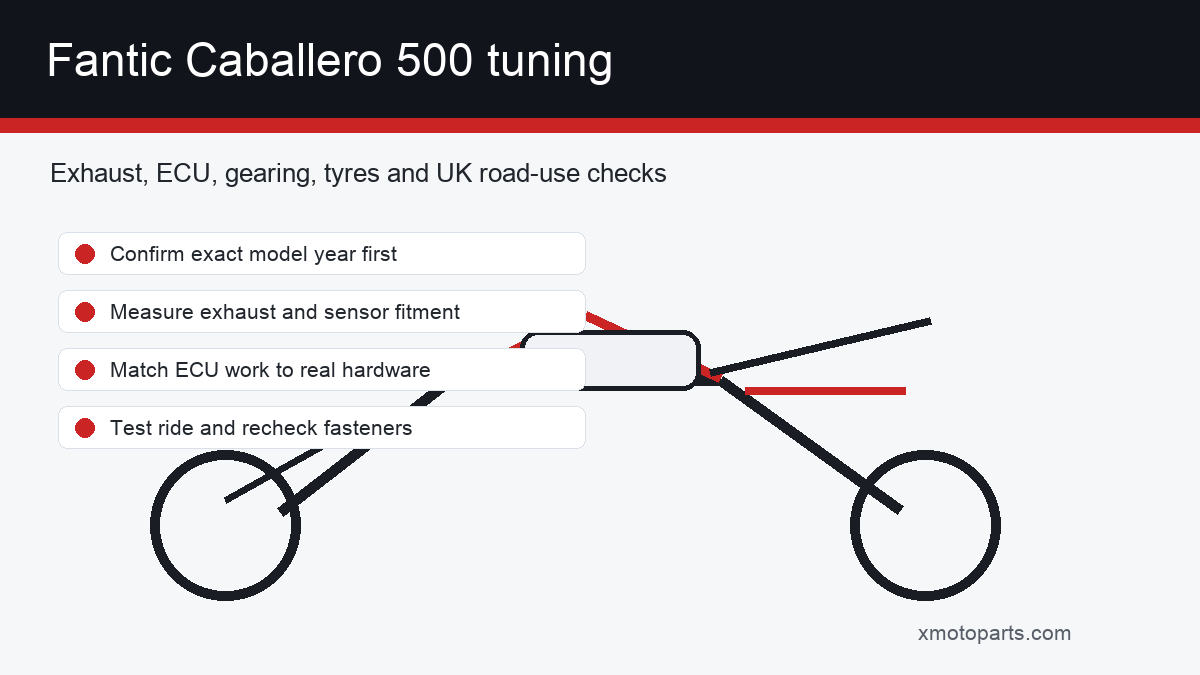
The best Fantic Caballero 500 tuning path is staged. Start by confirming the exact model year and engine version. Check chain condition, tyre wear, throttle response, brake drag, air filter condition and any stored fault codes if symptoms are present. Then choose one upgrade area and test it properly before moving on.
| Owner goal | First check | Possible upgrade | Risk if ignored |
|---|---|---|---|
| Better sound | Exhaust markings, DB-killer, catalyst and hanger position | Road-suitable slip-on or measured full system | Excessive noise, MOT issue or fuelling mismatch |
| Smoother throttle | Air filter, plugs, sensor connectors and ECU adaptation | Careful fuelling check or compatible ECU solution | Lean surge, rich running or warning lights |
| More lane control | Chain, sprockets, tyre choice and clutch feel | Sensible gearing and tyre change | Compromised cruising speed or twitchy road feel |
| Power-kit setup | Exact engine version, emissions equipment and warranty status | Matched exhaust, intake and ECU approach | Expensive parts that do not work together |
| Touring comfort | Suspension preload, tyre pressure and luggage clearance | Setup changes before engine tuning | Chasing engine changes when chassis setup is the issue |
Engine, electronics and model-year differences
The right Fantic Caballero 500 tuning path depends heavily on which Caballero 500 you own. Earlier versions and the latest Euro5+ machines are not identical. Fantic’s current official Caballero Scrambler 500 page describes a 463 cc DOHC liquid-cooled single-cylinder engine, ride-by-wire, two riding modes, cornering ABS, a stainless exhaust system with dual terminal by Arrow and Pirelli Scorpion Rally STR tyre sizes on the new generation: Fantic Caballero Scrambler 500 official specifications.
Those details matter. A bike with ride-by-wire, riding modes and updated emissions equipment should not be treated like an older basic single. Connector layouts, oxygen sensors, catalyst position, exhaust dimensions and ECU strategies can change between versions. When researching Fantic Caballero 500 tuning, compare your actual motorcycle to the part listing, not just the model name.
The Caballero is also sensitive to rider expectation. A single-cylinder 500 can feel lively because of torque and light weight, but its road behaviour still depends on gearing, tyres, wind, luggage, throttle mapping and maintenance. A clean standard bike often feels stronger than a neglected modified one.
Compatibility checks before buying parts
Fantic Caballero 500 tuning can become messy if parts are bought before measurements are taken. An exhaust has to clear the frame, shock, side panel, rider boot, luggage and indicators. An ECU or module has to match the connectors and sensor logic. A sprocket has to match chain pitch, bolt pattern and adjuster range. A tyre has to suit rim size, clearance and the surfaces you ride.
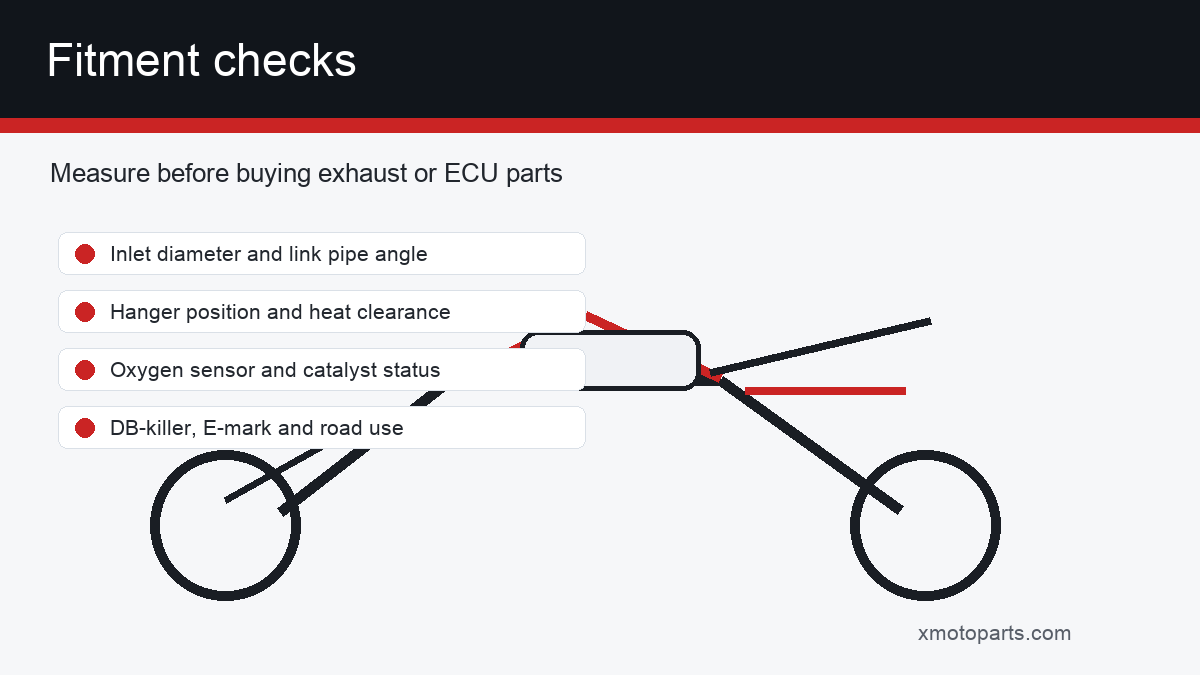
Before ordering, photograph the stock setup. Measure exhaust inlet diameter, hanger spacing, sleeve depth and available clearance. Count sprocket teeth and note chain condition. Check whether the bike already has aftermarket parts. If it does, the next part may not fit like it would on a standard bike. Good Fantic Caballero 500 tuning treats compatibility as a workshop step, not as something guessed from a product title.
| Vehicle or part type | Compatibility | Important note |
|---|---|---|
| Fantic Caballero 500 road/scrambler model | Yes, with year and version checks | Confirm engine generation, exhaust layout and sensor equipment |
| Caballero 125 or 700 | Not directly compatible | Engine, frame, exhaust and electronics differ significantly |
| Universal motorcycle exhaust | Possible | Requires diameter, bracket, clearance and road-use checks |
| ECU or fuelling module | Only when connector and model-year compatibility are confirmed | Ride-by-wire and emissions equipment can change the answer |
| Sprocket and chain changes | Usually possible when measured | Check chain pitch, sprocket carrier and axle adjustment range |
| Custom off-road project | Often possible | Professional fabrication may be required for exhaust and luggage clearance |
Exhaust, silencer, DB-killer and catalyst choices
For many riders, Fantic Caballero 500 tuning starts with the exhaust because the Caballero’s style makes the exhaust visually important. A lighter silencer or full system can change the bike’s character, but exhaust work is also where legal, fuelling and heat problems appear quickly.
Check whether the part is a slip-on, link pipe, decat, full system or track-use-only exhaust. A slip-on may retain more of the original emissions equipment. A decat or full system can have stronger fuelling and legality implications. A universal exhaust can work only when dimensions and hanger geometry are right. Use the universal motorcycle exhaust buying guide to understand diameter, bracket and DB-killer checks before ordering anything.
Do not confuse volume with performance. Removing a DB-killer can make a single-cylinder bike sound more aggressive, but it can also increase fatigue, create legal risk and reduce low-speed smoothness if the system is not properly matched. Sensible Fantic Caballero 500 tuning keeps the exhaust enjoyable without making the bike antisocial.
| Exhaust solution | Main advantage | Possible disadvantage | Best use |
|---|---|---|---|
| Original Arrow-style system | Matched to factory electronics and road use | Less individual sound | Daily road use and warranty confidence |
| Road-suitable slip-on | Better tone and reduced weight | Still needs fitment and legal checks | Riders wanting a tasteful upgrade |
| Full exhaust system | More complete performance potential | Higher cost, fuelling and emissions implications | Workshop-led matched tuning |
| Universal exhaust | Flexible for custom builds | Adapter and bracket work may be required | Measured custom fitment only |
| Track-use-only exhaust | Maximum sound and flow potential | Not suitable for road use if marked accordingly | Closed-course or private-area use only |
If you are considering a broader performance package, compare this guide with the Fantic Caballero 500 power kit article so the exhaust, intake and fuelling choices are treated as a connected system rather than separate decorations.
ECU, fuelling, air filter and ride-by-wire checks
Fantic Caballero 500 tuning on a modern injected motorcycle is not the same as changing jets on an old carburetted trail bike. Airflow, exhaust restriction, oxygen sensor feedback, throttle-by-wire strategy, riding modes and emissions calibration all matter. If an exhaust or intake change is large enough, the bike may need a compatible fuelling solution, but that solution must be designed for the exact model year.
Start with basics. Check the air filter, plugs, fuel quality, battery voltage, earths and throttle response before blaming the ECU. A dirty filter or loose intake clamp can make the bike feel worse after modifications. If warning lights appear after tuning work, do not keep riding hard until you know what the fault is.
When ECU work makes sense
ECU work or a module can make sense when the exhaust and intake setup has genuinely changed airflow and the product is matched to the motorcycle. The aim should be smoother response, safer fuelling and consistent rideability, not an invented dyno number. Keep standard files, settings or parts where possible so the bike can be returned to baseline.
When ECU work is the wrong answer
If the chain is tight, tyres are wrong for the road, the exhaust leaks, the air filter is dirty or the clutch is slipping, a fuelling module will not fix the real problem. Practical Fantic Caballero 500 tuning solves mechanical issues first and electronic adjustments second.
Gearing, chain, tyres and mixed-surface riding
Gearing can be one of the most useful parts of Fantic Caballero 500 tuning. Shorter gearing can help on lanes, steep hills and slow technical sections. Taller gearing can calm road cruising, but only if the engine can pull it without labouring. The Caballero sits between road bike and scrambler, so the right gearing depends on where it spends most of its life.
Tyres matter just as much. More aggressive tyres can improve loose-surface grip but add vibration, noise and slower steering on tarmac. Road-biased tyres can make the bike more precise on wet roads but reduce confidence on gravel. Before buying sprockets or tyres, read the Fantic Caballero 500 review and consider how the bike’s real use compares with its image.
Chain condition is the quiet limiter in many tuning projects. Tight spots, hooked teeth and poor alignment steal performance and make throttle response feel rough. If you are unsure, refresh chain and sprockets together instead of putting new tuning parts around worn drive components.
Workshop installation checks
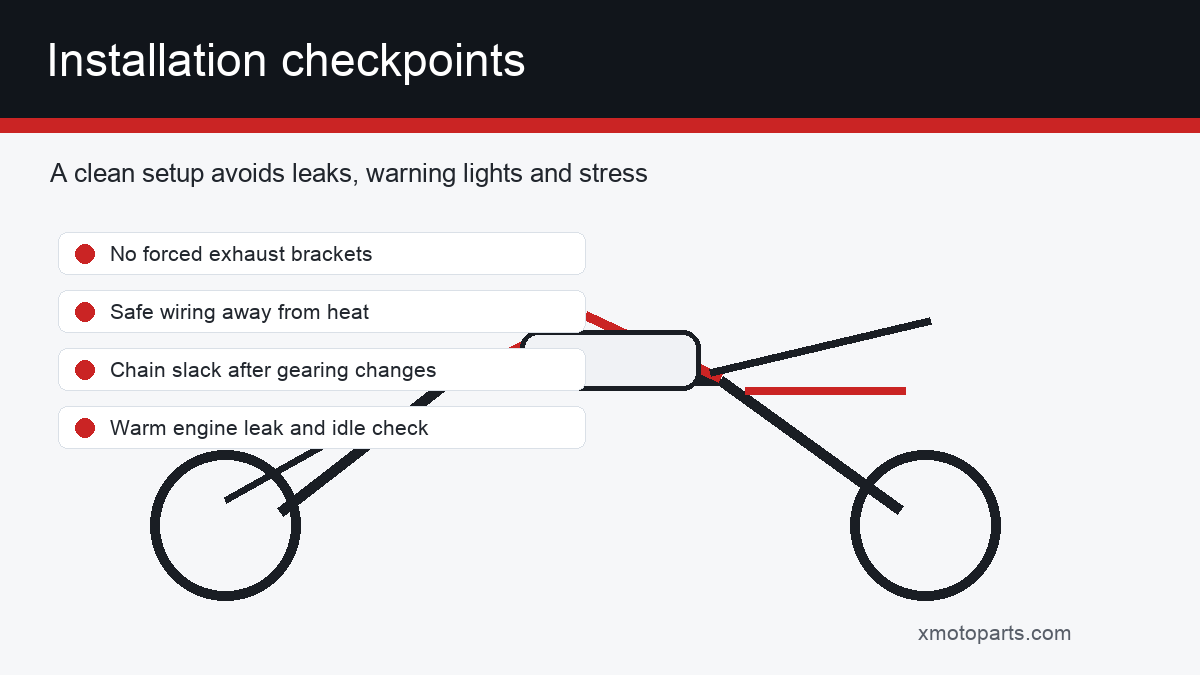
Install parts with the same care as a repair. Lay out parts, compare them with the originals and do not tighten brackets until everything is aligned. A silencer pulled into place under tension will crack mounts or leak. A wire routed near heat will fail later. A sensor connector forced into place is not compatible; it is damaged.
After fitting an exhaust, run the bike until warm and check for leaks at every joint. After ECU or module work, check warning lights, idle, fan operation and low-speed throttle. After gearing changes, check chain slack, wheel alignment and rear brake clearance. Use the Fantic Caballero 500 workshop manual guide as a reminder that torque values and service procedures matter.
UK road legality, MOT, E-mark and insurance
Road-focused Fantic Caballero 500 tuning must respect UK road legality. GOV.UK’s motorcycle MOT exhaust guidance explains that exhaust noise should not be clearly unreasonable compared with a similar motorcycle using a standard silencer, and that insecure exhaust parts can be major or dangerous defects: GOV.UK motorcycle MOT exhaust noise guidance.
Check E-marking, DB-killer status, catalytic converter equipment and any “not for road use” markings before fitting parts to a road bike. UK road use is different from closed-course use, private land or off-road riding. The United States, Canada, Australia, New Zealand and Ireland can also apply different rules, so imported forum advice should not be treated as UK legal guidance.
Tell your insurer about performance or exhaust changes. If Fantic Caballero 500 tuning changes power delivery, exhaust, intake, fuelling, tyres or brakes, it can matter after a claim. Keep receipts, product instructions and photos of the installation.
Common mistakes
The biggest mistake is buying parts for the image rather than the ride. A loud exhaust, aggressive tyres and a random fuelling device may look like a scrambler build, but if the bike surges, vibrates, fails MOT or annoys you on long rides, it is not a better motorcycle.
Other common mistakes include ignoring model-year differences, buying a universal exhaust without measuring diameter, removing the DB-killer for road use, fitting a decat without considering fuelling, forgetting E-mark and insurance issues, forcing brackets, routing wires near the cylinder head, changing gearing without checking chain wear and expecting a large power increase without a matched setup.
Good Fantic Caballero 500 tuning is quieter in method: inspect, measure, install without stress, test, cool down, recheck and only then decide whether the next change is needed.
How to choose the right upgrade path
If your Caballero is mostly a road bike, prioritise tyres, legal exhaust sound, smooth fuelling and comfort. If it is a lane bike, think about gearing, protection, chain condition and tyre choice before chasing horsepower. If you want a performance package, make sure the exhaust, intake and ECU work together rather than combining attractive parts randomly.
The most useful Fantic Caballero 500 tuning path depends on the weak point you can actually feel. Flat throttle response points towards service, fuelling and intake checks. Lazy low-speed pull may point towards gearing. Harsh behaviour on mixed surfaces may point towards tyres and suspension setup. A better sound may point towards an exhaust, but only after legality and fitment have been checked.
FAQ about tuning the Caballero 500
Is tuning the Fantic Caballero 500 worth it?
Fantic Caballero 500 tuning is worth it when the goal is better throttle response, more suitable gearing, improved exhaust character or a more controlled mixed-surface setup. It is not worth it if the rider expects one part to transform the whole motorcycle.
Do I need to remap after changing the exhaust?
It depends on the exhaust, catalyst, oxygen sensor setup and model year. A simple road-suitable slip-on may need only careful checks, while a decat or full system can require compatible fuelling work. Watch for surging, popping, heat, warning lights and poor low-speed control.
Can I fit a universal exhaust?
A universal exhaust can fit only if the inlet diameter, link pipe, hanger, heat clearance, sensor provision and road-use status are correct. The Caballero’s styling and exhaust position make bracket quality especially important.
Will Fantic Caballero 500 tuning increase horsepower?
Fantic Caballero 500 tuning can improve feel and may improve measured output when exhaust, intake and ECU work are matched, but unrealistic claims should be treated carefully. Rideability, torque delivery and reliability matter more than a headline number.
Is exhaust tuning legal in the UK?
Exhaust changes can be legal if the system remains secure, complete, not excessively noisy and suitable for road use. Parts marked “track use only” or “not for road use” should not be used on public roads, and insurance should be updated.
What gearing is best for a Caballero 500?
The best gearing depends on road speed, lane use, rider weight and tyre choice. Shorter gearing can help slow sections but raises revs on the road. Taller gearing can calm cruising but may weaken hill response.
Can tuning cause warning lights?
Yes. Incorrect sensor handling, poor electrical connections, unsuitable fuelling products or emissions-related changes can trigger warning lights. Stop and diagnose the issue rather than assuming the bike will adapt automatically.
What should I check after installing parts?
After any Fantic Caballero 500 tuning work, check exhaust leaks, fastener torque, heat clearance, chain slack, tyre pressure, warning lights, hot starting, idle stability and low-speed throttle control. Recheck after the first ride.
Final verdict
Fantic Caballero 500 tuning should make the bike more useful and more enjoyable without ruining its balance. Start with the exact model year. Measure before buying. Keep road legality, E-marking, DB-killer, catalyst and insurance in mind. Match exhaust, intake and ECU work rather than treating them as separate fashion parts.
Choose a universal product only when the measurements and brackets are right. Choose a power kit only when you understand the supporting exhaust and fuelling requirements. Choose gearing and tyres based on the roads and lanes you really ride. The best Fantic Caballero 500 tuning result is a bike that sounds better, responds cleaner, rides more confidently and remains dependable on the way home.