Peugeot Django 125 tuning: practical CVT, exhaust, fuelling and fitment guide
Peugeot Django 125 tuning starts with understanding what the Django actually is: a stylish 125cc automatic scooter built for town use, short commutes, relaxed riding and retro character. It is not a race engine waiting to be unlocked by one miracle part. The useful gains come from making the scooter respond cleanly, keeping the variator and belt in good condition, choosing exhaust parts that fit properly, checking fuelling behaviour after changes and staying realistic about UK road use.
This guide is for riders who want the Django 125 to feel sharper without becoming unreliable, illegal or unpleasantly noisy. We will cover CVT setup, roller weights, variator condition, drive belt wear, clutch behaviour, exhaust compatibility, DB-killer use, EFI limits, air filter checks, installation issues, MOT rules and the common mistakes that can make a small scooter slower after money has been spent. If you are planning Peugeot Django 125 tuning, the most important tool is not a catalogue; it is a careful measurement and inspection of the scooter you already own.
What this scooter can realistically improve
Peugeot Django 125 tuning should be judged by real riding: leaving a junction, holding speed up a gentle hill, rolling through traffic, starting cleanly when hot and cruising without the engine feeling strained. A 125cc automatic scooter has limited power, so the goal is not to create a completely different vehicle. The goal is to remove avoidable drag, refresh worn parts, choose a sensible CVT setup and avoid modifications that hurt the scooter’s easy-going nature.
Most Django owners search for tuning because they want stronger acceleration, better top-end feel, a sportier exhaust note, a quicker response from the variator or a way to correct a scooter that feels flat. Those are reasonable goals, but each one points to a different part of the machine. A worn belt will not be fixed by a loud exhaust. A clutch that judders will not be fixed by a fuel module. A scooter that cannot pull taller gearing or heavy rollers will feel worse, not faster.
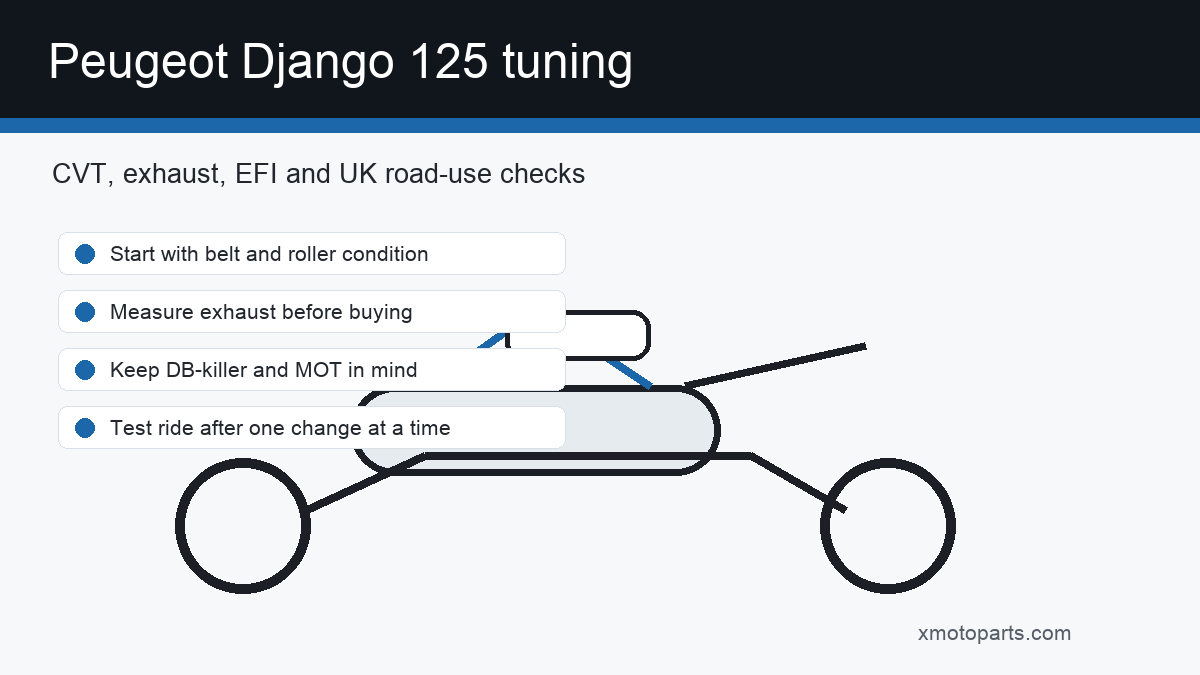
The useful way to approach Peugeot Django 125 tuning is staged. First, service the scooter. Then check the CVT. Then decide whether exhaust sound, variator response or fuelling smoothness is the weak point. Make one change at a time and test it on the same route. That is how you find improvements instead of chasing noise.
| Owner goal | First check | Possible upgrade | Realistic expectation |
|---|---|---|---|
| Sharper pull-away | Roller wear, belt width, clutch glazing and tyre pressure | Fresh belt, correct roller weights or variator refresh | Cleaner launch and steadier acceleration |
| Better hill response | CVT operation, engine health and rider/load weight | Sensible roller adjustment and service baseline | Improved rev behaviour, not a huge power increase |
| More exhaust character | Pipe diameter, bracket position and DB-killer | Road-suitable exhaust or carefully measured universal option | Better sound with legal and fitment checks |
| Smoother throttle | Air filter, spark plug, injector condition and intake leaks | Service work before electronic tuning | Cleaner response and fewer flat spots |
| Higher top speed | Brake drag, belt condition, wind, rider weight and road gradient | Only cautious CVT changes after baseline testing | Small changes, not motorway-style performance |
CVT, variator, rollers and belt condition
Tuning the Django is heavily linked to the CVT because it is an automatic scooter. The variator, roller weights, ramp plate, belt, clutch, contra spring and final drive determine how engine revs are translated into road speed. If these parts are worn or poorly matched, the scooter can feel sluggish even when the engine itself is healthy.
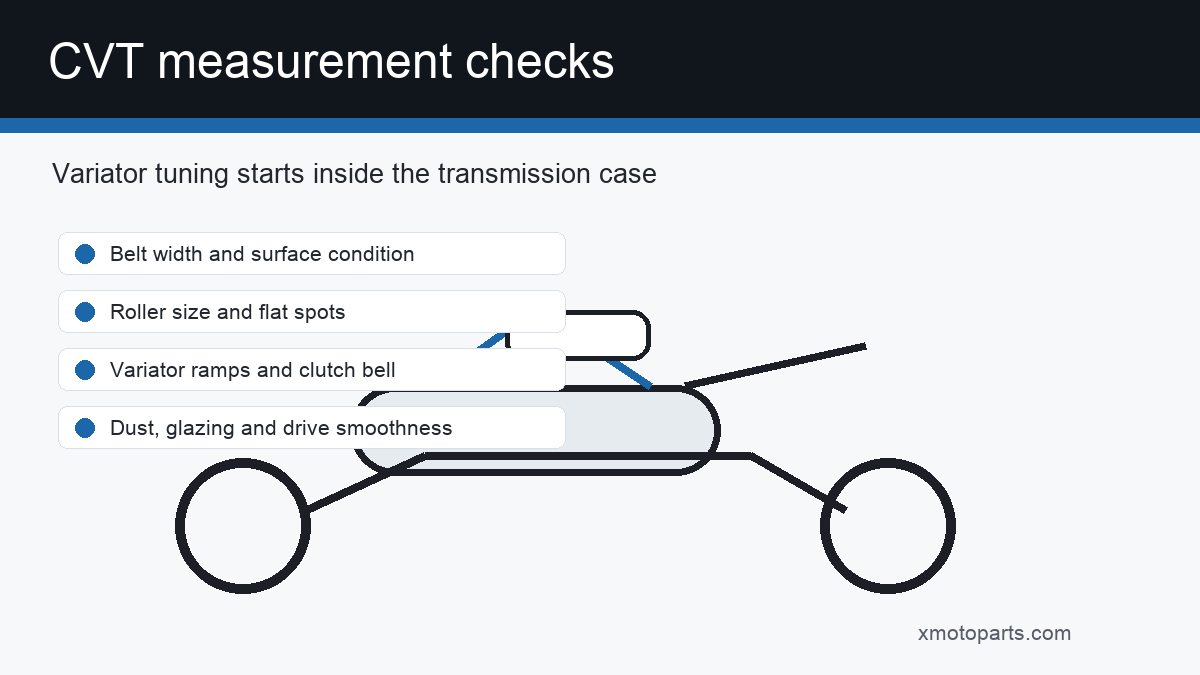
Before buying performance parts, inspect the belt width, belt surface, variator ramps, roller shape and clutch bell. Flat-spotted rollers can make the scooter hesitate or rev oddly. A worn belt can reduce effective gearing and make the engine work harder. A glazed clutch can cause judder from a stop. Dust inside the transmission case can hide problems. Good Peugeot Django 125 tuning begins by restoring the standard system to a clean, measurable baseline.
Roller weight choice is one of the most misunderstood areas. Lighter rollers can let the engine rev higher before the variator fully shifts, which may help acceleration if the engine is happiest there. Too light, and the scooter screams without gaining speed. Heavier rollers can lower revs and feel calmer, but too heavy can make the scooter lazy and weak uphill. The correct answer depends on the rider, roads, belt condition and engine health.
How to test CVT changes properly
Use a familiar route with a flat section, a gentle hill and a stop-start area. Warm the engine fully. Note engine feel, speed build-up, clutch engagement and whether the scooter holds revs smoothly. After any Peugeot Django 125 tuning change in the CVT, repeat the same test. Do not judge the result from one downhill run or one noisy launch outside the workshop.
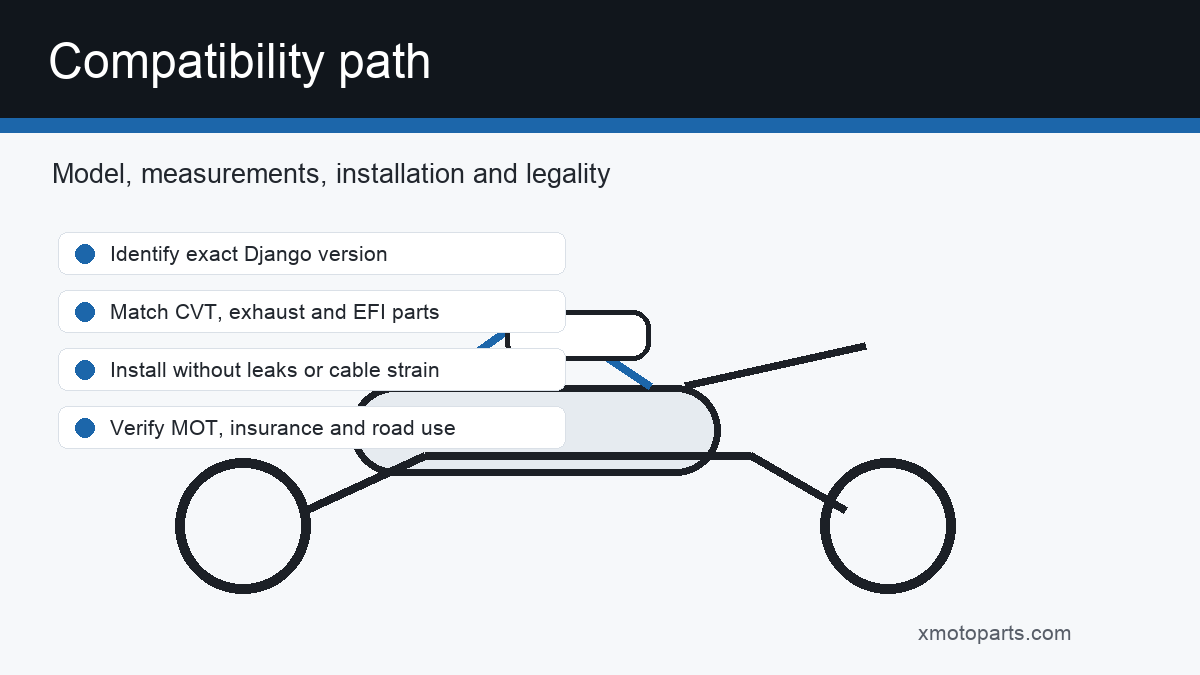
Compatibility checks before buying parts
Compatibility can be confusing because different Django 125 versions and markets may vary in specification, emissions equipment, exhaust layout and accessories. Official Peugeot Motocycles pages for current Django 125 versions describe an automatic 125cc scooter with electronic injection and dimensions such as 12-inch tyre fitment, low seat height and a compact urban chassis; those basics matter when choosing Peugeot Django 125 tuning parts: Peugeot Motocycles Django 125 specifications.
Compatibility is not only about engine size. A part can be sold for 125cc scooters and still be wrong for your Django. Exhaust inlet diameter, hanger angle, silencer length, oxygen sensor provision, heat shield position, bodywork clearance and centre stand clearance all matter. CVT parts must match the variator design, roller dimensions, belt size and clutch assembly. Electronic modules must match connectors and sensor logic.
| Part or use case | Compatibility | Important note |
|---|---|---|
| Peugeot Django 125 road scooter | Yes, with year and market checks | Confirm CVT part sizes, exhaust layout and emissions equipment |
| Django 50 or Django 150 | Not automatically compatible | Engine, CVT and exhaust dimensions can differ |
| Universal scooter exhaust | Possible | Adapter, hanger work or sensor provision may be required |
| Performance variator kit | Only if dimensions match | Check roller size, belt specification and crank fitment |
| Electronic tuning module | Only with confirmed connector compatibility | Never force plugs or assume every injected 125 uses the same logic |
| Custom project | Often possible | Professional installation may be needed for brackets, welding or wiring |
Exhaust, silencer and DB-killer choices
Many owners begin Peugeot Django 125 tuning with the exhaust because it changes the way the scooter looks and sounds. A good exhaust can sharpen the scooter’s personality, but a poor fit can create leaks, heat problems, bodywork clearance issues and MOT trouble. On a small automatic scooter, exhaust choice also affects how the CVT feels because the engine’s torque curve and rev behaviour are tied to the transmission setup.
Before buying a silencer, check whether it is model-specific or universal. A model-specific system should normally be easier to fit, but it still needs road legality, sensor and bracket checks. A universal exhaust may be flexible, but universal means adaptable, not guaranteed. The universal motorcycle exhaust buying guide is useful because the same measurement logic applies to scooters: diameter, hanger position, sleeve depth, clamp range and available space come before appearance.
Keep the DB-killer discussion realistic. Removing a baffle may make the scooter louder, but louder is not the same as quicker. A short, noisy exhaust can make a 125 feel busy and draw attention without improving actual road speed. Sensible Peugeot Django 125 tuning keeps sound, legal comfort and low-speed response in balance.
| Exhaust option | Main advantage | Possible disadvantage | Best use |
|---|---|---|---|
| Original exhaust | Quiet, compliant and predictable | Less visual character | Daily commuting and MOT confidence |
| Road-suitable sports exhaust | Better sound and style | Needs fitment and fuelling checks | Riders wanting a tasteful road upgrade |
| Universal scooter exhaust | Flexible and often affordable | Adapter or bracket work may be needed | Measured custom fitments |
| Full system | More complete exhaust change | Higher cost and stronger legal implications | Workshop-led projects |
| Track-use-only exhaust | Maximum noise and flow potential | Not suitable for road use if marked accordingly | Private land or closed-course use only |
If you want Peugeot-specific exhaust context, the Peugeot Speedfight exhaust guide is a helpful internal comparison for scooter exhaust fitment logic, while the existing Peugeot Django 125 power increase guide covers the narrower performance-angle discussion.
EFI, air filter and fuelling behaviour
Peugeot Django 125 tuning on an injected scooter should not ignore fuelling. A modern 125 with electronic injection reads sensors and works within a controlled emissions strategy. If the exhaust or intake changes enough, the scooter may respond differently. That does not automatically mean it needs a remap, but it does mean the rider should check hot starting, idle stability, throttle pickup, overrun popping and plug condition where inspection is practical.
Start with service basics. A dirty air filter, old spark plug, weak battery, loose intake clamp or poor fuel can mimic a tuning problem. A fuel module or intake part will not fix a scooter that is already overdue for maintenance. If Peugeot Django 125 tuning includes an electronic module, connector compatibility must be proved before installation, and the first setting should be conservative.
When a fuel module can help
A compatible module can be useful when a measured exhaust/intake setup causes a lean-feeling response or flat spot and the module is designed for the exact connector layout. It should improve smoothness, not create a fantasy power figure. If the scooter smells rich, feels heavy or loses crispness, reduce the setting or return to baseline.
When fuelling is not the problem
If the scooter launches badly, revs strangely or struggles up hills, inspect the CVT before blaming the injector or ECU. In many cases, Peugeot Django 125 tuning improves more from belt, roller and clutch work than from fuelling changes.
Workshop installation checks
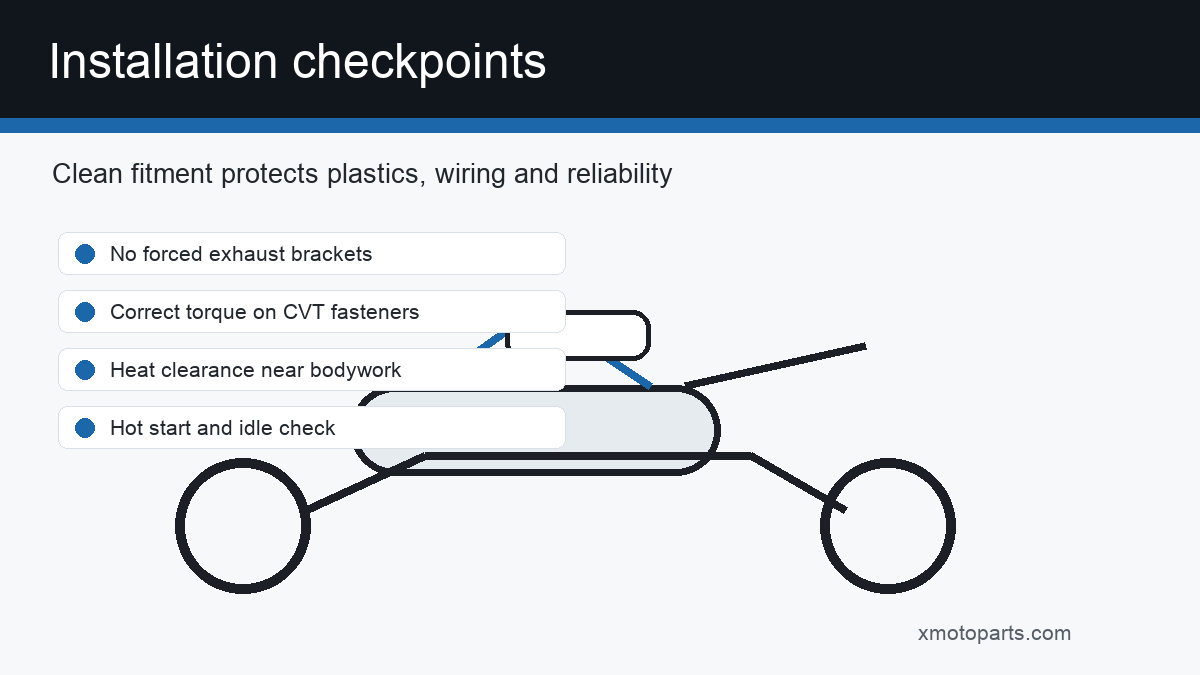
Install upgrades like careful maintenance, not like decoration. Remove panels patiently, store fasteners in order and avoid pulling bodywork until clips break. On scooters, a rushed job can damage plastics, pinch wiring or leave heat shields loose. The Django’s retro bodywork is part of its appeal, so a clean installation matters visually as well as mechanically.
For CVT work, clean the transmission case, inspect rollers and belt, avoid grease where it does not belong and torque the variator/clutch nuts correctly. For exhaust work, fit gaskets or sleeves squarely, support the silencer naturally and check for leaks after the first warm-up. For wiring, avoid heat, steering movement and water traps. Good Peugeot Django 125 tuning looks almost factory when finished.
UK road legality, MOT and insurance
Road-focused Peugeot Django 125 tuning must respect UK rules. The MOT is not a performance test, but it does check important safety and road-use items. GOV.UK’s motorcycle MOT exhaust guidance says a motorcycle exhaust should not emit noise clearly unreasonably above the level expected from a similar motorcycle with a standard silencer, and insecure exhaust parts can be major or dangerous defects: GOV.UK motorcycle MOT exhaust noise guidance.
Road use is different from track use, private land or off-road use. A silencer marked “NOT FOR ROAD USE” or “TRACK USE ONLY” is not a sensible road choice. E-marking, catalytic converter equipment, oxygen sensor provision, emissions compliance and noise limits can depend on year, product and market. UK rules also differ from the United States, Canada, Australia, New Zealand and Ireland, so do not copy advice from another country without checking the local context.
Insurance disclosure matters. If Peugeot Django 125 tuning changes the exhaust, fuelling, variator or performance, tell your insurer. A modification does not need to be dramatic to be relevant after a claim. Keep receipts, product information and photos of the installation.
Common mistakes
The most common mistake is fitting performance parts to a scooter that needs service work. A worn belt, sticky clutch or dirty filter can make any upgrade look bad. The second mistake is changing too much at once. If you fit a variator, change roller weights, change the exhaust and add a module in the same weekend, you will not know which part caused a problem.
Other mistakes include buying an exhaust without measuring diameter, ignoring DB-killer and E-mark issues, choosing rollers only from forum comments, forgetting belt width, reusing damaged gaskets, forcing brackets, leaving transmission dust inside the case, not test riding after warm-up, expecting large horsepower gains from a 125 and ignoring insurance. Good Peugeot Django 125 tuning is methodical: inspect, measure, change one thing, test, cool down and recheck.
How to choose the right upgrade path
If your scooter is used every day, start with reliability: belt, rollers, clutch, tyres, brakes, lights and clean EFI behaviour. If your goal is style and sound, choose an exhaust that fits the bodywork, keeps the DB-killer and does not create heat issues. If you want stronger acceleration, focus on CVT condition before fuelling. The Piaggio Liberty 125 tuning guide is a useful comparison because it shows how similar 125cc scooter logic applies across different models.
The smartest Peugeot Django 125 tuning path is not the loudest or most expensive. It is the one that suits your route, rider weight, legal requirements and maintenance condition. A carefully refreshed standard scooter can feel better than a badly modified one. A measured exhaust and CVT setup can be satisfying when it is installed without leaks, bracket stress or unrealistic expectations.
FAQ about tuning the Django 125
Is tuning the Peugeot Django 125 worth it?
Peugeot Django 125 tuning is worth it when the goal is smoother acceleration, better CVT response, cleaner exhaust sound or a more polished scooter. It is not worth it if the expectation is a huge power increase from one simple part.
Can I make a Peugeot Django 125 faster?
You can often improve how the scooter accelerates and holds revs by servicing the CVT, checking belt condition and choosing sensible roller weights. Actual top-speed gains are usually limited by power, wind, rider weight, gearing and legal constraints.
Do I need to change roller weights?
Roller weights may help if the scooter is revving too low, revving too high or not shifting smoothly. Measure the existing roller size, inspect wear and make small changes. Too light or too heavy can make the Django feel worse.
Will an exhaust improve performance?
An exhaust can improve sound and may sharpen feel slightly when matched correctly, but it will not transform the scooter alone. Exhaust fitment, DB-killer, sealing, fuelling behaviour and CVT setup must all be considered together.
Is a universal exhaust safe to fit?
A universal exhaust can be safe if the diameter, hanger, clearance, sensor provision and legal status are correct. It is not automatically plug-and-play, and professional installation may be needed if brackets or adapters are required.
Is tuning the Django 125 legal in the UK?
Peugeot Django 125 tuning can be legal in the UK when the scooter remains roadworthy, insured, not excessively noisy and compliant with relevant emissions and equipment requirements. Track-use-only or not-for-road-use parts should not be used on public roads.
Do I need a fuel module after CVT tuning?
No. CVT work changes transmission behaviour, not fuel delivery. A fuel module only becomes relevant when intake or exhaust changes affect running and the module is confirmed compatible with the scooter’s EFI connectors.
What should I check after installing tuning parts?
After any Peugeot Django 125 tuning work, check belt seating, variator nut torque, clutch engagement, exhaust leaks, fastener tightness, hot starting, idle stability and bodywork clearance. Recheck everything after the first ride.
Final verdict
Peugeot Django 125 tuning should make the scooter easier and more enjoyable to ride, not louder and more fragile. Start with the CVT and service condition. Measure exhaust parts before buying. Keep the DB-killer and road-use status in mind. Treat fuelling changes carefully and only use compatible electronic products.
Choose a universal part only when the measurements are right. Choose a CVT setup only after checking belt and roller wear. Choose an exhaust only when it fits the scooter, the bodywork and the way you ride. If you want a sensible next step, compare the existing Django power guide, exhaust fitment guides and scooter tuning examples before ordering parts.
The best Peugeot Django 125 tuning result is a scooter that launches more cleanly, sounds better without being a nuisance, keeps its retro charm and remains dependable on the commute home.