
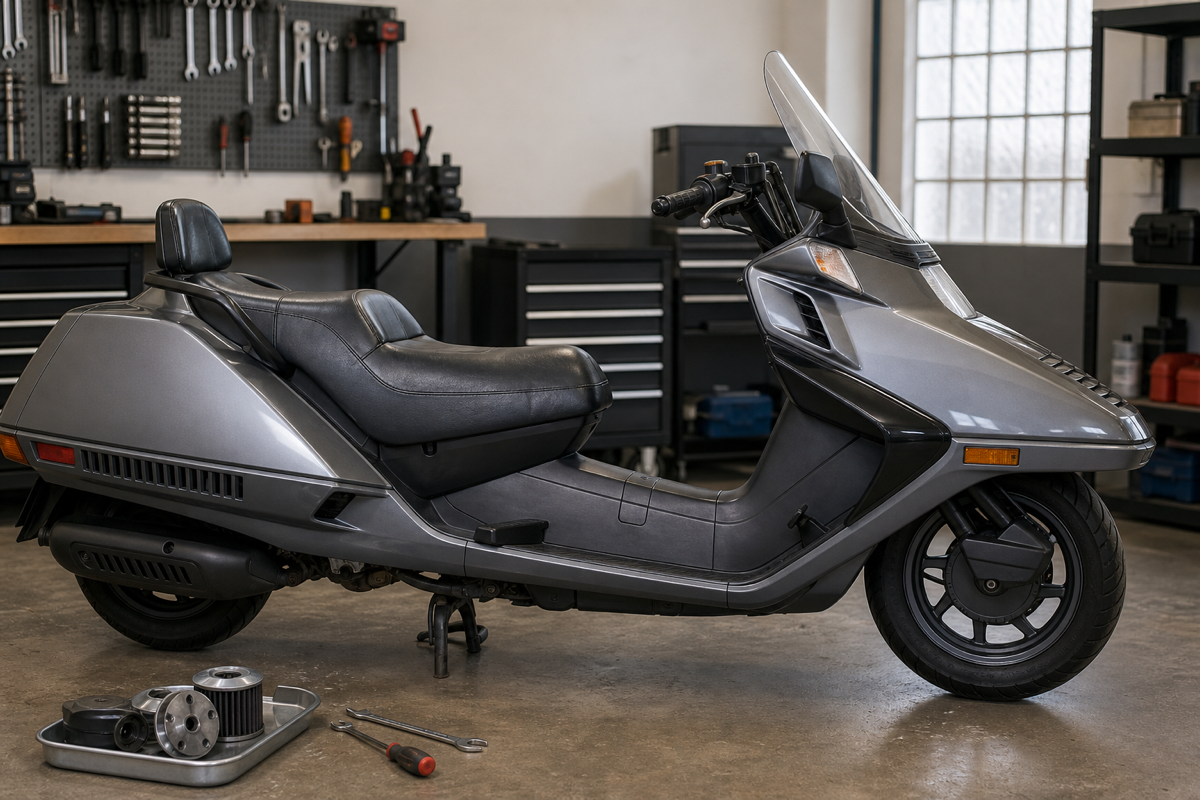
Honda Helix tuning: a practical CN250 guide for smoother power, CVT setup and reliable riding
Honda Helix tuning starts with understanding what the CN250 actually is: a long-wheelbase, liquid-cooled, single-cylinder maxi scooter built for comfort, smooth drive and durability rather than aggressive sport performance. That does not make it boring. It means the best results come from careful maintenance, correct CVT setup, clean carburetion, sensible exhaust choices and realistic expectations.

This guide is written from the point of view of a mechanic looking at an older CN250 on the workshop floor. Most owners searching for Honda Helix tuning want one of five things: better pull from traffic lights, steadier cruising, less tired acceleration, a cleaner exhaust note or a way to make an old scooter feel fresh again. The right answer depends on the condition of the belt, rollers, clutch, carburettor, tyres, brakes, cooling system and exhaust before any upgrade is fitted.
Quick answer: what is worth doing first?
Honda Helix tuning should usually begin with restoring lost performance before chasing extra power. A worn drive belt, flat-spotted rollers, glazed clutch shoes or sticky carburettor can make a healthy 250 feel weak. If the scooter has not had recent service work, the first upgrade is not a louder exhaust. It is a clean service baseline.
The most effective order is simple: service the engine, inspect the CVT, replace worn transmission parts, clean or rebuild the carburettor if needed, check cooling, fit good tyres, then decide whether a variator, roller-weight change, intake refresh or exhaust upgrade suits the way you ride. Done in that order, the work gives a smoother scooter and avoids blaming new parts for old problems.
| Owner goal | Best first check | Likely useful upgrade | What to avoid |
|---|---|---|---|
| Better take-off | Belt width, roller wear, clutch glazing | Fresh belt, correct rollers, clutch service | Very light rollers that make the engine scream |
| Smoother cruising | Tyres, engine mounts, carburettor cleanliness | Service tune, balanced CVT setup | Exhaust changes before fixing vibration |
| Sharper throttle | Air filter, plug, intake boot, carb diaphragm | Carburettor service and careful jetting only if required | Open filters without proper tuning |
| Better sound | Exhaust leaks, bracket condition, silencer state | Road-sensible exhaust with good mounting | Removing baffles for daily road use |
| Long-distance reliability | Cooling system, belt age, charging voltage | Preventive maintenance and quality consumables | Cheap parts with unknown dimensions |
Why the Honda Helix responds differently from a modern scooter
Honda Helix tuning is not the same job as tuning a modern fuel-injected 125 or a high-output 300. The CN250 is an older design with a relaxed engine character, carburettor fueling and a CVT transmission that has a huge influence on how fast the scooter feels. A small change in belt condition or roller weight can change the riding impression more than many owners expect.
The Helix is also a comfort scooter. The long bodywork, broad seat and laid-back ergonomics make it feel more like a small touring machine than a nervous city scooter. That matters because the setup should support the way the machine is used. A setup that feels exciting for two short blasts may be tiring on a long commute. A useful tune gives clean take-off, steady mid-range, sensible revs at cruise and no extra heat or vibration.
For original documentation and model-specific owner information, use Honda’s official owner resources where available through Honda Powersports owner manuals. For UK road-use context, especially exhaust condition and excessive noise during inspection, the GOV.UK motorcycle MOT nuisance section is a useful authority. Those references do not replace a workshop manual, but they show why service condition and road legality matter as much as parts choice.
Baseline service before any upgrade
Before spending money on Honda Helix tuning, check the scooter like a mechanic would check a customer bike. Start with oil level and oil condition. Check coolant level, fan operation, radiator condition and hoses. Inspect the spark plug, plug cap, battery voltage, earth connections and charging output. A weak battery or poor earth can make starting and low-speed running feel worse than it really is.
The intake side deserves close attention. The Helix is old enough that many examples have hardened rubber boots, tired vacuum lines, dirty carb passages or airbox leaks. A cracked intake boot can create a lean condition that no roller kit will fix. A blocked pilot circuit can make the scooter hesitate from idle. Tuning work helps only when the engine receives fuel and air consistently.
Also check tyres and brakes before chasing acceleration. Old tyres create drag, poor confidence and odd steering. Binding brakes can make the scooter feel underpowered. A rear brake that drags slightly will steal more performance than a small tuning part can add. Anyone planning upgrades should first make the scooter roll freely, stop straight and idle cleanly.
Workshop baseline checklist
| Area | What to inspect | Why it matters for tuning |
|---|---|---|
| Engine oil | Level, grade, service age, leaks | Old oil increases wear and heat |
| Cooling | Coolant, fan, radiator, thermostat behaviour | Tuning a hot-running scooter is risky |
| Carburettor | Pilot circuit, diaphragm, float height, choke | Poor fueling feels like weak power |
| Airbox | Filter, seals, intake boot cracks | Unmetered air makes setup unreliable |
| CVT | Belt width, roller shape, clutch dust, pulley faces | Transmission condition controls acceleration |
| Chassis | Tyres, brakes, wheel bearings, suspension | A faster-feeling scooter still needs control |
If you want a narrower guide focused on restrictions and realistic speed work, read the internal Honda Helix derestriction guide. It pairs naturally with this broader CN250 article because both start from the same principle: measure before modifying.
CVT and variator setup
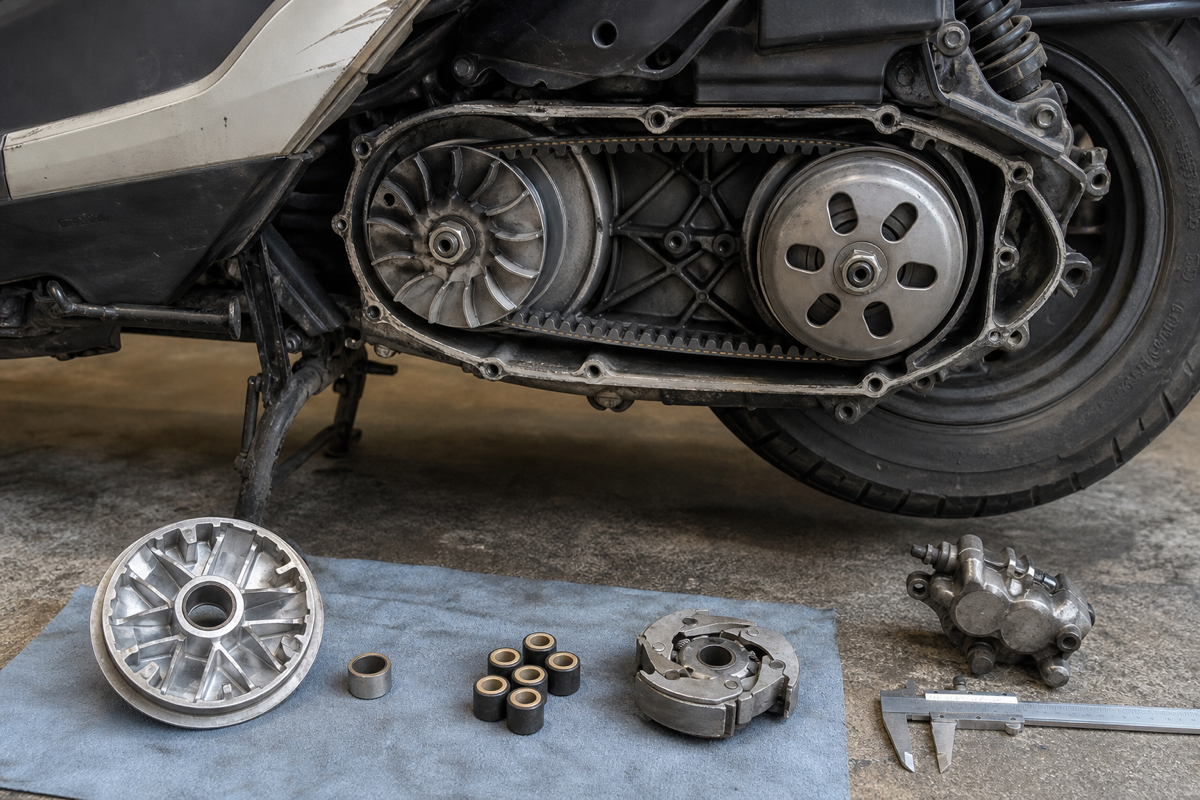
The CVT is where Honda Helix tuning becomes most practical. The engine can be healthy, but if the belt rides too low, the rollers are flat-spotted or the clutch engages badly, the scooter will feel lazy. On a CVT scooter, acceleration is not only engine power. It is also how the variator, belt and clutch keep the engine in its useful rev range.
Belt condition and belt width
A worn belt narrows with use. When that happens, the effective gearing changes and the scooter may lose top speed, acceleration consistency or smoothness. Belt width should be measured with callipers and compared with the correct service limit from the relevant manual or supplier data. Do not judge the belt only by looking for cracks. A belt can look acceptable and still be too narrow.
Roller weight and real-world response
Roller weight changes the rpm at which the variator shifts. Lighter rollers can let the engine rev higher before the gearing climbs. Heavier rollers can lower revs but may make the scooter sluggish if they move the engine out of its useful range. The mistake is going too extreme. A classic touring scooter should not sound like it is being punished at every green light.
The sensible method is to begin with known good factory-style parts, then make small changes. Record the old roller weight, belt brand, belt width, clutch condition and road-test notes. Test take-off, 30-50 mph roll-on and steady cruising. The scooter should pull better without becoming noisy, hot or unpleasant.
Clutch and contra spring checks
A dirty or glazed clutch can shudder, slip or engage too abruptly. Clean dust carefully, inspect the clutch bell for blue heat marks and check shoe wear. Stronger springs can raise engagement rpm, but they also change town manners. For most riders, the Helix does not need a harsh clutch. A smooth clutch with clean engagement is usually better than a racing-style setup on a long commuter scooter.
Owners comparing broader scooter transmission setup can also read the motorcycle chain tension adjustment guide. It is about chains rather than CVTs, but the workshop lesson is the same: final drive condition changes how a vehicle feels before any engine upgrade is involved.
Carburettor, intake and fueling
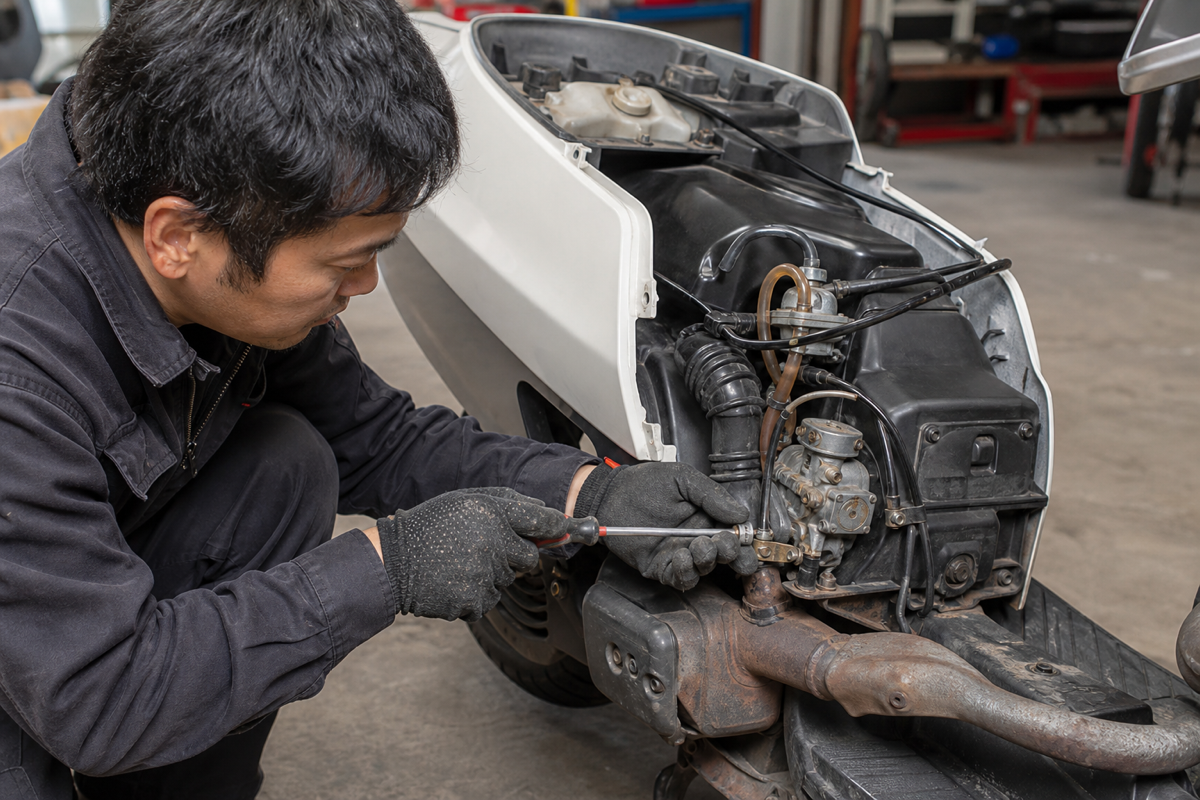
Honda Helix tuning often fails when owners skip carburettor condition. The CN250’s carburettor must be clean, correctly assembled and free from vacuum leaks. If the diaphragm is damaged, the slide may not lift properly. If the pilot jet is partially blocked, the scooter can hesitate from low throttle. If the auto choke is faulty, cold starting and warm idle can become inconsistent.
An intake refresh can be more valuable than an open filter. Replace a tired air filter, inspect the airbox lid, check every rubber boot and make sure clamps hold evenly. Removing the airbox or fitting a pod filter may look simple, but it can upset intake velocity, water protection and carburettor signal. A road-focused setup should preserve rideability, especially for a scooter used in rain and city traffic.
Jetting: when it is needed and when it is not
Jetting may be needed if the exhaust or intake has genuinely changed airflow, but it should not be the first guess. Start by reading the spark plug, checking for air leaks and confirming the carburettor is clean. If the scooter runs lean after an exhaust change, do not keep riding hard while hoping it will adapt. Older carburettor systems do not self-correct like modern closed-loop injection.
A careful CN250 setup may involve slightly adjusted jetting, but the aim is stable starting, clean idle, good mid-throttle response and safe full-throttle behaviour. If you are not comfortable reading plugs, checking mixture symptoms and measuring fuel system condition, use a mechanic who understands carburetted scooters.
Exhaust, sound and legal road use
Exhaust changes are popular in Honda Helix tuning, but they should be chosen carefully. A Helix with a rotten silencer, leaking gasket or cracked bracket may benefit from a replacement system. A Helix with a healthy original exhaust may not gain much from a very loud pipe. On a 250 scooter, sound can change more than performance.
Look for fitment, bracket alignment, gasket quality, heat shielding and noise control. If an exhaust is described as universal, check inlet diameter, mounting angle, bracket position and available space behind the bodywork. The long side panels of the Helix make heat clearance important. A good exhaust should not melt plastic, strain the header studs or make the scooter fail an inspection for excessive noise.
For exhaust choice and brand comparison, use the internal best motorcycle exhaust brands guide. If you are browsing parts rather than only reading, the chip tuning modules category is useful for understanding how X Moto Parts separates electrical response products from mechanical exhaust or transmission work.
UK, road use and insurance implications
In the UK, road legality depends on the vehicle, the part, noise level, emissions equipment and inspection condition. A scooter used on public roads must remain roadworthy. If an exhaust is excessively noisy, badly mounted, leaking, missing required parts or clearly sold for track use only, it can create MOT, police, insurance and resale problems. Road-use upgrades should always keep the scooter civil, secure and insurable.
The same caution applies outside the UK. The United States, Canada, Australia, New Zealand and Ireland all have their own rules around noise, emissions, roadworthiness and modified vehicles. Do not assume an exhaust acceptable in one market is acceptable everywhere. A private-area or show scooter can be set up differently from a daily road scooter, but the owner must know the difference before buying parts.
Compatibility for common Honda Helix upgrades
Compatibility is not only about whether a part can be forced to fit. Real compatibility means the part suits the year, engine, mounting points, body clearance, transmission dimensions and intended road use. The Helix/CN250 platform has age, market and previous-owner variation, so inspect the scooter in front of you.
| Upgrade area | Compatibility | Important note |
|---|---|---|
| Drive belt | Only exact-size compatible | Check belt width, length and service limits before fitting |
| Variator rollers | Depends on size and weight | Measure roller dimensions and avoid extreme weight changes |
| Clutch parts | Model-specific or carefully matched | Check clutch diameter, bell condition and spring fitment |
| Air filter | Prefer correct airbox filter | Open filters may require fueling work and reduce weather protection |
| Exhaust | Depends on header, bracket and body clearance | Universal silencers often need fabrication |
| Electrical accessories | Depends on charging health | Confirm battery and regulator output before adding load |
Best upgrades compared
Not every owner needs the same upgrade path. A neglected scooter needs restoration. A clean commuter may only need CVT refresh. A show-style project may focus on exhaust and appearance. A long-distance rider should prioritise reliability, cooling and tyres.
| Solution | Main advantage | Possible disadvantage | Best for |
|---|---|---|---|
| Factory-style service refresh | Restores lost smoothness | Less exciting than visible parts | Most used Helix scooters |
| Fresh belt and rollers | Improves acceleration consistency | Poor parts can make revs worse | Commuters and daily riders |
| Performance variator | Can sharpen response | Needs careful setup | Owners who test methodically |
| Carburettor rebuild | Fixes hesitation and poor idle | Requires cleanliness and correct parts | Older scooters with running issues |
| Aftermarket exhaust | Improves sound and may reduce weight | Noise, fitment and legality must be checked | Riders wanting character |
| Tyres and suspension refresh | Improves real-world confidence | Does not add power | Touring and wet-weather use |
Common mistakes to avoid
The biggest Honda Helix tuning mistake is fitting parts before diagnosis. Owners often replace the exhaust, rollers or air filter because the scooter feels slow, when the real issue is a worn belt, dragging brake, dirty carburettor or old fuel. Start with symptoms and measurements, not assumptions.
Another common mistake is choosing roller weights based on forum comments without checking the actual belt and pulley condition. Roller weight that works on one scooter may feel poor on another because the rider weight, tyre size, belt brand, clutch condition and riding environment are different. The Helix needs local testing, especially on hills and at cruising speed.
A third mistake is ignoring bodywork clearance. The Helix has enclosed styling, and parts that look simple on a naked scooter can be awkward under long panels. Exhausts, heat shields and intake changes must be checked with the scooter fully assembled. A pipe that clears with panels removed may be too close once the scooter is put back together.
Do not confuse universal with plug-and-play. Universal silencers, generic belts, random rollers and open filters can become expensive once brackets, spacers, clamps, jets and labour are included. The safest purchases are the ones where dimensions, year compatibility and return conditions are clear before money changes hands.
Mechanic-style road test after tuning
After Honda Helix tuning, do not judge the result from one noisy acceleration run. Warm the scooter fully. Check idle after the fan cycles. Ride gently first, listening for belt slap, clutch shudder, exhaust leaks, intake hiss or unusual vibration. Then test low-speed pull, mid-range roll-on and steady cruise.
A good setup should make the scooter easier to ride. It should pull away cleanly, hold speed without hunting, restart when hot, and keep temperatures normal. If the scooter feels faster but smells hot, surges at steady throttle or becomes unpleasantly loud, the setup is not finished. Real mechanical improvement is the point where the scooter works better every day, not only where it feels dramatic for ten minutes.
When to use a professional mechanic
Use a professional when the job involves carburettor rebuild, exhaust stud repair, cooling-system diagnosis, electrical charging faults, fabrication, brake work or unexplained overheating. The work is approachable, but the scooter is old enough that seized bolts, brittle plastic and previous repairs can turn a simple upgrade into a long afternoon.
A good mechanic will measure belt width, inspect rollers, test charging voltage, check plug colour, look for air leaks, verify coolant behaviour and road-test the scooter after the work. That is the difference between installing parts and building a reliable setup. If you are ordering parts yourself, take photos of the existing components and confirm dimensions before buying.
Image metadata prepared for this guide
| File name | Title | Alt text | Caption purpose | Recommended position |
|---|---|---|---|---|
| honda-helix-tuning.png | CN250 tuning guide image | Main Honda Helix tuning workshop image | Main workshop image for the complete guide | After introduction |
| honda-helix-tuning-cvt-checks.png | Honda Helix CVT tuning checks | Honda Helix tuning CVT checks with variator belt and rollers | Shows belt, variator and roller inspection | CVT section |
| honda-helix-tuning-installation-checks.png | Honda Helix installation checks | Mechanic checking Honda Helix tuning installation points | Shows real engine-bay fitment checks | Compatibility section |
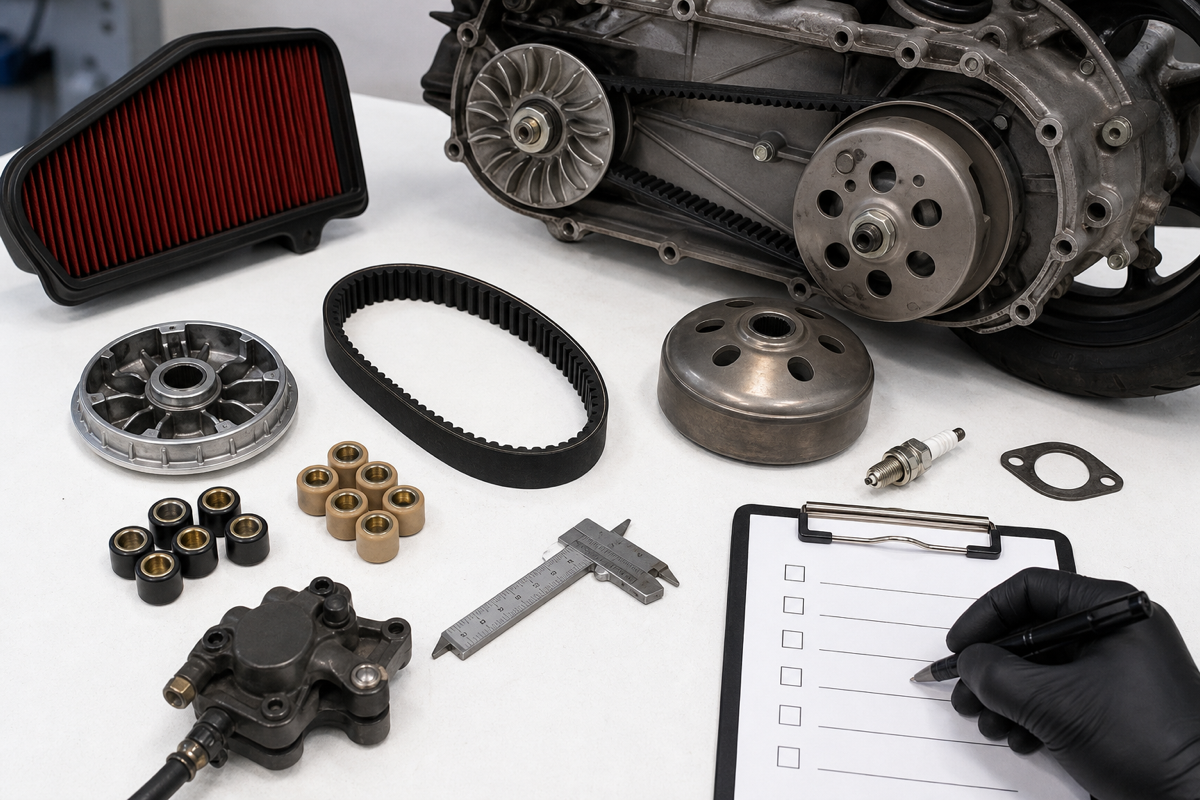
| honda-helix-tuning-compatibility-diagram.png | Honda Helix compatibility diagram | Honda Helix tuning compatibility diagram with CVT belt rollers air filter and exhaust checks | Summarises parts that must match the scooter | Common mistakes section |
FAQ about Honda Helix tuning
What is the best first step for Honda Helix tuning?
The best first step is a service baseline: oil, coolant, spark plug, air filter, carburettor condition, belt width, rollers, clutch and brakes. Honda Helix tuning is far more successful when the scooter is already healthy.
Can a Honda Helix be made much faster?
A Helix can usually be made smoother and more responsive, but it should not be treated like a modern sport scooter. The realistic target is better acceleration consistency, cleaner fueling and reliable cruising, not a dramatic engine transformation.
Do lighter rollers improve Honda Helix acceleration?
Lighter rollers can improve response if the current setup is too heavy or worn, but going too light can make the engine rev too high without adding useful road speed. Test small changes and record each setup.
Does Honda Helix tuning require carburettor jetting?
Not always. If the airbox and exhaust remain close to standard, cleaning and correct adjustment may be enough. Jetting becomes more relevant after major intake or exhaust changes, and it should be done carefully rather than guessed.
Is an aftermarket Honda Helix exhaust legal in the UK?
It depends on the exact exhaust, noise level, emissions equipment, installation condition and the scooter’s road-use status. For road use, avoid excessive noise, leaks, poor mounting and parts sold only for track or off-road use.
Can I fit universal scooter parts to a Honda Helix?
Sometimes, but universal parts are not the same as direct-fit parts. Check belt dimensions, roller size, exhaust inlet diameter, bracket position, heat clearance and bodywork space before buying.
Why does my Honda Helix feel slow after fitting new parts?
The new parts may not match the scooter, or an older fault may still be present. Check belt seating, roller weight, clutch operation, carburettor cleanliness, air leaks, brake drag and tyre pressure before assuming the part is bad.
Should I tune the Honda Helix for touring or city riding?
For city riding, smooth take-off and clean low-speed response matter most. For touring, keep revs reasonable, cooling healthy and reliability high. The same parts can feel different depending on the route.
Final advice before buying parts
Honda Helix tuning is most rewarding when it respects the scooter’s original character. The CN250 does not need to become loud, harsh or unreliable to feel better. Start with service condition, measure the CVT, refresh tired parts, keep the intake sealed, choose exhaust parts carefully and road-test the scooter like a mechanic, not like a catalogue reader.
If the scooter is mainly used on public roads, keep legality, insurance and noise in mind. If the scooter is a private-area project, you still need safe brakes, reliable cooling and secure mounting. The best Honda Helix tuning choice is the one that makes the scooter easier to live with after the ride home, not only more exciting on the day the box arrives.
Before ordering, compare your scooter with the dedicated Honda Helix derestriction guide, browse the chip tuning modules category for response-focused parts, and use the best motorcycle exhaust brands guide if sound and silencer quality are part of the plan. A careful buying decision is part of good Honda Helix tuning.