Ntorq exhaust price: real-world buying guide for fitment, sound, quality and road use
Ntorq exhaust price is the first thing many riders check when they want a deeper sound, a sportier look or a replacement for a damaged silencer on the TVS NTORQ 125. The price matters, but it is only half of the decision. A cheap exhaust that does not fit, leaks at the gasket, melts nearby plastic or makes the scooter unpleasantly loud can become more expensive than buying a better system in the first place.

This guide is written like a workshop buying conversation, not like a catalogue. Riders compare Ntorq exhaust price because they want to know what is fair, what is too cheap to trust, what actually changes on the scooter and which checks matter before ordering. The answer depends on whether you are buying an original-style replacement, a budget aftermarket silencer, a stainless sport exhaust, a full system, or a universal part that needs adaptation.
Quick answer: what is a fair Ntorq exhaust price?
A fair Ntorq exhaust price depends on the market, the exact NTORQ 125 variant, shipping, duties, material quality and whether the kit is a direct-fit system or a universal silencer. In broad practical terms, the cheapest exhaust is not always the cheapest finished job. The finished cost includes gaskets, clamps, brackets, possible welding, mechanic labour, noise compliance and the risk of returning a part that was never designed for the scooter.
If the scooter is used daily, a sensible exhaust budget is one that buys predictable fitment, secure mounting and acceptable sound. If the scooter is a private-area project, sound and style may matter more, but the exhaust still needs safe clearance from the tyre, bodywork, brake line and rear suspension. For public road use, avoid parts sold only for racing or off-road use unless you understand the legal and insurance consequences.
| Exhaust type | Typical buyer expectation | What can affect final cost | Workshop advice |
|---|---|---|---|
| Original-style replacement | Quiet, reliable, close to factory behaviour | Availability, genuine part cost, shipping | Best for commuters who want no drama |
| Budget aftermarket silencer | Lower purchase cost and sportier look | Extra clamps, gasket, bracket work | Measure before buying |
| Stainless sport exhaust | Better finish, stronger sound, lower weight | Material grade, weld quality, approval status | Good if fitment is clear |
| Full exhaust system | Sound and flow change from header to silencer | Fueling, emissions, installation labour | Check legality and engine behaviour |
| Universal exhaust | Flexible and affordable | Fabrication, adaptors, return risk | Only sensible if dimensions are confirmed |
What actually changes the Ntorq exhaust price?
Scooter exhaust cost changes because scooter exhausts are not all built the same way. A basic mild-steel replacement can be cheaper to buy, but it may rust faster in wet conditions. A stainless system costs more because the material, welding and finish are usually better. A carbon-look sleeve may raise the price without improving fitment. A branded kit with correct mounting hardware may cost more upfront but save labour.
Shipping matters too. The TVS NTORQ 125 is especially popular in India and several Asian markets, while riders in the UK, Ireland, Australia, New Zealand, Canada and parts of Europe may be dealing with import costs, currency changes and fewer local stockists. A low marketplace price can look attractive until delivery, duties, VAT and return shipping are added.
Material and finish
Material is one of the easiest ways to understand Ntorq exhaust price. Painted steel can be affordable and perfectly usable if the coating is good. Stainless steel is usually better for corrosion resistance. Aluminium sleeves can keep weight down. Carbon-look parts can be attractive, but inspect whether the part is real carbon, a wrap, or simply a cosmetic finish over a basic silencer.
Direct fit versus universal
A direct-fit system is designed around the scooter’s header angle, mounting points, gasket position and bodywork. A universal silencer may need a link pipe, hanger, clamp, spacer or welding. The advertised cost for a universal item may be lower, but the completed installation can cost more if a mechanic has to fabricate parts or correct leaks.
Noise control and DB-killer
A better exhaust usually controls sound instead of simply making the scooter louder. Look for a removable or fixed baffle, proper packing material and a silencer volume that suits a 125cc engine. A very loud exhaust can make a scooter feel faster for a day, then become tiring. Good money buys a controlled tone, not just noise.
Fitment and compatibility checks before buying
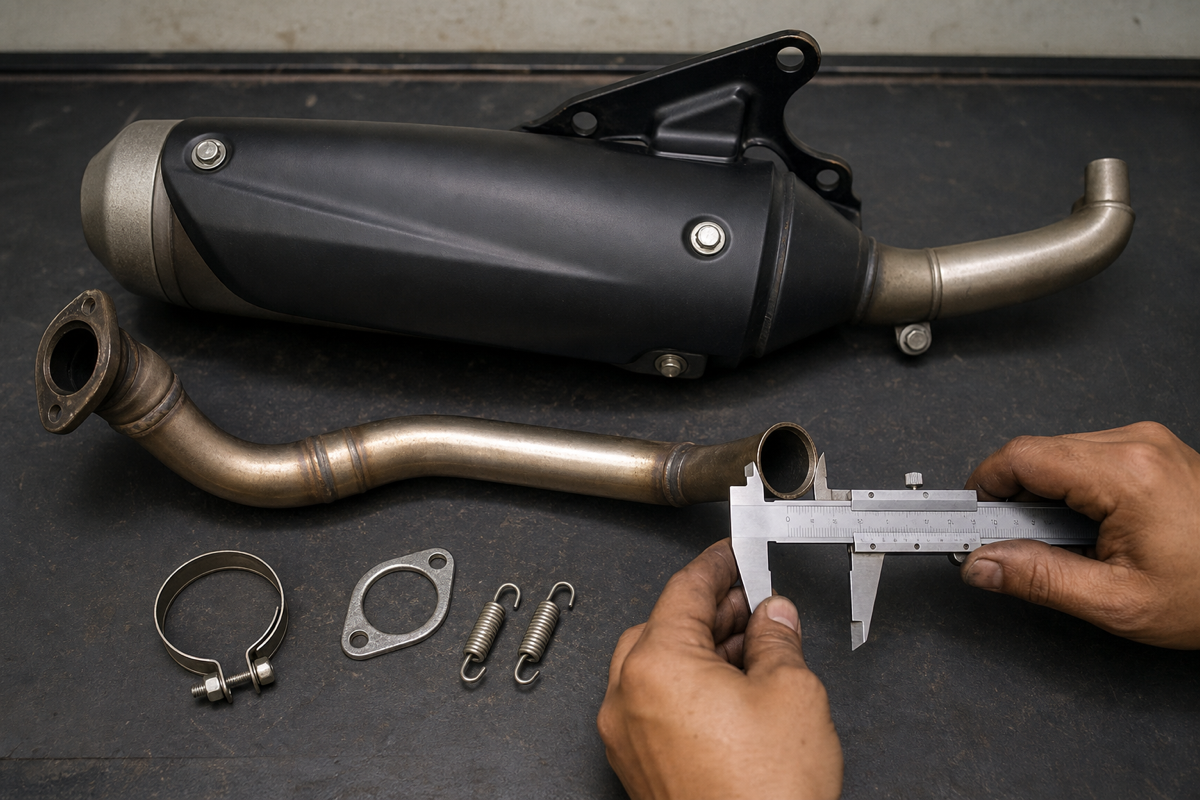
The biggest mistake when shopping by price is comparing parts only by photo. You need dimensions. Measure the inlet diameter, flange shape, bolt spacing, link-pipe angle, silencer length and bracket position. Also check whether the exhaust keeps enough distance from the rear tyre, shock absorber, brake hose, plastic panels and passenger footrest area.
For official model context, TVS lists the NTORQ 125 range and specifications through its own product pages, including engine and chassis information on the official TVS NTORQ page. Use official model data as a starting point, then inspect your exact scooter. Market versions, model years and previous repairs can still change what you see in the workshop.
Compatibility table
| Vehicle or use case | Compatibility | Important note |
|---|---|---|
| TVS NTORQ 125 stock scooter | Yes, with correct model-specific fitment | Check year, variant, bracket and gasket shape |
| NTORQ with previous exhaust modification | Depends on current header and hanger | Previous welding may change the job |
| Universal scooter silencer | Possible, not guaranteed | May need link pipe, bracket or fabrication |
| Other 125cc scooters | Only if dimensions match | Do not assume because engine size is similar |
| Track or private-area build | Often possible | Road legality may not apply, but safety still does |
| UK public road use | Only with suitable noise and roadworthy condition | Insurance and MOT expectations must be considered |
If you are comparing other exhaust decisions before buying, the X Moto Parts best motorcycle exhaust brands guide explains how construction, welds, packing and approval status separate good parts from noisy disappointments. Riders who want a wider fitment checklist should also read the universal motorcycle exhaust buying guide.
Build quality: what a better exhaust should include
A higher part cost is easier to justify when the kit includes the parts that prevent problems. Look for a correct gasket or gasket recommendation, clamps that suit the pipe, a strong hanger, a heat shield where needed, clean welds, a properly supported silencer and enough clearance around the bodywork. Missing small parts are not small when the scooter is on the stand and the old exhaust is already removed.
Look closely at weld beads, flange thickness, spring hooks and bracket design. Thin brackets can crack. Poor welds can leak. A flange that is not flat can blow exhaust gas at the cylinder head. If the kit uses a carbon-style sleeve, check the end caps and rivets. If the silencer can be repacked, that is useful for long-term ownership. A very low Ntorq exhaust price often means something has been simplified somewhere.
Sound versus performance
On a 125cc scooter, sound and performance are not the same thing. A freer exhaust may change throttle feel, but it will not turn the NTORQ into a larger-capacity machine. If the pipe is too open, the scooter can lose useful low-speed response. A balanced budget should pay for a system that sounds deeper while keeping daily rideability.
A small engine needs gas speed and clean fueling. If the exhaust change creates popping, flat spots or a strong fuel smell, check for leaks first. A leaking gasket can sound like a tuning issue. A misaligned bracket can crack a pipe. A poor seal at the header can disturb the way the engine runs. Do not assume that every symptom after an exhaust change means the scooter needs an ECU solution.
Installation checks that protect your money
Before judging whether the Ntorq exhaust price was worth paying, fit the part correctly. Work with the scooter cold. Support it securely on the centre stand. Remove the old exhaust carefully, inspect the studs, clean the gasket face and compare the new parts on the floor before tightening anything. If the kit does not naturally line up, stop and find out why.
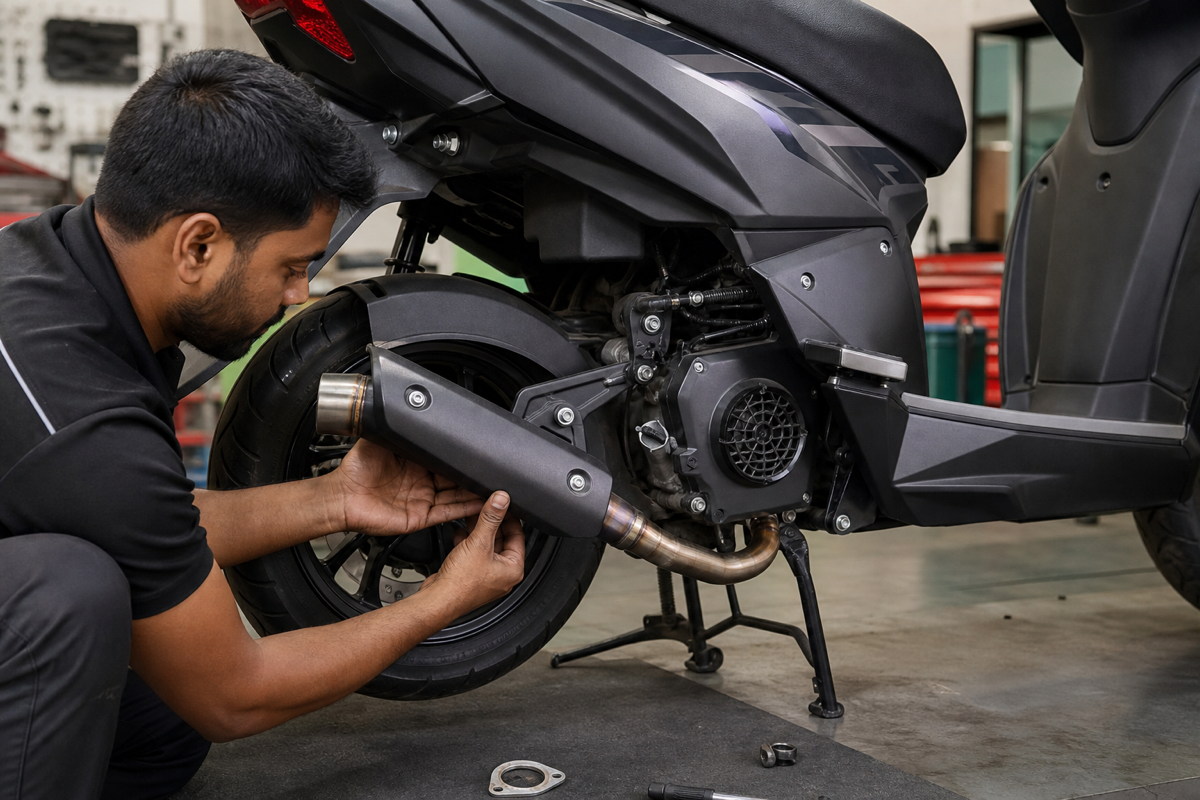
Fit all parts loosely first. Start at the header or link-pipe, then align the silencer and hanger. Do not use the mounting bolt to pull the exhaust into place. That creates stress, and stress becomes vibration, leaks or cracks. After the first heat cycle, let the scooter cool and recheck the fasteners. A sensible installation includes time for this second inspection.
Heat clearance
Scooter bodywork sits close to the exhaust. Check clearance near plastics, the rear shock, brake line and tyre. If the system includes a heat shield, make sure it is fixed securely. If the shield is decorative and does not cover the hot area, consider whether the exhaust is suitable for everyday use. This is where a cheap part can become annoying: poor heat management can damage panels or make the passenger area uncomfortable.
Leak testing
Start the engine briefly and feel for leaks without touching hot metal. Listen for sharp ticking at the flange and watch for exhaust gas marks after a short ride. A leak can make the scooter louder, weaker and less pleasant. If a new gasket is required, fit one. Reusing a crushed gasket just to save a few pounds is false economy.
UK road legality, MOT and English-speaking markets
For the UK, Ntorq exhaust price should never be separated from roadworthiness. The scooter may not be a common UK model, but the principle is still simple: an exhaust used on public roads should be secure, not excessively noisy, not leaking, and not obviously unsuitable for road use. The GOV.UK motorcycle MOT inspection guidance includes checks around exhaust condition and nuisance, including excessive noise, through the official motorcycle MOT inspection manual.
Rules vary by country. Ireland, Canada, Australia, New Zealand and the United States each handle noise, emissions and modified-vehicle enforcement differently. Some products are sold for track use, off-road use or private-area use only. If a part deletes emissions equipment, removes a catalytic converter where one is required, or is much louder than standard, check the rules before riding on public roads. A low purchase cost is not a bargain if it creates an inspection or insurance problem.
Comparing original, budget and premium exhaust options
A useful price comparison looks beyond the payment page. Ask what happens after six months of rain, heat cycles, vibration and daily use. A cheap system that rusts, loosens or becomes painfully loud can be poor value. A premium system is not automatically better either if it does not fit the exact scooter or if it is too loud for your use.
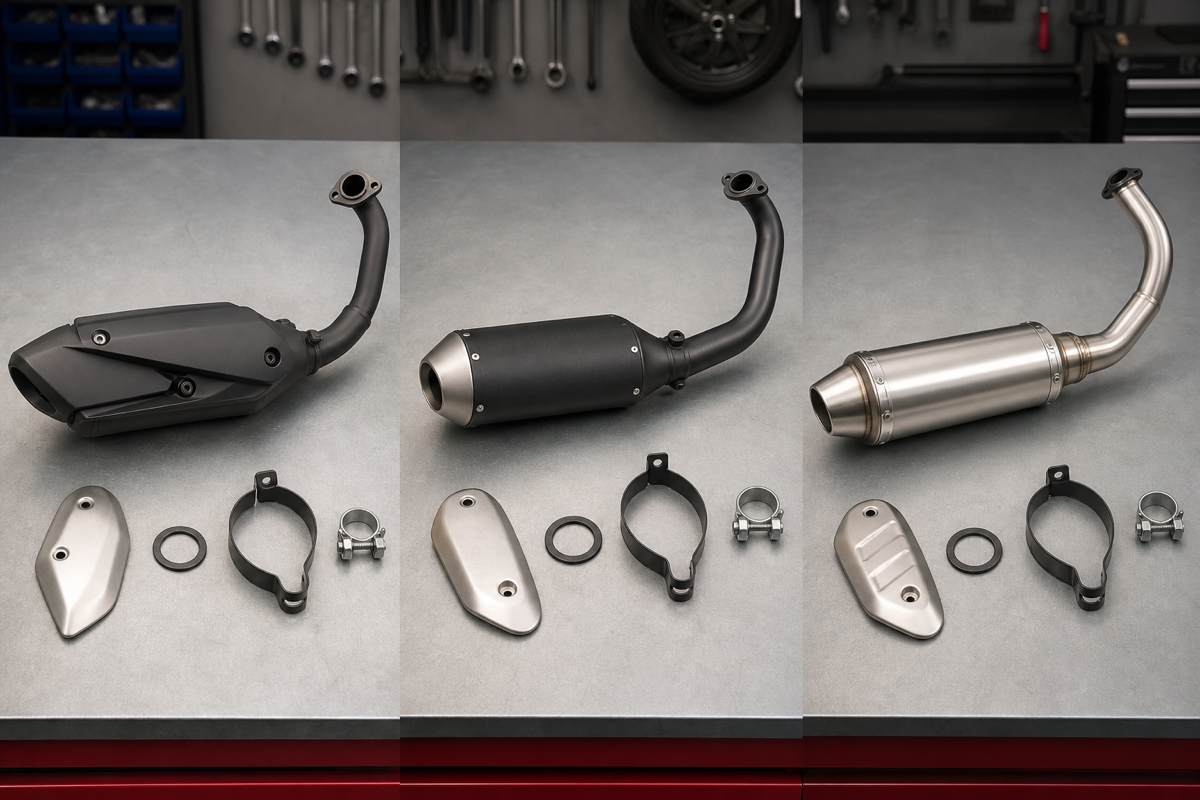
| Choice | Main advantage | Possible disadvantage | Best buyer |
|---|---|---|---|
| Original exhaust | Quiet, predictable, usually road-friendly | Less aggressive sound | Daily commuter |
| Budget sport exhaust | Lower purchase cost, stronger look | Fitment and noise can vary | Owner willing to measure carefully |
| Premium stainless exhaust | Better corrosion resistance and finish | Higher upfront cost | Long-term owner |
| Universal silencer | Flexible and often affordable | May require adaptation | Custom project with workshop support |
| Full system | Most complete sound and flow change | Legal and fueling checks matter more | Experienced modifier |
Common mistakes when shopping by price
The most common price-shopping mistake is buying from the cheapest listing without checking whether the system is for the correct scooter. A photo of a sporty silencer does not prove bracket alignment. A listing that says “for 125 scooter” does not prove NTORQ fitment. Ask for dimensions, mounting photos and included hardware.
The second mistake is ignoring the total cost. Add gasket, clamp, possible bracket, delivery, import charges, mechanic labour and return risk. A part that looks cheap online can cost more after it reaches the workshop, so Ntorq exhaust price should always be read as installed value, not only checkout value. Another mistake is removing the baffle to make the scooter louder, then discovering the engine feels worse at low speed or the scooter attracts unwanted attention.
The third mistake is fitting an exhaust without checking leaks. Even a good Ntorq exhaust price becomes poor value if the installation is rushed. Tighten evenly, recheck after heat cycling and inspect the hanger after the first rides. Vibrations on small scooters can loosen hardware if the bracket is stressed.
Finally, do not expect an exhaust alone to solve every performance complaint. If the scooter has a worn belt, dirty air filter, poor spark plug, low tyre pressure or dragging brake, an exhaust will not fix the underlying issue. For broader scooter maintenance thinking, the motorcycle chain tension adjustment guide shows the same principle in another final-drive system: the vehicle must be mechanically healthy before performance parts make sense.
Practical pre-purchase checklist
Before accepting any seller’s price, write down the scooter’s exact year, variant and market. Take photos of the current exhaust from both sides, including the flange, hanger and rear clearance. Measure the inlet where possible. Check whether the seller includes gasket, clamp, bracket, springs, heat shield and fitting instructions. Ask whether the part is road-use suitable or private-use only.
| Check | Why it matters | What good looks like |
|---|---|---|
| Inlet diameter | Wrong size causes leaks or fabrication | Matches the header or supplied link pipe |
| Flange and gasket | Sealing face must match | Flat flange, correct gasket, no forcing |
| Mounting bracket | Controls vibration and alignment | Bolt holes line up without stress |
| Heat shield | Protects rider and plastics | Secure shield near hot surfaces |
| Noise control | Affects comfort and legality | Controlled tone, DB-killer where required |
| Return policy | Protects against wrong fitment | Clear policy before installation marks appear |
Image metadata prepared for this guide
| File name | Title | Alt text | Caption purpose | Recommended position |
|---|---|---|---|---|
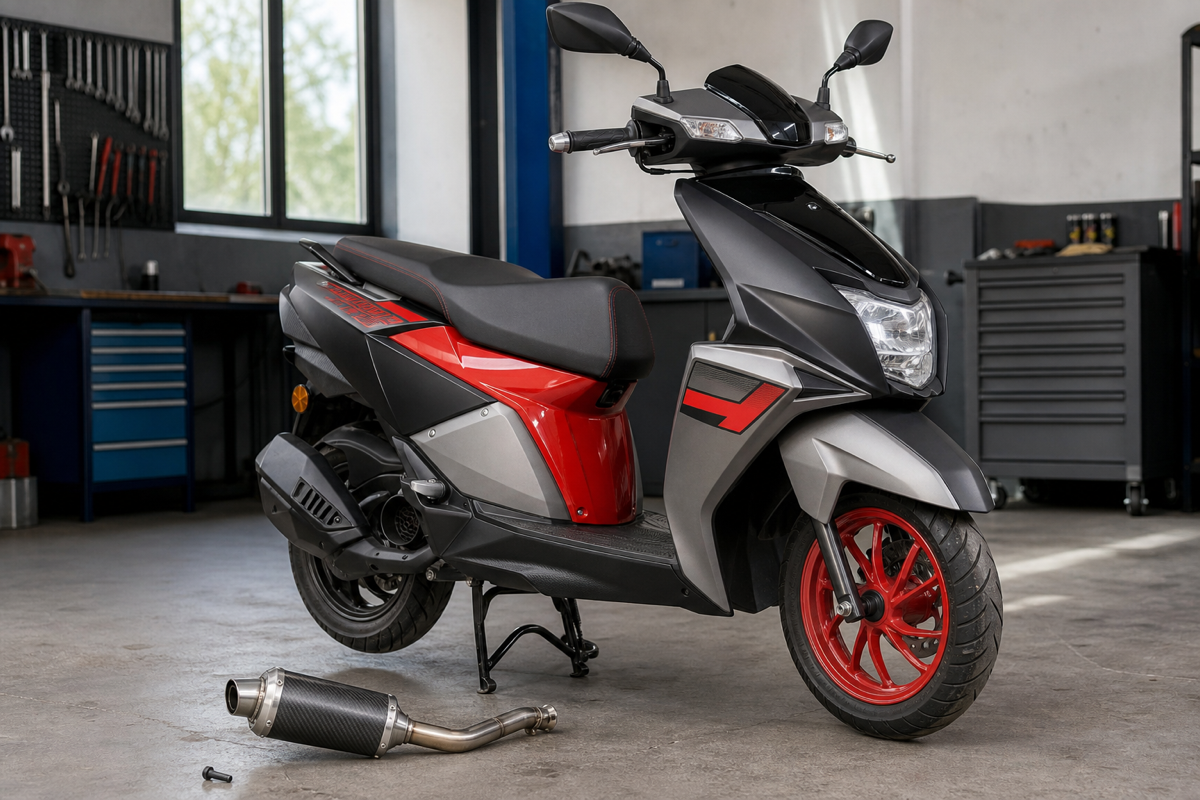
| ntorq-exhaust-price.png | NTORQ exhaust buying guide image | Ntorq exhaust price | Main image showing scooter and exhaust decision | After introduction |
| ntorq-exhaust-price-diameter-checks.png | Ntorq exhaust diameter checks | Ntorq exhaust price diameter and mounting checks | Shows the measurements that affect fitment | Fitment section |
| ntorq-exhaust-price-installation.png | Ntorq exhaust installation checks | Ntorq exhaust price installation checks on a sporty 125cc scooter | Shows bracket alignment and heat clearance checks | Installation section |
| ntorq-exhaust-price-comparison.png | Ntorq exhaust comparison | Ntorq exhaust price comparison between original budget and premium scooter exhausts | Shows original, budget and premium exhaust choices | Comparison section |
FAQ about Ntorq exhaust price
Why does Ntorq exhaust price vary so much?
Ntorq exhaust price varies because of material, fitment accuracy, included hardware, shipping, brand reputation, approval status and whether the system is original-style, sport, universal or full replacement.
Is the cheapest NTORQ exhaust a bad idea?
Not always, but it needs careful checking. A low-cost part can be acceptable if the diameter, bracket, gasket and sound level are right. It becomes a bad idea when it needs unexpected fabrication or leaks after fitting.
Will an aftermarket exhaust make a TVS NTORQ faster?
An exhaust may change sound, weight and throttle feel, but it will not turn a 125cc scooter into a much larger machine. Good setup protects rideability; poor setup can reduce low-speed response.
Do I need to remap or tune the scooter after changing the exhaust?
Many mild exhaust changes do not automatically require electronic tuning, but any popping, flat spots, overheating or poor running should be checked. Start with leaks, gasket condition, air filter and spark plug before assuming a remap is needed.
Can I fit a universal exhaust to a TVS NTORQ 125?
It may be possible, but only after measuring the inlet, link-pipe angle, bracket position and heat clearance. Universal means adaptable, not guaranteed plug-and-play.
Is a loud exhaust legal for road use?
Road legality depends on the country, inspection rules, noise level, emissions equipment and how the part is marketed. In the UK, an exhaust that is excessively noisy or insecure can create MOT and roadworthiness problems.
What should be included in a good NTORQ exhaust kit?
A good kit should include the correct silencer or system, link pipe if required, clamp, gasket guidance, bracket, springs where used, heat shield if needed and clear fitment information.
How should I compare Ntorq exhaust price before ordering?
Compare the total installed cost, not only the advertised part cost. Include shipping, tax, gasket, clamps, workshop labour, possible fabrication and whether the part can be returned if it does not fit.
Final advice before choosing an exhaust
Ntorq exhaust price should help you choose, but it should not make the decision alone. The best exhaust for a daily NTORQ 125 is the one that fits correctly, seals cleanly, keeps heat away from plastic, sounds controlled and suits the laws where the scooter is ridden. For a private-area project, you can accept more noise and adaptation, but safety still matters.
Before buying, measure the scooter, ask for real fitment details and check the total installed cost. If the listing is vague, pause. If the seller cannot explain brackets, inlet diameter or included hardware, keep looking. A well-chosen Ntorq exhaust price is not just a number; it is the cost of a part that lets the scooter ride properly after the box is opened.
For the next step, compare the X Moto Parts universal motorcycle exhaust buying guide, the best motorcycle exhaust brands guide and the motorcycle parts shop. Those pages will help you compare materials, fitment checks and realistic buying decisions before committing to an exhaust.