Yamaha XSR 125 power increase
Yamaha XSR 125 power increase is a common search because the XSR125 looks like a small retro roadster but uses a modern 125 cc, liquid-cooled, fuel-injected engine that is already close to the A1 learner limit. That makes the bike enjoyable, economical and stylish, but it also means the owner needs realistic expectations before buying exhausts, modules, filters, sprockets or tuning parts.
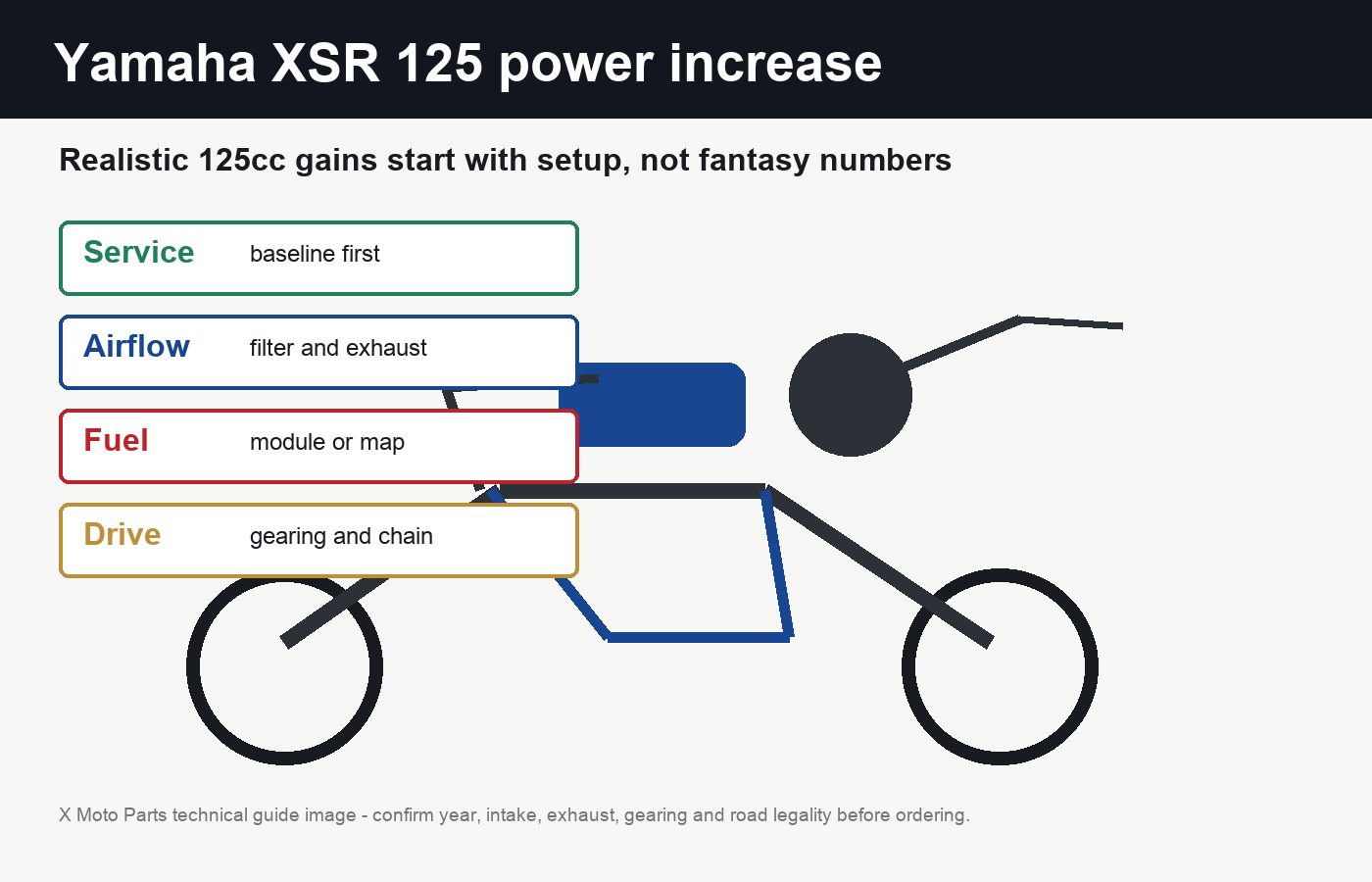
A sensible Yamaha XSR 125 power increase plan does not chase fantasy horsepower. It looks at the whole motorcycle: service condition, air filter, spark plug, chain, sprockets, tyre pressure, brake drag, exhaust fitment, fuelling support, rider weight, luggage and road legality. When those details are right, the bike can feel cleaner, sharper and more willing without becoming unreliable.

This guide is written like a workshop conversation with an owner standing beside the bike. It explains what a Yamaha XSR 125 power increase can actually achieve, which upgrades make sense, which ones create problems, how to check compatibility and how to keep the XSR125 useful for daily riding, weekend back roads and UK A1 use.
Realistic power on a 125
Yamaha XSR 125 power increase starts with the truth about the engine. The official Yamaha XSR125 Legacy specification lists a 124 cc liquid-cooled single-cylinder engine, electronic fuel injection, six-speed transmission and maximum power around 11 kW. That is already the A1-friendly ceiling many 125 riders are working around.
Because of that, a Yamaha XSR 125 power increase should be judged by ride quality as much as peak power. Cleaner throttle response, better pull through the mid-range, less hesitation after an exhaust change and gearing that suits the rider can all make the XSR125 feel stronger. A dyno sheet is useful, but the real test is whether the bike starts cleanly, pulls smoothly and remains pleasant on the road.
Why small gains still matter
On a 125, even small improvements can be felt. A well-serviced chain, correct tyre pressure and clean filter can change the way the bike accelerates. A carefully chosen Yamaha XSR 125 power increase setup may help the motorcycle recover better after a corner or climb more confidently, but the difference should be described honestly: response and usability first, major horsepower second.
If the motorcycle is slow because the chain is tight, the rear brake drags or the filter is dirty, a tuning module will not solve the real fault. The best Yamaha XSR 125 power increase work often begins with restoring the bike to its proper standard condition before adding any performance part.
Power, torque and gearing are not the same
Many owners ask for a Yamaha XSR 125 power increase when what they really want is better acceleration. Shorter final gearing can make the bike feel livelier in town and on hills, but it may raise rpm at cruising speed and reduce relaxed top-end running. Taller gearing can calm the bike down on faster roads, but it may make it feel weaker in traffic.
That is why the existing Yamaha XSR 125 tuning guide is useful background reading. This article focuses specifically on power-increase decisions, but tuning, gearing, exhaust and maintenance all overlap on a small-capacity motorcycle.
Baseline service before modification
A proper Yamaha XSR 125 power increase inspection begins before any new part is ordered. Check the service record, oil level, air filter, spark plug, coolant, chain slack, sprocket teeth, clutch free play, brake drag and tyre pressures. A 125 with neglected basics can feel tired even if the engine itself is healthy.
| Check | What to inspect | Why it matters |
|---|---|---|
| Air filter | Dirt, oiling, sealing and airbox condition | Restricted airflow can mimic weak engine performance |
| Chain and sprockets | Slack, tight spots, hooked teeth and alignment | Final drive friction makes the bike feel flat |
| Spark plug | Condition, colour and service age | Misfire or weak ignition ruins throttle response |
| Brakes | Dragging pads, sticking caliper or dry slider pins | Brake drag steals acceleration and fuel economy |
| Tyres | Pressure, size and wear pattern | Tyres change rolling resistance and stability |
The official Yamaha XSR125 Legacy specification page gives a useful standard reference for engine type, power, torque, fuel injection, chain final drive and tyre dimensions. Use the standard bike as the baseline before deciding whether a Yamaha XSR 125 power increase is worth pursuing.

Compatibility
A Yamaha XSR 125 power increase part must match the exact bike. The XSR125 shares family thinking with other Yamaha 125 models, but that does not make every exhaust, module, airbox part or sprocket setup universal. Model year, Euro emissions version, connector shape and exhaust routing can decide whether the part fits properly.
| Vehicle or setup | Compatibility | Important note |
|---|---|---|
| Yamaha XSR125 | Yes, with model-specific parts | Confirm year, market version and connector layout |
| Yamaha XSR125 Legacy | Often similar, still check | Wheel and styling details may differ, but engine checks remain important |
| Yamaha MT-125 or R125 parts | Not automatic | Shared engine family does not guarantee bracket, wiring or body clearance |
| Universal exhaust | Possible only with measurements | Pipe diameter, hanger line, catalyst and DB-killer must be checked |
| A1 road bike | Limited by legal context | Road legality, insurance and licence entitlement matter |
If the focus is reversible fuelling support, compare the performance parts category and confirm connector information before buying. A good Yamaha XSR 125 power increase should never require cutting the factory loom just to make an uncertain part fit.
Upgrade options compared
There are several ways to approach a Yamaha XSR 125 power increase. The right choice depends on whether the rider wants stronger low-speed pull, better sound, smoother fuelling after exhaust work or a more responsive commuter bike. Do not buy a full parts list until you know which problem you are solving.
| Upgrade | Main advantage | Possible disadvantage | Best suited to |
|---|---|---|---|
| Service-first refresh | Restores lost performance cheaply | No dramatic headline gain | Used bikes and unknown service history |
| Fuelling module | Can sharpen response when compatible | Connector and setup must be correct | Owners with exhaust or intake changes |
| Sports exhaust | Lower weight, sound and flow potential | Noise, E-mark and fuelling must be checked | Riders wanting feel and appearance |
| Final gearing change | Immediate acceleration feel | Can reduce relaxed cruising | Urban riding, hills and lighter riders |
| Full combined setup | Best balanced result if tested properly | More cost and more variables | Owners willing to install and test in stages |
A balanced Yamaha XSR 125 power increase usually works better than a loud, aggressive setup. Fit one change at a time where possible. Record how the bike starts, idles, pulls, cruises and uses fuel before each change. If a problem appears, you will know which part caused it.
Fuelling, exhaust and airflow
Yamaha XSR 125 power increase work often revolves around exhaust, airbox and fuelling. The XSR125 uses electronic fuel injection, so the bike is not tuned like an old carburetted 125. A freer-flowing exhaust may change sound and response, but if fuelling is not happy the engine can feel flat, hot, jerky or inconsistent.
Chip module or ECU work
For many owners, a reversible module is more practical than permanent ECU work. A Yamaha XSR 125 power increase module should match the sensor connector, be routed away from heat and moving parts, and be tested from the most conservative setting. If the bike runs worse, go back to baseline rather than increasing the setting blindly.
When a module is fitted correctly, the best improvement is usually cleaner throttle response and better feel after airflow changes. It should not be sold or judged as a miracle. A responsible Yamaha XSR 125 power increase keeps starting, idle, fuel economy and warning-light behaviour under control.

Exhaust, DB-killer and road sound
A sports exhaust can be part of a Yamaha XSR 125 power increase, but the details decide whether it is a good part or a noisy mistake. Check pipe diameter, hanger alignment, gasket seal, clearance near plastics, DB-killer fitment and whether the exhaust has road-use approval where needed. A leak at the header can make the bike pop, run poorly and sound broken.
Owners looking at exhaust changes should also read the universal motorcycle exhaust buying guide. It explains diameter, DB-killer and bracket checks that apply before any Yamaha XSR 125 power increase purchase involving exhaust parts.
Gearing and chain setup
Gearing changes can make a Yamaha XSR 125 power increase feel more obvious than engine parts. A smaller front sprocket or larger rear sprocket can help the bike pull harder at low speed, while a taller setup may suit riders who spend more time on flowing roads. The trade-off is always acceleration versus cruising rpm.
After changing sprockets, use the motorcycle chain tension adjustment guide. Chain slack on a small roadster is not decoration; it protects bearings, suspension movement and sprocket life. A poorly adjusted chain can undo the benefit of a Yamaha XSR 125 power increase very quickly.
Installation method
Fit a Yamaha XSR 125 power increase setup like a careful mechanic. Start with a clean bike. Photograph connector and exhaust routing. Keep standard parts. Use proper tools. Do not cross-thread exhaust studs, force plastic panels or route wiring where it can rub through. Small motorcycles respond badly to careless work because there is not much spare performance to hide mistakes.
Stage-by-stage workshop sequence
The safest sequence for a Yamaha XSR 125 power increase is service first, then one modification, then a proper test ride. If you fit exhaust, module, filter and sprockets at the same time, diagnosis becomes messy. If the bike surges or loses top speed, you will not know whether the cause is fuelling, gearing, an air leak or a dragging brake.
| Stage | Action | What to check after |
|---|---|---|
| 1 | Service baseline | Idle, starting, chain, tyre pressure and brake drag |
| 2 | Fit fuelling module if used | Connector security, warning lights and warm throttle response |
| 3 | Fit exhaust if used | Header seal, hanger alignment, DB-killer and noise |
| 4 | Adjust gearing if needed | Chain slack, axle alignment and cruising rpm |
| 5 | Final road test | Hot restart, steady throttle, plug condition and fuel use |
A good Yamaha XSR 125 power increase road test includes cold start, gentle warm-up, low-speed throttle, mid-range roll-on, engine braking, steady cruising and a hot restart. Listen for exhaust leaks, watch for warning lights and check that the throttle returns cleanly. The bike should feel sharper, not more fragile.

UK road legality and A1 limits
Yamaha XSR 125 power increase decisions must respect the UK road-use context. The XSR125 sits in the 125 cc learner/A1 world, where power, licence entitlement, insurance and roadworthiness matter. If a modification changes performance, sound, emissions equipment or declared specification, the rider should understand the legal and insurance consequences.
For UK riders, the GOV.UK motorcycle licence category guidance is essential reading. Exhaust changes also need care: excessive noise, missing road-use approval, removed catalyst or track-use-only parts can create road and insurance issues. A private-land performance setup is not the same as a road-legal setup.
In the United States, Canada, Australia, New Zealand and Ireland, rules vary by state, province, territory and vehicle registration. Do not assume a part is legal because it is sold online. Check road legality, emissions requirements, noise limits, insurance disclosure and local learner-bike rules before fitting performance parts to a bike used on public roads.
Common mistakes
The most common XSR125 upgrade mistake is expecting one part to overcome the legal and mechanical reality of a full-power 125. The second is fitting a loud exhaust without checking fuelling, DB-killer, gasket seal or road legality. The third is ignoring basic service condition and blaming the engine.
- Buying an exhaust without checking pipe diameter and hanger position.
- Assuming MT-125 or YZF-R125 parts automatically fit the XSR125.
- Ignoring UK A1 power context, insurance and road-use approval.
- Changing sprockets without checking chain length and slack.
- Fitting a module without confirming connector shape.
- Removing a DB-killer and then complaining about poor road manners.
- Using a dirty air filter as the baseline for tuning decisions.
- Expecting a 125 to behave like a larger bike after bolt-on parts.
- Changing too many parts at once and losing the diagnostic trail.
- Forgetting to recheck fasteners after the first heat cycle.
A mature XSR125 upgrade approach keeps the motorcycle enjoyable. The XSR125 is attractive because it is light, economical and simple to ride. Do not make it louder, fussier and less reliable just to chase a number that the engine was not designed to deliver.
FAQ
How much power can you get from a Yamaha XSR 125?
XSR125 power work should be realistic because the bike is already close to the A1-friendly 11 kW class. Bolt-on parts may improve response and feel, but major horsepower gains are not realistic without compromising cost, legality or reliability.
Is an exhaust worth it on the XSR125?
An exhaust can improve sound, reduce weight and slightly change response, but it must fit properly and remain suitable for road use. Exhaust work should be matched with fuelling checks and careful installation.
Do I need a remap after fitting an exhaust?
It depends on the exhaust, airbox condition and how the bike runs after fitting. If the bike surges, pops heavily, runs hot or feels flat, fuelling support may be needed. A conservative setup should be tested warm before further changes.
Can gearing make the Yamaha XSR125 faster?
Gearing can change acceleration feel, but it does not create engine power. Shorter gearing can make the bike pull harder at low speed, while taller gearing may help relaxed cruising if the engine can pull it. Choose based on riding use.
Is XSR125 performance tuning legal in the UK?
XSR125 performance work is only suitable for UK road use if the motorcycle remains legal, insured, roadworthy and appropriate for the rider’s licence category. Exhaust noise, emissions-related parts and declared modifications all matter.
Can I use universal 125 tuning parts?
Use caution. Universal parts may need adapters or may not suit the XSR125 at all. Pipe diameter, bracket position, sensor connector and clearance should be checked before buying any universal part.
What should I check after fitting performance parts?
Check idle, hot restart, throttle response, warning lights, exhaust leaks, chain slack, fuel smell, fasteners and plug condition. A good setup should feel cleaner and smoother, not unstable or harder to live with.
What is the best first upgrade?
The best first upgrade is usually a service baseline, then the part that solves your real complaint. If the bike feels flat because of gearing, change gearing. If it hesitates after exhaust work, look at fuelling. If it simply needs maintenance, do that first.
Final practical conclusion
XSR125 power work is worthwhile only when the goal is honest. The XSR125 is a stylish, full-power learner-friendly 125, not a hidden big bike waiting to be unlocked. The smartest improvements are service quality, correct chain setup, sensible gearing, well-fitted exhaust parts and compatible fuelling support where needed.
Before spending money, inspect the exact bike, confirm the model year, check the air filter, chain, brakes and tyres, then decide what problem you actually want to solve. If the bike is used on UK roads, keep licence, insurance, noise and emissions context in mind. For parts planning, compare the Yamaha XSR 125 tuning guide, the performance parts category and the chain tension guide before ordering.
A final upgrade check should ask one question: will this change make the motorcycle better to ride every day? If the answer is yes, fit carefully and test in stages. If the answer is only “it might sound faster”, keep looking for a better solution.
{
“@context”: “https://schema.org”,
“@type”: “Article”,
“headline”: “Yamaha XSR125 performance guide”,
“description”: “Yamaha XSR125 guide covering realistic gains, exhaust, fuelling, gearing, compatibility, installation and UK A1 road-use checks.”,
“author”: {
“@type”: “Organization”,
“name”: “X Moto Parts”
},
“publisher”: {
“@type”: “Organization”,
“name”: “X Moto Parts”,
“logo”: {
“@type”: “ImageObject”,
“url”: “https://xmotoparts.com/wp-content/uploads/x-moto-parts-logo.png”
}
},
“mainEntityOfPage”: {
“@type”: “WebPage”,
“@id”: “https://xmotoparts.com/yamaha-xsr-125-power-increase/”
}
}
{
“@context”: “https://schema.org”,
“@type”: “FAQPage”,
“mainEntity”: [
{
“@type”: “Question”,
“name”: “How much power can you get from a Yamaha XSR 125?”,
“acceptedAnswer”: {
“@type”: “Answer”,
“text”: “XSR125 power work should be realistic because the bike is already close to the A1-friendly 11 kW class. Bolt-on parts may improve response and feel, but major horsepower gains are not realistic without compromising cost, legality or reliability.”
}
},
{
“@type”: “Question”,
“name”: “Is an exhaust worth it on the XSR125?”,
“acceptedAnswer”: {
“@type”: “Answer”,
“text”: “An exhaust can improve sound, reduce weight and slightly change response, but it must fit properly and remain suitable for road use.”
}
},
{
“@type”: “Question”,
“name”: “Do I need a remap after fitting an exhaust?”,
“acceptedAnswer”: {
“@type”: “Answer”,
“text”: “It depends on the exhaust, airbox condition and how the bike runs after fitting. If the bike surges, pops heavily, runs hot or feels flat, fuelling support may be needed.”
}
},
{
“@type”: “Question”,
“name”: “Can gearing make the Yamaha XSR125 faster?”,
“acceptedAnswer”: {
“@type”: “Answer”,
“text”: “Gearing can change acceleration feel, but it does not create engine power. Shorter gearing can make the bike pull harder at low speed, while taller gearing may help relaxed cruising if the engine can pull it.”
}
},
{
“@type”: “Question”,
“name”: “Is XSR125 performance tuning legal in the UK?”,
“acceptedAnswer”: {
“@type”: “Answer”,
“text”: “XSR125 performance tuning is only suitable for UK road use if the motorcycle remains legal, insured, roadworthy and appropriate for the rider’s licence category.”
}
},
{
“@type”: “Question”,
“name”: “What should I check after fitting performance parts?”,
“acceptedAnswer”: {
“@type”: “Answer”,
“text”: “Check idle, hot restart, throttle response, warning lights, exhaust leaks, chain slack, fuel smell, fasteners and plug condition.”
}
}
]
}