
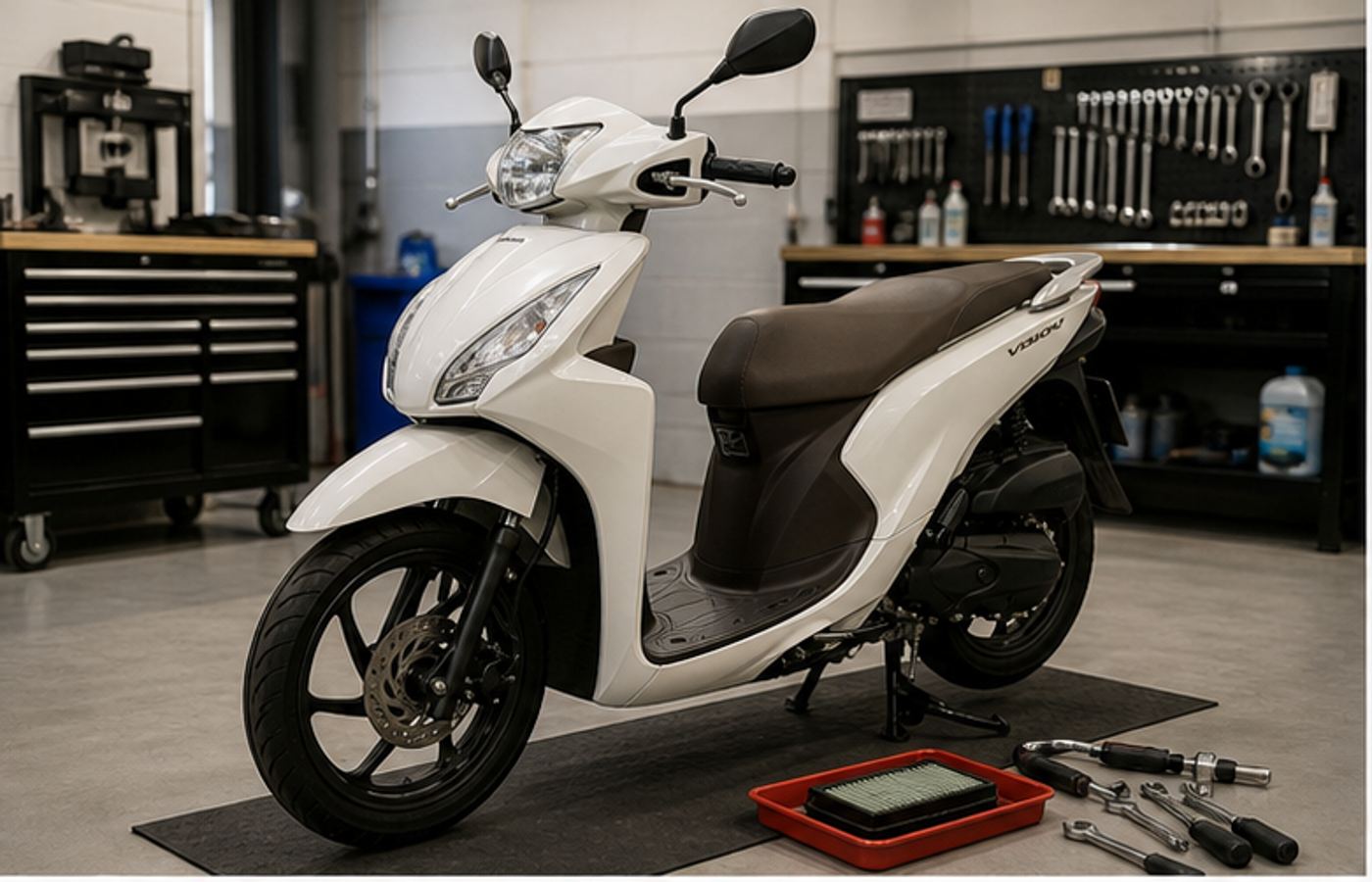
Honda Vision 110 power increase
Honda Vision 110 power increase is best understood as making a light commuter scooter cleaner, sharper and more willing in daily use, not turning it into a bigger-capacity machine. The Vision 110 is a practical air-cooled, fuel-injected, CVT scooter with modest factory output, low running costs and a simple job: start every morning, ride through traffic, carry shopping and use very little petrol. A good setup respects that character.

The important question is not whether a 109 cc scooter can be made faster in a dramatic way. The better question is where the scooter is losing response now. A worn belt, tired rollers, dirty air filter, weak spark plug, dragging brake or under-inflated tyre can make a Vision feel slower than it should. Once that baseline is right, small upgrades such as a carefully chosen exhaust, fresh CVT parts, sensible roller weight changes, a clean intake and conservative fuelling support can make the scooter feel more alert without damaging reliability.
What realistic gains actually mean
Honda Vision 110 power increase searches usually come from riders who want stronger pull away from junctions, less flatness on hills and a little more confidence when traffic speeds up. That is a sensible intention. The problem begins when owners expect a small commuter scooter to behave like a 125 sport scooter or a tuned two-stroke. Honda designed the Vision 110 for economy, easy maintenance and smooth automatic riding, so the available gains are mostly about response, drive and setup quality.
Honda’s UK specification lists the current Vision 110 with a 109 cc air-cooled two-valve OHC single-cylinder engine, PGM-FI fuel injection, CVT transmission and modest factory power output. You can check the official figures on the Honda UK Vision 110 specifications page. Those numbers matter because they set the ceiling. A small scooter can feel better, but a responsible Honda Vision 110 power increase does not ignore displacement, cooling, CVT gearing, emissions equipment or the intended learner-friendly character of the machine.
Where riders normally feel the weakness
Most complaints are not about peak speed alone. Owners talk about lazy acceleration from low speed, slow recovery after a roundabout, weak pull with a passenger, reduced speed into a headwind, vibration at high rpm or a scooter that once felt lively but now feels tired. In workshop terms, these symptoms point first to maintenance and transmission condition. A Honda Vision 110 power increase should start with diagnosis, because fitting parts to a scooter that is already down on basic condition only hides the real fault for a short time.
The Vision 110 uses a V-belt CVT, so the engine may be making normal power while the rear wheel is not receiving it efficiently. Belt width, roller wear, variator ramp condition, clutch shoe glazing and contra spring behaviour all affect how the scooter leaves a stop and climbs through speed. On a commuter that spends its life in town, CVT wear can feel exactly like engine weakness.
Checks before spending money on parts
Honda Vision 110 power increase decisions should begin with a simple inspection. Before ordering exhausts, tuning modules or transmission parts, confirm the exact model year, market version, engine code if available and whether the scooter is stock. A UK Vision, an EU-market Vision and an imported scooter can look similar while having different emission equipment, connector layouts or exhaust mounting details.

Start with tyre pressure, brake drag and wheel bearings. Then check oil level, air filter condition, spark plug colour, battery health, idle quality and any warning light history. If the scooter has old fuel, a restricted air filter, a slipping belt or a brake that does not fully release, the first improvement will come from maintenance, not performance parts. Riders looking for suitable scooter performance parts can compare relevant categories on X Moto Parts performance parts after these checks are complete.
Baseline inspection table
| Check | Why it matters | What a mechanic looks for |
|---|---|---|
| CVT belt | A worn belt changes effective gearing and acceleration | Width, cracks, glazing, dust and service interval |
| Rollers or sliders | Flat-spotted rollers make the scooter rev unevenly | Flat sides, weight match and variator ramp marks |
| Air filter | Restricted airflow reduces throttle response | Dirt, oil contamination and correct seating |
| Spark plug | Ignition quality affects starting and pull | Gap, colour, fouling, heat damage and service age |
| Exhaust joints | Leaks can make the engine noisy and inconsistent | Header gasket condition, hanger stress and corrosion |
| Brakes and tyres | Drag and pressure loss can mimic low power | Free wheel rotation, tyre pressure and uneven wear |
Compatibility for the Vision 110
Honda Vision 110 power increase compatibility is not only a question of engine size. The scooter’s CVT cover, exhaust hanger, oxygen sensor if fitted, intake routing, ECU strategy and emission equipment all decide whether a part will fit properly. Universal parts can work in some areas, but many are not plug-and-play. Model-specific parts are usually easier to install, while universal parts often require measurement and workshop judgement.
| Part or upgrade | Compatibility with Honda Vision 110 | Important note |
|---|---|---|
| CVT rollers or sliders | Usually possible when dimensions match | Weight and size must match the variator design |
| Drive belt | Only with exact dimension match | A wrong belt can reduce speed or damage the CVT |
| Sports exhaust | Depends on model year and mounting points | Check header shape, hanger, gasket and road approval |
| Air filter upgrade | Usually possible inside the original airbox | Open filters can hurt low-speed rideability |
| Fuel or response module | Depends on sensor connector and ECU layout | Confirm connector type before ordering |
| Custom project | Possible with professional work | May affect legality, insurance and reliability |
A rider considering a Honda Vision 110 power increase should never assume that any “110 cc scooter” part will fit. Honda’s underbone frame, wheel sizes and CVT packaging are specific enough that measurements matter. For broader fitment thinking, the universal motorcycle exhaust buying guide is useful because it explains pipe diameter, brackets, DB-killers and real mounting problems in plain terms.
CVT setup: the most honest route to better drive
Honda Vision 110 power increase work often begins inside the CVT cover because the scooter’s automatic transmission decides how engine power reaches the road. If the belt is narrow, the variator cannot push it to the same effective ratio. If rollers are worn, the engine may hang at the wrong rpm. If clutch shoes are glazed, the scooter may shudder away from a stop. These problems are common, practical and fixable.
Roller weight changes
Lighter rollers can let the engine rev sooner, which may improve take-off and hill response. Heavier rollers can calm revs and sometimes help cruising if the engine has enough torque to pull the ratio. The mistake is going extreme. A Honda Vision 110 power increase should use small changes, tested one step at a time, because a setup that feels punchy at 20 mph can become noisy, thirsty or slower at higher road speed.
Belt and variator condition
Measure the belt rather than judging it by eye alone. A belt can look acceptable while being narrow enough to change gearing. Clean the variator ramps, inspect the boss, check for uneven wear and remove dust from the clutch area. Do not grease the belt or pulley faces. If the scooter judders or smells hot after town riding, solve that before adding parts.

Exhaust, intake and fuelling on the Vision 110
Honda Vision 110 power increase upgrades around exhaust and intake need a careful approach. A freer exhaust may change sound and reduce weight, but it does not automatically create useful torque on a small four-stroke scooter. If the pipe diameter is too large, the engine may lose low-speed response. If the silencer is too loud or marked for track use only, the scooter may create MOT and insurance problems. If the intake is opened without fuelling support, the engine may run poorly.
The safest path for most owners is a healthy original airbox, a fresh filter, a sealed exhaust, correct gaskets and conservative fuelling support only when the scooter actually needs it. Anyone buying exhaust or intake-related parts should check the exact model year, hanger design and road-use status before ordering. The motorcycle exhausts category is a useful next step when you already know the measurements and the road-use requirement.
Comparing practical upgrade routes
| Solution | Main advantage | Possible disadvantage | Best suited to |
|---|---|---|---|
| Full service first | Restores lost performance and reliability | Does not add dramatic sound or appearance | Every used Vision 110 |
| CVT refresh | Improves pull-away and smoothness | Requires correct belt and roller dimensions | Town riders and high-mileage scooters |
| Sensible roller tuning | Can sharpen acceleration feel | Wrong weights can make the scooter slower | Riders who test methodically |
| Road-approved exhaust | Better sound and possible weight saving | Fitment and noise must be checked | Owners wanting sound plus neat appearance |
| Fuel or response support | Can help after airflow changes | Connector compatibility must be confirmed | Modified scooters that run lean or flat |
Installation advice from a mechanic’s point of view
Honda Vision 110 power increase parts should be fitted in stages. Do not install a belt, rollers, exhaust and fuelling device all in one afternoon and then try to guess which part caused a new symptom. Work cleanly, take photos before removing parts, keep original components and test after each change. This is slower, but it saves money and avoids chasing faults that were created during installation.
Workshop checks before the first ride
After CVT work, spin the rear wheel by hand with the scooter safely supported. Confirm that no tool or washer has been left inside the cover, the gasket area is seated, the kick-start parts if fitted are correctly positioned and the cover bolts are tightened evenly. After exhaust work, check header studs, gasket crush, hanger alignment and clearance from bodywork. After intake or wiring work, check that hoses, connectors and clips are not pinched under panels.
A clean Honda Vision 110 power increase road test starts gently. Warm the engine fully, listen at idle, ride at low speed, then roll on through the mid-range. Avoid judging the scooter in the first two minutes from cold. A small air-cooled engine and CVT need temperature before the behaviour is meaningful.

UK road legality, MOT and insurance
Honda Vision 110 power increase choices must respect road legality. In Great Britain, A1 and learner rules are important because a 110 cc scooter sits close to the everyday commuter and learner market. GOV.UK explains that A1 light motorcycles are up to 125 cc and up to 11 kW, and learner riding has its own CBT, L-plate and road-use rules. The official GOV.UK motorcycle licence categories page is the right place to confirm current licence entitlement.
The MOT view is also practical. The motorcycle MOT manual says exhaust noise should not be clearly unreasonably above the level expected from a similar motorcycle with a standard silencer, and insecure exhaust parts are a defect. Track-use-only markings can also create trouble on road machines. That means a Honda Vision 110 power increase based on a loud exhaust can be a poor choice for a daily scooter, even if it sounds exciting for the first week.
Outside the UK, rules differ. In the United States, Canada, Australia, New Zealand and Ireland, road legality, emissions equipment, noise, learner categories and insurance disclosure can vary by state, province, territory or registration class. A product sold online may be legal for private land, off-road use or competition but unsuitable for public roads. Keep receipts, part details and approval information, and tell your insurer about relevant modifications.
Common mistakes that make the scooter worse
Honda Vision 110 power increase mistakes are usually simple. The first is fitting rollers that are too light because the scooter feels lively on the stand. On the road, the engine may rev loudly without gaining speed. The second is fitting an exhaust without checking gasket sealing or hanger stress. A small leak at the head can sound like performance while reducing smoothness. The third is fitting an open intake that lets in hot air, water and dirt while losing the calm low-speed behaviour that makes the Vision useful.
Buying mistakes
Do not buy purely by appearance. Check scooter year, engine family, exhaust hanger position, pipe diameter, sensor requirements, CVT part dimensions and whether the component is road-approved. Do not confuse universal with plug-and-play. Universal parts often need measuring, brackets and workshop adaptation. If a seller cannot confirm fitment, ask before ordering rather than forcing the part onto the scooter.
Installation mistakes
Do not reuse a crushed exhaust gasket if it leaks. Do not tighten one hanger bolt fully before the rest of the system is aligned. Do not run the engine with loose panels near the fan or CVT cover. Do not ignore warning lights, fuel smell, rough idle, belt squeal or brake drag after the work. A proper Honda Vision 110 power increase feels cleaner after installation, not harsher, hotter or more fragile.
Signs the setup is working properly
A successful Honda Vision 110 power increase is obvious in a modest way. The scooter starts cleanly, idles steadily, pulls away without hesitation, keeps a more consistent rpm through the CVT and does not smell hot after a normal ride. It should not need excessive throttle just to keep up with town traffic. It should also remain quiet enough, economical enough and reliable enough for commuting.
| Symptom after modification | Likely area to recheck | Practical response |
|---|---|---|
| High revs but poor road speed | Roller weight or belt width | Return closer to standard roller weight and measure the belt |
| Flat response after exhaust change | Pipe diameter, leak or fuelling | Check gasket, hanger alignment and mixture symptoms |
| Judder on take-off | Clutch shoes or bell glazing | Inspect clutch condition and clean CVT dust properly |
| Hot smell after a short ride | Belt slip, brake drag or exhaust leak | Stop testing and inspect before riding further |
| Warning light appears | Sensor connector or ECU fault | Read fault codes and undo the latest change if needed |
When the upgrade is worth doing
Honda Vision 110 power increase work is worth doing when the owner wants a smoother, cleaner and more responsive scooter for real roads. It is not worth doing if the real goal is motorway performance, big top-speed gains or racing-style acceleration. For that, a larger scooter is usually cheaper and more reliable in the long run.
The best value route is normally service baseline, CVT refresh, careful roller choice, road-suitable exhaust only if fitment is clear, then fuelling support only when symptoms justify it. If the scooter is used for commuting, keep the setup quiet, easy to insure and easy to return to standard. Riders planning a broader scooter project can also compare general options through the X Moto Parts shop once measurements and model details are known.
FAQ
Can you make a Honda Vision 110 faster?
Yes, but the gains are modest. A Honda Vision 110 power increase should focus on restoring lost performance, improving CVT response and choosing sensible parts rather than chasing unrealistic horsepower figures.
What is the best first upgrade for the Honda Vision 110?
The best first upgrade is often not an upgrade at all. Service the scooter, inspect the CVT belt and rollers, check tyre pressure, replace a dirty air filter and make sure the brakes are not dragging. After that, performance parts make more sense.
Do lighter rollers improve acceleration?
Lighter rollers can improve initial response if the scooter was shifting too early, but going too light makes the engine rev without adding useful speed. Small changes and road testing are the right approach.
Does an exhaust add power to a Vision 110?
An exhaust can change sound, weight and throttle feel, but it will not transform the scooter by itself. Fitment, gasket sealing, pipe diameter, road approval and fuelling behaviour matter more than appearance.
Do I need a tuning module for a Honda Vision 110 power increase?
A tuning or response module is only worth considering when connector compatibility is confirmed and the scooter actually needs fuelling support after other changes. It should not be used to mask poor maintenance or a leaking exhaust.
Is Honda Vision 110 tuning legal in the UK?
It depends on the part and the final condition of the scooter. Road-use parts must be suitable for public roads, the scooter must remain insured and roadworthy, and exhaust noise or track-use-only markings can create MOT problems.
Will modifications affect insurance?
It can. Insurers may treat performance parts, exhaust changes or fuelling modifications as declarable modifications. Always tell the insurer before using a modified scooter on public roads.
Can I install the parts myself?
Basic service work may be suitable for a careful home mechanic, but CVT, exhaust and wiring work require proper tools, safe support and correct torque. If you are unsure, use a qualified mechanic.
Final buying advice
Honda Vision 110 power increase planning should be practical. Measure before ordering, check model year, inspect the CVT, confirm exhaust hanger alignment, keep the original airbox sensible, avoid extreme roller changes and make sure any road scooter remains legal, quiet enough and properly insured. If a part is universal, expect measuring and adaptation. If a part is model-specific, still confirm the year and market version. The right setup makes the Vision more pleasant to ride every day; the wrong setup makes a reliable commuter noisy, thirsty and harder to trust.
For most owners, the smart next step is to choose parts only after the service baseline is known. A careful Honda Vision 110 power increase starts with the scooter in front of you, not with a promise on a product page.
{
“@context”: “https://schema.org”,
“@type”: “Article”,
“headline”: “Honda Vision 110 power increase”,
“description”: “Honda Vision 110 power increase guide covering realistic gains, CVT setup, exhaust fitment, fuelling, installation, UK legality and buying advice.”,
“author”: {
“@type”: “Organization”,
“name”: “X Moto Parts”
},
“publisher”: {
“@type”: “Organization”,
“name”: “X Moto Parts”,
“logo”: {
“@type”: “ImageObject”,
“url”: “https://xmotoparts.com/wp-content/uploads/x-moto-parts-logo.png”
}
},
“mainEntityOfPage”: “https://xmotoparts.com/honda-vision-110-power-increase/”,
“image”: “https://xmotoparts.com/wp-content/uploads/honda-vision-110-power-increase.jpg”
}
{
“@context”: “https://schema.org”,
“@type”: “FAQPage”,
“mainEntity”: [
{
“@type”: “Question”,
“name”: “Can you make a Honda Vision 110 faster?”,
“acceptedAnswer”: {
“@type”: “Answer”,
“text”: “Yes, but the gains are modest. The best approach is restoring lost performance, improving CVT response and choosing sensible parts rather than chasing unrealistic horsepower figures.”
}
},
{
“@type”: “Question”,
“name”: “What is the best first upgrade for the Honda Vision 110?”,
“acceptedAnswer”: {
“@type”: “Answer”,
“text”: “The best first step is a full service, including CVT belt and rollers, tyre pressure, air filter, spark plug and brake drag checks.”
}
},
{
“@type”: “Question”,
“name”: “Do lighter rollers improve acceleration?”,
“acceptedAnswer”: {
“@type”: “Answer”,
“text”: “Lighter rollers can help if the scooter shifts too early, but rollers that are too light can make the engine rev loudly without adding useful speed.”
}
},
{
“@type”: “Question”,
“name”: “Does an exhaust add power to a Vision 110?”,
“acceptedAnswer”: {
“@type”: “Answer”,
“text”: “An exhaust can change sound, weight and throttle feel, but fitment, gasket sealing, pipe diameter, road approval and fuelling behaviour decide whether it works well.”
}
},
{
“@type”: “Question”,
“name”: “Do I need a tuning module?”,
“acceptedAnswer”: {
“@type”: “Answer”,
“text”: “Only when connector compatibility is confirmed and the scooter actually needs fuelling support after other changes.”
}
},
{
“@type”: “Question”,
“name”: “Is Honda Vision 110 tuning legal in the UK?”,
“acceptedAnswer”: {
“@type”: “Answer”,
“text”: “It depends on the part and the final condition of the scooter. Road-use parts must be suitable for public roads, and the scooter must remain insured and roadworthy.”
}
},
{
“@type”: “Question”,
“name”: “Will modifications affect insurance?”,
“acceptedAnswer”: {
“@type”: “Answer”,
“text”: “They can. Exhaust changes, performance parts and fuelling modifications should be declared to the insurer before road use.”
}
},
{
“@type”: “Question”,
“name”: “Can I install the parts myself?”,
“acceptedAnswer”: {
“@type”: “Answer”,
“text”: “Some service work is suitable for a careful home mechanic, but CVT, exhaust and wiring work require proper tools, safe support and correct installation.”
}
}
]
}