
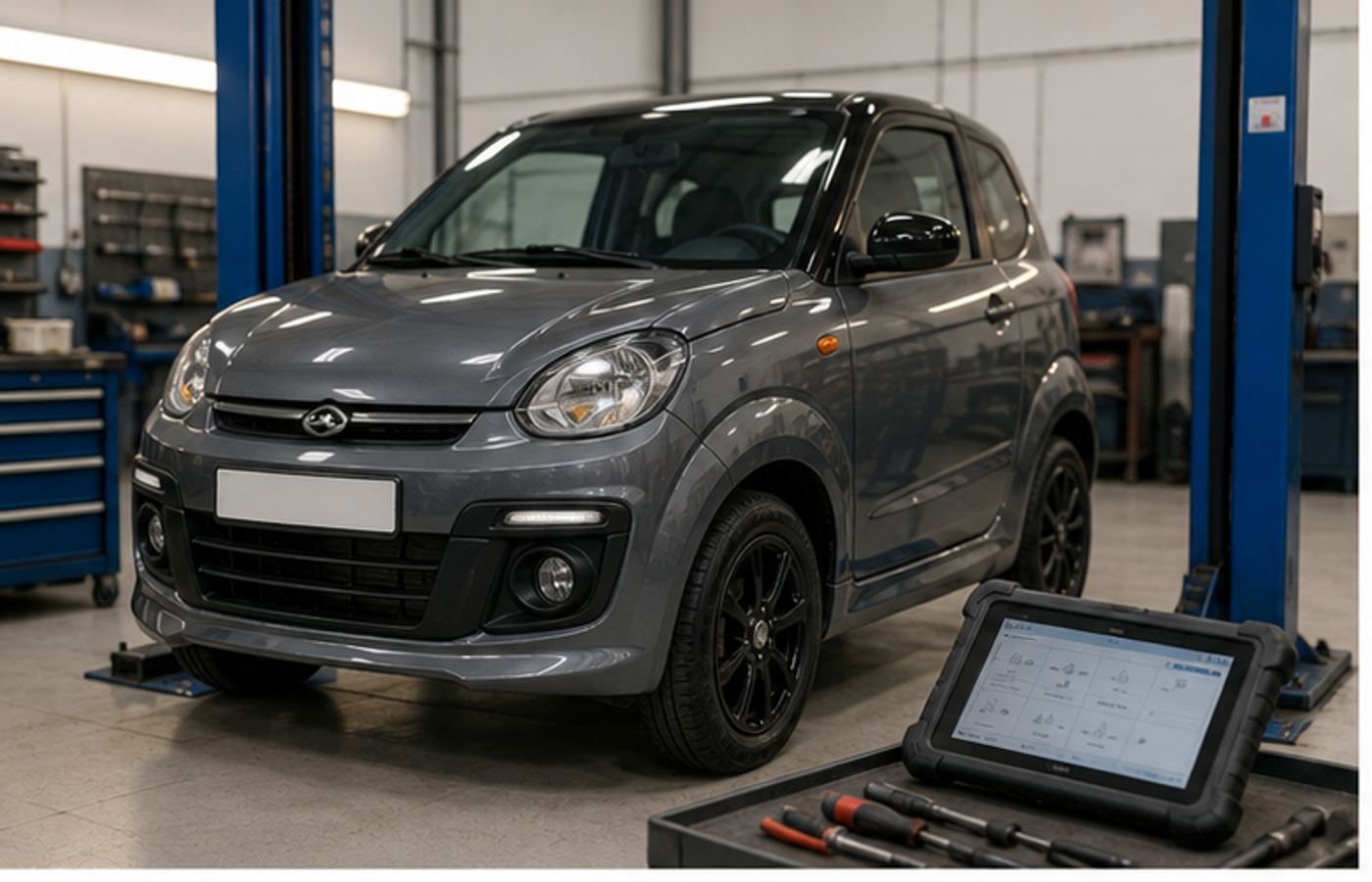
Ligier JS 50 tuning
Ligier JS 50 tuning should be treated as careful microcar setup, not as a shortcut to making a light quadricycle behave like a normal car. The JS50 is built for low-speed urban mobility, learner-style access in many European markets and very low running costs. That means the sensible route is to restore lost performance, reduce unnecessary drag, keep the CVT healthy, improve throttle response where possible and stay honest about road legality.

The biggest mistake is assuming the JS50 is slow only because it needs a tuning box. A dirty air filter, old fuel filter, weak battery, worn variator belt, sticking brake caliper, poor tyre pressure or tired exhaust joint can all make a microcar feel lazy. Once the basic condition is right, small improvements may be possible through CVT servicing, correct belt dimensions, intake maintenance, exhaust sealing and conservative electronic support. A good setup feels cleaner and safer; it does not make the vehicle unstable, illegal or unreliable.
What realistic microcar tuning can and cannot do
Ligier JS 50 tuning usually attracts owners who want better pull away from junctions, less struggling on hills, cleaner acceleration and fewer embarrassing moments in traffic. Those are understandable goals. The JS50, however, is a small quadricycle, not a hatchback. It is designed around low mass, restricted performance and compact diesel or small-capacity drivetrain packages depending on market and year.
Before buying parts, check the exact model and engine fitted to your vehicle. Ligier’s official model information is the best starting point for understanding the vehicle family, trim and intended use; the manufacturer site is available at Ligier official. A responsible Ligier JS 50 tuning plan respects the original vehicle category, braking capacity, tyres, suspension, noise level and insurance status.
Where owners normally feel the problem
Most complaints are practical: slow pull away, flat response after a bend, loss of speed on hills, vibration, excessive engine noise, belt squeal, rough idle or a vehicle that feels more tired than it used to. In a workshop, those symptoms do not point immediately to more power. They point to maintenance, CVT condition, fuel supply, intake restriction, exhaust leakage and drivetrain drag. Ligier JS 50 tuning works best when diagnosis comes before spending.
A microcar that cannot reach normal restricted speed may have a worn belt, blocked filter, dragging brake, low battery voltage affecting control systems or a slipping variator. A microcar that is loud but not stronger may have an exhaust leak rather than an upgrade. A vehicle that feels sharp for one day and then unreliable has probably been modified without checking the basics.
How to judge improvement without guessing
Ligier JS 50 tuning should be judged with repeatable checks, not only by feel. Note cold-start behaviour, warm idle, pull-away smoothness, belt noise, hill speed, braking feel and hot restart before fitting anything. After each change, repeat the same route with similar load and weather if possible. Ligier JS 50 tuning that genuinely works will make the vehicle more consistent in the same conditions, not just louder on the first test drive. If the result of Ligier JS 50 tuning is smoke, overheating, vibration or nervous braking, stop and inspect the installation instead of adding more parts.
Checks before buying tuning parts
Ligier JS 50 tuning should begin with a service baseline. Confirm the vehicle identification, year, engine type, transmission layout and whether the vehicle is already modified. Then inspect air filter condition, fuel filter age, battery voltage, glow system behaviour where applicable, coolant level, oil service history, exhaust joints, brake drag, tyre pressures and CVT belt condition.

These checks matter because many microcars live hard lives: short trips, cold starts, stop-start town driving and irregular servicing. Anyone planning Ligier JS 50 tuning should first make the vehicle perform as it did when healthy. After that, parts can be chosen with a clear purpose. For general upgrade browsing, use X Moto Parts performance parts only after confirming the mechanical baseline.
Baseline inspection table
| Area | Why it matters | Workshop check |
|---|---|---|
| CVT belt | Worn width changes drive ratio and acceleration | Measure width, inspect cracks, glazing and dust |
| Variator | Sticky rollers or ramps cause lazy pull away | Inspect ramps, weights, bushings and pulley faces |
| Air filter | Blocked airflow weakens throttle response | Check filter sealing, dirt and airbox clips |
| Fuel filter | Restricted diesel flow feels like low power | Replace if service age is unknown |
| Brakes | Dragging pads waste the limited available power | Spin wheels, check calipers and handbrake release |
| Tyres | Wrong pressure creates drag and poor stability | Set pressures, inspect wear and age |
Compatibility for the JS50
Ligier JS 50 tuning compatibility depends on engine version, injection system, CVT layout, belt size, exhaust routing, sensor connectors and the legal category of the vehicle. A part advertised for “microcar tuning” may not fit every Ligier. Aixam, Microcar, Chatenet and Ligier models can use similar ideas but different dimensions, brackets and electronics.
| Upgrade type | Compatibility | Important note |
|---|---|---|
| CVT belt | Only with exact dimension match | Wrong belt width can reduce speed or damage pulleys |
| Variator service parts | Depends on transmission version | Weights, ramps and bushings must match |
| Air filter | Usually possible when shaped for the airbox | Do not bypass filtration on a road vehicle |
| Exhaust repair or upgrade | Depends on hanger and pipe layout | Check noise, sealing and road-use status |
| Electronic module | Only if connector and engine system match | Incorrect wiring can create faults or unsafe behaviour |
| Custom setup | Possible with professional work | May affect insurance, category and road legality |
A careful Ligier JS 50 tuning decision uses measurements, not assumptions. Measure belt size, inspect pulley condition, photograph connectors, check exhaust hangers and confirm whether the vehicle is a light quadricycle or another category in the country where it is registered. For exhaust fitment principles, the universal exhaust fitment guide is useful even though a microcar is not a motorcycle, because pipe diameter, mounting and noise control still matter.
Engine, CVT and exhaust setup
Ligier JS 50 tuning often starts in the CVT because the transmission decides how small engine output reaches the road. If the belt is narrow, the vehicle may never reach the proper ratio. If the variator is dirty or worn, acceleration becomes uneven. If the clutch side is slipping, the engine revs but the vehicle does not move with confidence. A CVT refresh can feel like a power upgrade because it restores lost drive.
Diesel engine checks
Many JS50 vehicles use small diesel engines, so fuel delivery and air supply are critical. Replace an old fuel filter, check intake hoses, inspect for leaks, confirm the battery is strong and keep oil service intervals sensible. A Ligier JS 50 tuning plan that ignores fuel filter age or intake sealing is not a real plan. It is just guessing.
Exhaust and noise
Exhaust work should be conservative. A leaking or corroded exhaust can make the vehicle louder without improving performance. A road vehicle also needs reasonable noise levels and secure mounting. Check pipe joints, rubber mounts, hanger stress and clearance from bodywork. If a product is described as competition-only or private-land-only, do not treat it as a road solution.

Installation and road-test checks
Ligier JS 50 tuning parts should be installed one stage at a time. Service first, test. CVT belt next, test. Variator work next, test. Exhaust repair next, test. Electronic support only after compatibility is confirmed and mechanical condition is known. If everything is fitted together, new symptoms become difficult to trace.
After installation, use a calm road test. Start cold, idle, warm fully, pull away gently, check mid-speed response, listen for belt squeal, test braking, watch temperatures and perform a hot restart. The vehicle should feel more consistent, not more fragile. A good Ligier JS 50 tuning result does not create smoke, harsh vibration, warning lights, fuel smell, excessive noise or unstable braking.

UK and European road legality
Ligier JS 50 tuning must be considered within the vehicle category. In the UK, moped and light quadricycle rules are tied to licence categories, age and vehicle specification. GOV.UK explains mopeds, motorcycles and light quadricycle licence rules on its licence category guidance. If tuning changes the vehicle’s restricted status, speed, noise, emissions or declared specification, it can affect road legality and insurance.
In France, Italy, Ireland and other European markets, microcar rules can differ. Some JS50 vehicles are treated as light quadricycles, some owners use AM-category rules, and inspection requirements vary. A Ligier JS 50 tuning setup for private land is not the same as a road-approved setup. Distinguish road use, private land, competition use and off-road use before buying parts.
Common mistakes
Ligier JS 50 tuning goes wrong when owners chase speed before safety. The first mistake is ignoring brakes and tyres. A light quadricycle with more response but poor braking is worse, not better. The second is fitting the wrong CVT belt. The third is forcing a universal part into a system that needs exact dimensions. The fourth is hiding modifications from an insurer.
Buying mistakes
Do not buy a module without connector photos. Do not buy a belt without exact dimensions. Do not assume every JS50 year uses the same drivetrain. Do not choose exhaust parts only by sound. Do not ignore whether a part is road-approved. A proper Ligier JS 50 tuning purchase starts with engine, CVT, registration category and intended road use.
Installation mistakes
Do not run a belt on dirty pulley faces. Do not leave wiring near heat or moving parts. Do not ignore brake drag. Do not test at full load before warming the engine. Do not continue driving if the vehicle smokes, loses coolant, overheats or develops a new warning light. Good workshop discipline matters more than a big claim on a box.
Practical comparison of upgrade routes
| Route | Main advantage | Possible disadvantage | Best for |
|---|---|---|---|
| Full service baseline | Restores lost reliability and response | No dramatic headline gain | Every used JS50 |
| CVT belt and variator refresh | Improves real drive and consistency | Needs exact parts and clean installation | Vehicles with weak pull away |
| Intake and fuel filter care | Helps engine breathe and receive fuel cleanly | Small effect if already serviced | High-mileage microcars |
| Exhaust repair or mild upgrade | Can reduce leaks and tidy sound | Noise and fitment must be checked | Corroded or leaking systems |
| Electronic support | Can sharpen response when compatible | Legal and wiring risks if used badly | Professionally checked vehicles |
FAQ
Can you tune a Ligier JS50?
Yes, but Ligier JS 50 tuning should be realistic. The safest gains come from service condition, CVT health, correct belt dimensions, intake maintenance and careful compatibility checks.
Why is my Ligier JS50 slow?
Common causes include a worn CVT belt, dirty variator, blocked air filter, restricted fuel filter, dragging brakes, low tyre pressure, weak battery or exhaust leak. Diagnose these before buying tuning parts.
Does a tuning box work on a Ligier JS50?
Only if it matches the engine and connector system, and even then it should be adjusted conservatively. A tuning box cannot fix poor maintenance, a slipping belt or brake drag.
Can CVT work improve acceleration?
Yes. A fresh belt, clean variator and correct pulley operation can restore lost acceleration. On many microcars, CVT condition has more real effect than a bolt-on performance claim.
Is Ligier JS 50 tuning legal in the UK?
It depends on the vehicle category and the modification. Changes that affect speed, emissions, noise, insurance or registered specification can create legal problems on public roads.
Will tuning affect insurance?
It can. Any performance, exhaust, drivetrain or electronic modification should be declared to the insurer before road use.
Can I fit universal exhaust parts?
Sometimes, but universal does not mean bolt-on. Pipe diameter, hanger position, noise level, road-use status and body clearance must be checked.
Should I use a mechanic?
Use a mechanic if the job involves CVT internals, wiring, fuel system work, exhaust fabrication, warning lights or anything that affects brakes, steering or road legality.
Final buying advice
Ligier JS 50 tuning should make the vehicle healthier, smoother and more confidence-inspiring. Start with the service baseline, measure the CVT belt, inspect the variator, check brakes and tyres, confirm exhaust sealing and only then consider parts. Choose model-specific components when possible. Use universal parts only when you can measure and adapt them correctly. Keep the setup road-legal, insured and documented.
For owners comparing related parts, the practical next step is to check fitment and intended use through X Moto Parts shop and keep the existing Ligier JS50 derestriction guide in mind when the question is specifically about restricted speed rather than general setup. The best Ligier JS 50 tuning result is not the loudest or most aggressive one; it is the one that works every day without making the microcar unsafe or illegal.
{
“@context”: “https://schema.org”,
“@type”: “Article”,
“headline”: “Ligier JS 50 tuning”,
“description”: “Practical JS50 guide covering realistic microcar tuning, CVT setup, diesel engine checks, exhaust fitment, road legality and buying advice.”,
“author”: {
“@type”: “Organization”,
“name”: “X Moto Parts”
},
“publisher”: {
“@type”: “Organization”,
“name”: “X Moto Parts”,
“logo”: {
“@type”: “ImageObject”,
“url”: “https://xmotoparts.com/wp-content/uploads/x-moto-parts-logo.png”
}
},
“mainEntityOfPage”: “https://xmotoparts.com/ligier-js-50-tuning/”,
“image”: “https://xmotoparts.com/wp-content/uploads/ligier-js-50-tuning.jpg”
}
{
“@context”: “https://schema.org”,
“@type”: “FAQPage”,
“mainEntity”: [
{
“@type”: “Question”,
“name”: “Can you tune a Ligier JS50?”,
“acceptedAnswer”: {
“@type”: “Answer”,
“text”: “Yes, but it should be realistic. The safest gains come from service condition, CVT health, correct belt dimensions, intake maintenance and careful compatibility checks.”
}
},
{
“@type”: “Question”,
“name”: “Why is my Ligier JS50 slow?”,
“acceptedAnswer”: {
“@type”: “Answer”,
“text”: “Common causes include a worn CVT belt, dirty variator, blocked air filter, restricted fuel filter, dragging brakes, low tyre pressure, weak battery or exhaust leak.”
}
},
{
“@type”: “Question”,
“name”: “Does a tuning box work on a Ligier JS50?”,
“acceptedAnswer”: {
“@type”: “Answer”,
“text”: “Only if it matches the engine and connector system, and it cannot fix poor maintenance, a slipping belt or brake drag.”
}
},
{
“@type”: “Question”,
“name”: “Can CVT work improve acceleration?”,
“acceptedAnswer”: {
“@type”: “Answer”,
“text”: “Yes. A fresh belt, clean variator and correct pulley operation can restore lost acceleration.”
}
},
{
“@type”: “Question”,
“name”: “Is Ligier JS50 tuning legal in the UK?”,
“acceptedAnswer”: {
“@type”: “Answer”,
“text”: “It depends on the vehicle category and the modification. Changes that affect speed, emissions, noise, insurance or registered specification can create legal problems.”
}
},
{
“@type”: “Question”,
“name”: “Will tuning affect insurance?”,
“acceptedAnswer”: {
“@type”: “Answer”,
“text”: “It can. Performance, exhaust, drivetrain or electronic modifications should be declared to the insurer.”
}
},
{
“@type”: “Question”,
“name”: “Can I fit universal exhaust parts?”,
“acceptedAnswer”: {
“@type”: “Answer”,
“text”: “Sometimes, but pipe diameter, hanger position, noise level, road-use status and body clearance must be checked.”
}
},
{
“@type”: “Question”,
“name”: “Should I use a mechanic?”,
“acceptedAnswer”: {
“@type”: “Answer”,
“text”: “Use a mechanic for CVT internals, wiring, fuel system work, exhaust fabrication, warning lights or safety-related checks.”
}
}
]
}