
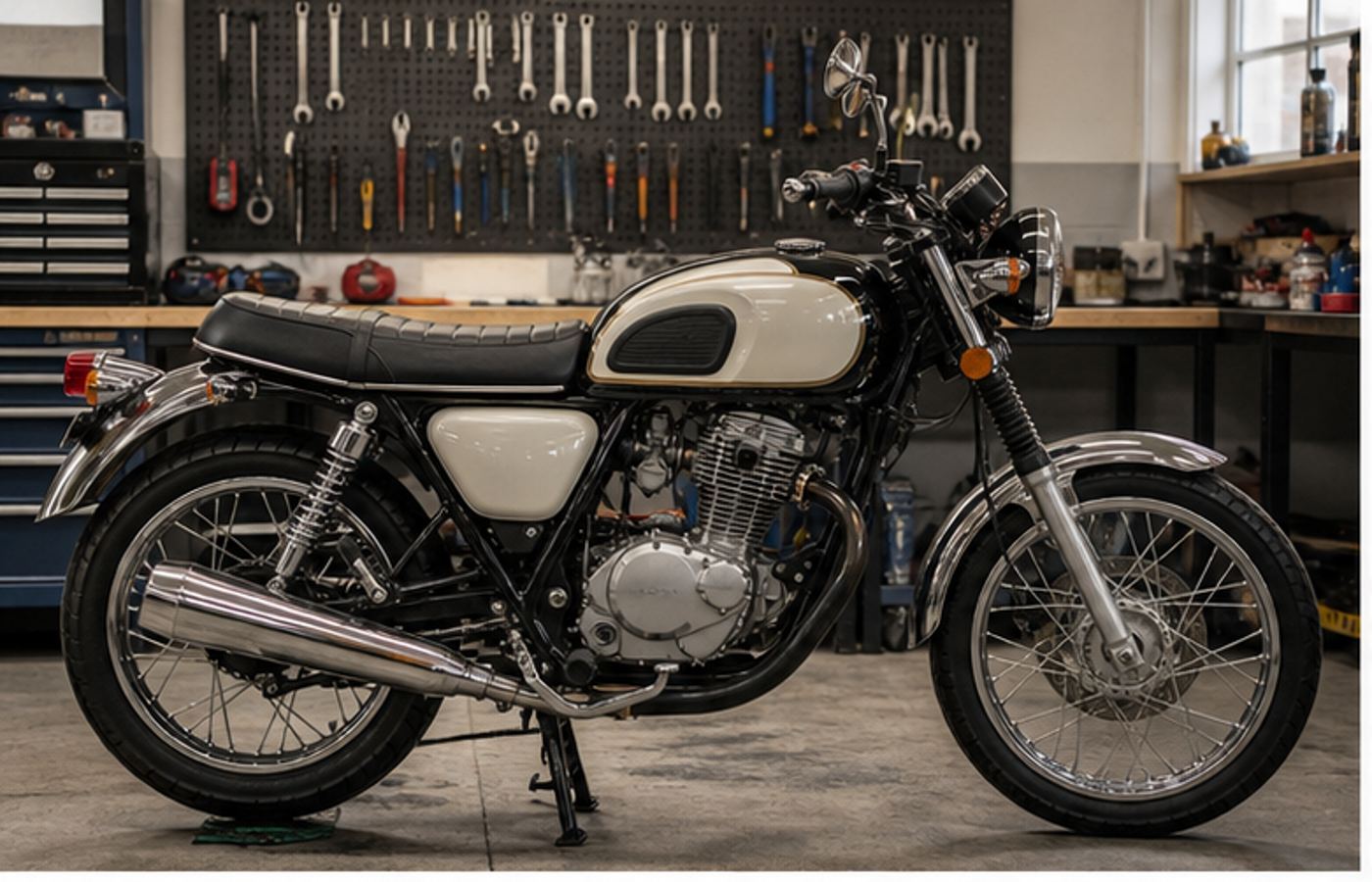
Mash 125 power increase
Mash 125 power increase is best approached as a careful setup of a simple retro 125, not as a promise that a learner-friendly single-cylinder motorcycle can suddenly behave like a 300. Mash 125 models are popular because they are light, easy to ride, classic-looking and mechanically straightforward. That simplicity is a strength, but it also means every small issue matters: chain drag, carburettor adjustment, fuel delivery, air leaks, exhaust sealing, ignition condition and gearing can all change how strong the bike feels on the road.

A good Mash should start easily, idle cleanly, pull from low speed without stumbling and feel predictable through the gears. If it feels flat, noisy, breathless or inconsistent, do not begin by buying the loudest exhaust or the cheapest tuning part. Begin by finding out whether the motorcycle is already giving you its normal performance. Once the basics are correct, a road-sensible exhaust, clean intake, correct jetting or fuelling support, fresh sprockets and careful gearing choices can make the bike more enjoyable without ruining reliability.
What a realistic Mash 125 power increase means
Mash 125 power increase usually means better throttle response, stronger pull in the middle of the rev range and a bike that feels less tired on hills. It rarely means a huge top-speed gain. Most 125 cc four-stroke motorcycles are already shaped by capacity, emissions, gearing and learner-friendly power limits. The useful work is in reducing losses, correcting setup and choosing parts that suit a small engine.
Mash model specifications vary by year and market, so confirm the exact motorcycle before ordering. The official Mash network is the right starting point for model context and current range information; you can begin at Mash Motors official. A responsible Mash 125 power increase should respect the engine type, road category, braking performance, tyres and rider licence.
Where owners normally feel the weakness
Riders usually notice slow pull away, hesitation after opening the throttle, weak hill climbing, poor hot starting, popping on overrun, excessive vibration or a bike that sounds busy without accelerating cleanly. These symptoms can come from carburettor settings, EFI adaptation, air leaks, poor spark, tight valve clearances, a worn chain, wrong sprocket choice or exhaust leaks. A good Mash 125 power increase starts by separating real engine limitation from fixable mechanical loss.
A retro 125 is honest: when the chain is dry, the tyre pressure is low or the carburettor is slightly off, the bike tells you immediately. The advantage is that many improvements are practical and affordable. The disadvantage is that random bolt-on parts can make the motorcycle worse if they are fitted without diagnosis.
Service baseline before tuning
Mash 125 power increase work should begin with oil condition, valve-clearance history, spark plug, air filter, fuel filter or fuel tap, carburettor cleanliness or EFI sensor condition, battery voltage, chain slack, sprocket wear, brake drag and tyre pressure. If the bike is used in wet weather, inspect connectors, earth points and exhaust fasteners for corrosion.

On carburetted versions, idle mixture, pilot jet condition, needle position, main jet and intake leaks can change the whole feel of the bike. On EFI versions, sensor condition, battery voltage and exhaust/intake changes matter. Anyone planning a Mash 125 power increase should first make the bike mechanically healthy. After that, compare sensible upgrades through X Moto Parts performance parts rather than buying by sound or appearance alone.
Baseline inspection table
| Check | Why it matters | Practical workshop note |
|---|---|---|
| Valve clearance | Tight valves can reduce compression and hot starting | Check if the service history is unknown |
| Air filter | Restricted airflow makes the bike feel flat | Inspect filter and airbox sealing |
| Fuel supply | Weak flow causes hesitation under load | Check tap, filter, line routing and tank contamination |
| Spark plug | Ignition quality affects starting and throttle response | Use the correct plug and inspect colour after riding |
| Chain and sprockets | Wear or incorrect slack wastes power | Replace as a set when hooked or stretched |
| Brakes and tyres | Drag and low pressure feel like low power | Spin wheels and set pressures before testing |
Compatibility before ordering parts
Mash 125 power increase compatibility depends on the exact model: Seventy, Black Seven, Dirt Track, Cafe Racer, Scrambler-style variants and market-specific versions may differ in exhaust shape, carburettor or EFI equipment, brackets, airbox layout and sprocket sizes. A universal 125 part may be close, but close is not the same as correct.
| Upgrade type | Compatibility | Important note |
|---|---|---|
| Slip-on silencer | Possible when diameter and hanger match | Check link pipe, bracket angle, DB-killer and road approval |
| Full exhaust | Model-specific | Header shape, gasket, sensor and frame clearance matter |
| Carburettor jetting | Only for carburetted versions | Jet changes must match intake, exhaust and plug reading |
| EFI response module | Only if connector layout matches | Confirm sensor plugs before buying |
| Sprocket gearing | Possible with correct pitch and tooth count | Changes acceleration, cruising rpm and chain length needs |
| Custom project | Possible with workshop adaptation | May affect road legality and insurance |
A careful Mash 125 power increase plan uses measurements. Measure exhaust diameter, photograph hanger points, check whether the bike has a carburettor or EFI, confirm sprocket pitch and inspect available space. The universal motorcycle exhaust buying guide is useful before buying a silencer because it explains pipe diameter, mounting points, DB-killers and real fitment problems.
Intake, fuel and exhaust setup
Mash 125 power increase often starts with exhaust sound, but the intake and fuel side decide whether the result is rideable. A freer silencer can reduce weight and improve character, but if the mixture is wrong the bike can stumble, run hot, pop excessively or lose low-speed pull. On a carburetted bike, jetting and plug reading matter. On EFI models, connector compatibility and conservative adjustment matter.
Carburettor versions
If the bike has a carburettor, do not jump straight to a bigger main jet because the exhaust is louder. First clean the pilot circuit, confirm float height, inspect the intake rubber and check the plug after a proper ride. A Mash 125 power increase based on carburettor setup should improve cold start, idle, transition from closed throttle and full-throttle pull without making the bike smell rich or foul plugs.
EFI versions
If the bike uses EFI, avoid cutting wires or forcing generic modules into unmatched connectors. Confirm the exact sensor layout, route wiring away from heat and start with conservative settings. Warning lights, erratic idle or poor hot restart are signs to stop and inspect. A good EFI setup should feel smooth, not dramatic.

Gearing and chain setup
Mash 125 power increase can also mean using the existing power better. Shorter gearing can make the bike pull more strongly in town and on hills, while taller gearing can lower cruising rpm if the engine can pull it. The wrong gearing makes the bike worse: too short and it becomes noisy; too tall and it becomes lazy.
Before changing sprockets, inspect chain condition, rear wheel alignment and adjuster position. If the chain is already worn, new sprockets alone are false economy. A proper Mash 125 power increase through gearing should include a road test on the kind of roads you actually ride, not only a short blast near the workshop.
Comparison of upgrade routes
| Route | Main advantage | Possible disadvantage | Best for |
|---|---|---|---|
| Service baseline | Restores lost reliability and response | No dramatic sound change | Every used Mash 125 |
| Road-approved exhaust | Better sound and possible weight saving | Fitment and fuelling must be checked | Riders wanting character without chaos |
| Carburettor tuning | Can clean up response on older bikes | Requires plug reading and patience | Carburetted models |
| EFI response support | Can help after airflow changes | Connector compatibility is critical | EFI models with symptoms |
| Sprocket change | Improves acceleration feel | Can raise cruising rpm | Town and hill riding |
Installation checks from a mechanic’s point of view
Mash 125 power increase parts should be installed one at a time. Change the exhaust, test. Adjust the carburettor, test. Change gearing, test. Fit an EFI module only after confirming compatibility, then test. If several parts are fitted together, a new hesitation could come from the exhaust gasket, intake leak, jetting, wiring, chain adjustment or fuel supply.
After exhaust work, check header nuts, gasket crush, hanger alignment and clearance from tyres, shocks and side panels. After carburettor work, check for fuel leaks and throttle return. After gearing work, check chain slack across wheel rotation and tighten axle fasteners correctly. A clean Mash 125 power increase should make the bike easier to ride, not harder to trust.

UK road legality, A1 limits and insurance
Mash 125 power increase decisions must respect road use. In the UK, 125 cc motorcycles are tied to A1 and learner rules, depending on rider age, licence and CBT status. GOV.UK explains motorcycle categories and A1 limits on its motorcycle licence category page. A motorcycle used on public roads must remain roadworthy, insured and suitable for the rider’s entitlement.
Exhaust changes need special care. Excessive noise, missing road approval, removed baffles, track-use-only silencers and emissions changes can create MOT and insurance issues. In the United States, Canada, Australia, New Zealand and Ireland, rules vary by state, province, territory and registration class. A Mash 125 power increase for private land is not automatically legal for road use.
Common mistakes
Mash 125 power increase mistakes are usually avoidable. The first is fitting a loud exhaust without checking mixture. The second is using an open filter that pulls hot air and dirt while losing low-speed smoothness. The third is changing sprockets without considering cruising rpm. The fourth is ignoring valve clearance and service history. The fifth is assuming universal parts fit without measuring.
Buying mistakes
Do not buy by appearance alone. Check model year, carburettor or EFI, exhaust diameter, hanger angle, sensor layout, sprocket pitch and road-use status. Do not confuse universal with plug-and-play. A proper Mash 125 power increase purchase should match the exact motorcycle, not just the engine size.
Setup mistakes
Do not make the mixture rich because the bike feels safer that way. Do not run lean because the plug looks clean after one short idle test. Do not over-tighten the chain. Do not ignore exhaust leaks. Do not keep riding with misfires, warning lights, fuel smell or hot running. The bike should feel sharper, not stressed.
Signs the setup is right
A successful Mash 125 power increase is modest but clear. The engine starts cleanly, idles steadily, pulls away without hesitation and feels smoother through the middle gears. The exhaust note is controlled rather than harsh. The chain runs quietly. The bike does not smell rich, pop constantly, overheat or feel breathless after a few miles.
| Symptom after modification | Likely area | Practical response |
|---|---|---|
| Popping and flat response | Exhaust leak or lean mixture | Check gasket, intake rubber and fuelling |
| Strong smell and black plug | Too rich | Reduce jetting or module setting and retest |
| Busy engine at cruising speed | Gearing too short | Return closer to standard sprocket choice |
| Slow pull despite loud exhaust | Poor pipe match or service issue | Check pipe diameter, valve clearance and fuel supply |
| Snatchy drive | Chain slack or carburettor transition | Set chain correctly and inspect pilot circuit |
FAQ
Can you increase power on a Mash 125?
Yes, but Mash 125 power increase work should be realistic. The best results come from service condition, intake health, correct fuelling, exhaust fitment and gearing rather than extreme horsepower claims.
What is the best first upgrade?
The best first step is a full baseline inspection: valves, plug, air filter, fuel supply, chain, sprockets, brakes and tyres. A healthy bike responds better to any later upgrade.
Does a performance exhaust help?
A suitable exhaust can improve sound and sometimes response, but it must fit correctly and the mixture must remain safe. A loud exhaust with poor fuelling can make the bike worse.
Do I need to rejet a carburetted Mash 125?
Possibly, especially after intake or exhaust changes. Rejetting should be based on plug reading, throttle behaviour and proper testing, not guesswork.
Do I need a module on an EFI Mash 125?
Only if the bike needs fuelling support and the connector layout is confirmed. A module should be adjusted conservatively and removed if it creates warning lights or poor running.
Can sprockets make the bike faster?
Sprockets change acceleration and cruising behaviour, not engine power. Shorter gearing can help town response, while taller gearing only works if the engine can pull it.
Is Mash 125 tuning legal in the UK?
It depends on the modification. The bike must remain roadworthy, insured and suitable for the rider’s licence category. Exhaust noise, emissions equipment and track-use-only parts need care.
Can I fit universal parts?
Sometimes, but universal does not mean bolt-on. Measure pipe diameter, hanger position, sensor layout, sprocket pitch and available space before ordering.
Final buying advice
Mash 125 power increase planning should be practical. Service the bike first, measure before ordering, check whether it is carburetted or EFI, keep the airbox sensible, choose a road-suitable exhaust, avoid extreme gearing changes and declare relevant modifications to the insurer. If a part is universal, expect measuring and adaptation. If a part is model-specific, still confirm year and market version.
The smartest Mash 125 power increase is the one that makes a simple retro 125 cleaner, smoother and more enjoyable without taking away its reliability. Riders comparing parts can use the X Moto Parts shop and related guides such as Bullit Hero 125 tuning to compare similar small-capacity retro motorcycle setup choices.
{
“@context”: “https://schema.org”,
“@type”: “Article”,
“headline”: “Mash 125 power increase”,
“description”: “Practical Mash 125 guide covering realistic power gains, carburettor and EFI checks, exhaust fitment, gearing, installation and UK road legality.”,
“author”: {
“@type”: “Organization”,
“name”: “X Moto Parts”
},
“publisher”: {
“@type”: “Organization”,
“name”: “X Moto Parts”,
“logo”: {
“@type”: “ImageObject”,
“url”: “https://xmotoparts.com/wp-content/uploads/x-moto-parts-logo.png”
}
},
“mainEntityOfPage”: “https://xmotoparts.com/mash-125-power-increase/”,
“image”: “https://xmotoparts.com/wp-content/uploads/mash-125-power-increase.jpg”
}
{
“@context”: “https://schema.org”,
“@type”: “FAQPage”,
“mainEntity”: [
{
“@type”: “Question”,
“name”: “Can you increase power on a Mash 125?”,
“acceptedAnswer”: {
“@type”: “Answer”,
“text”: “Yes, but the best results come from service condition, intake health, correct fuelling, exhaust fitment and gearing rather than extreme horsepower claims.”
}
},
{
“@type”: “Question”,
“name”: “What is the best first upgrade?”,
“acceptedAnswer”: {
“@type”: “Answer”,
“text”: “The best first step is a full baseline inspection of valves, plug, air filter, fuel supply, chain, sprockets, brakes and tyres.”
}
},
{
“@type”: “Question”,
“name”: “Does a performance exhaust help?”,
“acceptedAnswer”: {
“@type”: “Answer”,
“text”: “A suitable exhaust can improve sound and sometimes response, but it must fit correctly and the mixture must remain safe.”
}
},
{
“@type”: “Question”,
“name”: “Do I need to rejet a carburetted Mash 125?”,
“acceptedAnswer”: {
“@type”: “Answer”,
“text”: “Possibly, especially after intake or exhaust changes. Rejetting should be based on plug reading and throttle behaviour.”
}
},
{
“@type”: “Question”,
“name”: “Do I need a module on an EFI Mash 125?”,
“acceptedAnswer”: {
“@type”: “Answer”,
“text”: “Only if the bike needs fuelling support and the connector layout is confirmed.”
}
},
{
“@type”: “Question”,
“name”: “Can sprockets make the bike faster?”,
“acceptedAnswer”: {
“@type”: “Answer”,
“text”: “Sprockets change acceleration and cruising behaviour, not engine power.”
}
},
{
“@type”: “Question”,
“name”: “Is Mash 125 tuning legal in the UK?”,
“acceptedAnswer”: {
“@type”: “Answer”,
“text”: “It depends on the modification. The bike must remain roadworthy, insured and suitable for the rider’s licence category.”
}
},
{
“@type”: “Question”,
“name”: “Can I fit universal parts?”,
“acceptedAnswer”: {
“@type”: “Answer”,
“text”: “Sometimes, but pipe diameter, hanger position, sensor layout, sprocket pitch and available space must be checked.”
}
}
]
}