
P1541 Fiat
P1541 Fiat is the kind of diagnostic code that can send an owner down the wrong path if it is treated as a single universal fault. On some Fiat and Fiat-derived vehicles, manufacturer-specific P1 codes can change meaning depending on the model, engine, year, fuel type and control unit. A basic scanner may show a short description, but that description is only the beginning. The real job is to confirm which module stored the code, when it set, what symptoms appeared, and whether the fault is electrical, mechanical or a side effect of another problem.
This guide is written for Fiat owners, independent mechanics and used-car buyers who want to understand P1541 Fiat without wasting money on random sensors. It explains how to read the code properly, what freeze-frame data matters, which checks should come first, and why battery voltage, wiring, throttle/air control, fuel pressure, boost control and ECU communication all need to be considered before replacing expensive parts.
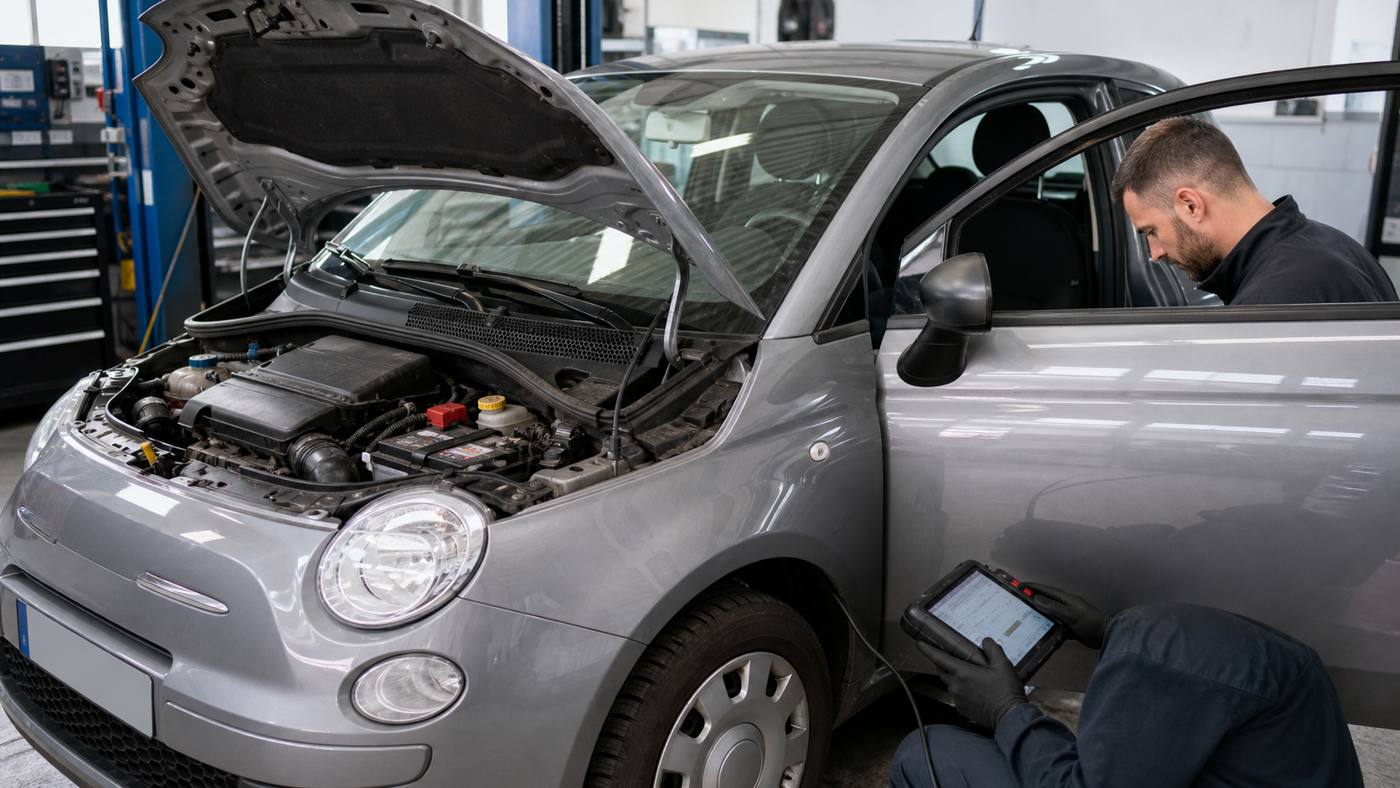
If you are learning diagnostic basics, the X Moto Parts guide to free ELM327 PC software, the OBD2 protocol list and the P0087 code guide are useful internal references. They show why generic scan tools can be helpful, but also why manufacturer-specific faults often need deeper data.
What the code can mean
P1541 Fiat should be treated as a manufacturer-specific diagnostic trouble code until proven otherwise. Generic OBD2 P0 codes are broadly standardised, but many P1 codes are defined by the vehicle manufacturer. That means the same number can point to different systems across brands, and even within a brand it may be interpreted differently by scanner software. A cheap reader may translate it loosely; a Fiat-capable tool may show a more accurate module-specific description.
The important lesson is this: do not diagnose P1541 Fiat from the number alone. Write down the exact scanner wording, the vehicle model, engine code, year, mileage, gearbox, fuel type and all other stored codes. A Fiat 500, Panda, Punto, Doblo, Bravo, Ducato, 1.3 Multijet, 1.4 petrol or TwinAir may not lead you to the same checks. The control unit and software version matter.
| Information to record | Why it matters | What to avoid |
|---|---|---|
| Exact model and year | Fault definitions can vary by platform | Using advice for a different Fiat model |
| Engine and fuel type | Diesel and petrol systems use different sensors | Applying diesel logic to a petrol engine |
| Scanner description | It shows how the tool interpreted the code | Trusting a vague app translation blindly |
| Freeze-frame data | It reveals load, rpm and temperature when the fault set | Clearing the code before saving evidence |
| Related codes | They often point to the real root cause | Repairing the first code in isolation |
A careful diagnosis of P1541 Fiat begins by asking whether the fault is current or historic. A current fault returns immediately. A historic fault may have happened once during low voltage, jump starting, connector disturbance or a previous repair. That distinction changes everything.
Symptoms owners may notice
P1541 Fiat may appear with a check engine light, reduced power, limp mode, poor throttle response, rough idle, hard starting, stalling, higher fuel consumption or no obvious symptom at all. The absence of a dramatic symptom does not mean the code is fake. It may be an intermittent electrical fault or a condition that only appears under certain load and temperature.
When the car drives normally
If the Fiat drives normally, save the data before clearing anything. Some owners clear P1541 Fiat and then lose the only clue they had. A code that set during cold start after a weak battery is different from one that set during motorway acceleration. If the fault does not return after a proper road test, the next step may be monitoring rather than parts replacement.
When limp mode appears
If limp mode appears, the ECU is limiting power because it does not trust a signal or operating condition. That may involve throttle control, air measurement, boost pressure, fuel pressure, EGR behaviour, sensor plausibility or wiring integrity depending on the vehicle. P1541 Fiat with limp mode deserves live data, not guessing.
First checks before parts replacement
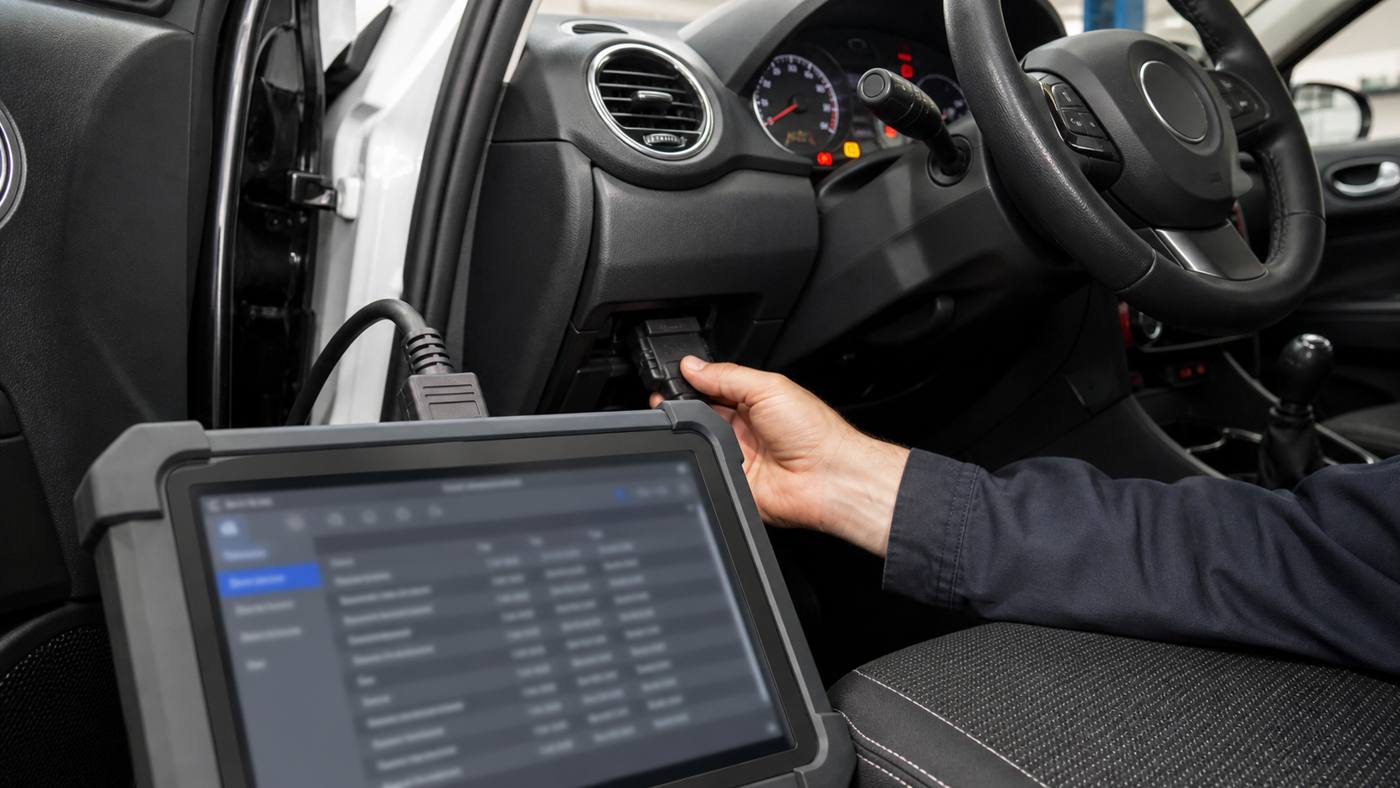
P1541 Fiat should be approached from the simple checks outward. Start with battery voltage, charging output, ground straps, fuse condition, connector security and visible wiring damage. Fiat electrical systems can be sensitive to low voltage, and many modern control units behave strangely when the battery is weak or a ground connection is poor.
Then inspect recent work. Was the battery replaced? Was the air filter box removed? Was the EGR valve cleaned? Was the timing belt changed? Was the vehicle jump-started? Was the engine washed? Did the code appear after a service? Many diagnostic faults begin after a connector was left loose, a hose was not seated, a vacuum line was cracked or a sensor plug was pulled tight.
| First check | What to inspect | Why it matters |
|---|---|---|
| Battery and charging | Resting voltage, cranking voltage, alternator output | Low voltage can trigger false or secondary faults |
| Grounds and terminals | Battery clamps, engine earth strap, body grounds | Voltage drop can affect sensors and ECU control |
| Fuses and relays | Engine bay fuse box, relay seating, corrosion | Intermittent supply faults can mimic sensor failure |
| Air and vacuum hoses | Loose ducts, split hoses, boost leaks, intake leaks | Air measurement faults often create confusing symptoms |
| Recent repair area | Connectors, clips, brackets and disturbed wiring | Faults often appear where hands recently worked |
For many owners, the cheapest repair for P1541 Fiat is not a new component; it is finding a poor connection, weak battery or disturbed hose. That is why visual inspection still matters in a world full of scanners.
Electrical and sensor diagnosis
P1541 Fiat can become expensive if wiring is ignored. A sensor fault description does not automatically mean the sensor is dead. It may mean the ECU received a signal that was too high, too low, missing, implausible or inconsistent with another sensor. The sensor may be reporting the truth while the real problem is supply voltage, ground, connector corrosion or mechanical airflow.
Connector and loom inspection
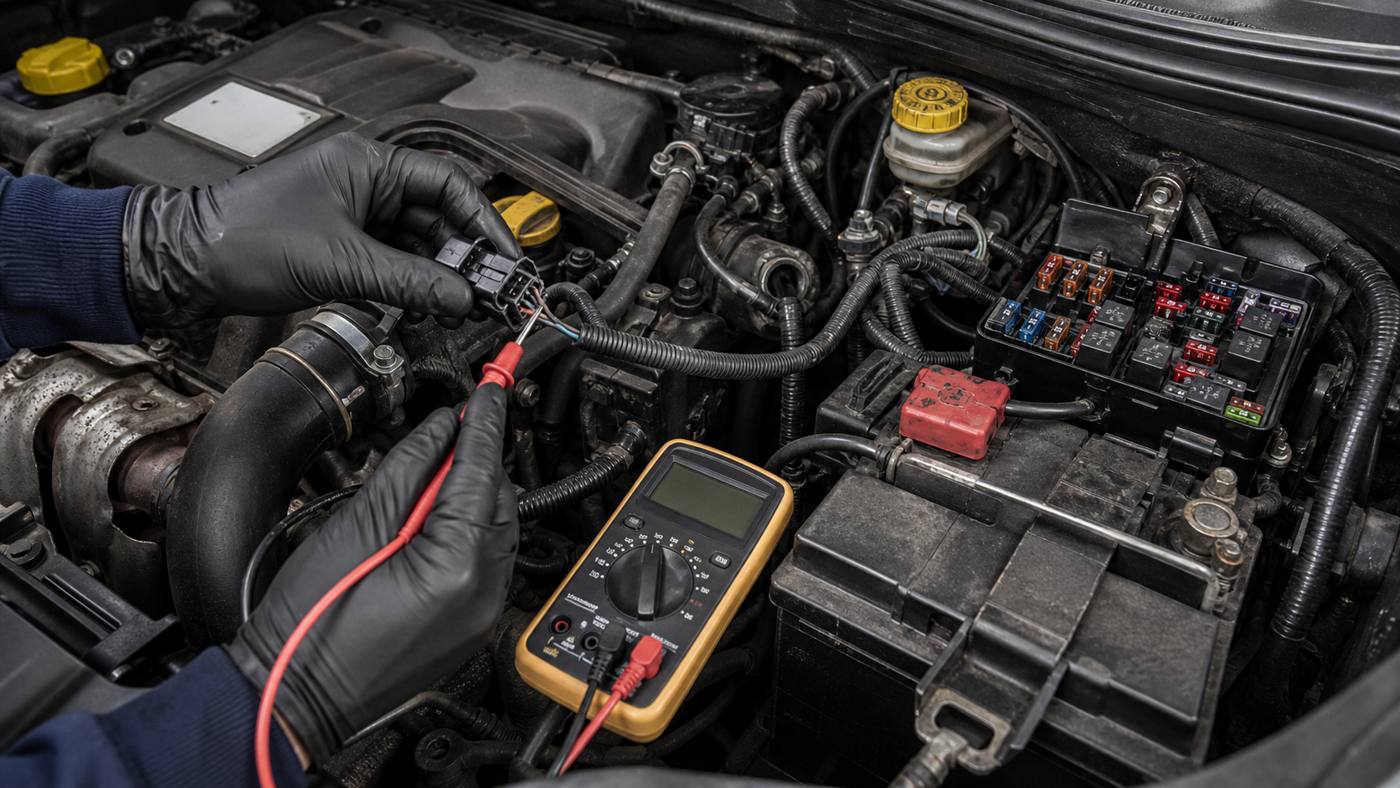
Inspect connectors for oil, water, bent pins, loose terminals and broken locking tabs. Follow the loom where it passes near the battery tray, engine mount, EGR area, turbo heat, airbox and gearbox. Look for rubbing, crushed insulation, previous repairs and wires stretched by engine movement. If P1541 Fiat appears intermittently over bumps or after rain, wiring and connector inspection becomes even more important.
Voltage, ground and continuity checks
A multimeter is useful, but it must be used correctly. Check sensor reference voltage, ground quality and signal behaviour against service data. Wiggle testing can reveal intermittent faults, but do it gently. Do not pierce wires unless there is no better method and the repair will be sealed afterwards. Poor probing can create the next fault.
Engine systems that can be involved
P1541 Fiat may lead toward air control, throttle behaviour, boost control, fuel delivery or another manufacturer-specific system depending on the exact vehicle. The safest approach is to compare live data rather than follow one generic internet answer. Look at throttle position, accelerator pedal request, manifold pressure, MAF reading, boost command, EGR command, fuel pressure, engine temperature and battery voltage where available.
Throttle and air-control checks
On petrol engines and some diesel intake systems, throttle body position, pedal sensor correlation, air leaks or adaptation problems can create drivability complaints. Cleaning a throttle body can help only if dirt is the problem and the correct relearn procedure is followed where required. If P1541 Fiat returns after cleaning, suspect wiring, adaptation, air leaks or another control issue rather than cleaning it again and again.
Diesel boost and fuel-pressure checks
On diesel models, symptoms such as limp mode under load, hesitation, smoke or poor acceleration may require boost and fuel checks. Do not condemn the turbocharger first. Inspect vacuum lines, boost hoses, intercooler connections, MAF/MAP data, EGR behaviour and fuel pressure. For low-pressure fuel logic, the P0087 code guide explains why fuel rail data must be interpreted under load.
| System | Possible evidence | Practical next check |
|---|---|---|
| Battery or supply voltage | Multiple unrelated codes, dimming, hard start | Load-test battery and measure voltage drop |
| Throttle or pedal signal | Poor response, limp mode, plausibility codes | Compare pedal request and throttle position live data |
| Air or boost control | Weak acceleration, smoke, underboost/overboost clues | Smoke-test intake and compare MAF/MAP readings |
| Fuel pressure | Hard start, stalling, load-related limp mode | Compare commanded and actual pressure under load |
| Wiring or connector | Intermittent fault, rain sensitivity, recent repair | Inspect pins, grounds and loom movement |
Diagnostic compatibility and tool choice
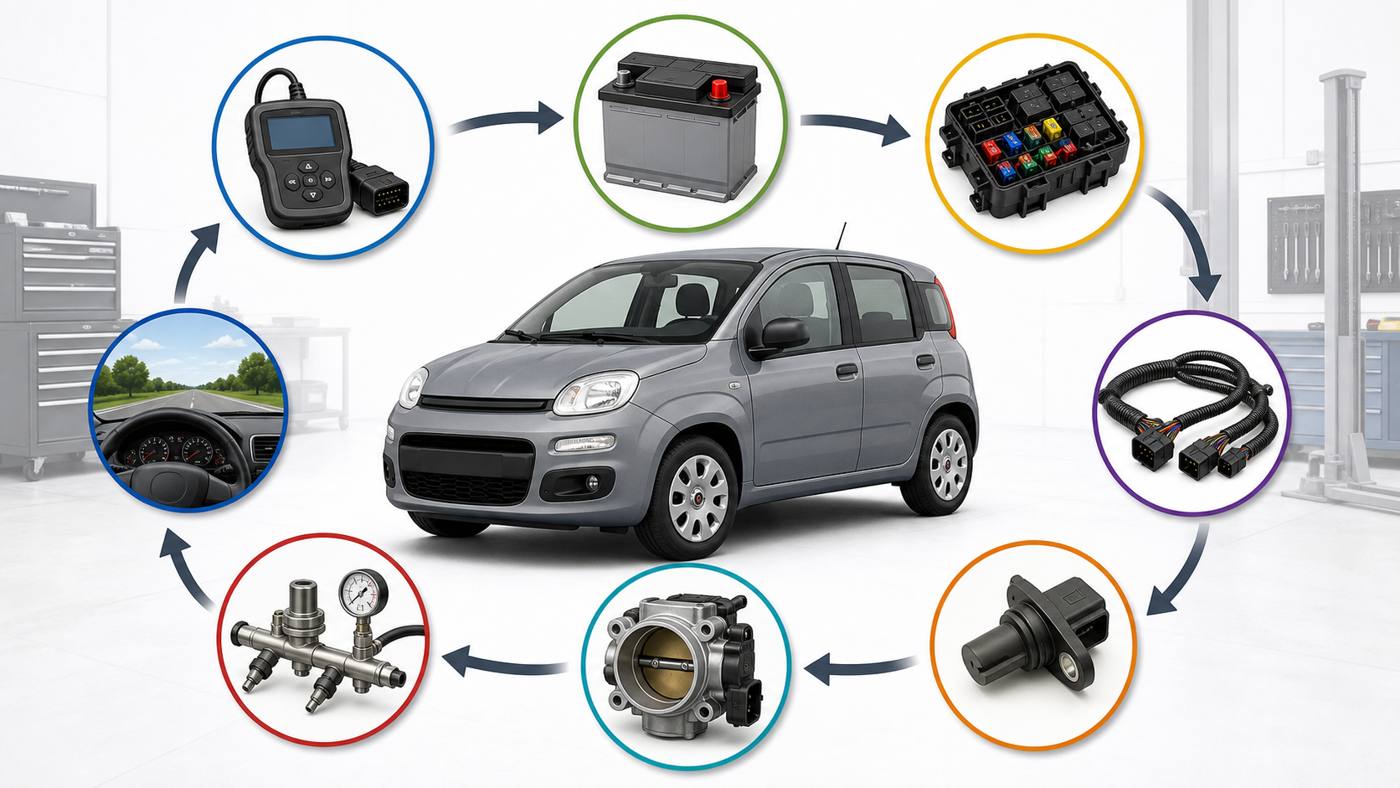
P1541 Fiat is a good example of why the scan tool matters. A generic ELM327 reader may read engine emissions codes, but it may not show the best manufacturer-specific description, live data, actuator tests or adaptation functions. A Fiat-capable diagnostic system can often access more modules and provide better context. The tool does not repair the car, but it decides how much of the story you can see.
| Diagnostic tool | Compatibility | Important note |
|---|---|---|
| Basic generic OBD reader | Useful for first code read | May show limited or vague manufacturer-specific data |
| ELM327 with laptop software | Depends on adapter quality and software | Good for learning, but not always enough for Fiat-specific tests |
| Fiat-capable scan tool | Best practical choice for diagnosis | Can show live data, module details and adaptations where supported |
| Dealer-level diagnostic system | Strongest route for complex faults | Useful for programming, guided tests and software-related issues |
| Multimeter and smoke tester | Needed for proof | Scan data should be confirmed with physical tests |
Anyone working through P1541 Fiat at home should understand tool limits. A basic reader can tell you that a fault exists. It may not tell you whether the ECU, sensor, loom, air leak or fuel system is responsible. That is where a proper mechanic earns the labour charge.
UK MOT, emissions and road-use notes
P1541 Fiat can affect roadworthiness if it brings on the engine management light, limp mode, emissions failure or unsafe running. In the UK, MOT inspection includes checks that can be affected by warning lamps, emissions condition and visible defects. Always compare the car’s condition with official guidance such as the GOV.UK MOT inspection manual for cars. For owner handbooks and model-specific information, start from the official Fiat eLum owner manual portal.
If the Fiat is in limp mode, has poor acceleration, stalls, smokes heavily or has an engine warning light, do not treat the code as only an inconvenience. A car that cannot accelerate predictably may be unsafe in traffic. A diesel with unresolved fuel, boost or emissions faults may also fail inspection or cause further damage. In Ireland, Australia, New Zealand, Canada and the United States, roadworthiness and emissions rules differ, so use the rule set for the country where the vehicle is registered.
Common mistakes
P1541 Fiat becomes more expensive when the first answer is a parts order. The code should be treated as evidence, not as an invoice. Good diagnosis prevents the classic cycle: replace one sensor, clear the light, fault returns, replace another sensor, fault returns again.
- Clearing the code before saving freeze-frame data.
- Using a generic scanner description as if it were Fiat service data.
- Replacing the throttle body, sensor or pump without voltage and wiring checks.
- Ignoring a weak battery or poor earth strap.
- Missing a loose intake hose after air-filter or EGR work.
- Assuming diesel and petrol causes are the same.
- Forgetting to check all stored codes, not only the first one shown.
- Driving hard in limp mode and creating more faults.
- Buying used electronic parts without confirming programming or compatibility.
- Trusting internet code lists without matching model, engine and ECU.
Workshop method for a reliable repair
P1541 Fiat should be repaired by following a repeatable path. First, confirm the complaint. Second, scan all modules that the tool can access. Third, save code descriptions and freeze-frame data. Fourth, check battery and grounds. Fifth, inspect the recent repair area. Sixth, compare live data during idle and road load. Seventh, test the suspect circuit physically. Eighth, repair the proven fault and road-test under the same conditions.
The repair is not finished when the warning light goes out. A proper final test includes a cold start, warm idle, gentle acceleration, load test, restart and post-drive scan. If P1541 Fiat does not return and live data is stable, the repair is much more trustworthy. If it returns with a different companion code, the original code may have been a symptom rather than the root cause.
When to use a professional
P1541 Fiat should go to a professional if the vehicle will not start, enters limp mode repeatedly, has multiple ECU communication faults, shows unstable throttle behaviour, has fuel-pressure complaints, has been flooded, has damaged wiring, or needs adaptation/programming after part replacement. A good auto electrician or Fiat specialist can test circuits without damaging connectors and can use model-specific data rather than guesswork.
For related diagnostic reading on X Moto Parts, compare Fiat 500L check engine light, free ELM327 PC software and car key not recognised. They cover different problems, but they share the same principle: electrical and control-system faults need evidence.
FAQ
What does P1541 mean on a Fiat?
P1541 Fiat is best treated as a manufacturer-specific code whose exact meaning depends on model, engine and ECU. Read the exact scanner description and confirm it with Fiat-capable diagnostic data before replacing parts.
Can I drive with this code?
If the car drives normally, short cautious driving may be possible while arranging diagnosis. If there is limp mode, stalling, poor throttle response, smoke, fuel smell or unsafe acceleration, avoid driving until the fault is checked.
Will a cheap OBD reader diagnose the problem?
A cheap reader may show the code and sometimes a description, but it may not provide the Fiat-specific live data or tests needed to prove the cause. Use it as a starting point, not the final answer.
Should I replace the sensor mentioned by the scanner?
No, not automatically. The scanner may name a circuit or signal, not the failed part. Check voltage, ground, connector condition, wiring and live data before replacing the sensor.
Can a weak battery cause this fault?
Yes. Low voltage can create confusing control-unit faults, especially after jump starting, cold weather or long storage. Battery and ground checks should be early steps in diagnosis.
Why does the code return after clearing it?
If the code returns immediately, the fault is likely current. If it returns only under load or after a warm-up, freeze-frame and road-test data become important. Clearing the light does not repair the cause.
Is this an MOT failure in the UK?
The code itself is not what the tester sees, but an engine management light, emissions problem or unsafe running condition can affect MOT outcome. Check the current GOV.UK MOT guidance and repair the cause properly.
Do Fiat diesel and petrol models have the same cause?
No. Diesel and petrol engines use different air, fuel, boost and throttle strategies. P1541 Fiat diagnosis must match the exact engine and control unit.
Final advice
P1541 Fiat is not a code to solve by guesswork. Treat it as a diagnostic trail: save the data, identify the exact vehicle, check battery health, inspect wiring, compare live data, verify the suspect circuit and only then replace parts. The best repair is the one proven before money is spent.
If the vehicle is safe and running well, you can take a measured approach. If it is in limp mode, stalling or showing multiple electrical faults, use a Fiat-capable technician. A calm diagnosis of P1541 Fiat protects the engine, the wallet and the driver.
{
“@context”: “https://schema.org”,
“@type”: “Article”,
“headline”: “P1541 Fiat”,
“description”: “P1541 Fiat can point to different systems depending on model, engine and ECU, so this guide explains how to diagnose it safely before replacing parts.”,
“image”: “https://xmotoparts.comhttps://xmotoparts.com/wp-content/uploads/2026/07/p1541-fiat.jpg”,
“author”: {
“@type”: “Organization”,
“name”: “X Moto Parts”
},
“publisher”: {
“@type”: “Organization”,
“name”: “X Moto Parts”,
“logo”: {
“@type”: “ImageObject”,
“url”: “https://xmotoparts.com/wp-content/uploads/x-moto-parts-logo.png”
}
},
“mainEntityOfPage”: {
“@type”: “WebPage”,
“@id”: “https://xmotoparts.com/p1541-fiat/”
}
}
{
“@context”: “https://schema.org”,
“@type”: “FAQPage”,
“mainEntity”: [
{
“@type”: “Question”,
“name”: “What does P1541 mean on a Fiat?”,
“acceptedAnswer”: {
“@type”: “Answer”,
“text”: “It is best treated as a manufacturer-specific code whose exact meaning depends on model, engine and ECU. Read the exact scanner description and confirm it with Fiat-capable diagnostic data before replacing parts.”
}
},
{
“@type”: “Question”,
“name”: “Can I drive with this code?”,
“acceptedAnswer”: {
“@type”: “Answer”,
“text”: “If the car drives normally, short cautious driving may be possible while arranging diagnosis. If there is limp mode, stalling, poor throttle response, smoke, fuel smell or unsafe acceleration, avoid driving until the fault is checked.”
}
},
{
“@type”: “Question”,
“name”: “Will a cheap OBD reader diagnose the problem?”,
“acceptedAnswer”: {
“@type”: “Answer”,
“text”: “A cheap reader may show the code and sometimes a description, but it may not provide the Fiat-specific live data or tests needed to prove the cause.”
}
},
{
“@type”: “Question”,
“name”: “Should I replace the sensor mentioned by the scanner?”,
“acceptedAnswer”: {
“@type”: “Answer”,
“text”: “No, not automatically. The scanner may name a circuit or signal, not the failed part. Check voltage, ground, connector condition, wiring and live data before replacing the sensor.”
}
},
{
“@type”: “Question”,
“name”: “Can a weak battery cause this fault?”,
“acceptedAnswer”: {
“@type”: “Answer”,
“text”: “Yes. Low voltage can create confusing control-unit faults, especially after jump starting, cold weather or long storage.”
}
},
{
“@type”: “Question”,
“name”: “Why does the code return after clearing it?”,
“acceptedAnswer”: {
“@type”: “Answer”,
“text”: “If the code returns immediately, the fault is likely current. If it returns only under load or after a warm-up, freeze-frame and road-test data become important.”
}
},
{
“@type”: “Question”,
“name”: “Is this an MOT failure in the UK?”,
“acceptedAnswer”: {
“@type”: “Answer”,
“text”: “The code itself is not what the tester sees, but an engine management light, emissions problem or unsafe running condition can affect MOT outcome.”
}
},
{
“@type”: “Question”,
“name”: “Do Fiat diesel and petrol models have the same cause?”,
“acceptedAnswer”: {
“@type”: “Answer”,
“text”: “No. Diesel and petrol engines use different air, fuel, boost and throttle strategies. Diagnosis must match the exact engine and control unit.”
}
}
]
}