
carburetor cleaner substitute
carburetor cleaner substitute is a useful search when a motorcycle, scooter, ATV or small engine carburettor needs cleaning and the proper aerosol cleaner is not on the shelf. The important point is that a substitute must remove varnish, old fuel residue and light gum without damaging aluminium, brass jets, rubber O-rings, plastic floats, diaphragms or painted surfaces. A random solvent can clean one part and ruin another.

The safest answer is simple: use purpose-made carburettor cleaner when you can, and use a substitute only when you understand what it touches. Brass jets and aluminium castings can tolerate stronger cleaning than rubber seals, accelerator pump diaphragms, vacuum slides and plastic floats. A good substitute is not just “anything that smells like solvent”. It is a cleaning method matched to the part.
What works as a carburetor cleaner substitute?
carburetor cleaner substitute options depend on what you are cleaning. For metal parts only, clean petrol, brake cleaner, electrical contact cleaner, acetone, isopropyl alcohol and ultrasonic cleaning solutions are sometimes used in workshops. Each has limits. Brake cleaner can attack some plastics and rubbers. Acetone is aggressive and evaporates quickly. Isopropyl alcohol is safer on many surfaces but weaker on heavy varnish. Petrol dissolves fuel residue but is highly flammable and not ideal indoors.
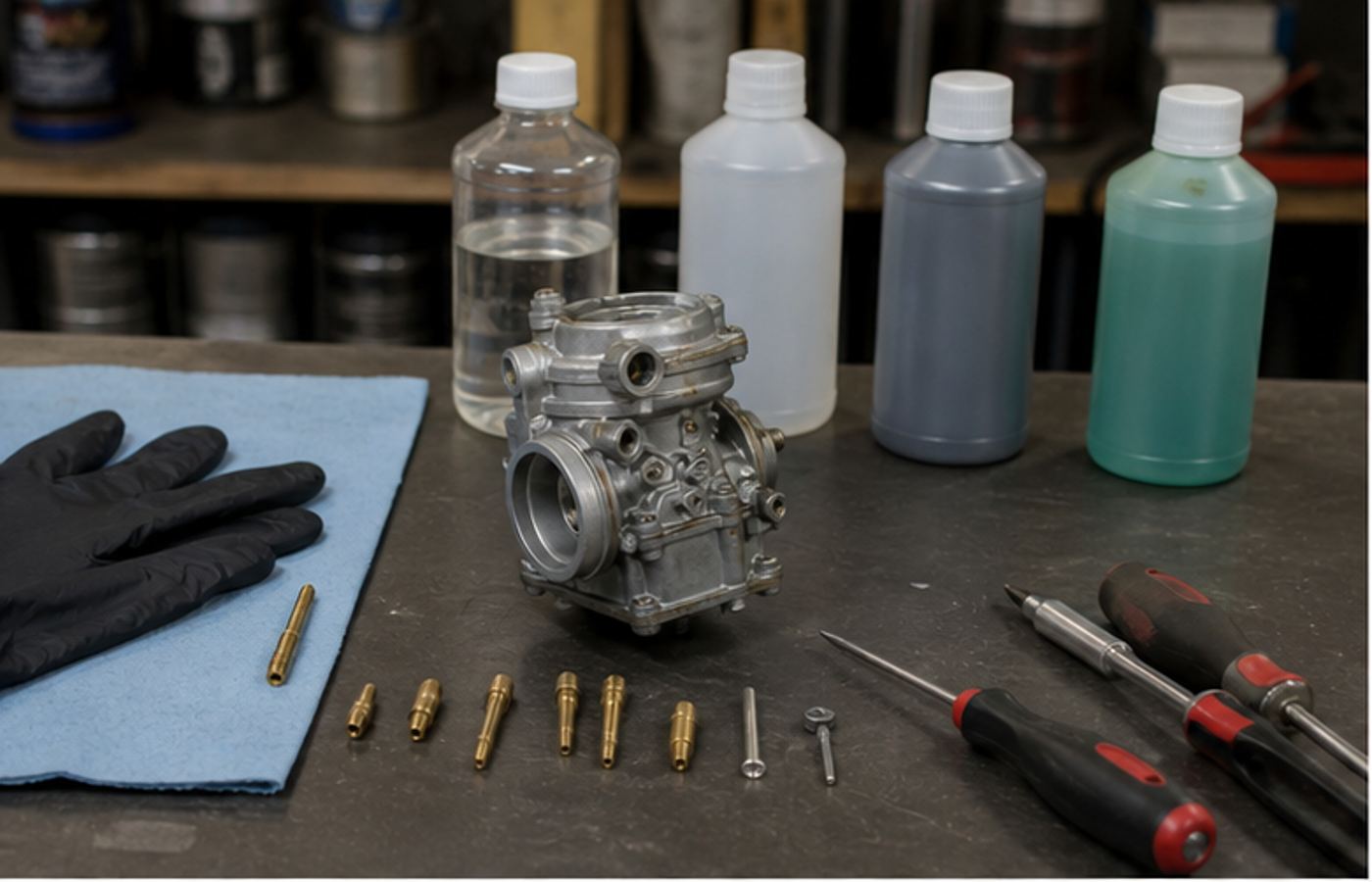
The correct choice starts with disassembly. Remove rubber O-rings, gaskets, diaphragms, plastic floats and seals before using stronger solvent. Use mild detergent and warm water for outside dirt first, then a more specific cleaner for metal passages. A carburetor cleaner substitute should be tested on a hidden area if you are unsure, and no substitute should be left soaking on mixed materials without knowing compatibility.
Practical substitute comparison
| Substitute | Useful for | Risk | Workshop verdict |
|---|---|---|---|
| Brake cleaner | Metal surfaces, oily residue, quick rinse | Can damage rubber, plastic and paint | Use carefully on stripped metal parts |
| Electrical contact cleaner | Light residue, connectors, delicate areas | Often weaker on heavy varnish | Useful for final rinse, not deep cleaning |
| Isopropyl alcohol | Light fuel film and final wipe | Limited on thick gum | Safer but not always strong enough |
| Acetone | Stubborn residue on bare metal | Very aggressive on plastic, rubber and paint | Use only with parts fully separated |
| Ultrasonic solution | Jets, passages and complex castings | Wrong mix can darken aluminium | Excellent when used correctly |
What should not be used?
carburetor cleaner substitute advice online often gets dangerous when people recommend random household chemicals. Avoid oven cleaner, caustic soda, bleach, drain cleaner, strong acids and unknown degreasers. These can attack aluminium, stain castings, destroy seals or create dangerous fumes. Also avoid pushing hard steel wire through precision jets. A jet enlarged by wire is no longer the correct jet.
Do not soak a complete carburettor in petrol overnight with rubber parts still installed. Do not use a naked flame to dry solvent. Do not use compressed air without eye protection. Do not spray solvent near ignition sources, pilot lights, heaters or battery sparks. A good carburetor cleaner substitute is only useful when the cleaning method is controlled.
Can you clean a carburettor without removing it?
carburetor cleaner substitute questions often come from riders hoping to clean the carburettor while it is still on the bike. A quick spray into the intake may remove a little surface dirt, but it rarely clears a blocked pilot jet, dirty emulsion tube or varnished float bowl. If the engine only runs on choke, stalls at idle or has fuel sediment in the bowl, proper removal is usually the better repair.
External cleaning can help when the throttle linkage is sticky, the outside of the body is oily or you need to inspect for fuel leaks. Internal cleaning needs access. Remove the float bowl, jets and needle components carefully, then clean each part according to material. A carburetor cleaner substitute used through an assembled carburettor can also wash dirt into smaller passages, which makes the fault harder to find.
Air leaks after cleaning
After reassembly, check intake rubbers, clamps, vacuum caps and manifold gaskets. A bike can run worse after cleaning if old rubber was disturbed and begins leaking air. Spray testing around the intake must be done with extreme care because many cleaners are flammable. In a workshop, the safer route is visual inspection, replacement of cracked rubbers and controlled diagnosis. carburetor cleaner substitute work is successful only when the carburettor is clean and the intake tract is sealed.
Compatibility by carburettor material
carburetor cleaner substitute compatibility matters because a carburettor is not one material. The body is usually aluminium alloy or zinc alloy. Jets are often brass. The float needle may have a rubber tip. O-rings, bowl gaskets and diaphragms are soft materials. Plastic floats can absorb or react to some solvents. Cleaning everything with the same chemical is how good carburettors get ruined.

| Part | Usually safe approach | What to avoid |
|---|---|---|
| Brass jets | Carb cleaner, ultrasonic bath, soft copper strand | Hard steel wire or drilling |
| Aluminium body | Purpose cleaner, mild ultrasonic solution, gentle brushing | Caustic or acidic household cleaners |
| Rubber O-rings | Replace if old; clean gently with mild soap if reused | Acetone, strong brake cleaner, long solvent soaking |
| Plastic float | Wipe gently and inspect for fuel inside | Strong solvent soaking |
| Diaphragm | Clean carefully with mild product only | Stretching, solvent soaking or compressed-air abuse |
How to clean jets and passages properly
carburetor cleaner substitute work should never become aggressive scraping. Remove the float bowl, jets, emulsion tube, float needle and mixture screw only if you can record their original positions. Photograph everything. Count mixture-screw turns gently before removal. Keep jets in order. Spray or soak metal parts briefly, then use compressed air carefully through the correct direction of passages.

Jet cleaning without damage
If a jet is blocked, use a strand of soft copper wire from an electrical cable or a nylon bristle, not a steel needle. The goal is to remove varnish, not increase the hole size. Hold the jet up to light before and after cleaning. A carburetor cleaner substitute may soften residue, but mechanical force must stay gentle.
Float bowl and idle circuit
The float bowl often holds brown fuel varnish, water marks or sediment. Clean it separately and inspect the drain screw. The idle circuit is more delicate: small passages block easily and create poor starting, hanging idle or stalling. If the bike starts only with choke, the pilot jet and idle passages deserve careful attention.
Workshop safety, fumes and disposal
carburetor cleaner substitute products are often flammable, irritating or harmful in poorly ventilated spaces. Use gloves, eye protection and ventilation. The CDC/NIOSH safety guidance on organic solvents is a strong reference for understanding why vapours, skin contact and ventilation matter; see NIOSH organic solvent safety. For disposal, many solvent wastes should be treated as hazardous household or workshop waste; the EPA household hazardous waste guidance explains the principle clearly.
Do not pour solvent, petrol, dirty cleaner or carburettor residue down drains. Keep waste in a suitable container, away from heat, and follow local disposal rules. In the UK, council household waste sites may have rules for solvent waste and used fuel. A carburetor cleaner substitute that cleans the carb but creates a fire risk or disposal problem is not a good workshop choice.

When substitute cleaning is not enough
carburetor cleaner substitute methods have limits. If the carburettor has white corrosion, blocked pressed-in passages, damaged jets, torn diaphragms, hardened O-rings, a leaking float or stripped screws, cleaning alone will not fix it. A rebuild kit, replacement jets, ultrasonic cleaning or a replacement carburettor may be needed.
For PZ-style carburettors and small motorcycle engines, use related technical guides when the issue is adjustment rather than cleaning. The PZ27 carburetor adjustment guide, PZ30 carburetor diagram and PZ19 carburetor manual help with mixture screws, jets, float bowl layout and reassembly decisions after cleaning.
Common mistakes
carburetor cleaner substitute mistakes usually come from impatience. The first is soaking rubber parts in strong solvent. The second is drilling jets. The third is mixing up jet positions. The fourth is losing the tiny spring, washer or O-ring from the mixture screw. The fifth is cleaning the carburettor but leaving a rusty fuel tank or old fuel line to contaminate it again.
Buying mistakes
Do not buy the strongest solvent because it sounds professional. Check whether you need metal cleaning, rubber-safe cleaning, contact cleaning or ultrasonic cleaning. A strong carburetor cleaner substitute may be right for a bare brass jet and wrong for a vacuum diaphragm.
Reassembly mistakes
Do not overtighten brass jets. Do not crush the float bowl gasket. Do not guess mixture screw settings. Do not reuse swollen O-rings if they no longer fit. Do not install the carburettor before checking throttle return and fuel leaks. A cleaned carburettor should be safer and easier to tune, not more fragile.
Practical cleaning workflow
| Step | What to do | Why it matters |
|---|---|---|
| Photograph | Take pictures before disassembly | Helps correct reassembly |
| Separate materials | Remove rubber, plastic and diaphragms | Prevents solvent damage |
| Clean metal parts | Use suitable cleaner, brush and air | Removes varnish and blocked passages |
| Inspect wear | Check float needle, jets, screws and gaskets | Cleaning cannot fix worn parts |
| Reassemble | Use correct settings and new seals if needed | Prevents leaks and tuning problems |
FAQ
Can I use brake cleaner as a carburetor cleaner substitute?
Yes, but only carefully. Brake cleaner can work on stripped metal parts, but it may damage rubber, plastic, paint and some seals. Remove sensitive parts first.
Can I use petrol to clean a carburettor?
Petrol can dissolve fuel residue, but it is highly flammable and not a good indoor cleaning solution. It is also poor for safe soaking of mixed materials.
Is acetone safe for carburettors?
Acetone can clean bare metal but is aggressive. Keep it away from rubber, plastic, diaphragms and paint, and use strong ventilation.
Can I clean jets with wire?
Use only very soft copper wire or nylon bristles if needed. Hard wire, needles and drill bits can enlarge jets and ruin fuelling.
Is vinegar a good carburetor cleaner substitute?
Vinegar is not a good general carburettor cleaner. It can affect metals and is not suitable for mixed carburettor assemblies.
Can ultrasonic cleaning replace carburettor cleaner?
Often yes, especially for metal bodies and jets. Use the correct solution, remove rubber parts and rinse/dry thoroughly after cleaning.
Should I replace O-rings after cleaning?
Yes if they are hard, swollen, cracked or flattened. Old O-rings can leak air or fuel even after the carburettor is clean.
Why does the engine still run badly after cleaning?
The problem may be float height, mixture setting, air leak, valve clearance, ignition, fuel tank contamination or wrong jetting rather than dirt alone.
Final workshop advice
carburetor cleaner substitute choices should be based on the part, not on convenience. Use proper carburettor cleaner when possible. If you substitute, separate rubber and plastic first, clean metal parts gently, protect yourself from fumes, dispose of waste correctly and replace damaged seals. The best result is a carburettor that starts cleanly, idles steadily, responds smoothly and can be adjusted accurately.
A careful carburetor cleaner substitute approach saves parts rather than attacking them. If the carburettor is corroded, worn or missing pieces, move from cleaning to repair. For riders working on small motorcycles, scooters or pit bikes, the next useful step is usually to compare the cleaned carburettor with the correct adjustment guide before blaming the engine.
What to check after the first start
After cleaning and reassembly, do not judge the repair in the first ten seconds. Let the float bowl fill, check for leaks, start with the choke or enrichment circuit as normal and allow the engine to warm. A good result is a stable idle, clean throttle pickup and no fuel dripping from overflow or bowl gasket. If the idle hangs high, look for an air leak. If the engine dies when the throttle opens, recheck the pilot circuit, needle position and fuel flow. If it runs rich and smells heavy, inspect float height, choke plunger seating and air filter condition. Cleaning is only one part of carburettor repair; adjustment and fuel supply finish the job.
Also check what feeds the carburettor. A rusty tank, perished fuel hose or missing inline filter can contaminate fresh jets within minutes. Drain stale fuel, inspect the tap or petcock and make sure the tank cap vent works. If fuel cannot flow steadily, even a perfectly cleaned carburettor will behave like it is still blocked. This final check saves repeat strip-downs and wasted parts.
{
“@context”: “https://schema.org”,
“@type”: “Article”,
“headline”: “carburetor cleaner substitute”,
“description”: “Practical guide to safe carburettor cleaner substitutes, solvent compatibility, jet cleaning, rubber and brass protection, workshop safety and common mistakes.”,
“author”: {
“@type”: “Organization”,
“name”: “X Moto Parts”
},
“publisher”: {
“@type”: “Organization”,
“name”: “X Moto Parts”,
“logo”: {
“@type”: “ImageObject”,
“url”: “https://xmotoparts.com/wp-content/uploads/x-moto-parts-logo.png”
}
},
“mainEntityOfPage”: “https://xmotoparts.com/carburetor-cleaner-substitute/”,
“image”: “https://xmotoparts.com/wp-content/uploads/carburetor-cleaner-substitute.jpg”
}
{
“@context”: “https://schema.org”,
“@type”: “FAQPage”,
“mainEntity”: [
{
“@type”: “Question”,
“name”: “Can I use brake cleaner as a carburetor cleaner substitute?”,
“acceptedAnswer”: {
“@type”: “Answer”,
“text”: “Yes, but only carefully on stripped metal parts because it may damage rubber, plastic, paint and some seals.”
}
},
{
“@type”: “Question”,
“name”: “Can I use petrol to clean a carburettor?”,
“acceptedAnswer”: {
“@type”: “Answer”,
“text”: “Petrol can dissolve fuel residue, but it is highly flammable and not a good indoor cleaning solution.”
}
},
{
“@type”: “Question”,
“name”: “Is acetone safe for carburettors?”,
“acceptedAnswer”: {
“@type”: “Answer”,
“text”: “Acetone can clean bare metal but is aggressive and should be kept away from rubber, plastic, diaphragms and paint.”
}
},
{
“@type”: “Question”,
“name”: “Can I clean jets with wire?”,
“acceptedAnswer”: {
“@type”: “Answer”,
“text”: “Use only very soft copper wire or nylon bristles if needed. Hard wire, needles and drill bits can enlarge jets.”
}
},
{
“@type”: “Question”,
“name”: “Is vinegar a good carburetor cleaner substitute?”,
“acceptedAnswer”: {
“@type”: “Answer”,
“text”: “Vinegar is not a good general carburettor cleaner and is not suitable for mixed carburettor assemblies.”
}
},
{
“@type”: “Question”,
“name”: “Can ultrasonic cleaning replace carburettor cleaner?”,
“acceptedAnswer”: {
“@type”: “Answer”,
“text”: “Often yes, especially for metal bodies and jets, provided rubber parts are removed and the correct solution is used.”
}
},
{
“@type”: “Question”,
“name”: “Should I replace O-rings after cleaning?”,
“acceptedAnswer”: {
“@type”: “Answer”,
“text”: “Replace O-rings if they are hard, swollen, cracked or flattened because they can leak air or fuel.”
}
},
{
“@type”: “Question”,
“name”: “Why does the engine still run badly after cleaning?”,
“acceptedAnswer”: {
“@type”: “Answer”,
“text”: “The issue may be float height, mixture setting, air leak, valve clearance, ignition, fuel tank contamination or wrong jetting.”
}
}
]
}