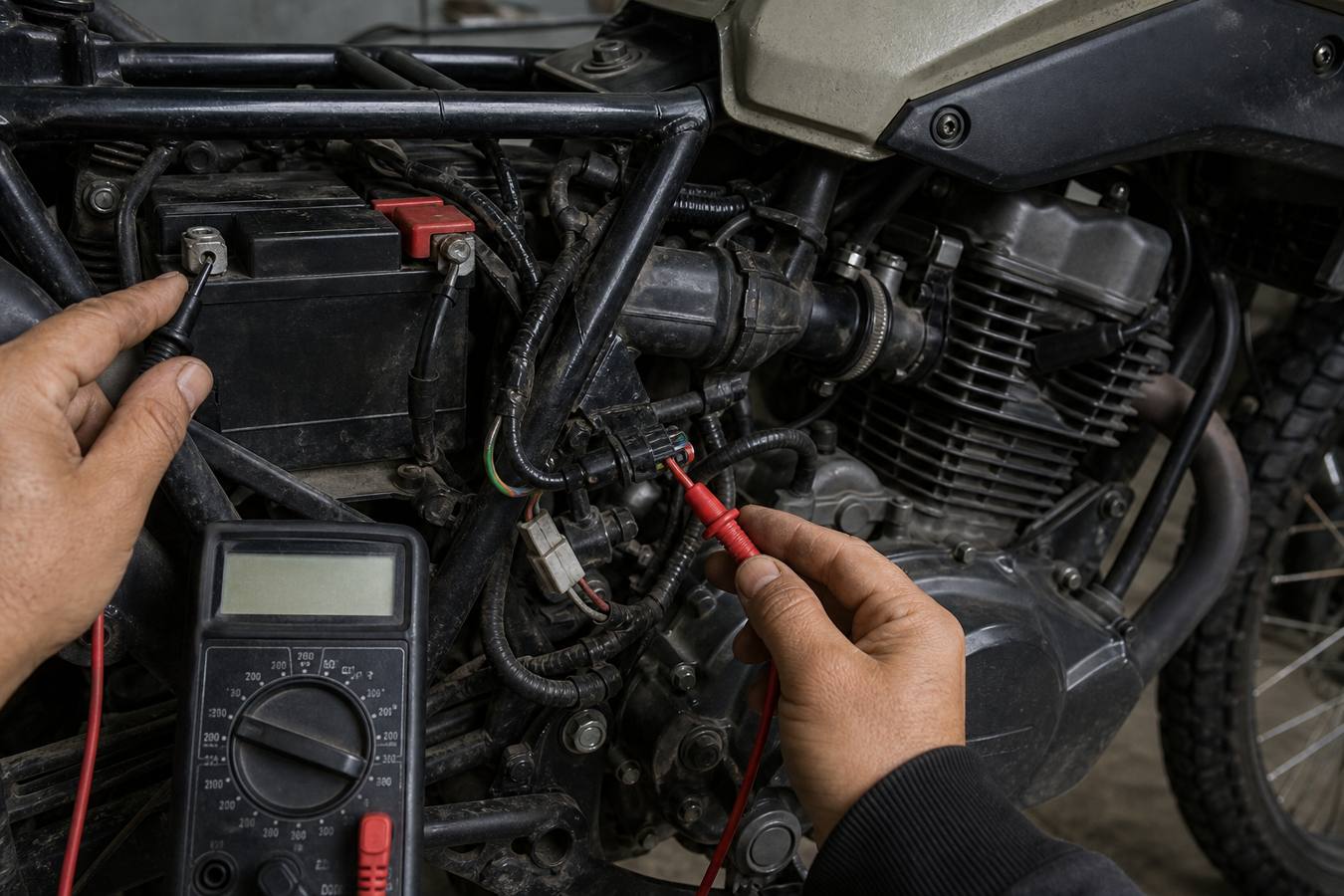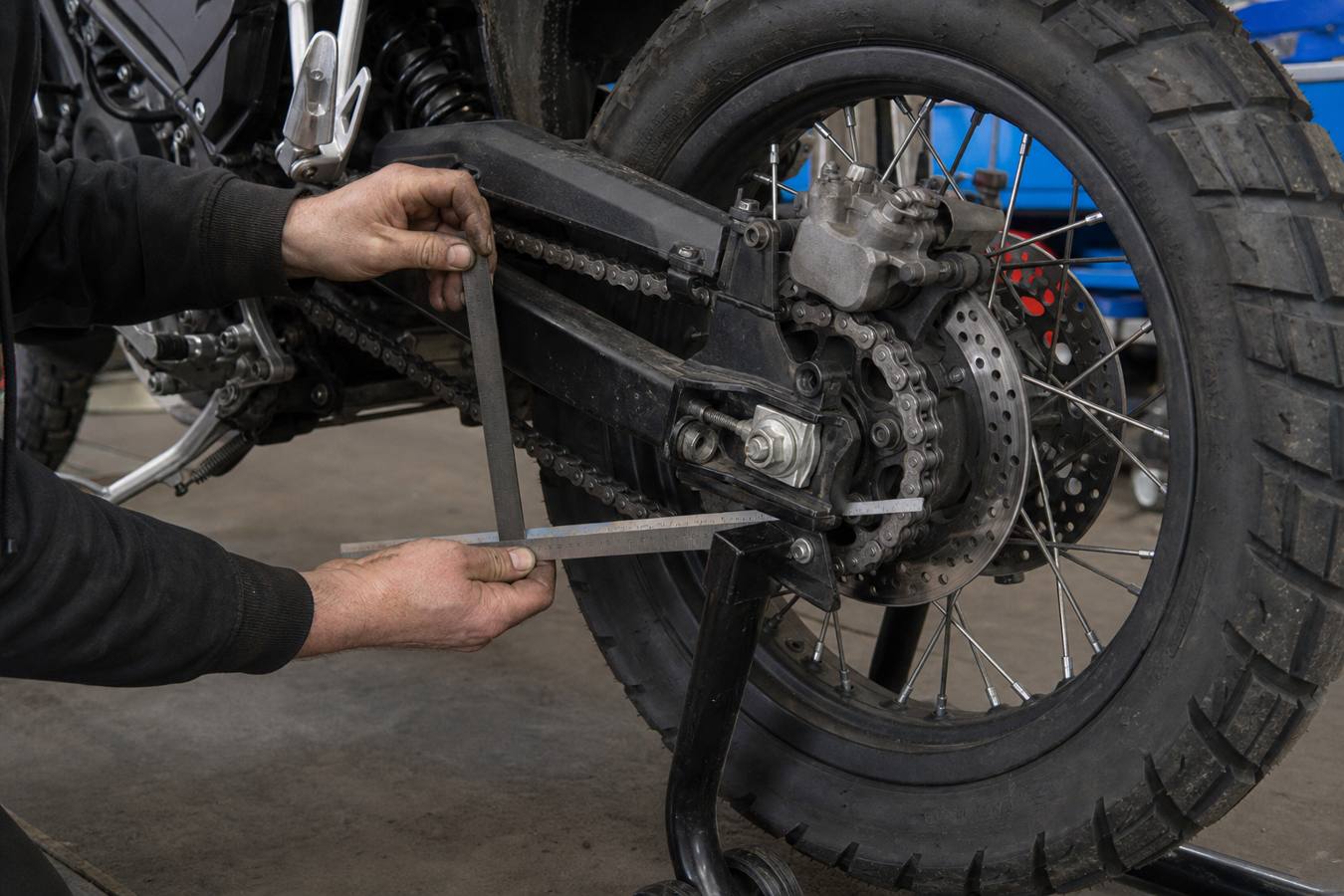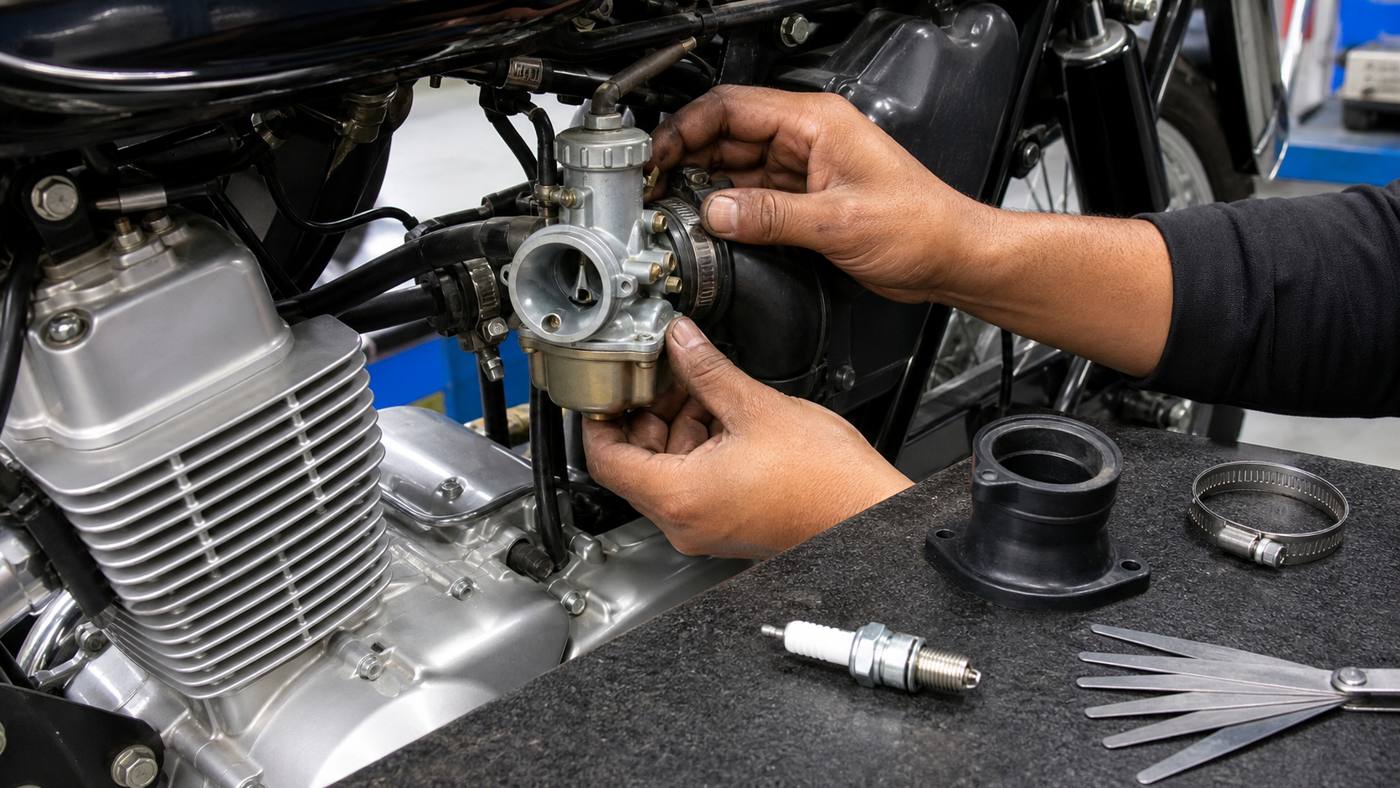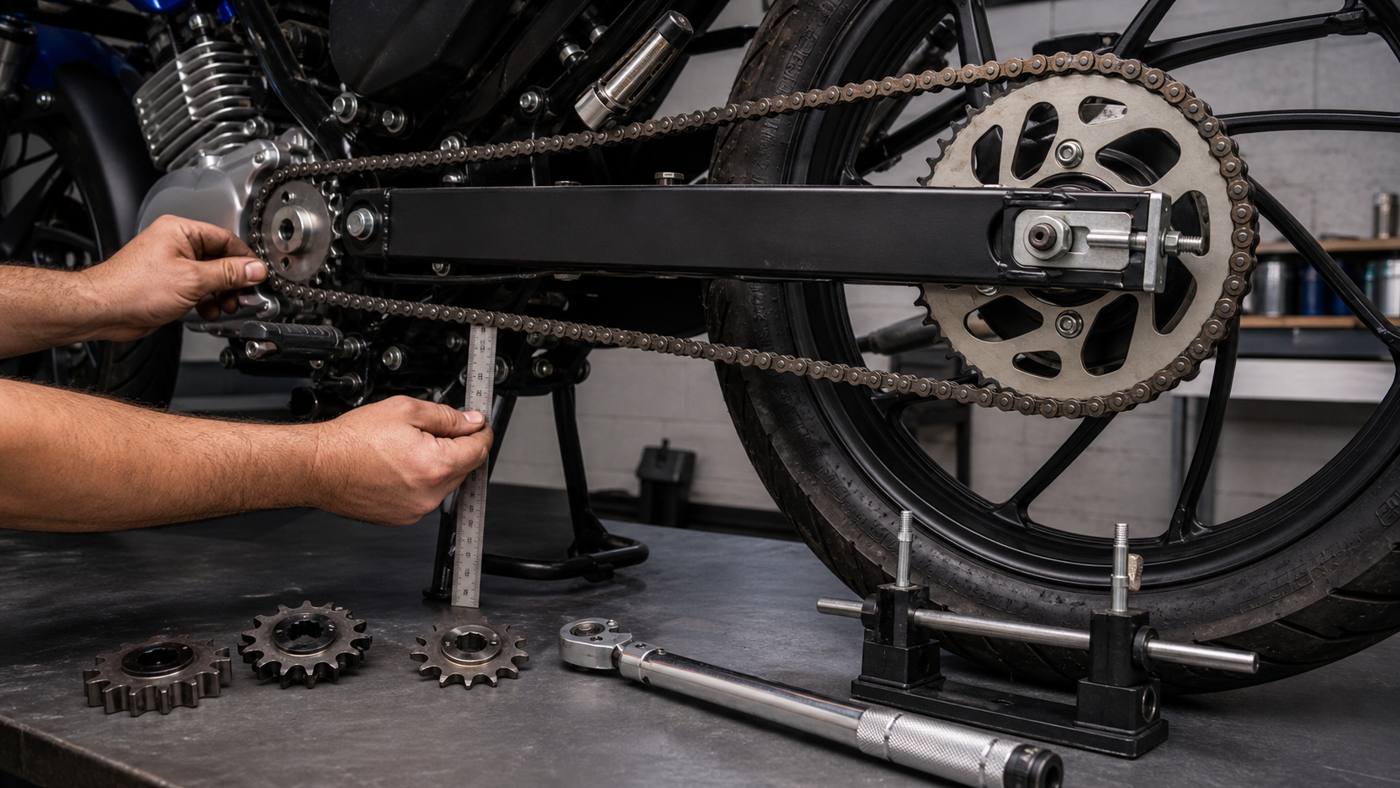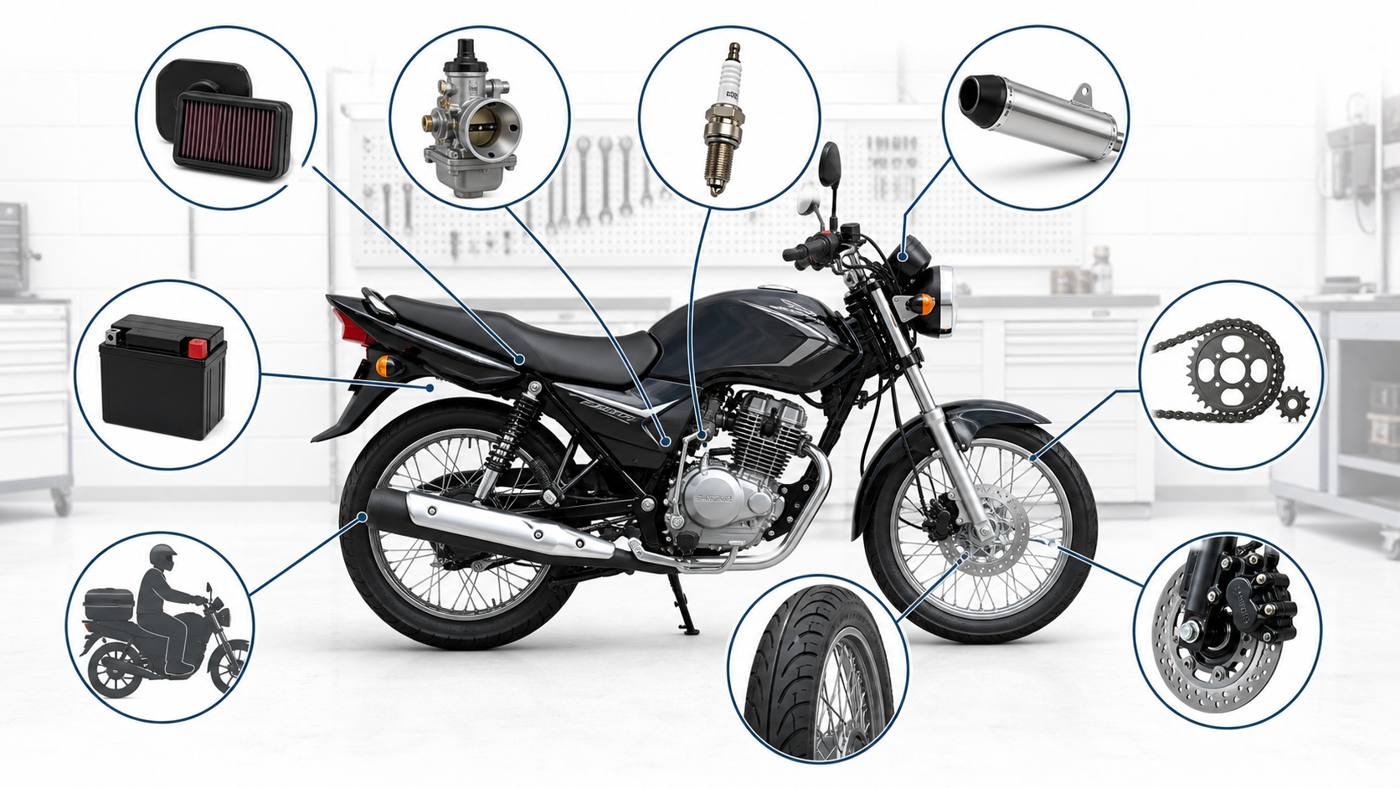
Category: Motorcycle Tuning Guides

English motorcycle tuning guides covering derestriction, chip modules, setup checks and model-specific performance upgrades for riders who want clear fitment information before buying parts.

  • Aprilia Leonardo 125 tuning

    Aprilia Leonardo 125 tuning

    Aprilia Leonardo 125 tuning

    Aprilia Leonardo 125 tuning is best approached as a careful scooter setup, not as a promise of miracle power from one bolt-on part. The Leonardo 125 is an older, practical, liquid-cooled commuter scooter, and the biggest difference usually comes from restoring lost performance first: a healthy CVT, correct belt condition, clean fuelling, good ignition, a leak-free exhaust and sensible setup choices. Once those basics are right, tuning can make the scooter feel sharper, smoother and more willing without turning it into something unreliable.

    This guide is written for owners who are trying to decide what to buy, what to check before ordering and how to avoid the usual mistakes around exhaust fitment, variator parts, CDI or fuelling modules and road legality. It is also for riders looking at a used Leonardo and wondering whether performance parts will fix a tired engine. In many cases, Aprilia Leonardo 125 tuning starts with measurement, maintenance and diagnosis before money is spent on upgrades.
    Aprilia Leonardo 125 tuning
    The Leonardo 125 should be assessed by its real mechanical condition, not only by the part that looks fastest online.

    What tuning actually means on the Leonardo 125

    Aprilia Leonardo 125 tuning should be understood as a complete setup of a small automatic scooter. A 125cc four-stroke engine has limited headroom, so the most satisfying gains normally come from making the transmission hold the engine in its useful rev range, improving throttle response, reducing exhaust restriction where legal and ensuring every service item is in good order. If the belt is worn narrow, the rollers are flat, the plug is tired or the exhaust joint leaks, a new performance part may only hide the real problem for a short time.

    Owners often search for Aprilia Leonardo 125 tuning after noticing slow pull-away, a flat mid-range, poor hill climbing or lower top speed than expected. Those symptoms can be caused by wear as much as by factory restriction. A mechanic would normally check belt width, roller condition, clutch engagement, air filter cleanliness, spark quality, charging voltage, coolant temperature and exhaust sealing before recommending a sports exhaust or tuning module. That order matters because the Leonardo is old enough now that condition varies more than brochure specifications.

    The right target is not a fantasy horsepower number. The right target is a scooter that starts cleanly, idles evenly, pulls away without judder, accelerates without an empty pause, holds road speed on moderate climbs and does not run hot or noisy after fitting parts. Good Aprilia Leonardo 125 tuning feels tidy and repeatable. Bad tuning feels loud, inconsistent and expensive.

    If you are comparing parts, it helps to read related scooter setup guides before choosing. The principles are similar to modern maxi-scooter work such as the Piaggio X10 125 tuning guide and lighter urban scooter guides such as the Daelim S3 125 tuning guide, even though the exact fitment and engine layout are different.

    Compatibility checks before ordering parts

    Parts for this scooter are not all interchangeable across every Leonardo version, market or production year. The name on the fairing is only the first clue. Before ordering, confirm the engine type, year range, exhaust pipe diameter, mounting points, sensor layout and whether the scooter has already been modified. A used scooter may have a replacement exhaust, a non-standard variator, missing airbox pieces or wiring repairs that change the installation work completely.

    Area to checkWhy it mattersPractical note
    Model year and marketParts listings may separate early and later Leonardo versionsUse the registration document and frame plate rather than a guess from photos
    Engine conditionA tired engine will not respond well to upgradesCheck compression, oil use, coolant behaviour and warm idle quality
    CVT belt and rollersTransmission wear can feel like lack of powerMeasure belt width and inspect rollers before changing weights
    Exhaust diameterA universal silencer may need an adapter or fabricationMeasure the pipe at the joint and confirm hanger alignment
    Electrical connectorsCDI or module fitment depends on plug type and wiring layoutInspect the connector before buying any plug-in unit
    Road useNoise and emissions rules vary by countryCheck whether the part is road-approved, track-only or off-road-only

    The safest buying process is simple: identify the scooter, photograph the original part, measure the relevant dimension and only then compare product listings. Anyone considering Aprilia Leonardo 125 tuning should treat “fits Leonardo” as a starting claim, not final proof. For general upgrade browsing, the performance parts category is useful only after these measurements are known, especially when Aprilia Leonardo 125 tuning involves parts sold for more than one engine size.

    Compatibility table for typical Leonardo 125 upgrades

    Upgrade typeCompatibilityImportant note
    Variator rollersUsually possibleWeight and size must match the installed variator, not just the scooter name
    Drive beltModel-specificCorrect length and width are essential for ratio and reliability
    Sports exhaustDepends on pipe and hanger layoutCheck diameter, bracket position, gasket type and road approval
    Universal silencerPossible with adaptationMay need reducer sleeves, welding or a custom hanger
    CDI or fuelling moduleConnector-specificDo not assume plug-and-play without checking wiring and sensor layout
    Air filter changesPossible but easy to overdoOpen filters can worsen fuelling and weather protection on a commuter scooter

    CVT, variator and belt setup

    Aprilia Leonardo 125 tuning often begins inside the CVT cover because the automatic transmission controls how the engine uses its modest power. If the scooter revs too low during acceleration, it feels lazy. If it revs too high without road speed rising, it feels noisy and inefficient. The aim is to keep the engine in a useful band while the belt moves cleanly across the variator faces.

    Start by checking the belt. A belt worn below service width sits differently in the pulleys and can reduce top speed or make the scooter sluggish off the line. Then inspect rollers for flat spots. Flat rollers do not move smoothly, so the transmission can hang between ratios. Clutch shoes, bell glazing and weak springs can also create judder or delayed engagement. Many riders blame the engine, when the problem is actually transmission wear.
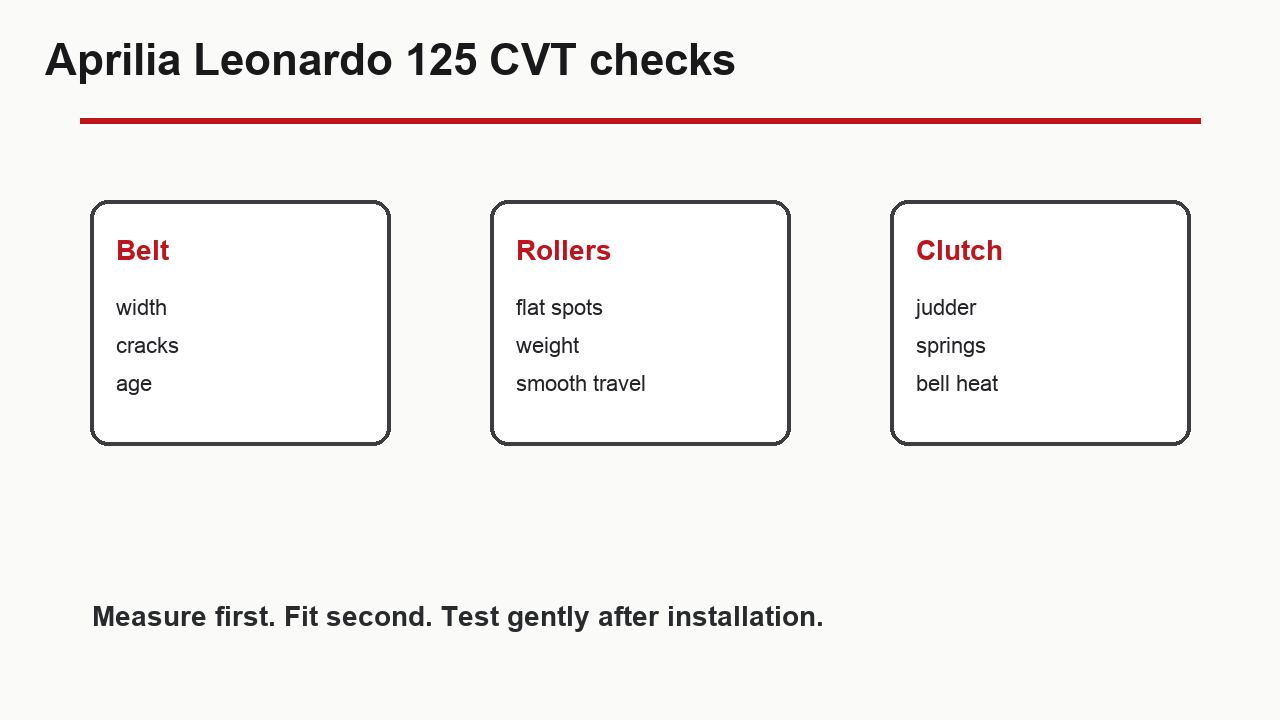
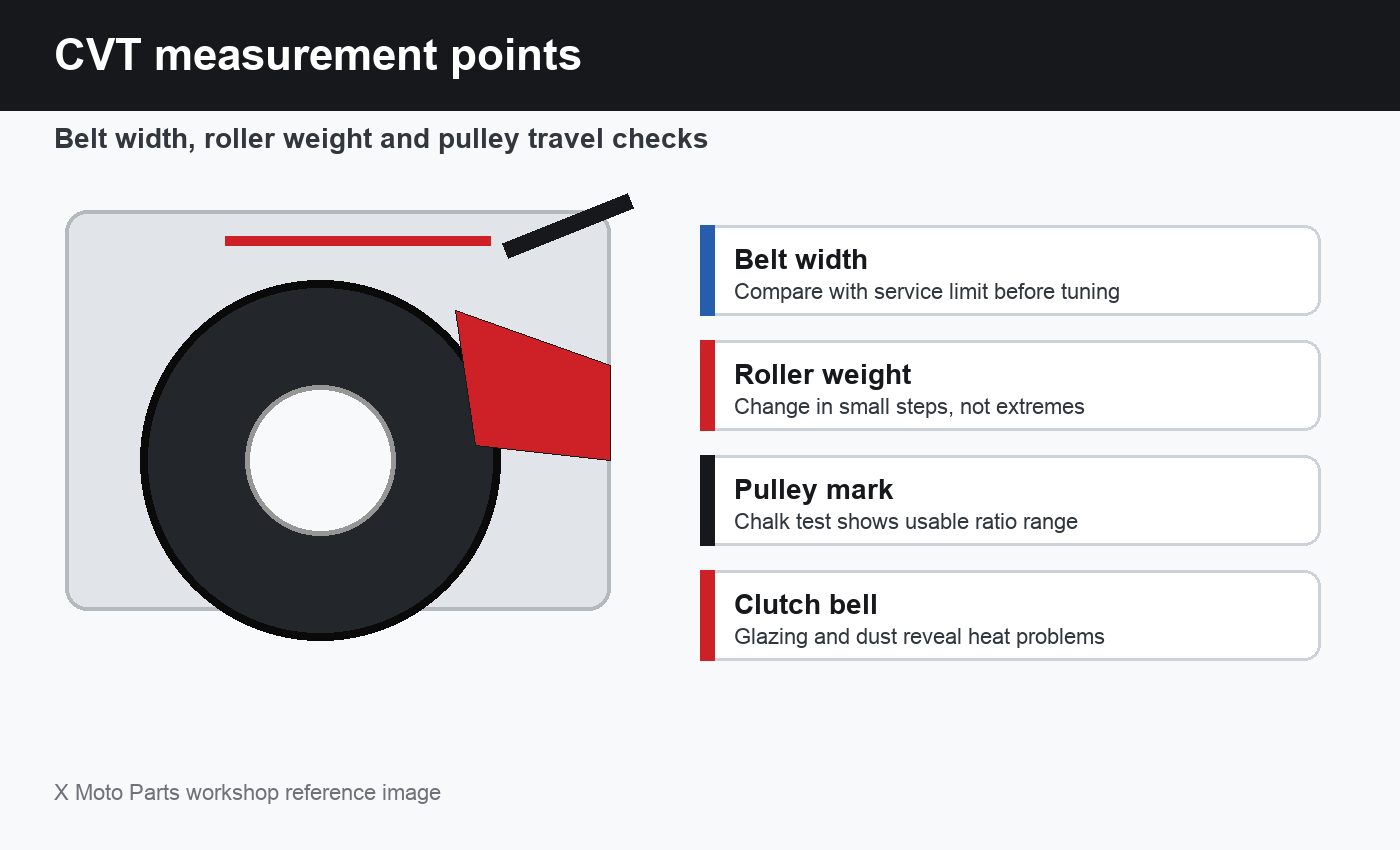
    Aprilia Leonardo 125 CVT belt roller and clutch checks for scooter tuning
    Measure belt width and inspect roller wear before choosing lighter or heavier variator rollers.

    Roller weight choice

    For Aprilia Leonardo 125 tuning, lighter rollers can improve pick-up by allowing the engine to rev higher before the transmission shifts. Too light, however, and the scooter sounds busy without gaining speed. Heavier rollers may calm cruising revs, but too heavy can make acceleration flat. The correct answer depends on rider weight, hills, exhaust setup, belt condition and whether the scooter is used in city traffic or open roads.

    A practical workshop method is to record the current setup first: belt width, roller weight, roller size, variator condition and maximum indicated speed on the same route. Change one thing at a time. If the owner fits a sports exhaust, a fresh belt and different rollers on the same afternoon, it becomes hard to know which part improved the scooter and which one introduced a new problem.

    CVT choiceMain advantagePossible disadvantageBest use case
    Fresh standard belt and rollersRestores original smoothnessMay not feel sportierUnknown service history or tired scooter
    Slightly lighter rollersSharper take-off and hill responseCan increase cruising revsUrban riding and heavier riders
    Performance variatorBroader ratio control when well matchedNeeds careful setupOwners willing to test and maintain
    Stiffer clutch springsLater clutch engagementCan make low-speed riding less smoothSportier starts, not heavy stop-start commuting
    Random mixed kitLooks cheap onlineOften creates poor matchingBest avoided unless specifications are clear

    Exhaust, silencer and sound choices

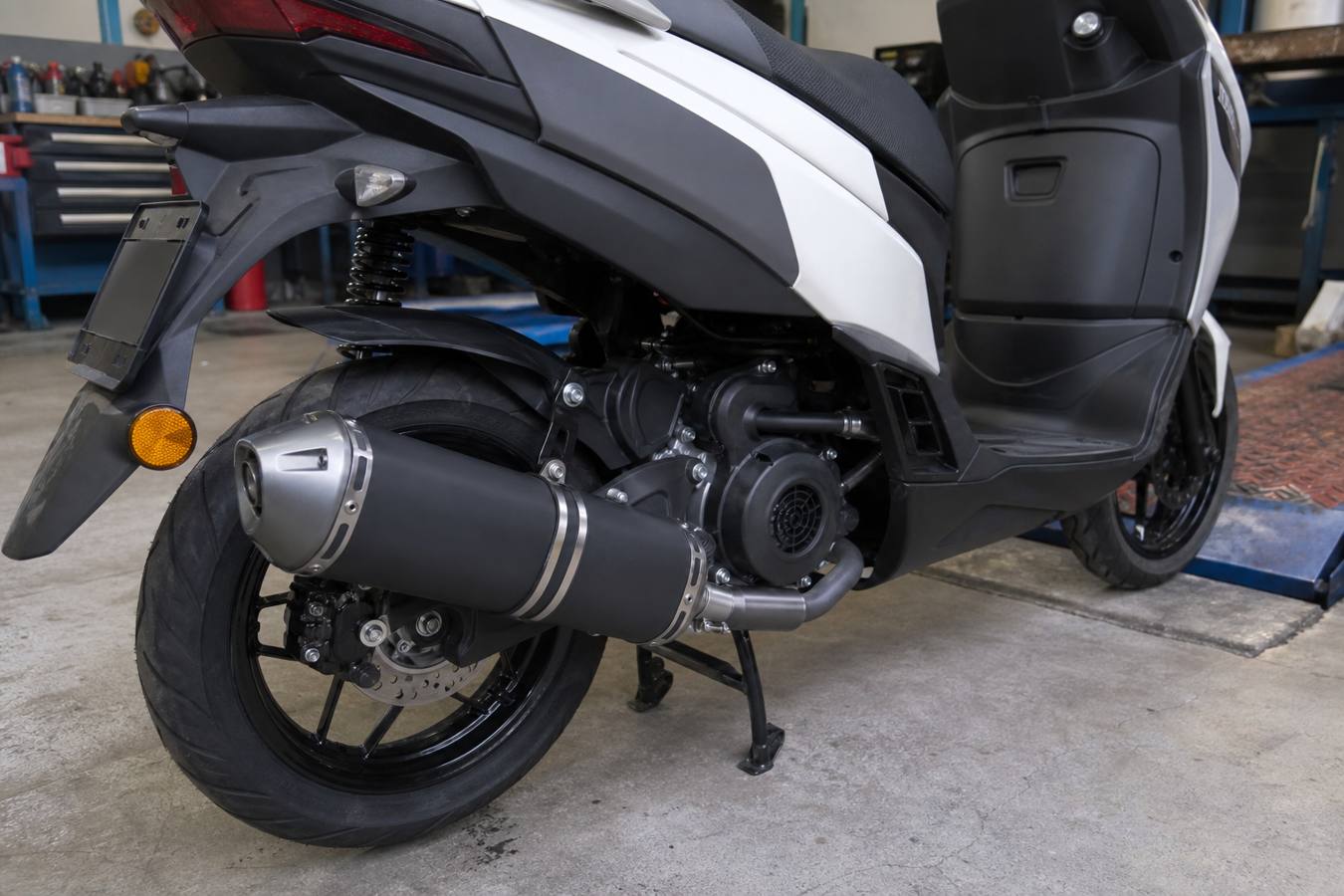
    Aprilia Leonardo 125 tuning often includes an exhaust because it changes sound, appearance and sometimes throttle response. On a small four-stroke scooter, an exhaust alone rarely transforms performance. The best result comes when the silencer, header, gasket, mounting bracket and fuelling are all compatible. A leaking joint can cause popping, weak response and heat marks. A badly supported silencer can crack brackets or stress the cylinder head studs.

    Before buying a motorcycle exhaust or scooter silencer, measure the pipe diameter and compare the hanger position. Universal exhausts can work well on custom projects, but they are not automatically plug-and-play. Model-specific systems are easier when available, while universal parts need more care. Riders looking for compatible options can start from the motorcycle exhausts category, but measurement still comes first.

    DB-killer, catalyst and noise

    A removable DB-killer can make a scooter sound more aggressive, but road use is a different question from private-area or track use. If a silencer was designed with a baffle, removing it can increase noise, alter back pressure and attract attention during inspection. Some systems may also affect catalyst presence or emissions equipment. For a road-going Leonardo, the mature choice is to keep the scooter civil enough for daily riding unless it is genuinely used away from public roads.

    The UK MOT inspection manual includes checks for exhaust noise and condition, and the official motorcycle MOT guidance is a better reference than internet hearsay: GOV.UK motorcycle MOT exhaust noise guidance. For broader rider safety context, the United States NHTSA motorcycle safety material is useful for owners comparing road behaviour and risk: NHTSA motorcycle safety information.

    Exhaust solutionMain advantagePossible disadvantageWhat to check
    Original exhaustUsually quiet and compliantMay be corroded or restrictive with ageRust, leaks, internal rattles and mounting rubbers
    Road-approved sports exhaustBetter appearance and controlled soundMay cost moreApproval markings, supplied hardware and gasket fit
    Universal silencerFlexible and affordableMay need adaptationDiameter, sleeve, bracket line and rear wheel clearance
    Track-use-only exhaustMore sound and freer flowNot suitable for normal road useLegal status, insurance implications and noise limits
    Used exhaustLower purchase costUnknown historyHidden cracks, missing baffle and damaged threads

    CDI, fuelling modules and electrical reality

    Aprilia Leonardo 125 tuning can involve CDI or fuelling changes, but this area needs more caution than a simple cosmetic part. Some listings use broad words such as chip, ECU, CDI or power unit, while the scooter may have a connector layout that differs by year or market. A plug that looks similar in a photo can still have different pin positions. Before any electrical part is ordered, photograph the original connector, count pins, inspect wire colours and check whether the scooter has previous repairs.

    A small tuning module can only work correctly if the engine is mechanically healthy. If the intake manifold is cracked, the automatic choke is faulty, the battery voltage is weak or the charging system is unstable, fuelling changes may make the symptoms worse. Clean electrical basics matter: battery resting voltage, charging voltage, earth points, plug cap resistance, ignition lead condition and dry connector routing.
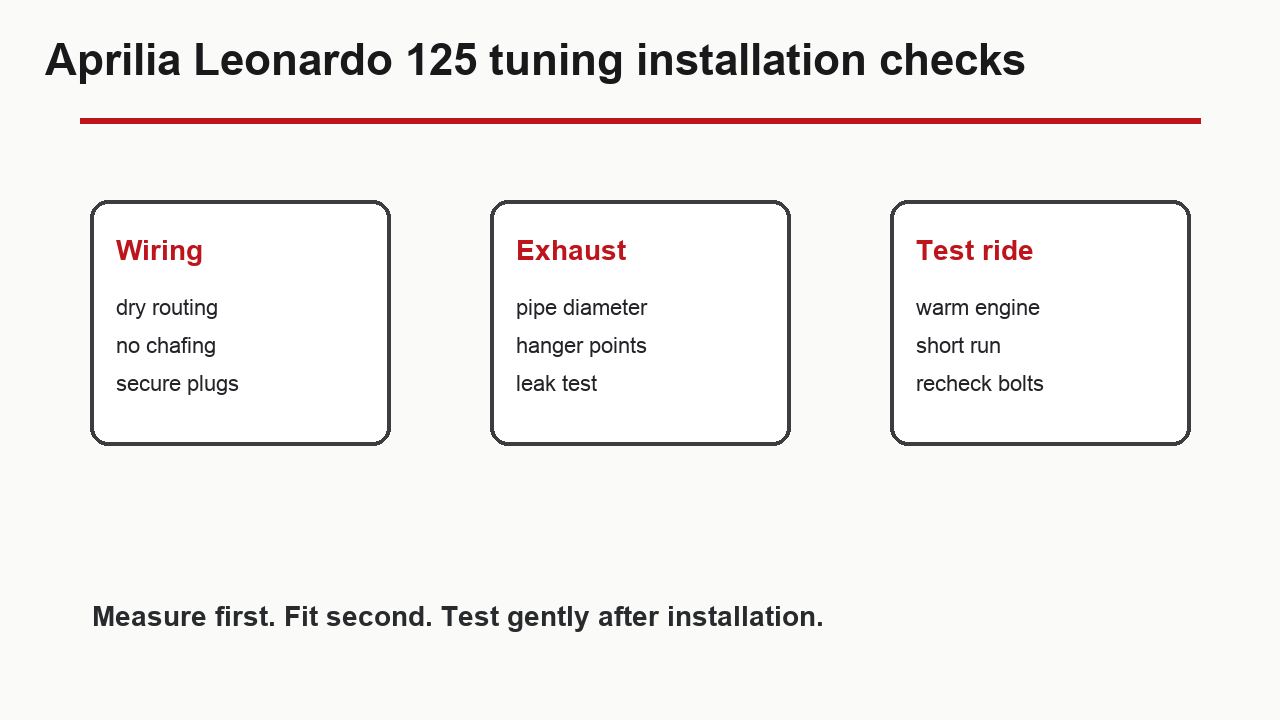
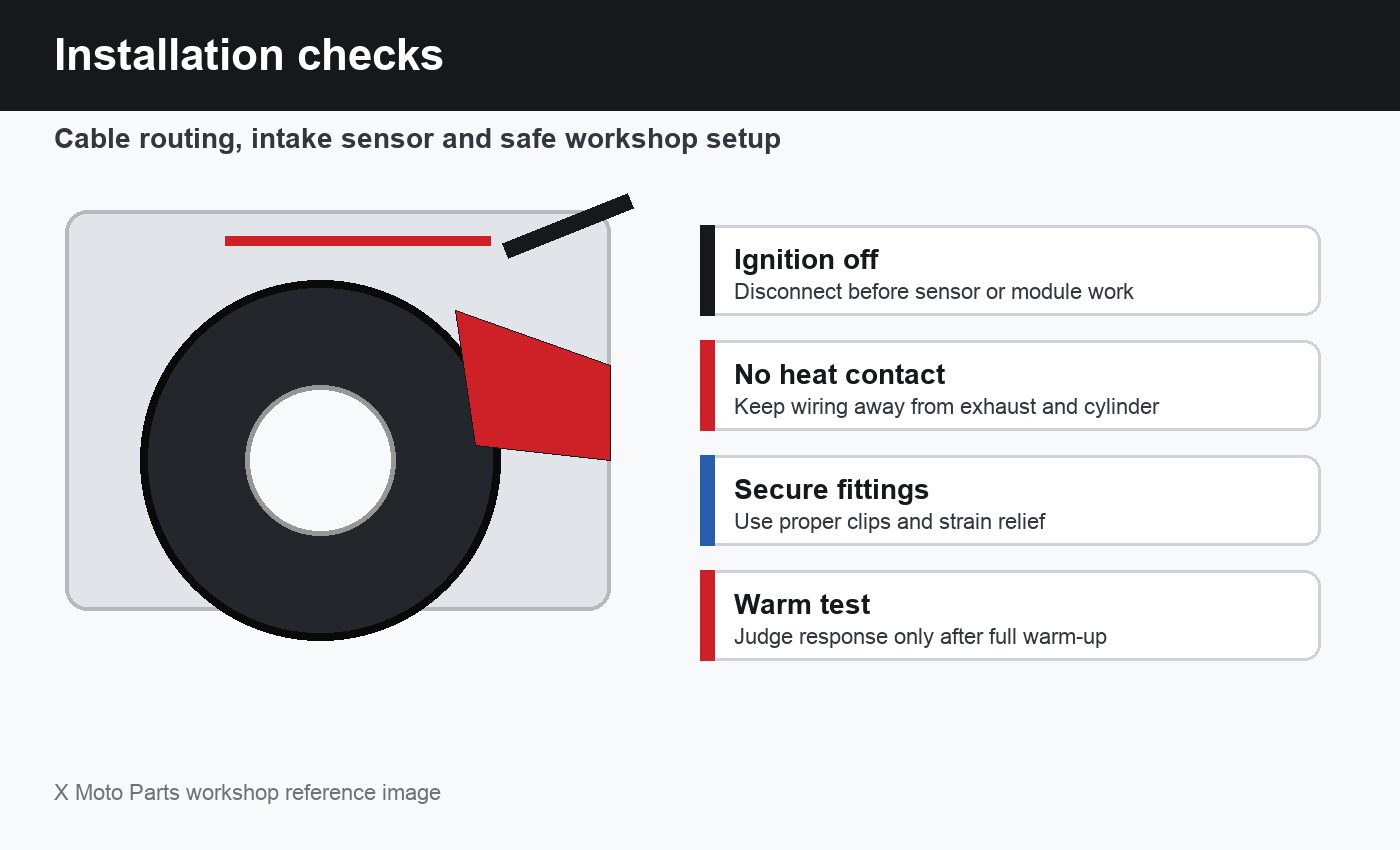
    Aprilia Leonardo 125 tuning installation checks for wiring exhaust and road testing
    Good installation means secure wiring, correct exhaust support and a gentle test ride before judging the result.

    What a mechanic checks before fitting a module

    Before fitting any module during Aprilia Leonardo 125 tuning, check warm idle, throttle return, air filter condition, plug colour, cooling fan operation and whether the scooter restarts easily when hot. A module should not be used to cover a fault. If the scooter hesitates because of old fuel, dirty carburation or an intake leak, tuning will not be a clean fix. On an older Leonardo, a careful service can feel like a performance upgrade because it brings back response that slowly disappeared over years.

    Aprilia Leonardo 125 tuning has to be separated into road use, private land use, track use and off-road use. In the UK, an exhaust that is excessively noisy or clearly marked for competition use can create MOT, police and insurance problems. A part may fit physically and still be unsuitable for road use. In the European context, E-marking can matter for certain components, but it is not a magic answer for every installation because the whole vehicle condition, noise level and emissions equipment still matter.

    In the United States, Canada, Australia, New Zealand and Ireland, rules vary by state, province or national road authority. Some areas focus heavily on noise. Others focus on emissions equipment, inspection status or whether a vehicle remains as approved for road use. The practical advice is to confirm local rules before buying parts that change exhaust noise, emissions equipment, lighting, speed restriction or engine management. Sensible scooter modification keeps documentation, receipts and installation notes because those details can help with insurance and inspection questions later.

    Insurance is often forgotten. If a modification changes sound, power delivery, engine management or fitted equipment, declare it where required. A small scooter part may look minor to the owner, but insurers can treat undeclared modifications seriously after an accident. This does not mean every owner should avoid upgrades. It means upgrades should be chosen with the same care as tyres and brakes.

    Common mistakes that make Leonardo tuning disappointing

    Aprilia Leonardo 125 tuning goes wrong when the owner buys parts before understanding the scooter. The most common mistake is fitting a loud exhaust to a worn CVT and then expecting better acceleration. The second is choosing roller weights from a forum without checking the existing variator. The third is buying a universal silencer without measuring pipe diameter, bracket alignment or rear bodywork clearance.

    Other mistakes are less obvious. Some owners remove the DB-killer, then wonder why the scooter feels rough at low throttle. Some fit an open air filter and expose the intake to rain, dirt and hot air from inside the bodywork. Some ignore a weak battery and then blame a CDI. Some tighten exhaust studs too hard and damage threads in the cylinder head. Some assume that a part for Leonardo 150 or 250 will fit a Leonardo 125 because the body looks similar.
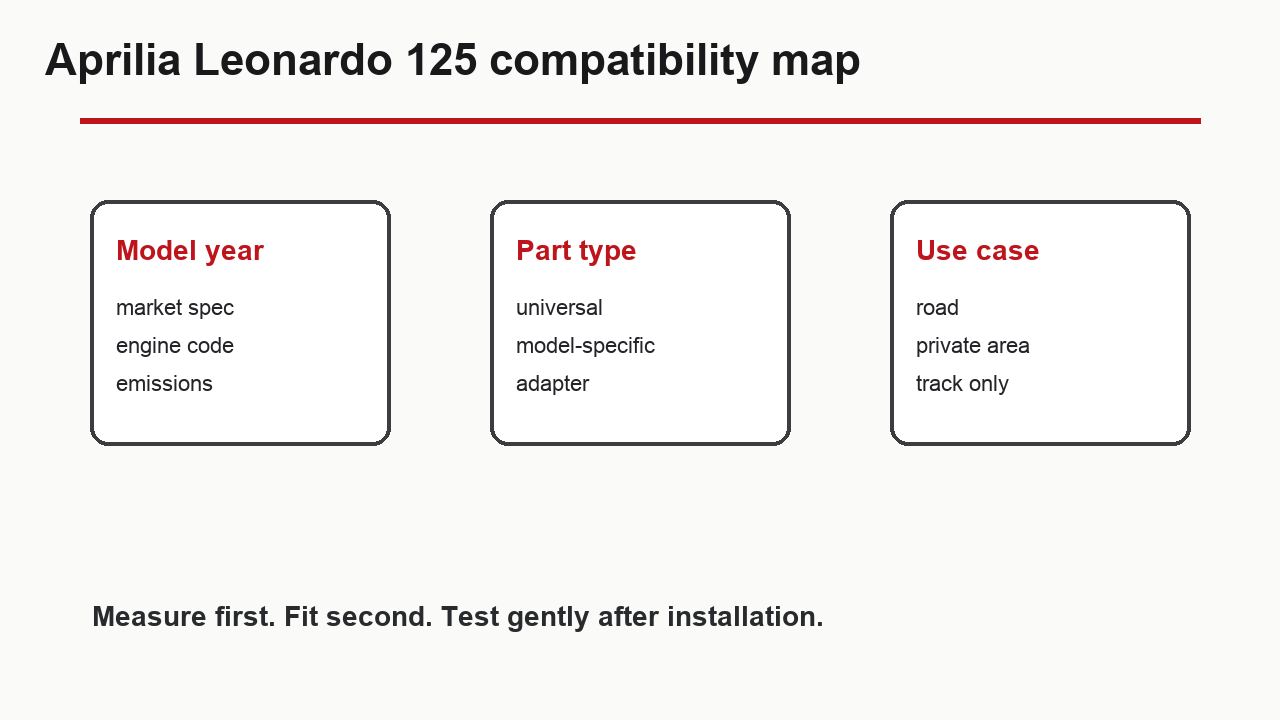
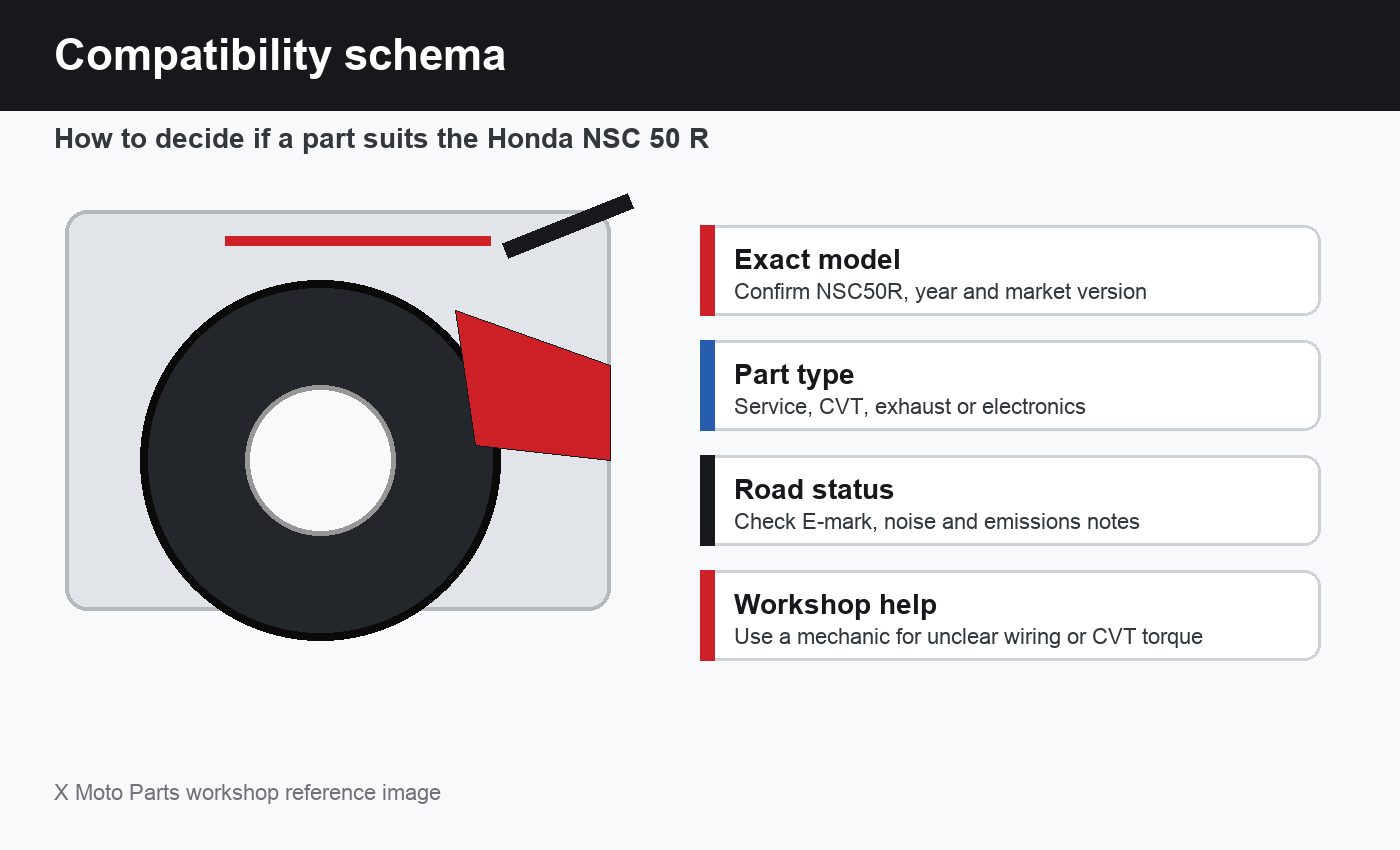
    Aprilia Leonardo 125 compatibility checks for model year part type and road use
    Compatibility is a chain of checks: model year, engine layout, part type and intended use must all agree.

    Symptoms after a poor setup

    After a poor setup, the scooter may bog from a stop, rev without acceleration, pop on overrun, run hotter than before, vibrate through the exhaust bracket or use more fuel. These symptoms do not always mean the part is bad. They often mean the part is mismatched, badly installed or fitted to a scooter that needed maintenance first. A short test ride is not enough. Recheck bolts, belt dust, exhaust leaks and plug condition after the first heat cycles.

    Workshop-style setup process

    Aprilia Leonardo 125 tuning should follow a disciplined order. First, service the scooter: oil, coolant condition, air filter, spark plug, tyre pressures and brake drag. Second, inspect the CVT: belt, rollers, guides, clutch shoes and variator faces. Third, decide whether the owner wants better commuting smoothness, stronger pull-away, more sound or a visual refresh. Fourth, choose parts that match that goal. Fifth, install one area at a time and test after each change.

    This is where experience matters. A scooter that spends its life in city traffic may benefit from a slightly more responsive CVT setup but become annoying if it revs too high on every journey. A scooter used on A-roads may need a healthier belt and standard-like gearing more than aggressive roller changes. A rider carrying luggage or a passenger should avoid chasing a sharp launch at the cost of heat and clutch wear. Good Aprilia Leonardo 125 tuning respects the way the scooter is actually used.

    Useful measurements before buying

    • Drive belt width, length code and visible cracking.
    • Roller size and weight from the fitted variator.
    • Exhaust pipe outside diameter at the joint.
    • Distance between exhaust hanger points and body clearance.
    • Battery voltage before start and charging voltage at idle and raised rpm.
    • Connector shape and pin count before buying any electrical module.
    • Tyre size, tyre age and whether the brakes drag when the wheel is lifted.

    If those checks sound too involved, that is the point at which a mechanic becomes good value. This job is not difficult for a competent workshop, but it becomes frustrating when guesswork replaces measurement.

    Buying advice for owners

    Aprilia Leonardo 125 tuning parts should be chosen according to the problem you are solving. If the scooter is slow away from traffic lights, inspect CVT wear first. If it sounds tired or leaks from the exhaust, focus on gasket, corrosion and bracket condition. If the rider wants a sportier look and sound, choose an exhaust with clear fitment information and road-use status. If throttle response is weak, do not ignore air leaks, old fuel, spark condition and battery voltage.

    There is also a difference between a universal solution and a model-specific solution. Universal parts can be perfectly usable, especially for owners comfortable with adaptation. Model-specific parts reduce fabrication work when the listing is accurate. A cheap universal part can become expensive if it needs sleeves, hangers, cutting, welding or repeated garage time. A more expensive part can be better value if it fits cleanly and arrives with the right hardware.

    For riders still comparing categories, use X Moto Parts as a starting point rather than guessing from generic photos. Compare exhaust options in the motorcycle exhaust section, then compare broader upgrade ideas in the X Moto Parts shop. Always match the product to the exact scooter before ordering.

    FAQ

    Is Aprilia Leonardo 125 tuning worth doing?

    Aprilia Leonardo 125 tuning is worth doing when the scooter is healthy and the goal is realistic. It can improve response, smoothness, sound and usability, but it will not turn a 125cc commuter scooter into a high-performance motorcycle. Start with service condition and CVT health.

    What is the best first upgrade for an Aprilia Leonardo 125?

    The best first upgrade is often not a new part but a proper inspection. A fresh belt, correct rollers, clean air filter, good spark plug and leak-free exhaust may improve the scooter more than a random performance part.

    Can I fit a universal exhaust to an Aprilia Leonardo 125?

    A universal exhaust may be possible, but it is not automatically plug-and-play. Measure pipe diameter, hanger position, bodywork clearance and gasket style. For Aprilia Leonardo 125 tuning, poor exhaust support can cause cracks, leaks and vibration.

    Do I need to remap after changing the exhaust?

    On many small scooters, a mild road exhaust may not require a full remap, but fuelling behaviour still needs to be checked. If Aprilia Leonardo 125 tuning includes a very free-flowing exhaust, intake changes or electrical modules, monitor plug colour, starting, idle and throttle response carefully.

    Will lighter rollers increase top speed?

    Lighter rollers usually improve acceleration feel rather than guaranteed top speed. If they are too light, the scooter may rev more but travel no faster. In Aprilia Leonardo 125 tuning, roller choice must match belt condition, rider weight, route and variator design.

    Is a louder exhaust legal in the UK?

    A louder exhaust is not automatically legal. The UK MOT includes exhaust noise and condition checks, and an excessively noisy or competition-marked exhaust can cause problems. Any Aprilia Leonardo 125 tuning for road use should respect MOT, insurance and local enforcement expectations.

    Can tuning fix a slow Leonardo 125?

    Sometimes, but only after diagnosis. A slow Leonardo may have a worn belt, flat rollers, dragging brakes, low compression, old fuel, blocked filter or exhaust leak. Aprilia Leonardo 125 tuning works best after these faults are corrected.

    Should I choose a chip, exhaust or CVT kit first?

    Choose according to symptoms. For weak launch, inspect CVT first. For corrosion or sound, inspect the exhaust. For throttle response, check electrical and fuelling basics. Aprilia Leonardo 125 tuning is most reliable when each part solves a confirmed issue.

    Practical conclusion

    Aprilia Leonardo 125 tuning should finish with a clear choice, not a basket full of uncertain parts. If the scooter is tired, restore the CVT, ignition, intake and exhaust sealing first. If it is healthy and you want stronger city response, consider a measured CVT setup. If you want better sound, check pipe diameter, hanger points, DB-killer status and road approval before buying an exhaust. If you want an electrical module, confirm the connector and make sure the scooter has no underlying fault.

    The best Leonardo setups are modest, measured and reliable. They start easily on a cold morning, pull cleanly through traffic, hold speed without screaming and pass inspection without drama. For a daily scooter, that is far more valuable than a noisy part fitted without thought. When you are ready to compare practical parts, begin with the relevant X Moto Parts categories and keep the measurements beside you while ordering.

    Aprilia Leonardo 125 tuning works when the owner treats the scooter as a complete machine: engine, CVT, exhaust, electrics, tyres, brakes and legal use all have to agree. That is the difference between a scooter that only sounds modified and one that genuinely rides better.

    {
    “@context”: “https://schema.org”,
    “@type”: “Article”,
    “headline”: “Leonardo 125 scooter tuning guide”,
    “description”: “A practical guide for CVT setup, exhaust fitment, fuelling checks, compatibility, UK road legality and common installation mistakes.”,
    “image”: “https://xmotoparts.com/wp-content/uploads/2026/07/aprilia-leonardo-125-tuning.jpg”,
    “author”: {“@type”: “Organization”, “name”: “X Moto Parts”},
    “publisher”: {“@type”: “Organization”, “name”: “X Moto Parts”},
    “mainEntityOfPage”: “https://xmotoparts.com/aprilia-leonardo-125-tuning/”
    }

    {
    “@context”: “https://schema.org”,
    “@type”: “FAQPage”,
    “mainEntity”: [
    {“@type”: “Question”, “name”: “Is tuning worth doing on this scooter?”, “acceptedAnswer”: {“@type”: “Answer”, “text”: “It is worth doing when the scooter is mechanically healthy and the owner wants realistic improvements in response, smoothness, sound or usability.”}},
    {“@type”: “Question”, “name”: “Can I fit a universal exhaust to an Aprilia Leonardo 125?”, “acceptedAnswer”: {“@type”: “Answer”, “text”: “A universal exhaust may fit with adaptation, but pipe diameter, hanger alignment, clearance and road-use approval must be checked before ordering.”}},
    {“@type”: “Question”, “name”: “Do I need to remap after changing the exhaust?”, “acceptedAnswer”: {“@type”: “Answer”, “text”: “A mild road exhaust may not require a full remap, but fuelling, starting, idle quality and throttle response should always be checked after installation.”}}
    ]
    }
  • Aprilia Pegaso 650 tuning

    Aprilia Pegaso 650 tuning

    Aprilia Pegaso 650 tuning: exhaust, fuelling, gearing and setup guide

    Aprilia Pegaso 650 tuning

    Aprilia Pegaso 650 tuning
    Aprilia Pegaso 650 tuning

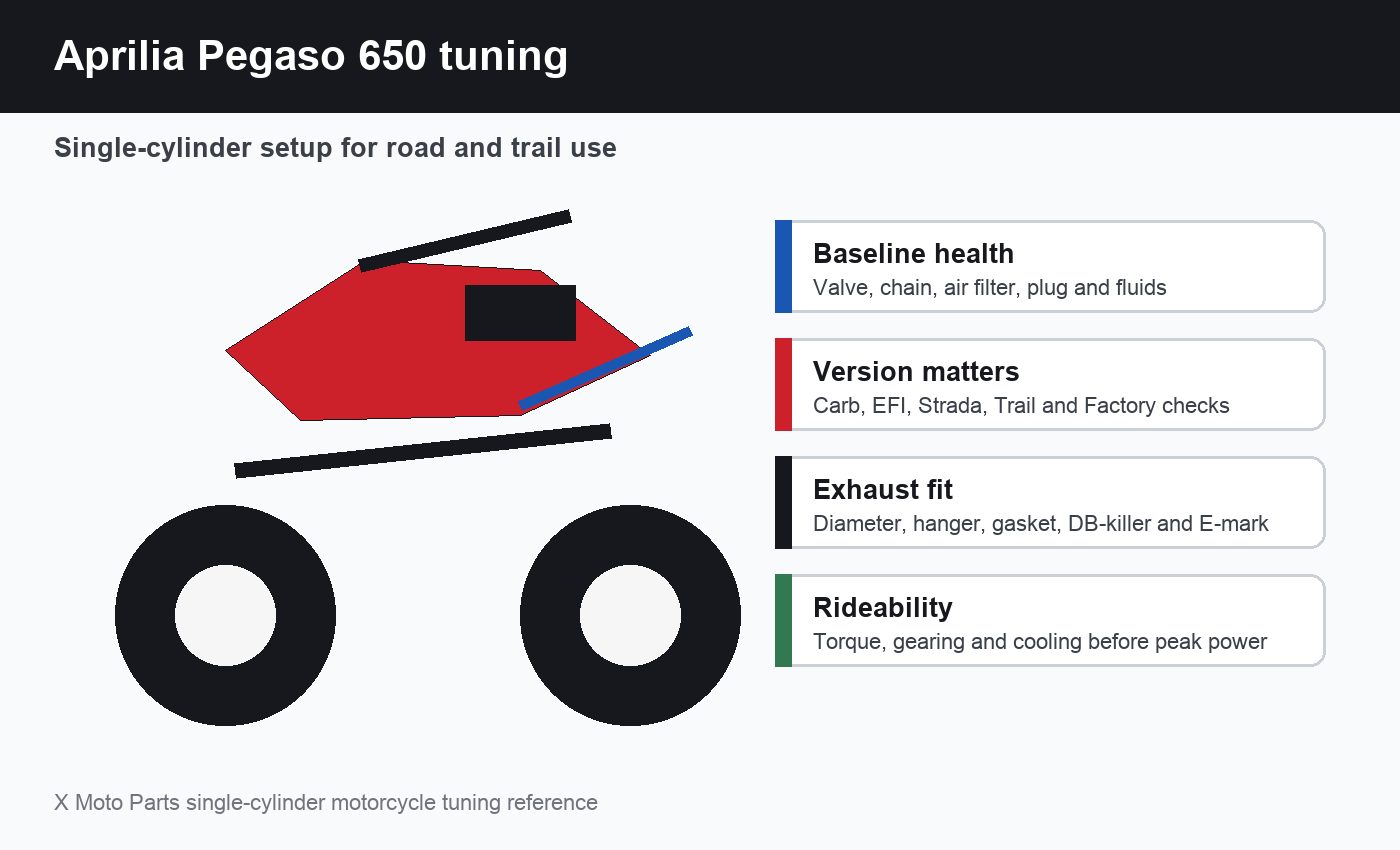
    Aprilia Pegaso 650 tuning should make a big single-cylinder motorcycle easier to ride, stronger in the mid-range and more dependable, not simply louder. The Pegaso name covers different years and versions, from earlier Rotax-based machines to later models with different fuel systems and chassis trim, so a good upgrade plan starts with identifying the exact bike before buying parts.

    Most owners want the same things: cleaner throttle response, less hesitation, stronger drive out of bends, a better exhaust note, improved gearing for road or light trail use and fewer rough spots at low rpm. Those goals are realistic. What is not realistic is expecting a mild exhaust, filter or plug-in module to turn the Pegaso into a modern twin-cylinder adventure bike. A well-set Pegaso remains a torquey, characterful single.

    This guide explains how to approach tuning like a mechanic: baseline checks, exhaust fitment, carburettor or EFI logic, gearing and chain setup, compatibility between versions, road legality and the common mistakes that create surging, heat, noise and poor reliability.

    Identify the exact Pegaso 650 version first

    Aprilia Pegaso 650 tuning starts with the model year. Earlier Pegaso 650 machines and later Pegaso 650 Strada, Trail and Factory-style versions do not all use the same engine management, exhaust layout, airbox details, dashboard logic or chassis parts. Some owners use the same name for quite different motorcycles, which is why compatibility mistakes are common.

    Before buying anything, write down the year, version, VIN details if needed, engine type, fuel system, current exhaust, airbox condition, sprocket sizes, chain pitch and any existing modifications. If the bike has been through several owners, do not assume it is standard. Used Pegasos often arrive with aftermarket silencers, missing DB-killers, altered gearing, open filters or old wiring repairs. A careful Aprilia Pegaso 650 tuning plan starts by finding out what has already been changed.

    A realistic Aprilia Pegaso 650 tuning result is usually about mid-range torque and throttle smoothness. The engine is already large enough to feel strong on country roads, but a worn chain, dirty air filter, leaking exhaust gasket or badly chosen sprocket can make it feel rough and tired. Start by making the motorcycle honest.

    For similar single-cylinder and road-trail tuning logic, the Mash X-Ride 650 tuning guide is useful. Riders comparing Aprilia road-trail behaviour can also read the Fantic Caballero 500 tuning guide and the motorcycle chain tension adjustment guide.

    Owner goalMost relevant areaFirst check
    Stronger mid-rangeFuelling, intake and exhaust sealAir filter, intake leaks, plug colour, exhaust gasket and throttle response
    Better soundSilencer and link pipeDiameter, hanger alignment, DB-killer, E-mark and road-use notes
    Less snatchy throttleFuel system and chain setupIdle, throttle free play, chain slack and worn sprockets
    Improved road gearingFront/rear sprocketsCurrent tooth count, chain condition and riding speed
    Trail or touring useTyres, suspension and coolingTyre type, fork/shock condition, fan operation and luggage clearance

    Baseline checks before performance parts

    Aprilia Pegaso 650 tuning should begin with service condition. Check engine oil, coolant, air filter, spark plug, battery voltage, charging output, throttle cables, clutch adjustment, chain slack, sprocket wear, tyre pressure, brake drag, wheel bearings and any warning lights. A single-cylinder motorcycle can feel dramatically worse when the basics are off.

    Listen cold and hot. A worn chain can make throttle response feel harsh. An exhaust leak can make the engine pop on overrun and confuse fuelling judgement. A weak battery can upset EFI behaviour on later bikes. Tight valves, dirty carburettor circuits or a blocked air filter can make a Pegaso feel flat no matter what exhaust is fitted.

    A proper Aprilia Pegaso 650 tuning baseline uses a repeatable road test. Ride the same hill, the same bends and the same cruising section before and after each change. Note surging, hesitation, heat, fan behaviour, clutch feel and fuel economy. If you change exhaust, filter and gearing together, you will not know what helped or hurt.

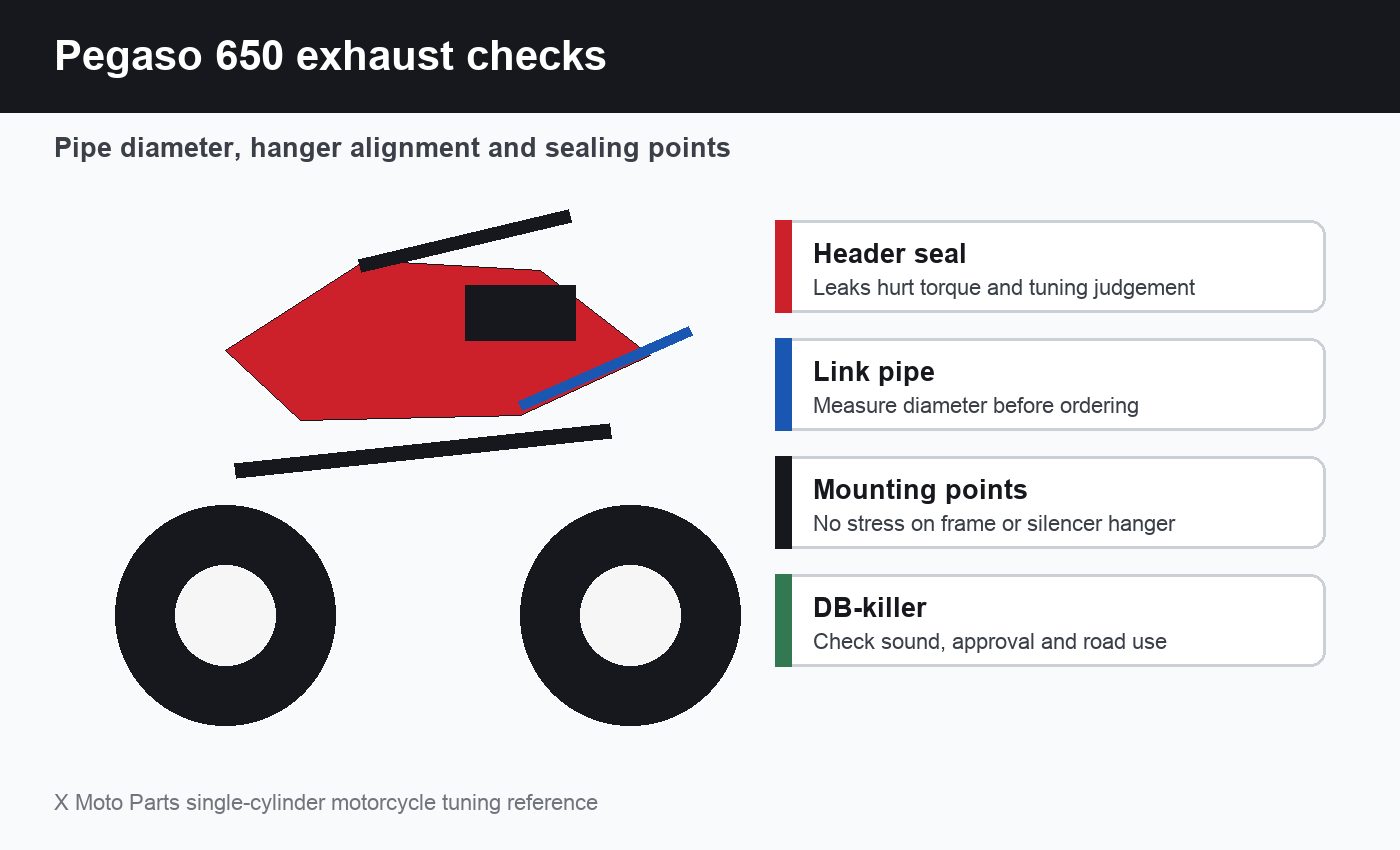
    Aprilia Pegaso 650 exhaust pipe diameter hanger and DB-killer measurement points
    Measure pipe diameter, hanger alignment and DB-killer fitment before ordering an exhaust.

    What to fix before tuning

    Fix vacuum leaks, old fuel, worn chain kits, weak batteries, dirty filters and leaking exhaust joints before chasing performance. Many complaints described as tuning problems are ordinary maintenance problems. A big single needs clean combustion and a tight drivetrain to feel smooth.

    Aprilia Pegaso 650 tuning works best when the motorcycle is already dependable. If the bike hunts at idle, stalls hot, surges at steady throttle or smells rich, diagnose the cause before adding parts. A good mechanic wants a stable baseline before making changes.

    Exhaust, intake and fuelling setup

    The exhaust is often the first part considered in Aprilia Pegaso 650 tuning, and it can be worthwhile. A well-made silencer can reduce weight, improve sound and help the single feel freer. But the Pegaso also needs low-rpm torque, so an exhaust that is too open, too loud or badly sealed can make the bike worse on the road.

    Measure the link pipe diameter and inspect the mounting points before buying. Check whether your bike uses a single or twin-exit arrangement, how the hanger aligns, whether the side panel or luggage rack clears the silencer and whether a catalyst or emissions equipment is present on your version. A universal exhaust may be adaptable, but it is not automatically correct.

    Intake work needs the same restraint. A clean standard airbox often gives better wet-weather reliability than an exposed filter. If you use a freer filter, check sealing and fuelling carefully. Earlier carburettor bikes may need jetting changes; later injection bikes may need sensor checks or compatible fuelling support. Aprilia Pegaso 650 tuning must follow the fuel system fitted to the bike, not a generic internet recipe.

    UpgradeMain advantagePossible disadvantageBest use
    Service refreshRestores lost smoothness and torqueLess exciting than visible partsAny unknown or high-mileage Pegaso
    Road-approved silencerBetter sound and lower weightFitment and approval must be checkedRoad riders wanting a cleaner note
    Open exhaustMore aggressive soundCan reduce low-rpm pull and create legal issuesPrivate-area or track-only use where appropriate
    Air filter upgradeCleaner airflow when maintainedPoor sealing can harm reliabilityWhen combined with correct fuelling checks
    Fuelling adjustmentCan smooth response after changesWrong setup can cause rich or lean runningOnly after version and fuel system are confirmed

    Carburettor versus fuel injection logic

    A key Aprilia Pegaso 650 tuning decision is whether the motorcycle is carburetted or fuel-injected. Carburettor bikes may need pilot, needle and main jet attention after intake or exhaust changes. Fuel-injected bikes need sensor health, battery voltage, intake sealing and compatible electronics. The symptoms can look similar, but the fixes are different.

    If a carburettor bike hesitates off idle, clean and inspect before rejetting blindly. If an EFI bike surges, check throttle body condition, connectors and intake leaks before adding fuel. A tuning part should solve a known problem, not become a way to avoid diagnosis. For Aprilia Pegaso 650 tuning, the right fuelling path depends entirely on the bike in front of you.

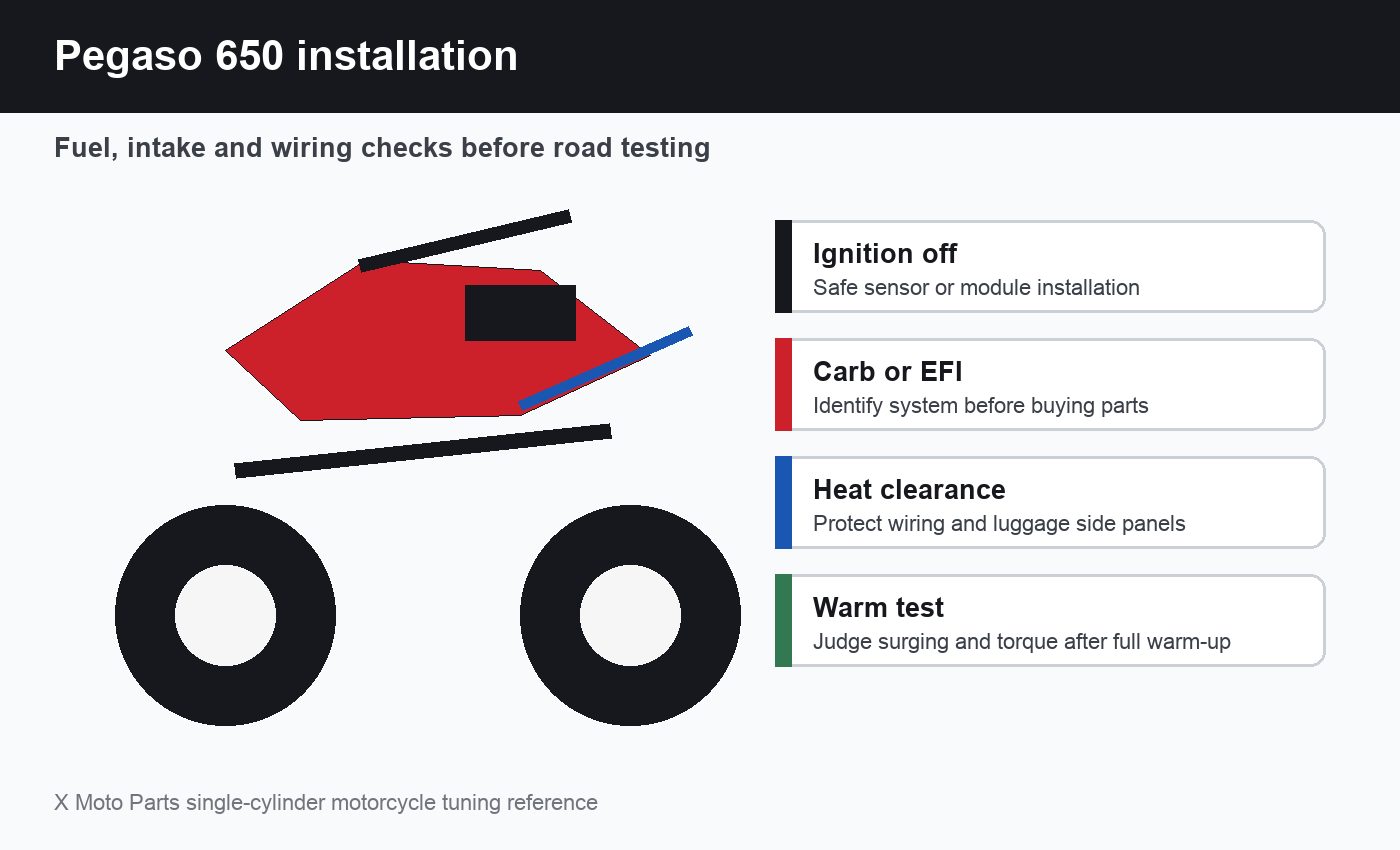
    Aprilia Pegaso 650 intake exhaust wiring and fuelling installation checks
    Confirm fuel system type, route wiring away from heat and test only after full warm-up.

    Gearing, chain and road feel

    Aprilia Pegaso 650 tuning is not only about engine parts. Gearing changes can transform how the bike feels. A smaller front sprocket or larger rear sprocket can make the bike pull harder at low speed, but it may raise cruising rpm and increase vibration. Taller gearing can calm cruising, but it can make the bike lazy in town or on trails.

    Before changing sprockets, inspect chain and sprocket wear. A tight spot, hooked teeth or poor alignment can make throttle response jerky. Correct chain slack matters on a long-travel motorcycle because suspension movement changes chain tension. If the chain is too tight, it can damage bearings and make the ride harsh. If it is too loose, it can snatch and wear quickly.

    For road use, many riders prefer a setup that improves roll-on response without making the engine busy at cruising speed. For trail or mountain use, shorter gearing may be worth the compromise. Aprilia Pegaso 650 tuning should match the roads you ride, not the gearing someone else liked on a different version.

    Compatibility checks for Pegaso 650 parts

    Compatibility is where many Pegaso projects go wrong. Aprilia Pegaso 650 tuning has to consider early and later versions, Rotax-based and later 660-family associations, carburettor versus EFI, Strada, Trail and Factory-style trim, exhaust route, airbox, sensor layout and mounting brackets. Model name alone is not enough.

    Part or vehicle areaCompatibilityImportant note
    Aprilia Pegaso 650 motorcycleYes, when exact year/version is confirmedCheck engine family, fuel system and trim before ordering.
    Aftermarket exhaustDepends on pipe diameter and mountingCheck header, link pipe, hanger, clearance, DB-killer and E-mark.
    Air filter and intake partsVersion-specificAirbox design and sealing can differ between models.
    Fuelling partsOnly with matching carb/EFI setupCarb jets and EFI modules are not interchangeable solutions.
    Sprockets and chainDimension-specificConfirm chain pitch, tooth count, carrier and intended road use.

    After measuring, the motorcycle exhausts category is a useful place to compare exhaust options, while the performance parts category can help riders think about supporting upgrades without buying blindly.

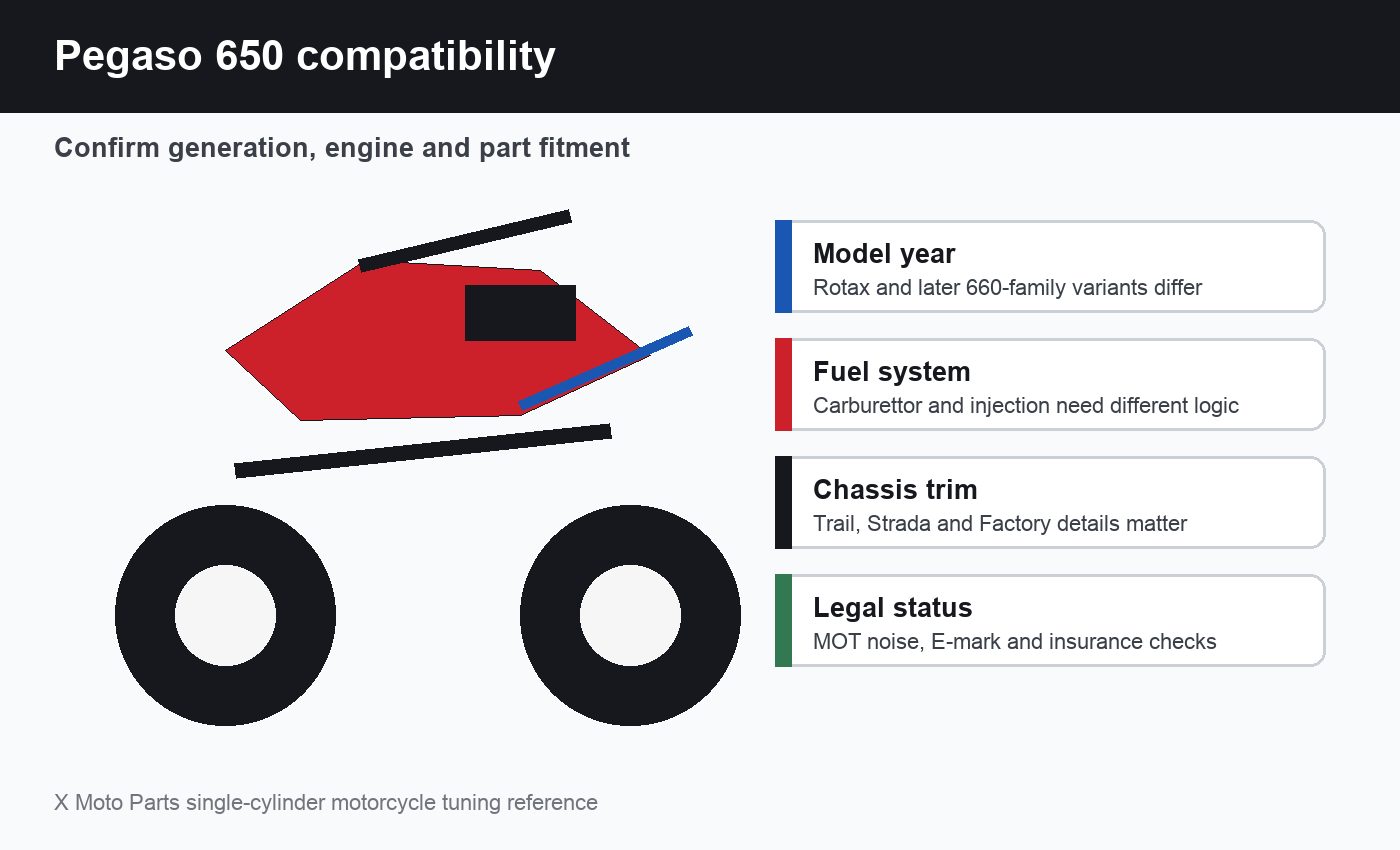
    Aprilia Pegaso 650 compatibility checklist for exhaust fuelling gearing and model version
    Confirm model year, fuel system, exhaust route and gearing dimensions before ordering parts.

    Aprilia Pegaso 650 tuning for public roads must respect noise, emissions, inspection and insurance rules. In the UK, motorcycle MOT inspection includes exhaust security and noise. A silencer that is clearly unreasonably louder than a similar motorcycle with a standard silencer can be a problem, and products marked for track use only are not road parts.

    Road riders should check E-mark or approval information where relevant, keep the DB-killer fitted if approval depends on it, avoid removing emissions equipment and disclose modifications to insurance. In the United States, Canada, Australia, Ireland and New Zealand, rules vary by state, province or national framework. A part can physically fit and still be unsuitable for public roads.

    For UK reference, the GOV.UK motorcycle MOT exhaust noise section explains how exhaust noise is assessed. For general rider-safety context when changing performance, tyres or braking feel, the NHTSA motorcycle safety resource is also useful for anglophone riders, although local legal rules still apply.

    Road use versus private-area tuning

    Road-focused Aprilia Pegaso 650 tuning should keep the bike civil, insurable, reliable and comfortable. Private-area or track-only work can be more aggressive, but safe installation still matters. Loose exhaust brackets, hot wiring, poor fuel hose routing and badly adjusted chains are dangerous anywhere.

    Common mistakes that make the Pegaso worse

    The most common mistake is treating every Pegaso 650 as the same motorcycle. Another is fitting a loud exhaust without checking fuelling, exhaust leaks or DB-killer status. A third is changing sprockets before inspecting the chain. A fourth is assuming an open filter will help without considering rain, dust and airbox sealing.

    Aprilia Pegaso 650 tuning should be guided by the bike’s symptoms. If it surges, inspect fuelling and chain snatch. If it lacks drive, check compression feel, filter, plug, exhaust seal and gearing. If it runs hot, check cooling, fan operation and mixture before chasing more power.

    MistakeWhat happensBetter approach
    Ignoring model yearWrong exhaust, filter or fuel partConfirm version before ordering.
    Removing DB-killer for road useNoise, MOT and insurance problemsUse approved parts correctly fitted.
    Changing gearing with worn chainJerky response and fast wearInspect chain and sprockets as a set.
    Opening intake without fuelling checksFlat spots, lean running or poor wet-weather behaviourKeep the airbox sealed and tune carefully.
    Expecting peak horsepower miraclesDisappointment and poor choicesOptimise torque, response and reliability.

    Workshop sequence for a clean Pegaso setup

    A reliable Aprilia Pegaso 650 tuning sequence is simple: identify the exact version, restore service condition, inspect chain and sprockets, check exhaust sealing, test the bike warm, then change one part at a time. Exhaust, intake, fuelling and gearing should support each other rather than fight each other.

    After installation, check for exhaust leaks, loose hangers, hot side panels, cable strain, fuel smell, surging, warning lights, chain noise and fuel-economy changes. Recheck fasteners after the first heat cycle. If welding, fabrication, carburettor tuning or EFI diagnosis is beyond your comfort level, use a mechanic. A tidy Aprilia Pegaso 650 tuning job should feel cleaner on the road, not more temperamental.

    Used-bike checks before ordering parts

    A Pegaso that has lived through years of commuting, winter storage or mixed road and trail use deserves a close inspection before money is spent on upgrades. Look around the cylinder head, exhaust ports, coolant hoses, regulator wiring, battery earth point and rear subframe mounts. A small leak, corroded connector or tired rubber mount can change the way the bike feels more than many riders expect.

    Check the clutch cable for smooth movement, the throttle for clean return, the sidestand switch for intermittent cutting out and the rear brake for dragging after a ride. Inspect the front sprocket area after removing built-up chain paste; oil and grit can hide wear, leaks and poor alignment. If the bike has hard luggage, also check silencer clearance and heat shielding because a new pipe may sit slightly differently from the old one.

    On the test ride, hold a steady throttle through town, then roll on from low rpm in a higher gear. A healthy big single may pulse, but it should not cough, surge violently or feel as if the chain is snapping tight. After the ride, let the bike idle until the fan cycle can be confirmed, then shut it off and restart it hot. These simple checks separate a motorcycle ready for upgrades from one that first needs repair.

    FAQ about Pegaso 650 tuning

    Is Aprilia Pegaso 650 tuning worth it?

    Aprilia Pegaso 650 tuning is worth it when the goal is better mid-range, smoother throttle and a cleaner exhaust setup. It is not worth it if the owner expects a mild road build to become a modern high-output adventure bike.

    What should I tune first on a Pegaso 650?

    Start with service condition, chain and sprockets, air filter, plug, exhaust sealing, throttle adjustment and fuel-system health. Those checks make later upgrades meaningful.

    Does a sports exhaust improve the Pegaso 650?

    A suitable exhaust can reduce weight and improve sound, but it must seal properly, fit the brackets, suit the fuel system and remain legal for the intended use.

    Do I need to rejet or remap after an exhaust?

    It depends on the version and fuel system. Carburettor bikes may need jetting work, while fuel-injected bikes need sensor and fuelling checks. Mild changes may not need major adjustment.

    Can gearing changes help the Pegaso 650?

    Yes. Shorter gearing can improve low-speed pull, while taller gearing can calm cruising. The right choice depends on road use, chain condition and rider preference.

    Are all Pegaso 650 parts interchangeable?

    No. Model year, engine family, fuel system, exhaust route and trim can differ. Always confirm exact compatibility before ordering.

    Is an aftermarket exhaust legal in the UK?

    It depends on approval, markings, noise, emissions equipment and installation condition. Track-only parts and excessively noisy silencers can create MOT and insurance problems.

    Why does my Pegaso run worse after tuning?

    Common causes include exhaust leaks, wrong fuelling, intake leaks, poor jetting, weak battery, worn chain, unsuitable gearing or a part fitted for the wrong model year.

    Final verdict

    Aprilia Pegaso 650 tuning works best when it respects the motorcycle’s character: a strong, practical single that rewards torque, clean fuelling and a tidy drivetrain. Identify the exact version, fix maintenance issues, choose exhaust parts by measurement, keep the airbox and fuel system sensible, and use gearing to suit your roads.

    Before ordering parts, confirm model year, fuel system, exhaust diameter, hanger points, DB-killer status, chain and sprocket dimensions, road legality and insurance implications. A measured Aprilia Pegaso 650 tuning plan will make the bike more enjoyable without turning it into a fragile collection of mismatched parts.


  • Piaggio X10 125 tuning

    Piaggio X10 125 tuning

    Piaggio X10 125 tuning: CVT, exhaust, EFI and touring scooter setup guide

    Piaggio X10 125 tuning

    Piaggio X10 125 tuning
    Piaggio X10 125 tuning

    Piaggio X10 125 tuning should make a comfortable touring-style 125 scooter feel cleaner, smoother and more confident, not louder and more fragile. The X10 125 is not a lightweight sports scooter. It is a relatively substantial machine with wind protection, storage, commuting comfort and, on some versions, equipment such as ABS or traction-related systems. That means the best tuning work is practical: restore the CVT, keep the fuel injection healthy, choose exhaust parts carefully and make sure the scooter remains safe for daily road use.

    Owners usually start looking for tuning because the scooter feels slow away from traffic lights, weak on hills, lazy with a passenger or unwilling to recover speed after a roundabout. Those complaints do not automatically mean the engine needs aggressive parts. A 125cc scooter can lose a lot of performance through a worn belt, flat-spotted rollers, a glazed clutch, blocked air filter, old tyres, brake drag or an exhaust leak. The right first move is inspection.

    This guide explains how to approach the X10 like a mechanic would: baseline checks, CVT measurement, variator decisions, intake and exhaust choices, electronic compatibility, UK road-use rules, common mistakes and the questions riders normally ask before buying parts.

    What realistic X10 125 tuning can improve

    Piaggio X10 125 tuning is mostly about delivery rather than headline power. A 125cc engine has limited torque, and the X10 body is designed for comfort and road presence rather than minimum weight. That makes CVT condition especially important. If the belt is narrow or the variator is dirty, the scooter may feel as if the engine has lost power even when the engine itself is healthy.

    Real improvement is felt in normal riding: smoother take-off, less clutch judder, better recovery from 20 to 50 mph, steadier hill climbing, more predictable throttle and less strain when carrying luggage. It should not feel like excessive revs, harsh vibration or a hot clutch smell after every traffic queue.

    A sensible Piaggio X10 125 tuning target is a scooter that feels easier to ride. It should leave junctions cleanly, hold urban speeds without fuss and cruise at its realistic limit without sounding tortured. If the owner expects a dramatic top-speed jump, the project is already aimed in the wrong direction.

    For riders comparing similar Piaggio scooter logic, the Piaggio Liberty 125 tuning guide explains lighter 125cc CVT behaviour, while the Piaggio MP3 300 power increase guide shows how heavier scooters need realistic expectations around weight, transmission and road use.

    Owner complaintLikely area to inspectWhy it matters
    Slow launchClutch, rollers and belt widthThe CVT controls how quickly engine torque reaches the rear wheel.
    Poor hill speedVariator travel, tyre pressure and brake dragSmall drag losses are obvious on a comfortable 125 scooter.
    Flat throttleAir filter, EFI sensors and intake sealingFuel injection needs clean airflow and stable sensor readings.
    Loud but not fasterExhaust fitment and fueling behaviourA poor pipe can reduce low-rpm pull and create leaks.
    Unstable braking or handlingTyres, brakes, suspension and wheel bearingsMore response is useless if the chassis is tired.

    Baseline checks before tuning parts

    Piaggio X10 125 tuning starts with service condition. Put the scooter on the centre stand and inspect oil, coolant if applicable to your version, air filter, spark plug, battery voltage, charging output, throttle movement, brake drag, tyre pressures, tyre age, wheel bearings and any warning lights. On versions equipped with ABS or ASR-related systems, warning lights and sensor condition should be treated seriously before performance work.

    Ride the scooter warm before making changes. Notice clutch engagement, vibration, engine response, braking feel and whether performance fades after traffic. If the scooter is stronger when cold and weaker when hot, the CVT or clutch may be building heat. If it hesitates from idle, inspect intake sealing and sensor connectors before changing the variator. A measured Piaggio X10 125 tuning baseline makes the final result much easier to judge.

    A careful Piaggio X10 125 tuning baseline should record rider weight, passenger use, luggage, screen position, tyre pressure and current modifications. A touring-style scooter carrying a top box and rider through hills needs a different setup from a lightly loaded city machine. The road test has to match real use.

    Piaggio X10 125 CVT belt roller variator and clutch measurement points
    Measure belt width and inspect rollers, pulley faces and clutch heat before changing the CVT setup.

    Service restoration is often the cheapest gain

    A new belt of the correct dimension, fresh rollers, clean variator, good spark plug, clean filter and correct tyre pressures may restore the response the owner was trying to buy with tuning parts. If the scooter has unknown history, assume the CVT needs inspection before buying performance parts.

    Piaggio X10 125 tuning becomes predictable only after worn basics are fixed. A fuel module will not cure a slipping belt. A sports exhaust will not fix brake drag. Lighter rollers will not hide a clutch that judders because the bell is glazed. Diagnosis saves money.

    CVT, variator, belt and clutch setup

    The CVT is the most important part of Piaggio X10 125 tuning. The engine has limited displacement, so the transmission has to keep it in the useful rpm range. When the variator shifts too early, the scooter feels lazy. When rollers are too light, it revs without useful speed. When the belt is worn, the scooter may never use the full ratio range.

    Remove the CVT cover and inspect before ordering. Look for belt dust, heat marks, grooves on pulley faces, flat-spotted rollers, worn guides and glazing on the clutch bell. Clean the cover and cooling paths. Measure belt width with a caliper if possible, and compare it with the appropriate service information for your exact model year.

    For Piaggio X10 125 tuning, roller or slider changes should be moderate. Slightly lighter weights can improve launch and hill recovery, but very light weights can make the engine busy without making the scooter faster. A performance variator can help only if the belt, clutch and chosen weights work together. In practice, Piaggio X10 125 tuning is controlled setup work, not a one-part miracle.

    CVT solutionMain advantagePossible disadvantageBest use
    OEM-style refreshRestores smooth original operationDoes not change the character muchUnknown history or high-mileage scooter
    Slightly lighter rollers/slidersSharper launch and hill recoveryCan create excessive revs if overdoneUrban riding and heavier loads
    Performance variatorCan improve ratio behaviourNeeds correct weights and testingOwners prepared for measured setup work
    Clutch serviceReduces judder and heat fadeMay reveal worn shoes or bellRough take-off or hot clutch smell
    Final drive changesCan alter cruising feelMay weaken accelerationRarely the first choice on a 125 X10

    How to test the CVT on the road

    A useful Piaggio X10 125 tuning test uses the same hill, same rider load and a warm scooter. If the engine revs high but speed does not follow, the setup may be too light or the belt may be slipping. If the engine feels loaded and slow after corners, the rollers may be too heavy or the variator may not be moving freely.

    The best CVT setup feels calm but willing. It should not judder, smell hot, make the engine scream or become inconsistent after a few minutes in traffic. Recheck the cover and belt dust after the first rides.

    EFI, intake and exhaust choices

    Piaggio X10 125 tuning can include intake, exhaust and electronic work, but only after the scooter is healthy. The standard airbox is often better for road use than an exposed filter because it protects against rain, road dirt and hot air. A clean air filter and sealed intake usually help more than a noisy intake that upsets low-speed behaviour.

    Before fitting a module, inspect battery voltage, intake boots, sensor connectors, throttle body condition and any stored warning lights. EFI tuning should be reversible and conservative. If the scooter starts worse, smells rich, loses fuel economy or hesitates when warm, the setting or installation needs correction.

    Exhaust choice deserves careful measurement. A sport silencer can change sound and reduce weight, but pipe diameter, header gasket, bracket alignment, bodywork clearance, DB-killer and road approval matter. Anyone considering a universal exhaust should first read the universal motorcycle exhaust buying guide and compare it with the motorcycle exhausts category only after fitment details are known.

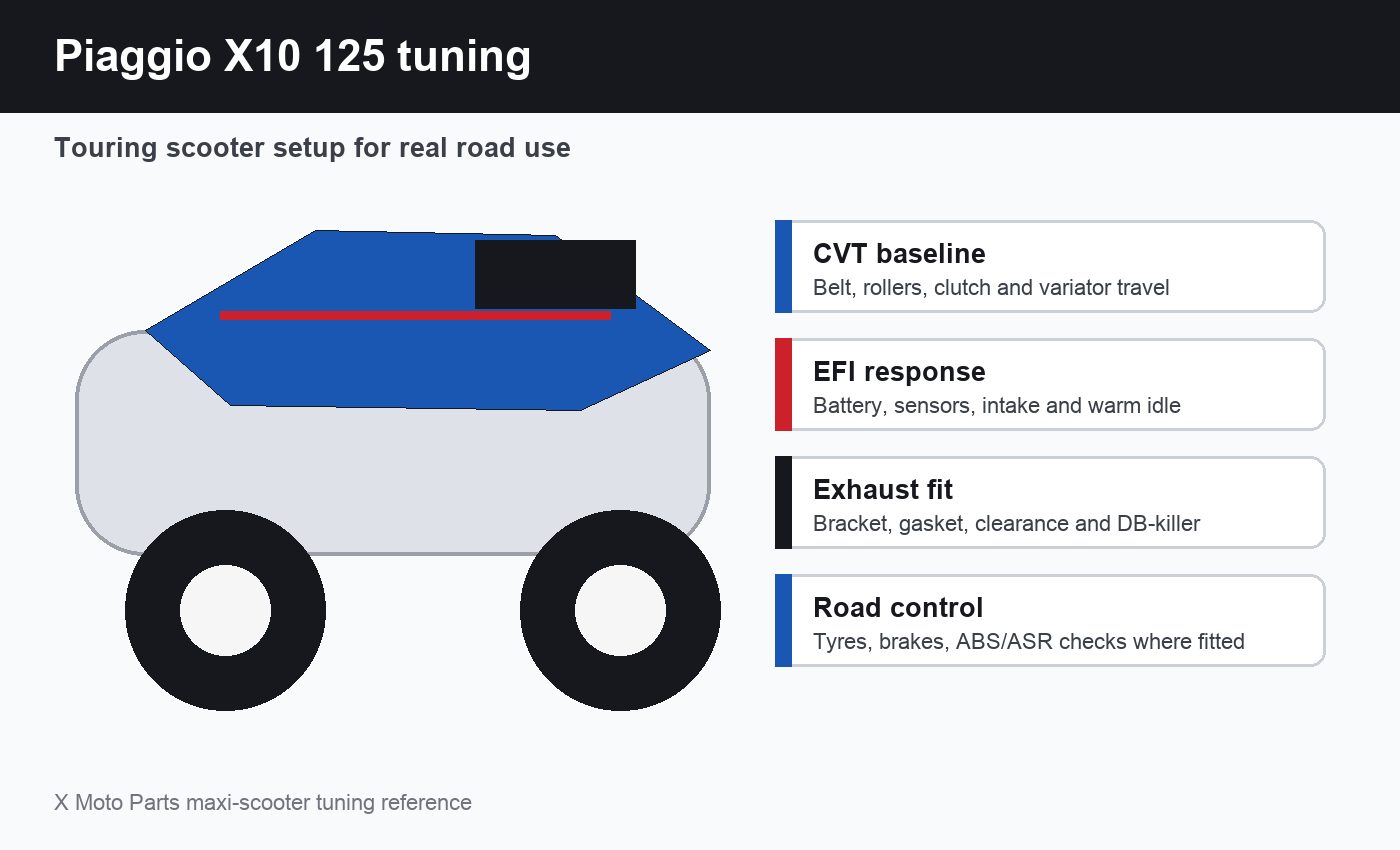
    Piaggio X10 125 exhaust sensor wiring and installation checks
    Check exhaust sealing, sensor wiring, heat clearance and bracket alignment before road testing.

    When electronics are useful

    A compatible module may help when intake or exhaust changes create a real fueling need, but Piaggio X10 125 tuning should not start with electronics. Start from the lowest setting, warm the engine fully and judge normal riding. A 125 scooter used every day needs reliable starts and steady idle more than a dramatic throttle feel.

    If the connector layout is unclear, stop and identify the sensor correctly. Poor wiring can create intermittent faults that are much harder to trace than the original performance complaint. Use a mechanic for unclear wiring, CVT torque settings or exhaust fabrication.

    Compatibility checks for Piaggio X10 125 parts

    Compatibility matters because the X10 family includes different engine sizes and market versions. Piaggio X10 125 tuning should begin by confirming exact model year, engine version, ABS/ASR equipment if fitted, CVT belt and roller dimensions, exhaust route, sensor connectors and existing modifications. Do not buy parts for an X10 350 or 500 and assume they suit the 125.

    Part or vehicle areaCompatibilityImportant note
    Piaggio X10 125 scooterYes, when exact version is confirmedCheck model year, engine version and ABS/ASR equipment where fitted.
    CVT belt and rollersDimension-specificConfirm belt length, width, roller/sliders size and service limits.
    Aftermarket exhaustDepends on pipe route and bracketsCheck gasket, hanger, clearance, catalyst notes, DB-killer and E-mark.
    Fuel or chip moduleOnly with matching connectorsInspect sensor layout before ordering or installation.
    Universal scooter partsOften possible with adaptationUniversal does not mean plug-and-play; bodywork clearance is critical.

    For related scooter comparisons, the Peugeot Pulsion 125 tuning guide is useful because it covers another comfortable 125 scooter where CVT condition, weight and road use affect the result. The Yamaha Majesty 400 tuning guide is helpful for understanding the same maxi-scooter logic on a larger engine.

    Piaggio X10 125 compatibility checklist for CVT exhaust EFI and ABS ASR equipped scooters
    Confirm year, CVT dimensions, exhaust route, sensor layout and road status before ordering parts.

    Piaggio X10 125 tuning for public roads needs clear legal thinking. In the UK, motorcycle MOT inspection includes exhaust condition and noise. A silencer that is clearly unreasonably louder than a similar machine with a standard silencer can be a problem, and a product marked for track use only is not suitable for public roads.

    Road riders should check E-mark or approval information, keep the DB-killer fitted when the exhaust approval depends on it, avoid removing emissions equipment and disclose modifications to insurance. In the United States, Canada, Australia, Ireland and New Zealand, rules vary by state, province or national framework. A part that physically fits is not automatically road legal. Responsible Piaggio X10 125 tuning keeps the scooter usable on public roads.

    For UK context, the GOV.UK motorcycle MOT exhaust noise section explains how exhaust noise is assessed. For broader rider safety context, the NHTSA motorcycle safety resource is useful, especially when changes affect acceleration, braking or control.

    Road setup versus private-area experimentation

    Road-focused Piaggio X10 125 tuning should keep the scooter quiet enough, reliable, insured and suitable for inspection. Private-area or track-only work can be more experimental, but installation quality still matters. Exhaust leaks, loose brackets, poor wiring and overheated CVT parts are not acceptable anywhere.

    Common mistakes that make the X10 worse

    The biggest mistake is treating the X10 125 like a tiny lightweight scooter. It is comfortable and substantial, so transmission condition and load matter a lot. Fitting aggressive rollers without measuring the belt can make it louder but slower. Fitting an exhaust without checking brackets can create leaks and bodywork clearance issues. Adding electronics before fixing intake leaks can make diagnosis worse.

    Piaggio X10 125 tuning should always be guided by what the scooter actually does on the road. If it shudders from a stop, inspect clutch and belt. If it struggles only with a passenger, choose a CVT setup for load. If it handles poorly, check tyres and suspension before asking for more response.

    MistakeWhat happensBetter approach
    Ignoring belt wearPoor acceleration and weak ratio rangeMeasure the belt before tuning roller weight.
    Choosing extreme roller weightsHigh revs or lazy responseChange gradually and test warm.
    Buying exhaust by appearanceLeaks, drone or legal troubleCheck pipe route, hanger, DB-killer and approval.
    Ignoring ABS/ASR warningsPossible safety-system issuesDiagnose warnings before performance work.
    Skipping insurance checksRisk after a claimDeclare meaningful modifications before road use.

    Workshop sequence for a clean X10 125 setup

    A reliable Piaggio X10 125 tuning sequence is straightforward: service the scooter, inspect tyres and brakes, diagnose warning lights, clean the CVT, measure the belt, refresh worn transmission parts, test the bike warm, then change one variable at a time. Exhaust and electronics should come after the scooter proves that the basic drivetrain is healthy.

    After installation, check for exhaust leaks, rubbing bodywork, loose brackets, abnormal belt dust, hot clutch smell, warning lights and fuel-economy changes. Recheck fasteners after the first heat cycle. If the work involves CVT torque settings, sensor wiring or exhaust fabrication, use a professional mechanic. A tidy Piaggio X10 125 tuning installation should feel boringly reliable after the first ride.

    FAQ about X10 125 scooter tuning

    Is Piaggio X10 125 tuning worth it?

    Piaggio X10 125 tuning is worth it when the scooter is healthy and the goal is better response, smoother launch and stronger hill recovery. It is not worth it if the owner expects a 125 to behave like a larger maxi-scooter.

    What should I tune first on a Piaggio X10 125?

    Start with service and CVT condition: belt width, rollers, variator guides, clutch, air filter, tyres, brakes and battery voltage. Those checks often restore lost performance.

    Will lighter rollers make the X10 125 faster?

    Lighter rollers can improve pull-away, but too light can make the engine rev without useful speed. The right weight depends on rider load, roads and belt condition.

    Can an aftermarket exhaust improve the X10 125?

    A suitable exhaust can improve sound and reduce weight, but fitment, sealing, DB-killer, approval and low-rpm response must be checked carefully.

    Do I need a fuel module after fitting an exhaust?

    Not automatically. Use a compatible module only when intake or exhaust changes create a clear fueling need and the scooter is already mechanically healthy.

    Are X10 350 or X10 500 parts compatible with the X10 125?

    Not by assumption. Engine, exhaust, CVT and chassis parts can differ between capacities. Always verify exact dimensions and part application.

    Can tuning affect ABS or ASR systems?

    Mechanical tuning should not create warning lights. If ABS or ASR warnings appear, diagnose wheel sensors, wiring, battery voltage and related systems before further modification.

    Can tuning affect UK insurance?

    Yes. Exhaust, intake, fuel and performance changes should be declared to the insurer before public road use.

    Final verdict

    Piaggio X10 125 tuning works best when it respects the scooter’s touring character. Service it properly, measure the CVT, choose moderate transmission changes, keep exhaust fitment legal and use electronics only when there is a clear reason. A good X10 125 should leave traffic smoothly, pull hills more consistently and remain dependable every day.

    Before ordering parts, confirm model year, engine version, CVT dimensions, belt condition, exhaust route, sensor connectors, ABS/ASR status where fitted, road-use approval and insurance implications. A measured Piaggio X10 125 tuning plan will always beat random parts fitted without diagnosis.


  • Honda SH 300 tuning

    Honda SH 300 tuning

    Honda SH 300 tuning: CVT, exhaust, EFI and road setup guide

    Honda SH 300 tuning

    Honda SH 300 tuning
    Honda SH 300 tuning

    Honda SH 300 tuning should make a quick, practical high-wheel scooter feel sharper, smoother and more controlled, not merely louder. The SH300i already has useful torque, stable road manners and enough performance for commuting and fast urban riding, so the best tuning work is usually about restoring lost response, improving the CVT setup, choosing an exhaust carefully and making sure the scooter remains reliable on real roads.

    Owners often look for tuning because the scooter feels flat from a stop, vibrates on take-off, loses confidence when overtaking, sounds restricted or feels less lively than expected. Sometimes the engine needs help, but very often the real cause is transmission wear, belt slip, flat-spotted rollers, clutch glazing, a dirty air filter, old tyres, brake drag or an exhaust that was fitted without proper sealing. A strong setup begins with diagnosis.

    This guide is written for riders who want a useful Honda SH300i setup rather than fantasy horsepower claims. It covers CVT checks, variator choices, intake and exhaust decisions, fuel-injection behaviour, UK road-use rules, compatibility and the common mistakes that turn a good scooter into a noisy compromise.

    What realistic SH300i tuning can improve

    Honda SH 300 tuning is best judged by rideability. A high-wheel scooter is used differently from a sports motorcycle: it filters traffic, crosses rough city surfaces, carries luggage, starts and stops often, and may run warm in town before opening up on faster roads. That means the most valuable improvements are clean pull-away, predictable throttle, stronger mid-range, less CVT hesitation and better control under braking.

    Honda’s official SH300i information over the years has described a liquid-cooled fuel-injected single-cylinder scooter with automatic transmission, large wheels and practical road equipment. Exact specifications vary by model year and market, so owners should confirm their own version before buying parts. The general lesson is consistent: the SH300i has a strong engine for a scooter, but the belt drive and chassis condition decide how well that strength reaches the road.

    A well-planned Honda SH 300 tuning result should feel tidy. The scooter should pull away without judder, hold speed more confidently, respond cleanly after a roundabout and cruise without harsh vibration. It should not need excessive revs, smell hot from the clutch or drone painfully through a sports exhaust.

    Riders comparing nearby Honda scooter setups can use the Honda SH 350 tuning guide for the later larger model, the Honda SH 150 tuning guide for smaller-capacity logic and the Honda SH 125 chip tuning guide for conservative electronics and connector checks.

    Rider goalMost likely tuning areaFirst thing to inspect
    Sharper pull-awayCVT and clutchBelt width, roller wear, clutch glazing and pulley cleanliness
    Better mid-rangeVariator setup and engine healthRoller/sliders, air filter, plug, tyre pressure and brake drag
    Improved soundExhaust systemHeader gasket, bracket alignment, DB-killer, catalyst notes and approval
    Cleaner throttleEFI and sensorsBattery voltage, intake sealing, sensor plugs and warning lights
    Safer faster ridingTyres, brakes and suspensionTyre age, brake condition, wheel bearings and rear shock condition

    Baseline checks before fitting tuning parts

    Honda SH 300 tuning should begin with the unglamorous checks. Put the scooter on the centre stand and inspect it cold. Check oil, coolant level where applicable, air filter, spark plug, battery voltage, charging behaviour, throttle movement, brake drag, tyre pressures, wheel bearings and any engine warning lights. A 300cc scooter has more performance than a 125, but it still loses response quickly when wear and drag build up.

    Then ride the scooter warm on the same route you will use later for testing. Notice clutch engagement, vibration, acceleration from 20 to 50 mph, engine smoothness, braking feel and whether performance fades after the CVT heats up. If the scooter feels strong at first and weaker after traffic, inspect clutch heat and belt condition before touching fuel or exhaust parts. A measured Honda SH 300 tuning baseline makes each upgrade easier to judge.

    A careful Honda SH 300 tuning baseline should include notes on rider weight, passenger use, top box or screen, road type and current modifications. A scooter used for city commuting needs a different compromise from one used for longer dual carriageway journeys. The best setup matches the job the bike does every week.

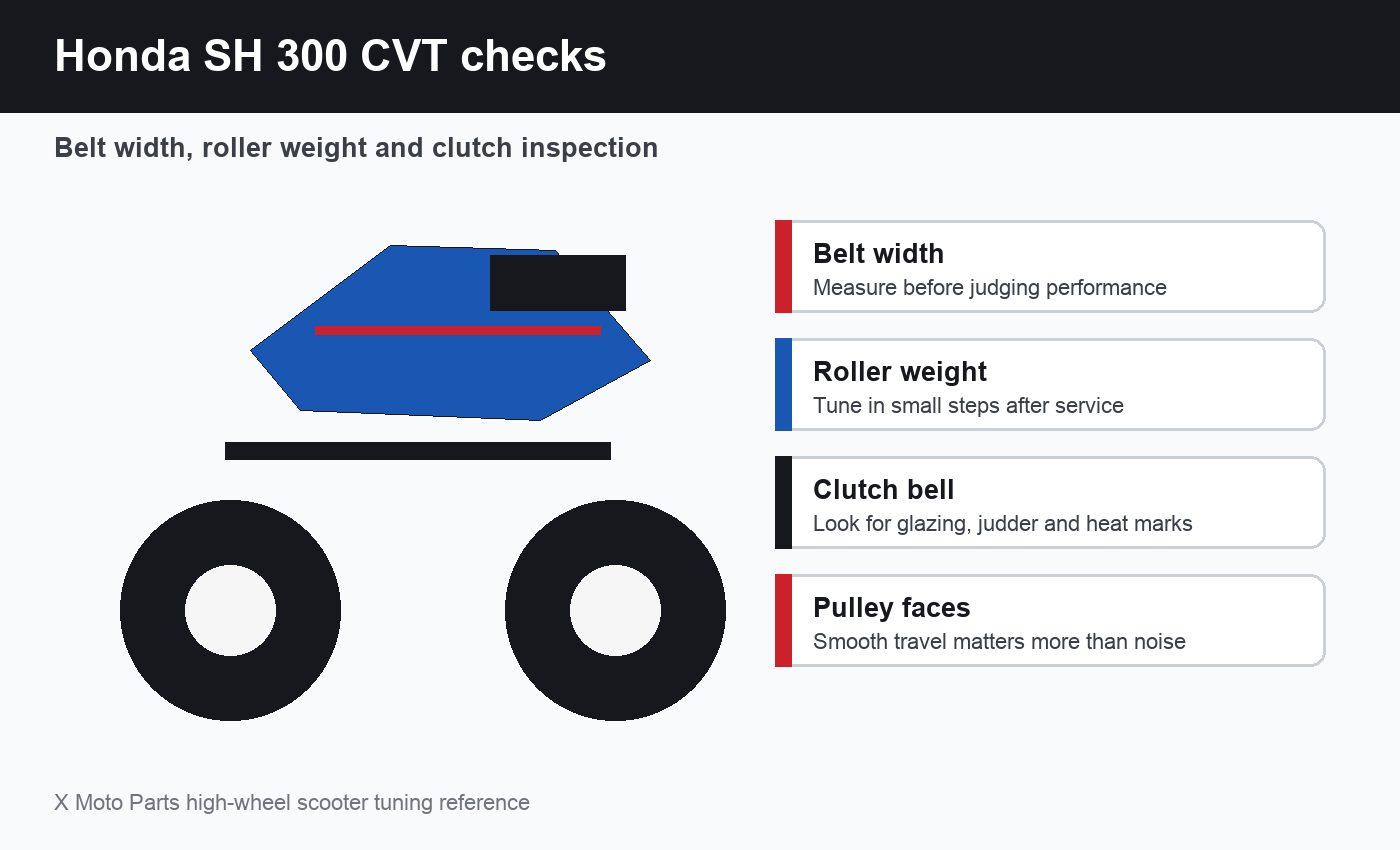
    Honda SH300i CVT belt roller variator and clutch measurement points
    Measure belt width, inspect rollers and check clutch heat before changing the transmission setup.

    Service restoration comes before performance parts

    A fresh belt of the right dimension, clean variator, good rollers, healthy clutch, clean filter and correct tyre pressure can restore performance that the owner may think has disappeared forever. Many scooters feel transformed after basic maintenance because the CVT was no longer allowing the engine to work properly.

    Honda SH 300 tuning becomes predictable only after the scooter is healthy. If the rear brake drags, the belt is narrow or the clutch bell is glazed, a sports exhaust will not fix the problem. If the battery is weak or a sensor plug is corroded, a fuel module can make diagnosis harder. Start with the known faults.

    CVT, variator, belt and clutch setup

    The CVT is the centre of Honda SH 300 tuning. The engine produces torque, but the automatic belt drive decides where the engine sits in the rev range. A worn or poorly matched CVT makes a strong scooter feel dull. A good CVT setup makes the same engine feel cleaner, quicker and easier to control.

    Inspect the belt for width, cracks, glazing and age. Check the variator guides and pulley faces. Look at rollers or sliders for flat spots. Inspect the clutch bell for blue heat marks and the shoes for uneven contact. Clean the CVT cover and cooling paths. If the scooter has been used heavily in stop-start traffic, clutch heat can be a bigger issue than engine power.

    For Honda SH 300 tuning, roller or slider changes should be moderate. Slightly lighter weights can improve response, but too light makes the scooter rev more than it accelerates. Too heavy can make the engine labour and feel slow after corners. A performance variator can help, but only when installed with the right weights for the rider’s roads. In workshop terms, Honda SH 300 tuning is a set of measured adjustments, not one universal recipe.

    CVT optionMain advantagePossible disadvantageBest use
    OEM-style refreshRestores smooth factory responseLimited change in characterHigh-mileage scooters or unknown history
    Lighter rollers/slidersSharper launch and recoveryCan cause excessive revs if overdoneUrban riding, hills and heavier load
    Performance variatorCan improve ratio behaviourNeeds setup, testing and correct torqueOwners who want a controlled upgrade
    Clutch serviceReduces judder and heat fadeMay reveal worn bell or shoesRough starts, vibration or hot smell
    Final drive changesCan alter cruising rpmMay hurt accelerationSpecific touring builds, not a first step

    How to test a CVT change

    A proper Honda SH 300 tuning CVT test uses the same hill, the same rider load and a fully warm scooter. If revs rise sharply but speed does not follow, the setup may be too light or the belt may be slipping. If the scooter feels heavy and slow to recover, the setup may be too tall or the variator may be worn.

    Do not judge the result only by sound. The better question is whether the scooter reaches speed with less strain and repeats the result after traffic. If it feels good for two minutes and then becomes inconsistent, investigate heat, clutch condition and belt slip.

    Fuel injection, intake and exhaust choices

    Honda SH 300 tuning can include intake, exhaust and electronic work, but those parts must be chosen carefully. The standard airbox is often a better road component than an exposed filter because it protects the engine from rain, grit and hot air. A clean filter and sealed intake usually beat a noisy intake that upsets low-speed running.

    Before fitting any module, check battery voltage, intake boots, throttle body cleanliness, sensor connectors and warning lights. A fuel-injected Honda relies on stable readings. If there is an intake leak or electrical fault, the scooter may hesitate no matter what tuning part is fitted.

    Exhaust choice is more than sound. A sports silencer can save weight and make the SH feel livelier, but poor fitment can cause leaks, bracket stress, bodywork clearance problems and loss of low-rpm response. Anyone considering a universal pipe should read the universal motorcycle exhaust buying guide before assuming pipe diameter and mounting points will match.

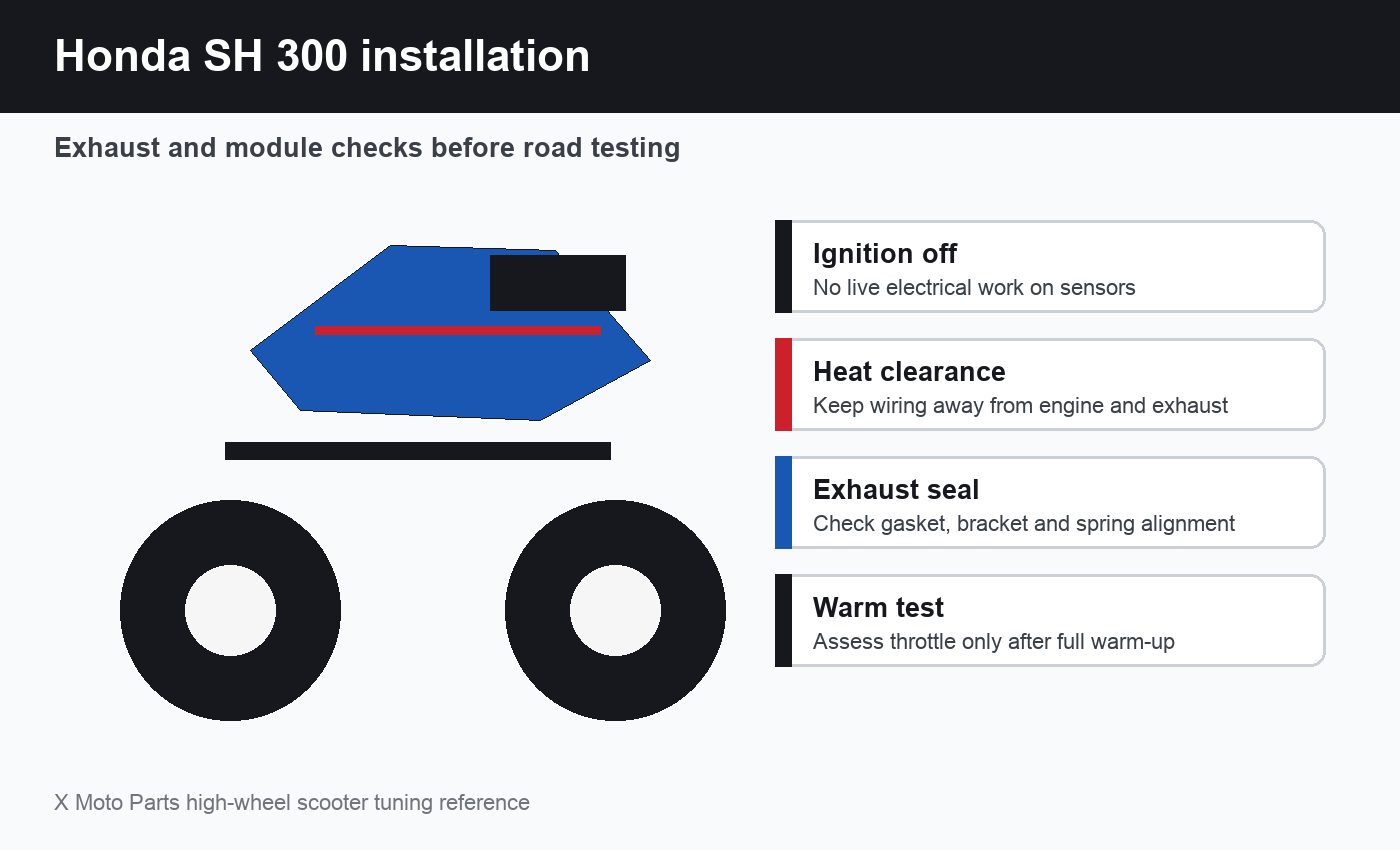
    Honda SH300i exhaust fuel module wiring and installation checks
    Check exhaust sealing, heat clearance and wiring routes before road testing any upgrade.

    When electronics are useful

    A compatible module may help when the scooter has a clear fueling need after intake or exhaust changes, but Honda SH 300 tuning should not begin with electronics. Fit any module with the ignition off, route the harness away from heat and start with conservative settings. If the scooter smells rich, starts worse, hesitates or shows a warning light, return to a safer setting or stock.

    Good electronic tuning should be reversible and tidy. Twisted wires, loose connectors and cables running close to the exhaust are not acceptable. If the sensor layout is unclear, use a mechanic rather than guessing.

    Compatibility checks for SH300i parts

    Compatibility is especially important because SH300i years and markets can differ. Honda SH 300 tuning should always start by confirming exact model year, engine version, emissions equipment, CVT dimensions, exhaust route, sensor connector layout and existing modifications. A part that physically looks close may still be wrong for your scooter.

    Part or vehicle areaCompatibilityImportant note
    Honda SH300i scooterYes, when exact year is confirmedCheck generation, market version and engine/emissions layout.
    CVT belt and rollersDimension-specificConfirm belt size, roller/sliders dimensions and service limits.
    Aftermarket exhaustDepends on header, bracket and clearanceCheck gasket, catalyst notes, DB-killer, E-mark and bodywork clearance.
    Fuel or chip moduleOnly with matching connectorsInspect sensor layout and wiring before ordering.
    Universal scooter partsOften possible with adaptationUniversal does not mean plug-and-play; professional fitting may be required.

    When the fitment checks are complete, the performance parts category is a useful place to compare upgrade types. For exhaust-focused decisions, the motorcycle exhausts category should be used only after confirming pipe diameter, bracket position and road-use status.

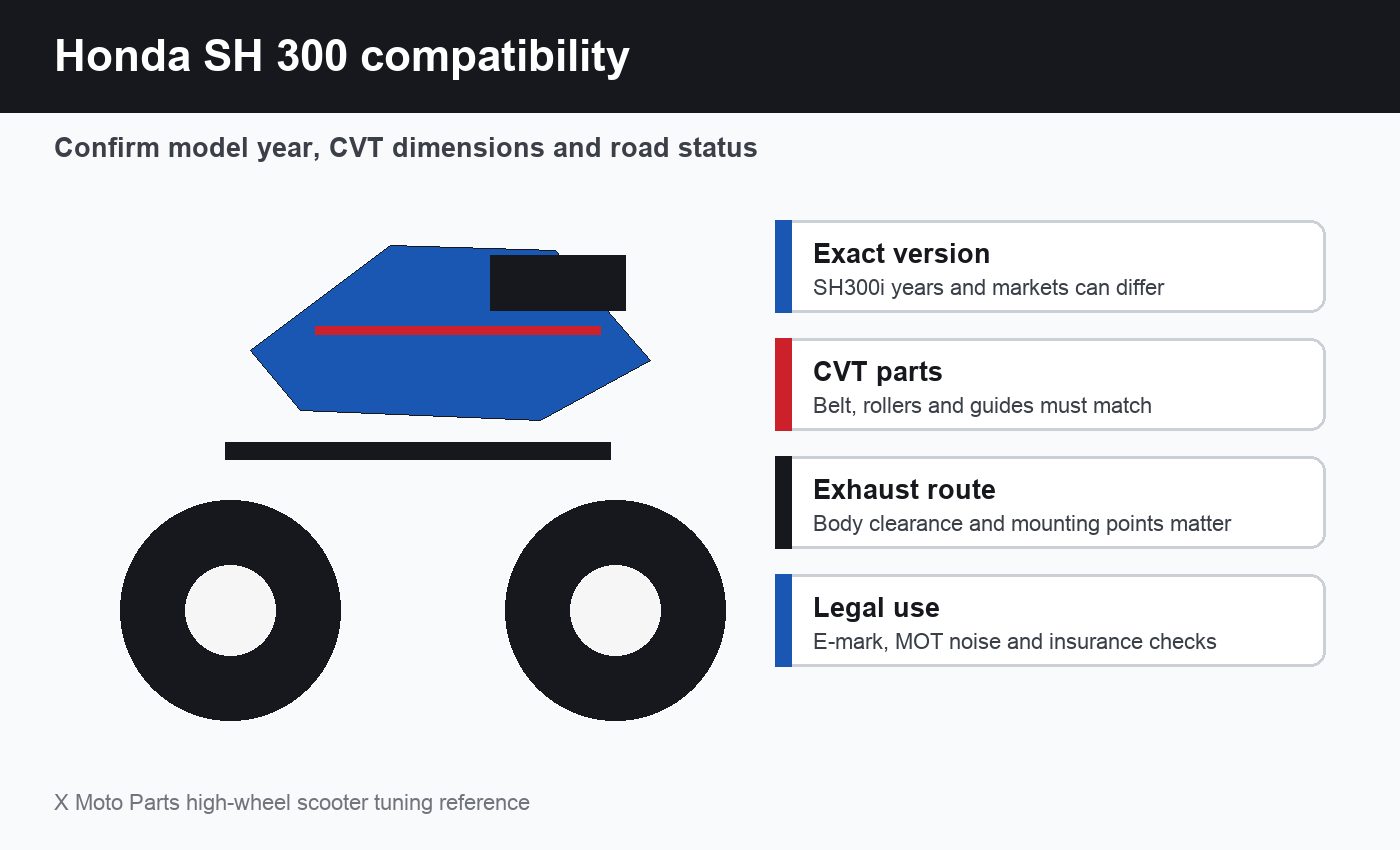
    Honda SH300i compatibility checklist for CVT exhaust and tuning module parts
    Confirm model year, CVT dimensions, exhaust route and legal status before ordering parts.

    Honda SH 300 tuning for public roads needs legal context. In the UK, motorcycle MOT inspection includes exhaust condition and noise. A silencer that is clearly unreasonably louder than a similar motorcycle with a standard silencer can be a problem, and parts marked for track use only are not road parts. This matters for sports exhausts, removed DB-killers and poorly sealed systems.

    Road riders should check E-mark or approval information where relevant, keep catalytic converter and emissions equipment in place where required, retain the DB-killer if the exhaust approval depends on it and disclose modifications to insurance. In the United States, Canada, Australia, Ireland and New Zealand, rules vary by state, province or national framework. Do not mix those rules together. Responsible Honda SH 300 tuning keeps the scooter legal for the roads where it is actually used.

    For UK reference, the GOV.UK motorcycle MOT exhaust noise section explains how exhaust noise is assessed. For official Honda model context, use Honda’s owner information and model pages where available; the Honda UK owner manuals resource is a sensible starting point for checking model-specific documentation.

    Road use versus private-area setup

    Road-focused Honda SH 300 tuning should keep the scooter civil, safe and insurable. Private-area or track-only work can be more aggressive, but installation quality still matters. Exhaust leaks, loose brackets, overheated CVT parts and bad wiring are not acceptable just because the scooter is not on the public road.

    Common mistakes that make the SH300i worse

    The most common mistake is tuning before measuring. Owners fit an exhaust while the clutch is glazed, change roller weight while the belt is worn, or fit electronics while the battery is weak. The scooter then has more parts but no clear improvement.

    Honda SH 300 tuning should not be based only on noise or appearance. A high-wheel scooter depends on balance. If the front tyre is old, the rear shock is tired or the brakes need service, extra response can make the bike feel less safe. Performance work should include the chassis.

    MistakeRoad resultBetter workshop method
    Ignoring belt wearPoor acceleration and inconsistent ratio rangeMeasure belt width before changing rollers.
    Fitting very light rollersMore revs, heat and little extra speedAdjust gradually and test warm.
    Buying exhaust by sound onlyDrone, leaks or legal troubleCheck approval, DB-killer, bracket and gasket seal.
    Skipping tyre and brake checksMore speed without controlService chassis items before chasing response.
    Using electronics to hide faultsRough running and confusing diagnosisFix intake, battery and sensor issues first.

    Workshop sequence for a clean SH300i setup

    A reliable Honda SH 300 tuning sequence is simple: service the scooter, inspect tyres and brakes, clean and measure the CVT, replace worn transmission parts, test the bike warm, then adjust one variable at a time. Exhaust and electronics come after the scooter proves that the basic drivetrain is healthy.

    After any installation, check for exhaust leaks, rubbing bodywork, loose brackets, abnormal belt dust, hot clutch smell, warning lights and changes in fuel economy. Recheck fasteners after the first heat cycle. If the job involves CVT torque settings, sensor wiring or exhaust fitment you are unsure about, use a professional mechanic. A tidy Honda SH 300 tuning build is worth more than a fast-looking mistake.

    FAQ about SH300i tuning

    Is Honda SH 300 tuning worth it?

    Honda SH 300 tuning is worth it when the scooter is healthy and the goal is better response, smoother launch and stronger mid-range. It is not worth it if the rider expects sportbike performance from a practical scooter.

    What should I tune first on a Honda SH300i?

    Start with the CVT and service condition: belt width, rollers, clutch, air filter, plug, tyres, brakes and battery voltage. Those checks often restore lost performance.

    Will lighter rollers make the SH300i faster?

    Lighter rollers can improve response if chosen carefully, but too light can make the engine rev without adding useful road speed. Test in small steps.

    Can an aftermarket exhaust improve the SH300i?

    A suitable exhaust can improve sound and feel, but fitment, sealing, catalyst notes, DB-killer, E-mark and low-speed torque all need checking.

    Do I need a fuel module after fitting an exhaust?

    Not automatically. Use fueling support only when compatible and when intake or exhaust changes create a clear need. Start conservatively.

    Is a universal exhaust plug-and-play on the SH300i?

    No. Universal exhausts still need correct pipe diameter, hanger alignment, gasket sealing, bodywork clearance and road-use approval.

    Can tuning affect UK insurance?

    Yes. Exhaust, intake, electronic and performance modifications should be declared to the insurer before road use.

    Why does my SH300i feel slower after tuning?

    The usual causes are wrong roller weight, belt slip, clutch heat, exhaust mismatch, intake leaks, weak battery, poor wiring or testing before the scooter is fully warm.

    Final verdict

    Honda SH 300 tuning works best when it respects what the scooter is: a fast, practical, high-wheel commuter that rewards clean setup. Restore the CVT, service the engine, choose exhaust parts by fitment and legality, keep electronics conservative and never forget tyres, brakes and suspension. The result should be a scooter that feels sharper without becoming fragile.

    Before ordering parts, confirm year, SH300i version, CVT dimensions, belt condition, exhaust route, sensor connectors, road-use approval and insurance position. A measured Honda SH 300 tuning plan will always beat random parts fitted because they looked quick online.


  • Daelim S3 125 tuning

    Daelim S3 125 tuning

    Daelim S3 125 tuning: CVT, exhaust, EFI and practical scooter setup guide

    Daelim S3 125 tuning

    Daelim S3 125 tuning
    Daelim S3 125 tuning

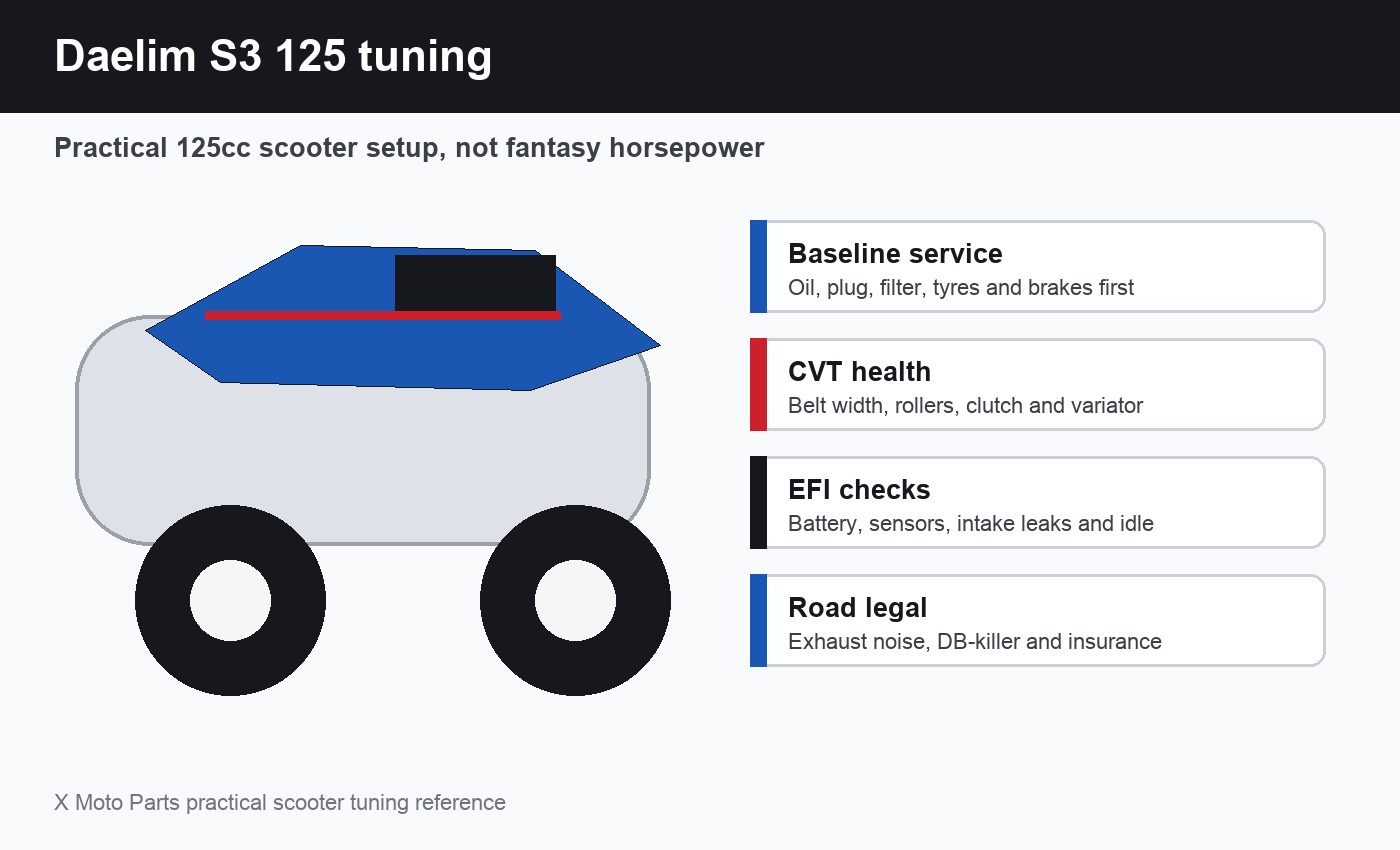
    Daelim S3 125 tuning should be approached like a careful workshop job, not like a race promise. The S3 125 is a practical fuel-injected scooter, so the useful gains are usually smoother pull-away, cleaner throttle response, better hill recovery, less CVT hesitation and a setup that feels stronger in daily traffic. If the scooter is tired, poorly serviced or fitted with mismatched parts, tuning can make it louder without making it better.

    Owners usually search for this topic because the scooter feels slow from a stop, struggles with a passenger, loses speed on climbs or feels flat after fitting an exhaust. Those complaints are real, but the cause is not always lack of power. A worn belt, flat-spotted rollers, glazed clutch, dirty air filter, weak battery, dragging brake or intake leak can steal enough performance to make a 125 feel restricted.

    A strong result comes from restoring the baseline first and tuning second. That means measuring, inspecting and testing before buying parts. The best 125cc scooter setup is rarely extreme; it is balanced, repeatable and easy to live with.

    What realistic tuning can improve on the S3 125

    Daelim S3 125 tuning is mainly about how the available power is delivered. A 125cc scooter has limited torque, but a clean CVT can keep the engine in the right rpm range and make the scooter feel much more willing. Good tuning improves launch, mid-range response, hill pull and consistency when hot. It does not turn the bike into a 300cc maxi-scooter.

    The S3 125 is often used for commuting, so many examples have lived through short journeys, stop-start traffic, neglected CVT cleaning and long periods parked outside. That matters because a scooter used this way may have transmission wear before it has engine trouble. When the belt narrows, the variator loses range. When rollers flatten, the shift becomes uneven. When the clutch glazes, take-off becomes rough and hot.

    A practical Daelim S3 125 tuning plan answers the rider’s real question: why does this scooter feel weaker than it should, and what change will make it better without hurting reliability? Sometimes the answer is a variator refresh. Sometimes it is a correct belt. Sometimes it is an exhaust fitted properly with no leaks. Sometimes it is simply maintenance.

    SymptomFirst area to inspectWhy it matters
    Slow pull-awayClutch, belt and roller conditionThe CVT controls how quickly torque reaches the rear wheel.
    Flat mid-rangeVariator travel and air filterA small engine needs clean airflow and the right rpm band.
    Loss of speed uphillBelt width, tyre pressure and brake dragMinor drag is very obvious on a 125.
    Rough running after partsEFI sensors and intake leaksElectronic injection depends on stable sensor readings.
    Louder but not quickerExhaust fitment and fueling behaviourA mismatched pipe can reduce low-rpm pull.

    Baseline checks before buying parts

    Daelim S3 125 tuning should begin with a cold inspection and a warm test ride. Check engine oil, coolant if applicable to your exact version, air filter, spark plug, battery voltage, charging output, throttle movement, tyre pressure, brake drag, wheel bearings and any warning lights. A small scooter has little spare power, so hidden resistance makes a big difference.

    Ride the scooter on the same road before changing anything. Notice how the clutch engages, whether the engine flares without road speed, whether vibration appears at take-off and whether performance fades after ten minutes. If the scooter is better cold than hot, look closely at the clutch, belt and CVT cooling. If it hesitates from idle, inspect intake sealing and EFI connectors before blaming the variator. A measured Daelim S3 125 tuning baseline makes each later change easier to judge.

    A careful Daelim S3 125 tuning baseline also records the rider’s real use. A commuter in heavy traffic needs clean engagement and reliability. A heavier rider in hilly roads may need a CVT setup that holds rpm a little better. Someone doing faster suburban routes may want smoother cruising and better braking before any louder exhaust.

    Daelim S3 125 CVT belt roller pulley and clutch measurement points
    Measure belt width, inspect rollers and check clutch condition before tuning the CVT.

    Service parts that restore performance

    A fresh plug, clean filter, correct oil, healthy battery and properly inflated tyres can restore a surprising amount of response. If the scooter has unknown service history, assume the CVT needs inspection. Belt dust, flat rollers, worn guides and a glazed clutch bell are common reasons a scooter feels slow.

    Daelim S3 125 tuning becomes far more predictable after those basics are right. A new performance part fitted over a worn belt only hides the real problem. A fuel module fitted over an intake leak only adds another variable. A sports exhaust fitted to a scooter with dragging brakes will not cure the lost speed.

    CVT, variator, belt and clutch setup

    The CVT is usually the most important part of Daelim S3 125 tuning. The engine can only do its job if the belt drive lets it sit in the useful rpm range. A standard scooter that has lost belt width may feel slow because it is no longer reaching the intended ratio. Rollers with flat spots can make acceleration uneven. A dirty variator can shift poorly. A glazed clutch can make take-off harsh and waste heat.

    Start with measurement. Confirm belt length and width for your exact model year and market version. Check roller or slider dimensions before ordering. Inspect pulley faces for grooves and heat marks. Make sure the variator moves freely and that guides are not worn. If the clutch bell is blue or polished, clean and inspect carefully because heat can make the scooter feel worse as the ride continues.

    For balanced Daelim S3 125 tuning, do not jump to the lightest rollers. Slightly lighter rollers can improve launch and hill response, but too light makes the engine rev without speed. Too heavy can make the scooter labour below its useful power band. The correct choice depends on rider weight, road gradient, belt condition and whether the scooter carries a top box or passenger. In practice, Daelim S3 125 tuning is controlled adjustment, not a single magic roller weight.

    CVT optionMain advantagePossible disadvantageBest use
    Stock refreshRestores smooth original responseLimited change in characterUnknown history or worn transmission
    Slightly lighter rollersSharper pull-awayMore revs if overdoneUrban use and mild hills
    Performance variatorCan improve ratio behaviourNeeds correct setup and testingOwners willing to tune methodically
    Clutch serviceReduces judder and heatMay reveal other worn partsRough starts or hot clutch smell
    Final drive changesCan alter cruising feelMay weaken accelerationRarely a first step on a 125 scooter

    How to road-test the CVT

    A useful Daelim S3 125 tuning road test uses the same route every time. Warm the engine, use the same rider load and test one hill, one urban launch and one steady cruising section. If revs rise but speed does not follow, the setup may be too light or the belt may be slipping. If the scooter feels lazy and low in the revs, the rollers may be too heavy or the variator may be dirty.

    The best setup sounds calm but eager. It should not scream, judder, smell hot or lose consistency in traffic. After any CVT work, recheck fasteners, listen for new noises and inspect for belt dust after a few rides. A small scooter rewards patience.

    Fuel injection, intake and exhaust choices

    Daelim S3 125 tuning can include EFI support, intake work and exhaust changes, but each part has to solve a real problem. The standard airbox is often better for commuting than an exposed cone filter because it protects against rain, road dirt and hot air. A clean panel filter and sealed airbox usually give more consistent everyday running.

    Before fitting electronics, inspect the intake air temperature sensor area, throttle body, manifold rubber, battery terminals and sensor plugs. A weak battery or intake leak can create hesitation that looks like a fueling problem. If there is a warning light, diagnose it first. A compatible module should be reversible, securely routed and set conservatively.

    Exhaust upgrades need the same care. A sport silencer can reduce weight and make the scooter sound more pleasant, but pipe diameter, bracket alignment, gasket sealing, DB-killer and approval status all matter. Anyone comparing exhaust parts should read the universal motorcycle exhaust buying guide before assuming a universal part will fit correctly.

    Daelim S3 125 exhaust wiring intake and installation checks
    Secure wiring, seal exhaust joints and check heat clearance before testing the scooter.

    When a chip module makes sense

    A chip or fuel module only makes sense after the scooter is healthy. For Daelim S3 125 tuning, electronics should be treated as a fine adjustment, not a cure for worn rollers or a blocked filter. Start from the lowest setting, warm the engine fully and judge throttle response under normal riding, not only on a short blast.

    Reduce the setting or return to stock if the scooter smells rich, starts worse, idles roughly, loses fuel economy or shows a warning light. Good tuning makes the engine easier to use, not more fragile. If wiring is unclear, a mechanic should handle the installation.

    Compatibility checks for Daelim S3 125 parts

    Compatibility is critical because model names, years and market versions can be confusing. Daelim S3 125 tuning should always begin by confirming the exact model, production year, engine version, CVT dimensions, exhaust route and sensor connector layout. A product listing that looks right may still be wrong if it was built for another Daelim model or a different market.

    Part or vehicle areaCompatibilityImportant note
    Daelim S3 125 scooterYes, when year and market are confirmedCheck exact model name, engine version and existing modifications.
    CVT belt and rollersDimension-specificMeasure belt width and confirm roller/sliders size before ordering.
    Aftermarket exhaustDepends on bracket and pipe routeCheck gasket, hanger, pipe diameter, DB-killer, clearance and approval.
    Fuel or chip moduleOnly with matching connectorsInspect sensor location and wiring before installation.
    Universal scooter partsOften possible with adaptationUniversal does not mean plug-and-play; bodywork clearance matters.

    For related scooter setup examples, the Daelim Otello 125 FI tuning guide is useful because it explains similar EFI and CVT decisions on another Daelim scooter. The Peugeot Tweet 125 tuning guide helps compare lightweight 125 scooter behaviour, while the Suzuki Address 110 tuning guide shows why belt and roller condition often matter more than loud parts.

    Daelim S3 125 compatibility checklist for CVT exhaust and EFI tuning parts
    Match every part to the exact year, dimensions and connector layout before ordering.

    Daelim S3 125 tuning for road use must respect the rules where the scooter is ridden. In the UK, exhaust condition and noise are part of the motorcycle MOT inspection. A silencer that is clearly unreasonably louder than a similar standard machine can be a problem, and a product marked for track use only is not suitable for normal road use.

    Road riders should check E-mark information where relevant, keep any DB-killer fitted if the exhaust was approved with it, avoid removing emissions equipment and disclose modifications to insurance. An insurer may treat exhaust, intake, fueling or performance changes as material modifications even if the rider sees them as small. Legal Daelim S3 125 tuning should keep the scooter usable, insurable and suitable for the roads it actually uses.

    For authoritative UK context, the GOV.UK motorcycle MOT exhaust noise section explains the inspection position on exhaust noise. Riders outside the UK should check local rules; the NHTSA motorcycle safety resource is a useful high-level safety reference for the United States, though road legality and emissions rules still vary by state.

    Road use versus private-area tuning

    Road-focused Daelim S3 125 tuning should keep the scooter quiet enough, dependable, insured and suitable for inspection. Private-area or track-only setups can be more experimental, but they still need safe exhaust mounting, reliable brakes, secure wiring and predictable throttle response. A loose bracket or hot wire routing is not acceptable anywhere.

    Common mistakes that make the S3 worse

    The biggest mistake is buying parts before diagnosing the scooter. Owners fit a pipe when the clutch is glazed, fit light rollers when the belt is worn, or add electronics when the intake rubber is leaking. The result is a scooter with more variables and less clarity.

    Daelim S3 125 tuning should not be based only on sound, looks or someone else’s roller weight. Check dimensions, road use, service condition and the job the scooter actually has to do. A delivery rider, commuter and weekend rider may need different compromises.

    MistakeWhat happensBetter approach
    Ignoring belt wearPoor ratio range and weak accelerationMeasure and refresh before tuning roller weight.
    Choosing very light rollersHigh revs with little road speedChange gradually and test the same route.
    Fitting an exhaust by appearanceLeaks, drone or legal troubleCheck pipe diameter, bracket, DB-killer and E-mark.
    Using electronics to mask faultsRough running and wasted moneyFix service, intake and sensor issues first.
    Skipping insurance checksRisk after a claimDeclare meaningful modifications before road use.

    Workshop sequence for a clean setup

    A reliable Daelim S3 125 tuning sequence is straightforward: service the scooter, inspect brakes and tyres, clean the CVT, measure the belt, refresh worn parts, road-test warm, then change one performance variable at a time. If the scooter gets worse, return to the last known good setup.

    After installation, check for exhaust leaks, rubbing bodywork, loose brackets, warning lights, belt dust, clutch heat and changes in fuel economy. Recheck fasteners after the first heat cycle. If the job involves wiring, make sure the harness cannot touch the cylinder, exhaust or moving suspension parts. If torque settings or connector identification are unclear, use a mechanic.

    For owners ready to compare parts after doing those checks, the performance parts category is a sensible next step. Choose based on exact fitment and support, not only price.

    FAQ about Daelim S3 125 scooter tuning

    Is Daelim S3 125 tuning worth it?

    Daelim S3 125 tuning is worth it if the scooter is mechanically healthy and the goal is better response, smoother launch and stronger hill pull. It is not worth it if the expectation is a dramatic top-speed transformation.

    What should I tune first on a Daelim S3 125?

    Start with service condition and the CVT. Check belt width, rollers, clutch, variator guides, air filter, plug, tyres and brakes before buying performance parts.

    Will lighter rollers make the S3 125 faster?

    Lighter rollers can improve launch and hill response, but too light can make the engine rev without useful acceleration. Test in small steps.

    Can an aftermarket exhaust improve performance?

    A suitable exhaust can change sound, weight and response, but poor fitment can reduce low-speed torque, create leaks or cause legal problems.

    Do I need a fuel module after fitting an exhaust?

    Not automatically. Mild changes may not need fueling support. Use a compatible module only when there is a clear reason and the scooter is already healthy.

    Is a universal exhaust plug-and-play?

    No. Universal parts still need the right pipe diameter, bracket position, gasket seal, bodywork clearance and road-use status.

    Can tuning affect UK insurance?

    Yes. Exhaust, intake, fueling and performance modifications should be disclosed to the insurer before using the scooter on public roads.

    Why does my scooter feel slower after tuning?

    Common causes include wrong roller weight, belt slip, clutch heat, intake leaks, exhaust mismatch, poor wiring or judging performance before the engine is fully warm.

    Final verdict

    Daelim S3 125 tuning is best when it makes a practical scooter feel healthier, smoother and more confident. Start with service condition, measure the CVT, avoid extreme roller choices, choose exhaust parts by fitment and legal status, and use electronics only when there is a clear need. The strongest setup is usually the one that still starts easily, runs quietly enough, pulls cleanly and stays reliable in traffic.

    Before ordering anything, confirm model year, CVT dimensions, belt condition, exhaust bracket layout, sensor connectors, road legality and insurance implications. A tidy, measured Daelim S3 125 tuning build will always beat a noisy collection of parts fitted without diagnosis.


  • Yamaha Majesty 400 tuning

    Yamaha Majesty 400 tuning

    Yamaha Majesty 400 tuning: CVT, exhaust, fuelling and road setup guide

    Yamaha Majesty 400 tuning

    Yamaha Majesty 400 tuning
    Yamaha Majesty 400 tuning

    Yamaha Majesty 400 tuning should make a large scooter smoother, stronger and more confident, not noisier and harder to live with. The Majesty 400 is a practical maxi-scooter, so the best upgrades are the ones that improve launch, mid-range pull, overtaking response, motorway comfort and reliability without destroying the qualities that made the bike useful in the first place.

    Most owners arrive at this subject with one of three complaints. The scooter feels lazy away from the lights, it struggles to recover speed with a passenger, or it sounds as if the engine is working harder than the road speed suggests. Those symptoms can come from real performance limits, but they can also come from a tired belt, worn rollers, a dirty air filter, a dragging brake, old tyres, an exhaust leak or a clutch that has spent too much time slipping in urban traffic.

    A good tuning plan therefore starts like a workshop inspection. You check the machine, measure the wear parts, decide what needs restoring, then choose upgrades that match the engine, transmission and intended use. That is the difference between useful work and random parts.

    What realistic Majesty 400 tuning can improve

    Yamaha Majesty 400 tuning is most effective when the target is rideability. A 400cc single-cylinder maxi-scooter already has enough torque for commuting and touring, but the way that torque reaches the rear wheel depends heavily on the CVT. If the belt is narrow, rollers are worn, clutch shoes are glazed or the variator is dirty, the scooter can feel flat even when the engine itself is healthy.

    Official Yamaha owner information for the YP400 Majesty describes a liquid-cooled four-stroke single with fuel injection and automatic V-belt transmission. That layout is robust, but it is also sensitive to wear. The engine produces power through one cylinder; the transmission has to keep it in the useful rpm band; the rear tyre, brakes and suspension have to manage the extra weight of a maxi-scooter. You cannot treat it like a lightweight 125 or a manual motorcycle.

    A sensible Yamaha Majesty 400 tuning result feels like this: cleaner pull-away, less clutch shudder, stronger acceleration from 30 to 60 mph, steadier cruising, fewer flat spots and a more composed scooter when carrying luggage. It does not feel like an over-revving transmission, a harsh exhaust drone or a hot clutch smell after every town ride.

    Riders comparing broader scooter performance topics can use the performance parts category after checking their exact model year and part dimensions. The aim is to choose parts that solve a real problem, not to build a shopping list before the scooter has been inspected.

    Rider goalMost relevant areaWhat to check first
    Better launchCVT and clutchBelt width, roller condition, clutch glazing and variator cleanliness
    Better mid-rangeVariator setup and engine healthRoller/sliders, air filter, plug, throttle body and tyre pressure
    Improved soundExhaust systemHeader seal, silencer approval, DB-killer, bracket alignment and leaks
    Cleaner throttleFuel injection and sensorsBattery voltage, intake leaks, sensor plugs and warning lights
    Touring comfortSuspension, tyres and gearing feelTyre age, pressures, bearings, fork condition and rear shocks

    Baseline checks before buying tuning parts

    Yamaha Majesty 400 tuning starts with the scooter you already own. Put it on the centre stand and inspect it cold. Check engine oil condition, coolant level, battery voltage, air filter, spark plug, charging behaviour, tyre pressures, rear wheel drag, brake pad clearance, throttle movement and any stored warning lights. A maxi-scooter carries more bodywork than a small bike, so hidden wear can stay ignored until performance drops noticeably.

    Ride the scooter warm before making changes. Notice how quickly the clutch engages, whether take-off is smooth, whether the engine flares without road speed, whether the rear brake drags after a stop and whether the exhaust smells rich or leaks at the header. If the Majesty feels strong cold and weaker hot, heat in the CVT or clutch is worth investigating before touching fuel or exhaust parts. A measured Yamaha Majesty 400 tuning baseline keeps every later choice honest.

    Good Yamaha Majesty 400 tuning should be measured against a repeatable baseline. Use the same stretch of road, similar fuel load and similar rider weight. Record what changed. If you fit three parts together and the scooter becomes worse, you will not know which part caused it. A mechanic would isolate variables; an owner should do the same.

    Yamaha Majesty 400 CVT belt variator and clutch measurement points
    Measure the belt, inspect rollers and check clutch heat before altering the CVT setup.

    Service restoration is often the first performance gain

    A fresh belt of the correct size, clean variator, healthy rollers, good plug, clean air filter and correct tyre pressure can restore more performance than a flashy part. This is especially true on older Majesty 400 scooters that have done years of town starts, motorway heat cycles and short-trip commuting. If the belt is below service width or the rollers have flat spots, the scooter cannot show its real performance.

    Yamaha Majesty 400 tuning works best on a scooter that starts easily, idles calmly, reaches operating temperature correctly and rolls freely. If there is an engine warning light, coolant issue, charging fault, binding caliper or rumbling wheel bearing, fix that first. Tuning on top of a fault is expensive confusion.

    CVT, variator, belt and clutch setup

    The CVT is the heart of Yamaha Majesty 400 tuning. The engine can make torque, but the belt drive decides how that torque is used. A variator that shifts too early can make the scooter feel lazy. Rollers that are too light can make it rev loudly without road speed. A worn belt can reduce effective gearing. A glazed clutch can make pull-away rough and hot.

    Start by removing the CVT cover and reading the evidence. Belt dust, heat marks, grooved pulley faces, flat-spotted rollers, worn guides and blueing on the clutch bell all tell you what the scooter has been doing. Clean carefully, inspect the cooling paths and measure the belt. On a maxi-scooter, belt condition is not a minor detail; it is a major performance variable.

    For a controlled Yamaha Majesty 400 tuning setup, change one CVT variable at a time. If you use sliders instead of rollers, confirm the correct size and weight. If you fit a performance variator, do not assume the supplied roller weight suits your body weight, roads and riding style. If you ride two-up or carry luggage, the scooter may need a different compromise from a solo city commuter. In real workshop terms, Yamaha Majesty 400 tuning is adjustment by evidence, not adjustment by guesswork.

    CVT solutionMain advantagePossible disadvantageBest use
    OEM-style refreshRestores smooth factory behaviourLimited change in characterHigh-mileage scooters or unknown history
    Slightly lighter rollers/slidersSharper response and hill recoveryMore revs if taken too farUrban use and heavier riders
    Performance variatorCan improve ratio controlNeeds testing and correct weightsOwners prepared to tune methodically
    Clutch service or springsCleaner engagementCan become harsh if aggressiveJudder, glazing or weak take-off
    Final drive changesMay alter cruising feelCan hurt accelerationSpecific touring builds, not a first step

    How to judge roller weight on the road

    During Yamaha Majesty 400 tuning, listen less to noise and more to speed build-up. If the engine revs high but the scooter does not accelerate with authority, the setup may be too light or the belt may be slipping. If the engine feels loaded and slow to climb into its power band, it may be too heavy or the variator may be worn. The best setup feels eager but not frantic.

    Testing on a hill is helpful because it reveals whether the transmission holds the useful rpm range under load. A short blast on flat ground can hide a poor setup. Warm the scooter fully, test the same hill and compare how quickly it reaches and holds speed. That gives more truth than guessing from a forum roller weight.

    Fuel injection, intake and exhaust setup

    Yamaha Majesty 400 tuning also involves the engine side, but the engine should not be treated as a mystery box. The Majesty uses electronic fuel injection, so intake air, sensor signals, exhaust flow and battery health all affect throttle behaviour. Before fitting a fuel module or exhaust, check the simple items: air filter, intake boots, throttle body cleanliness, battery voltage and connectors.

    An open filter is rarely the obvious answer on a road maxi-scooter. The standard airbox protects against rain, road dirt and hot air, and it helps maintain stable low-speed running. A clean stock or quality replacement filter is often smarter than an exposed intake that sounds faster but loses consistency. If the airbox has been modified, check whether the scooter hesitates from a stop or surges at steady throttle.

    Exhaust changes should be chosen for fitment, weight, sound quality and road suitability. A sports silencer can make the scooter more enjoyable, but a poor pipe can drone at cruising speed, leak at the gasket or reduce low-speed response. Anyone looking at a universal silencer should read the universal motorcycle exhaust buying guide before assuming the diameter, bracket and DB-killer will suit the Majesty.

    Yamaha Majesty 400 exhaust module wiring and installation checks
    Check wiring routes, heat clearance, exhaust brackets and leaks before the first road test.

    When a fuel or chip module is worth considering

    A compatible module can be useful when intake or exhaust changes create a genuine fueling need, but Yamaha Majesty 400 tuning should not begin with electronics. Start with the scooter in standard healthy condition, then judge the effect of mechanical work. If the module is appropriate, fit it with the ignition off, secure the harness away from heat and begin with conservative settings.

    Bad signs after electronic changes include rough idle, hard starting, rich smell, worse fuel economy, hesitation, warning lights or a scooter that feels strong for a few minutes then inconsistent when hot. If any of those appear, reduce the setting or return to stock before blaming another part. Reliable daily running is part of performance.

    Compatibility checks for Majesty 400 parts

    Compatibility is where many projects fail. Yamaha Majesty 400 tuning has to account for model year, market version, YP400 generation, exhaust route, sensor layout, CVT dimensions and whether the scooter has already been modified. A part that fits one Majesty 400 listing may not be correct for every year or every market.

    Vehicle or part areaCompatibilityImportant note
    Yamaha Majesty 400 / YP400 scooterYes, when model year is confirmedCheck generation, engine code and market version before ordering.
    CVT belt and rollersDimension-specificConfirm belt length, width, roller/sliders size and service limits.
    Aftermarket exhaustDepends on flange, bracket and clearanceCheck gasket, hanger alignment, catalyst notes, DB-killer and E-mark.
    Fuel moduleOnly with matching connectorsInspect sensor layout and wiring before purchase or installation.
    Universal accessoriesPossible with adaptationUniversal does not mean plug-and-play; bodywork clearance matters.

    For comparison with similar scooter work, the Yamaha XMAX 300 power increase guide is useful because it explains how CVT condition and rider expectations shape results on a smaller Yamaha maxi-scooter. The Honda Helix tuning guide is another practical reference for older large scooters where transmission condition matters as much as engine output.

    Yamaha Majesty 400 compatibility checklist for CVT exhaust and fuel module parts
    Confirm the exact year, CVT dimensions, exhaust route and legal status before ordering parts.

    Yamaha Majesty 400 tuning must be separated into road use, track use and private-area experimentation. In the UK, exhaust changes are especially important because the MOT inspection includes checks for exhaust security, condition and noise. A silencer that is clearly unreasonably louder than a similar machine with a standard system can fail, and products marked for track use only are not suitable for normal road use.

    Road riders should check E-mark or approval information where relevant, keep the DB-killer fitted if the exhaust was approved with it, avoid removing emissions equipment and keep paperwork. Insurance also matters. A modification that seems small to an owner may still be a material change to an insurer. If you alter exhaust, intake, fuelling or performance parts, disclose it properly.

    For UK reference, the GOV.UK motorcycle MOT exhaust noise section explains how exhaust noise is assessed. Yamaha owners should also use official model documentation and service information where available; the Yamaha Motor owner manuals resource is a high-authority place to confirm maintenance and model information before modification.

    In the United States, Canada, Australia, Ireland and New Zealand, road rules differ by state, province or national framework. Do not assume a UK-friendly exhaust is legal elsewhere, and do not assume a track-only product becomes legal because it physically fits. Yamaha Majesty 400 tuning for road use should always respect local noise, emissions, inspection and insurance rules. Sensible Yamaha Majesty 400 tuning keeps the scooter usable on the roads where it actually lives.

    Road setup versus track-only setup

    A road-focused Majesty should start quietly, idle cleanly, cruise without excessive drone and remain comfortable in traffic. A track-only or private-area setup can be more aggressive, but it still needs safe installation. Loose brackets, exhaust leaks, overheated CVT parts and poorly routed wiring are not acceptable anywhere. Yamaha Majesty 400 tuning should leave the scooter safer and more controlled, not merely louder.

    Common mistakes during Majesty 400 tuning

    The first mistake is fitting a performance variator without measuring the old belt. If the belt is worn, the new setup is judged against a false baseline. The second mistake is choosing roller weight from someone else’s riding style. The third is fitting a loud exhaust and assuming sound equals torque. The fourth is ignoring legal markings and MOT implications. The fifth is installing electrical parts with poor routing near hot engine or exhaust areas.

    Yamaha Majesty 400 tuning becomes much easier when each part has a job. A belt restores ratio range. Rollers tune rpm behaviour. An exhaust changes flow, sound and weight. A fuel module adjusts response only when compatible and needed. Tyres, brakes and suspension keep the scooter safe enough to use the improvement. Mixing those roles creates confusion.

    MistakeResult on the roadBetter workshop approach
    Skipping CVT inspectionNoisy tuning with poor accelerationClean, measure and refresh wear parts first.
    Going too light on rollersHigh revs, heat and little extra speedAdjust in small steps and test warm.
    Buying exhaust by looks onlyDrone, leaks or legal problemsCheck fitment, approval, DB-killer and support brackets.
    Ignoring wiring qualityIntermittent faults and warning lightsUse secure connectors and route away from heat.
    Expecting sportbike gainsDisappointment and poor choicesOptimise the maxi-scooter for torque, comfort and consistency.

    Workshop sequence for a clean setup

    A practical Yamaha Majesty 400 tuning sequence is simple. First, restore service condition. Second, inspect and measure the CVT. Third, test the scooter warm. Fourth, choose a mild transmission setup that suits the rider’s roads. Fifth, consider exhaust only after confirming fitment and legality. Sixth, use fueling support only if there is a clear reason. Seventh, check brakes, tyres and suspension because extra response is only useful if the scooter remains composed.

    After installation, look for leaks, loose brackets, burning smells, rubbing bodywork, belt dust, clutch judder and warning lights. Recheck fasteners after the first heat cycle. If the scooter is used for commuting, test it in traffic, not only on an empty road. A maxi-scooter that feels good for five minutes but overheats the clutch in town has not been improved.

    For riders who want a broader view of exhaust choices before buying, the motorcycle exhausts category is useful after pipe diameter, bracket position and road-use status have been checked. That step keeps the choice practical rather than cosmetic.

    FAQ about Majesty 400 tuning

    Is Yamaha Majesty 400 tuning worth it?

    Yamaha Majesty 400 tuning is worth it when the scooter is mechanically healthy and the goal is better response, smoother launch and stronger mid-range. It is not worth it if the owner expects a maxi-scooter to become a sportbike.

    What should I tune first on a Yamaha Majesty 400?

    Start with service condition and the CVT. Check the belt, rollers, clutch, variator guides, air filter, plug, tyres and brakes before buying performance parts.

    Will lighter rollers make the Majesty 400 faster?

    Lighter rollers can improve response, but too light will make the engine rev without adding useful road speed. The correct weight depends on rider load, roads and existing belt condition.

    Can an aftermarket exhaust improve the Majesty 400?

    A suitable exhaust can improve sound, reduce weight and sharpen feel, but poor fitment can cause leaks, drone, lost low-speed pull and MOT or insurance problems.

    Do I need a fuel module after fitting an exhaust?

    Not automatically. Mild exhaust changes may not need extra fueling. If intake or exhaust modifications create hesitation, rough running or clear fueling symptoms, use only a compatible module and conservative settings.

    Is a universal exhaust safe to fit?

    It can be safe only when pipe diameter, bracket alignment, gasket sealing, clearance and legal status are correct. Universal does not mean direct fitment on every Majesty 400.

    Can tuning affect insurance in the UK?

    Yes. Performance, exhaust, intake and electronic modifications should be declared to the insurer. Undeclared changes can create problems after a claim.

    Why does my Majesty 400 feel slower after tuning?

    The common causes are wrong roller weight, belt slip, clutch heat, exhaust mismatch, intake leaks, poor electrical connections or testing before the scooter is fully warm.

    Final verdict

    Yamaha Majesty 400 tuning is best approached as a careful refinement of a practical maxi-scooter. The engine has useful torque, but the CVT, clutch, belt, exhaust fitment and service condition decide whether that torque feels strong or wasted. Do not chase noise first. Start with measurement, then choose upgrades that match the bike’s real use.

    Before ordering parts, confirm model year, YP400 variant, CVT dimensions, belt condition, exhaust mounting points, sensor connectors and UK road-use status. Choose a road setup if the scooter is used daily, keep track-only products off public roads, disclose modifications to insurance and use a mechanic when torque settings, wiring or exhaust sealing are unclear. A well-planned Yamaha Majesty 400 tuning project should leave every ride calmer, cleaner and more confident.


  • Honda NSC 50 R power increase

    Honda NSC 50 R power increase

    Honda NSC 50 R power increase: realistic tuning, CVT setup and legal checks

    Honda NSC 50 R power increase

    Honda NSC 50 R power increase
    Honda NSC 50 R power increase

    Honda NSC 50 R power increase is not about turning a fuel-injected 49cc scooter into a fast motorcycle. It is about finding the performance the scooter can safely deliver, removing the drag created by worn parts, setting up the V-Matic transmission properly and choosing only the upgrades that make the bike nicer to ride in the real world.

    The NSC50R is a small, efficient Honda scooter with a four-stroke air-cooled engine, PGM-FI fuel injection, an automatic centrifugal clutch and a belt-driven CVT. That combination is reliable, economical and easy to use, but it also means every improvement has to be judged carefully. A loud exhaust, an extreme roller weight or a badly fitted intake part can make the scooter slower, noisier and less pleasant. A good Honda NSC 50 R power increase plan starts with diagnosis, not shopping.

    Owners usually search this topic because the scooter feels lazy uphill, struggles to hold speed in traffic, has poor launch from a standstill or feels restricted compared with expectations. Sometimes the answer is tuning. More often, the answer is a tired belt, flat-spotted rollers, poor tyre pressure, dragging brakes, a dirty air filter or a service item that has been ignored. The practical route is to restore the baseline first, then improve the setup step by step.

    What realistic gains look like on the Honda NSC50R

    Honda NSC 50 R power increase should be measured by rideability first. On a 50cc four-stroke scooter, the useful improvements are usually cleaner launch, stronger pull from low speed, less hesitation after opening the throttle, steadier climbing on gentle hills and less of that tired feeling when the belt gets warm in traffic. Expecting a dramatic top-speed jump is the fastest way to make bad decisions.

    Honda’s own NSC50R press information describes a compact 49cc air-cooled SOHC two-valve single with PGM-FI electronic fuel injection, V-Matic belt drive, CBS braking and a fuel-saving design. In other words, the engine was built for urban mobility and reliability, not high-output tuning. That does not make improvement impossible. It simply means the best work is precise and restrained.

    A healthy NSC50R should start easily, idle steadily, pull away without a long delay and climb through the CVT ratio smoothly. If yours does not, tuning parts may hide the symptom for a short time, but they will not fix the cause. Before considering a chip tuning module category or exhaust work, confirm the scooter is mechanically sound.

    Owner complaintLikely first checkWhy it matters
    Slow pull-awayRollers, belt width, clutch glazingThe CVT decides how quickly engine torque reaches the rear wheel.
    Poor hill speedTyre pressure, brake drag, variator travelA small engine loses performance quickly when drag rises.
    Flat throttle responseAir filter, spark plug, injector conditionFuel-injected scooters need clean airflow and stable combustion.
    More noise but no speedExhaust fitment and fueling behaviourA freer pipe can reduce low-rpm pull if badly matched.
    Intermittent hesitationBattery voltage, sensor plugs, intake leaksEFI problems can feel like tuning problems.

    Baseline checks before spending money

    Honda NSC 50 R power increase begins with boring checks, which is exactly why it works. Put the scooter on the centre stand, let the engine cool and inspect it like a mechanic taking over an unknown machine. Check oil level and condition, spark plug type and gap, air filter condition, battery voltage, throttle free play, brake drag, tyre pressure, rear wheel bearing feel and any unusual CVT noise.

    The scooter’s small engine has very little spare torque. A rear brake that drags slightly, a soft rear tyre or a worn belt can steal enough performance to make the bike feel restricted. If the belt is old or narrow, the variator may not reach its full ratio range. If the rollers are flat-spotted, the engine can hang in the wrong rpm band. If the air filter is blocked, the ECU has less clean air to work with.

    For a careful Honda NSC 50 R power increase, record the scooter’s behaviour before changing parts. Use the same route, rider weight, tyre pressure and fuel load as much as possible. Note how it launches, how it climbs a familiar hill and how warm performance compares with cold performance. That simple baseline saves money because you can see whether each change actually helped.

    Honda NSC50R CVT belt and variator measurement points
    Measure belt width, roller condition and pulley travel before choosing tuning parts.

    Service parts that restore lost performance

    A fresh spark plug, clean air filter, correct oil, healthy battery and properly inflated tyres can do more for a neglected scooter than a performance part fitted on top of poor maintenance. The aim is not glamour. The aim is to remove friction, restriction and inconsistency so the little Honda works as intended.

    If the scooter has high mileage, inspect the variator guides, ramp plate, drive face, belt and clutch shoes. Dust inside the CVT cover is normal, but heavy belt dust, heat marks and glazed clutch surfaces show that the transmission has been working hard. Honda NSC 50 R power increase done properly treats the CVT as a wear system, not just a place to throw lighter rollers. A patient Honda NSC 50 R power increase check also looks for small drag losses that riders often overlook.

    CVT, variator and roller setup

    The V-Matic transmission is the centre of any sensible Honda NSC 50 R power increase project. A CVT scooter does not have gears for the rider to choose. Roller weight, belt condition, pulley angle, clutch engagement and contra spring behaviour decide whether the engine stays in its useful rpm range. If the CVT is wrong, the engine can sound busy without converting that noise into acceleration.

    Start with inspection. Remove the CVT cover, clean the dust, check for oil contamination and inspect every rotating part. Measure the belt width with a vernier caliper if possible. Look for cracks, glazing and uneven wear. Check rollers for flat sides. If the clutch judders, inspect the bell for glazing and the shoes for uneven contact. When the parts are worn, replacing them with correct-quality standard parts may be the most honest performance upgrade.

    Only after the baseline is healthy should you consider different roller weights or a variator kit. Lighter rollers usually let the engine rev higher before the ratio changes; too light, and the scooter screams without gaining speed. Heavier rollers can feel calmer, but too heavy makes the engine labour. Good Honda NSC 50 R power increase work changes roller weight in small steps and tests the same road after each change.

    CVT optionMain advantagePossible downsideBest use case
    Correct stock refreshRestores smooth original performanceDoes not change the character muchUnknown service history or worn commuter scooter
    Slightly lighter rollersSharper launch and better hill responseMore revs and possible noise if overdoneUrban riding and heavier riders
    Performance variatorCan improve ratio behaviourNeeds correct setup, not plug-and-forgetOwners willing to test carefully
    Clutch spring changesCan alter take-off feelMay create harsh engagementOnly after clutch condition is confirmed
    Final drive changesPotential top-speed biasCan weaken acceleration badlyRarely the first choice on a 50cc commuter

    The chalk test for pulley travel

    A workshop trick for a Honda NSC 50 R power increase check is to mark the drive face with chalk or a removable marker from centre to edge, then ride normally and inspect how much of the mark has been wiped away. If a wide band remains near the outer edge, the belt may not be climbing fully. The cause might be belt width, roller weight, variator wear or a setup mismatch.

    This test does not replace service data, but it gives useful evidence. A small scooter needs the transmission to use as much safe ratio range as possible. When the CVT operates cleanly, the rider feels a scooter that pulls with less fuss and reaches its normal cruising speed with less strain. For Honda NSC 50 R power increase, that repeatable feel matters more than a single optimistic speed reading.

    Fuel injection, airbox and exhaust choices

    Honda NSC 50 R power increase often attracts quick-fix promises around fuel modules, open filters and louder exhausts. Be careful. The NSC50R uses PGM-FI injection and was designed around a specific airbox, exhaust catalyst, throttle body and sensor layout. If you change airflow without thinking, the scooter can become less stable at low rpm, lose fuel economy or fail to pull cleanly when hot.

    The standard airbox is usually better than an exposed cone filter for daily use because it shields the intake from rain, road dirt and hot air. A clean panel filter and sealed airbox are often the correct choice. Intake leaks around the manifold can create lean symptoms, hard starting and hesitation. Before fitting any electronic product, inspect the sensor connectors and wiring condition. A compatible module should be reversible, secure and set conservatively.

    Exhaust work needs the same restraint. A lighter silencer can improve appearance and sound, but on a 49cc four-stroke the wrong pipe can reduce low-speed torque. The exhaust must fit securely, clear bodywork and suspension, seal correctly at the header and remain suitable for the intended use. Anyone comparing exhaust parts should also read the universal motorcycle exhaust buying guide before assuming that a universal silencer is plug-and-play.

    Honda NSC50R installation checks for wiring intake and scooter tuning
    Secure wiring, avoid heat and confirm sensor connectors before fitting any tuning component.

    When a chip module makes sense

    A module only makes sense when it matches the exact connector layout and the scooter is already healthy. For Honda NSC 50 R power increase, electronics should be treated as fine adjustment, not a cure for worn mechanical parts. Start from the lowest setting, warm the engine fully and watch for rich smell, rough idle, hesitation or worse fuel economy.

    If the scooter runs worse after the part is fitted, do not keep increasing the setting. Return to the baseline, inspect the connectors and test again. If a fault light appears, stop guessing and diagnose the issue. A small Honda that starts cleanly every morning is worth more than a slightly sharper throttle that becomes unreliable in wet traffic.

    Compatibility checks for parts and upgrades

    Compatibility is where many 50cc scooter projects go wrong. Honda NSC 50 R power increase searches often mix the NSC50R, Vision 50, regional model names and different production years. Before buying anything, confirm the exact model, market version, engine type, sensor location, exhaust mounting points and CVT dimensions. Theoretical fitment is not the same as real fitment on a scooter that has been repaired, modified or imported.

    Part or vehicle areaCompatibilityImportant note
    Honda NSC50R / Vision 50 engine service partsUsually model-specificConfirm year, plug type, filter shape and engine code before ordering.
    CVT belt and rollersDepends on exact dimensionsMeasure belt width and roller size; do not rely only on model name.
    Aftermarket exhaustDepends on mounting and road approvalCheck flange, bracket, clearance, catalyst notes, DB-killer and E-mark where relevant.
    Fuel or chip moduleOnly with matching sensor connectorsInspect intake air temperature sensor area and wiring before ordering.
    Universal scooter partsOften possible with adaptationUniversal does not mean plug-and-play; professional fitting may be necessary.

    For product browsing after the checks above, the performance parts category is a better next step than buying blindly from a generic listing. Riders comparing similar Honda small-capacity tuning approaches can also use the Honda Vision 110 tuning guide and the Piaggio Liberty 50 4T power increase guide to understand how service condition and CVT setup affect small scooters.

    Honda NSC 50 R power increase has to be separated into road use, track use, private-area use and off-road use. In the UK, a moped and its rider must remain within the correct licence, CBT and vehicle category rules. GOV.UK explains CBT requirements for mopeds and motorcycles, including the basic age and training framework for riding on the road. Always check your own licence position before modifying a 50cc scooter.

    For MOT, the UK motorcycle inspection manual states that the exhaust should not be clearly unreasonably louder than a similar motorcycle with a standard silencer in average condition, and the structure section treats insecure exhausts and silencers marked “track use only” or similar as serious defects. That is why exhaust legality is not just about volume. It is about marking, security, leaks, noise and intended use.

    In practical terms, road riders should verify E-mark information where relevant, keep any DB-killer fitted if the exhaust is approved with it, avoid removing emissions equipment and tell the insurer about modifications. In the United States, Canada, Australia, New Zealand and Ireland, rules differ by state, province or national framework. Do not assume a part accepted in one market is legal in another. GOV.UK CBT motorcycle and moped training is a useful UK starting point, while the GOV.UK motorcycle MOT exhaust noise section explains how exhaust noise is assessed in Britain.

    Road tuning versus private-use tuning

    Road-focused Honda NSC 50 R power increase should keep the scooter civil, quiet enough, reliable and compatible with inspection rules. Track-only or private-area experimentation can be different, but the rider still needs safe installation, secure exhaust mounting and predictable braking. A 50cc scooter with more revs, worn tyres and weak brakes is not an upgrade; it is a problem waiting for traffic.

    Common mistakes that make the scooter worse

    The most common Honda NSC 50 R power increase mistake is fitting parts before diagnosing the scooter. Owners buy an exhaust because the bike is slow, then discover the belt was worn. They fit extreme rollers because a forum suggested it, then the engine revs more without moving faster. They install an intake filter because it sounds sporty, then rain and heat soak make the scooter worse in daily riding.

    Other mistakes include ignoring tyre pressure, not measuring belt width, assuming every NSC50R variant uses identical parts, fitting an exhaust without checking bracket alignment, removing a DB-killer on a road bike, running wiring near the cylinder or exhaust, leaving the battery weak, and judging performance by sound instead of measured road behaviour. Good tuning is calm, repeatable and easy to live with.

    MistakeWhat usually happensBetter approach
    Buying a loud exhaust firstMore noise, possible loss of low-speed torqueService and test CVT condition before exhaust changes.
    Using very light rollersHigh revs with little extra road speedMove in small weight steps and compare on the same hill.
    Ignoring belt wearPoor ratio range and inconsistent warm performanceMeasure belt width and replace worn parts with correct dimensions.
    Assuming universal fitmentBracket, clearance or sensor mismatchCheck physical dimensions and connector layout before ordering.
    Skipping legal checksMOT, insurance or road-use problemsConfirm approval markings, intended use and local rules.

    Workshop-style setup sequence

    A careful Honda NSC 50 R power increase sequence looks like this: service the engine, inspect the brakes and tyres, clean the CVT, measure the belt, refresh worn standard parts, test the scooter, then make one tuning change at a time. The order matters because every later decision depends on the earlier evidence.

    After each change, ride the scooter warm. Listen for belt slap, clutch judder, exhaust leaks and flat spots. Check that the rear wheel spins freely, the throttle returns instantly and the scooter starts normally after a hot stop. If performance improves for five minutes then fades, suspect heat, belt slip, clutch glazing or fueling inconsistency.

    Honda NSC50R compatibility schema for service CVT exhaust and electronics
    Match every part to the exact scooter version, not only to a broad model name.

    When to use a mechanic

    Use a mechanic when you are unsure about CVT torque settings, exhaust sealing, wiring, sensor identification, fuel leaks, brake drag or strange noises after installation. Honda NSC 50 R power increase should not leave the scooter difficult to start, unstable at idle or unsafe to stop. Professional help is cheaper than replacing damaged transmission parts or chasing an electrical fault caused by poor routing.

    Buying advice before choosing parts

    Before buying, decide what problem you are solving. If the scooter is slow from a stop, look at belt, rollers and clutch condition. If it struggles only on hills with a heavy rider, a mild CVT setup may help more than exhaust work. If throttle response is flat after intake or exhaust changes, check fueling only after the mechanical side is confirmed. A balanced Honda NSC 50 R power increase plan chooses parts around evidence.

    Anyone shopping for scooter parts should write down the exact model name, production year, current mileage, engine condition, any existing modifications, belt size, roller size and intended use. Then compare products based on compatibility and support, not only price. The X Moto Parts shop can be used as a starting point for checking categories and related motorcycle parts after those measurements are known. A sensible Honda NSC 50 R power increase purchase should make the scooter easier to use, not harder to maintain.

    FAQ about Honda NSC50R tuning and power

    Can a Honda NSC50R be made much faster?

    Honda NSC 50 R power increase can improve the way the scooter pulls and responds, but a 49cc four-stroke has strict physical limits. Expect better setup and recovered performance rather than big motorcycle speed.

    What is the best first upgrade for a slow NSC50R?

    The best first upgrade is often maintenance: belt, rollers, air filter, plug, tyre pressure and brake check. If those are neglected, tuning parts will not give a fair result.

    Do lighter rollers always improve acceleration?

    No. Slightly lighter rollers can help launch and hill response, but rollers that are too light make the engine rev without useful speed. Testing in small steps is essential.

    Will an exhaust improve Honda NSC 50 R power increase results?

    An exhaust can change sound, weight and response, but it must match the engine and remain suitable for the road if used legally. A badly matched pipe can reduce low-rpm torque.

    Do I need to remap a Honda NSC50R after fitting an exhaust?

    Not always. A mild exhaust on a healthy scooter may not need electronic changes. If intake or exhaust changes create clear fueling symptoms, use only compatible and conservative products.

    Is derestricting a 50cc scooter legal in the UK?

    It depends on the scooter category, licence position, road use and resulting performance. If changes move the vehicle outside its legal moped classification or affect MOT/insurance status, road use can become a problem.

    Can I fit universal tuning parts to the NSC50R?

    Some universal parts can be adapted, but universal does not mean plug-and-play. Measure CVT parts, exhaust brackets, pipe diameter and wiring connectors before buying.

    Why does my scooter feel slower after tuning?

    The usual causes are rollers that are too light or heavy, belt slip, exhaust mismatch, intake leaks, clutch glazing, poor wiring or judging the scooter before it is fully warm.

    Final verdict

    Honda NSC 50 R power increase is worth doing when the goal is a cleaner, healthier and more responsive scooter. The right path is simple: restore the service baseline, measure the CVT, make modest changes, keep road-use rules in mind and test each result honestly. The wrong path is chasing noise, extreme rollers or vague universal parts without checking what the scooter actually needs.

    Before placing an order, check the exact model year, belt and roller dimensions, exhaust mounting points, sensor connectors, intended road legality and the condition of the bike you already own. If the part needs adaptation or the wiring is unclear, use a mechanic. A well-set NSC50R should start easily, pull away smoothly, hold its normal speed with less effort and remain dependable for daily riding.


  • Aprilia SXR 50 exhaust

    Aprilia SXR 50 exhaust

    Aprilia SXR 50 exhaust

    Aprilia SXR 50 exhaust choice is not only about making a 50cc scooter louder. On a small four-stroke scooter, the exhaust affects fitment, heat control, back pressure, emissions equipment, road legality, mounting strength and the way the engine feels at low speed. A good exhaust decision starts with measurements and expectations, not with the biggest silencer photo on a product page.

    This guide is for riders who are comparing an original silencer, a replacement exhaust, a sport exhaust or a universal scooter exhaust for the Aprilia SXR 50. The goal is practical: understand what fits, what needs measuring, what can go wrong during installation and how to avoid buying a part that looks right but creates leaks, noise issues or poor running.

    Aprilia SXR 50 exhaust
    Aprilia SXR 50 exhaust fitment should be checked around the rear wheel, engine case, bracket and pipe route before ordering.

    Quick answer

    Aprilia SXR 50 exhaust upgrades can make sense when the original silencer is rusty, damaged, too restrictive, too heavy or no longer sealing correctly, but the part must match the scooter’s engine version, exhaust flange, pipe diameter, mounting bracket and rear-wheel clearance. A 50cc scooter has limited power, so the best result is usually cleaner response, reliable sealing, controlled sound and a tidy installation rather than a dramatic speed increase.

    Before buying, compare your scooter with the Aprilia SXR 50 tuning guide, check suitable options in the motorcycle exhaust category and use the X Moto Parts shop only after confirming dimensions. If you are also thinking about power changes, read the motorcycle power unit guide so the exhaust is treated as part of a complete setup.

    Fitment checks before buying

    Aprilia SXR 50 exhaust fitment begins with the exact scooter, not with the model name alone. The SXR 50 can be sold across different markets, and listings may use translated terms such as sportauspuff, auspuff, scarico, marmitta, uitlaat or echappement. Those words describe an exhaust, but they do not confirm that the flange, bracket and pipe angle match your scooter. Measure the part already on the bike and compare it with the replacement before payment.

    Look at the engine side first. The exhaust must meet the cylinder head or header connection cleanly, use the correct gasket and sit squarely without forcing the studs. Then check the rear support. A scooter silencer is heavy enough to crack a bracket if it is pulled into position under tension. Finally, check wheel clearance, centre stand clearance, suspension movement and access to the oil drain, brake hardware and rear tyre valve.

    Fitment pointWhat to checkWhy it mattersCommon mistake
    Flange or header jointBolt spacing, gasket shape and sealing facePrevents exhaust leaks and broken studsReusing a crushed old gasket
    Pipe diameterOuter diameter and inner flow pathDetermines whether adapters are neededMeasuring with tape instead of calipers
    Silencer bracketMounting hole spacing and angleSupports weight without stressForcing the bracket to line up
    Rear wheel clearanceSpace at full suspension movementAvoids tyre or bodywork contactChecking only with the scooter unloaded
    Heat shieldCoverage near plastics and passenger areaProtects bodywork and legsLeaving plastics too close to the silencer

    Pipe diameter, gasket and flange

    Aprilia SXR 50 exhaust measurements should be taken when the scooter is cold and stable. Measure the pipe where the replacement must join, not at a random visible section. If the system uses a flange, check bolt spacing centre-to-centre and inspect the sealing face for warping. If it uses a slip joint, measure the pipe accurately and confirm whether the replacement is designed to slide over, slide inside or use an adapter sleeve.

    Small leaks matter on a 50cc scooter. A leak near the head can create noise, poor throttle feel and hot gases near plastics or wiring. A leak at a slip joint can make the scooter sound rough and may encourage the rider to over-tighten clamps until the pipe distorts. Use a new gasket whenever the original has been compressed or damaged. Tighten evenly, heat-cycle the scooter, then recheck fasteners once it has cooled.

    Measuring pipe diameter for an Aprilia SXR 50 exhaust fitment check
    Pipe diameter and flange measurements should be taken before ordering a replacement or sport exhaust.

    Universal versus model-specific exhaust

    Aprilia SXR 50 exhaust buyers often ask whether a universal scooter silencer will fit. Sometimes it can, but universal means adaptable, not guaranteed. The pipe angle, bracket position and available space around the rear wheel decide whether it works. A model-specific system is usually easier to install because the bracket and route have already been designed for that scooter, but even then the year and market version should be checked.

    SolutionMain advantagePossible disadvantageBest for
    Original exhaustQuiet and usually compliantCan be heavy or expensiveDaily road use and MOT simplicity
    Aftermarket replacementRestores function at lower costQuality varies by brandRusty or damaged original systems
    Sport exhaustBetter look and stronger soundLegal status and fuelling must be checkedRiders wanting style and response
    Universal silencerFlexible and often affordableMay need brackets or adaptersCustom projects with careful measuring
    Full systemBest fit if designed for the scooterUsually higher costClean installation and fewer compromises

    Installation and common workshop problems

    Aprilia SXR 50 exhaust installation should start with penetrating oil on old fasteners, especially if the scooter has seen winter roads. Support the old silencer before removing the final bolt so its weight does not stress the studs. Clean the sealing face carefully, compare the new part with the old one on the floor and test the bracket alignment before tightening anything fully.

    Fit all bolts loosely first. If the flange is tightened before the rear bracket is aligned, the system can sit under stress. If the rear bracket is tightened first, the flange may not seal squarely. Work gradually between the front joint and rear mount until the system sits naturally. After the first heat cycle, let the scooter cool and recheck fasteners. Exhaust systems expand and settle, especially when new gaskets compress, so Aprilia SXR 50 exhaust installation should always include a second inspection after the first ride.

    Aligning scooter exhaust mounting points before tightening the silencer bracket
    Bracket alignment should be checked before final tightening so the exhaust is not installed under stress.

    Common mistakes

    Aprilia SXR 50 exhaust problems after fitting are often caused by avoidable mistakes: buying without checking pipe diameter, ignoring the gasket, forcing a bracket, removing the DB-killer for road use, choosing by sound alone, fitting a part too close to plastics, forgetting insurance disclosure, expecting big power without fuelling checks, failing to inspect for leaks and not retightening after the first ride.

    A loud system can also hide mechanical issues. A worn variator, slipping belt, dragging brake or low tyre pressure may be the real reason the scooter feels slow. Do the basic service checks before judging the exhaust. If the scooter feels worse after fitting, look for leaks, bracket stress, blocked flow, poor gasket seal and changes in throttle response.

    Sound, performance and fuelling expectations

    Aprilia SXR 50 exhaust changes can alter sound and throttle feel, but a 50cc four-stroke scooter will not become a large-displacement machine. The exhaust can help the engine breathe more cleanly when matched properly, yet excessive pipe size can reduce low-speed response. A very open silencer can make the scooter louder without making it more useful in traffic.

    For daily riding, the practical target is smooth pull-away, predictable idle, no leaks, controlled noise and stable running when hot. If the scooter is fuel injected, sensor signals and fuelling strategy matter. If it uses a restricted setup, legal and mechanical consequences should be understood before changing parts. Use performance claims carefully and look for fitment evidence, not only decibel promises.

    Rider expectationRealistic outcomeWhat to check first
    More top speedUsually small unless restrictions and gearing allow itBelt, variator, tyre pressure, legal limits
    Better accelerationPossible if the old system was poor or setup is matchedCVT condition, weight rollers, fuelling
    Louder soundEasy to achieve but not always road-friendlyDB-killer, certification, MOT and local rules
    Cleaner lookOften a good reason to upgradeHeat shield, bracket style, rear clearance
    Lower weightPossible with some aftermarket silencersMount strength and material quality

    Compatibility table

    Aprilia SXR 50 exhaust compatibility depends on the exact system being purchased. A listing that says SXR 50 is more useful than one that only says “50cc scooter”, but it still needs measurement. Universal exhausts can work, yet they often require adapters, bracket fabrication or careful alignment.

    Vehicle or use caseCompatibilityImportant note
    Aprilia SXR 50Yes, if model year and mounting matchCheck flange, gasket, pipe diameter and rear bracket
    Other Aprilia 50 scooterDepends on engine and frameSimilar displacement does not guarantee fitment
    Universal 50cc scooter exhaustSometimes possibleAdapter or bracket modification may be required
    Track or private-area setupDepends on productNoise and emissions limits may be different from road use
    UK road useOnly with suitable road-legal equipmentCheck noise, certification, emissions equipment and insurance
    Aprilia SXR 50 exhaust compatibility checks for flange gasket bracket and DB-killer outlet
    Compatibility checks should include the flange, gasket, bracket, pipe diameter, rear clearance and DB-killer outlet.

    Aprilia SXR 50 exhaust legality depends on the market, the product and how the scooter is used. In the UK, a moped or small scooter used on public roads must remain roadworthy, reasonably quiet and compliant with the rules that apply to its age and type approval. The official UK motorcycle MOT manual explains inspection points including exhaust security and noise through GOV.UK motorcycle MOT inspection guidance. Riders should also check licensing and moped rules through GOV.UK motorcycle and moped rules.

    Do not confuse road use, track use, private land and off-road use. A silencer sold without E-mark or road approval may be fine for display, private testing or competition depending on local rules, but that does not make it suitable for commuting. In the United States, Canada, Australia, New Zealand and Ireland, roadworthiness, emissions, noise and insurance requirements vary. If the exhaust changes catalytic converter function, DB-killer use, excessive noise, emissions output or declared performance, check the exact local requirement before riding on public roads.

    Practical mechanic advice

    Aprilia SXR 50 exhaust work is simple only when the old fasteners cooperate and the replacement is correct. A mechanic will check whether the studs are corroded, whether the gasket seat is clean, whether the bracket lines up without force and whether the rear suspension can move without touching the silencer. They will also listen for leaks after the first start and inspect the joint after cooling.

    If you are unsure, pay for proper installation. Broken exhaust studs in a small scooter cylinder head can turn a quick job into an expensive repair. Professional help is especially sensible when fasteners are seized, the scooter has crash damage, the replacement needs fabrication, the exhaust sits close to plastic panels or the engine runs poorly after fitting.

    FAQ

    Is an Aprilia SXR 50 exhaust universal?

    Aprilia SXR 50 exhaust fitment is not automatically universal. A universal silencer may be adaptable, but the pipe diameter, flange, gasket, bracket angle and rear-wheel clearance must all be checked before installation.

    Will an aftermarket exhaust make an Aprilia SXR 50 faster?

    Aprilia SXR 50 exhaust changes may improve sound and response when the setup is correct, but large top-speed gains are not realistic from an exhaust alone. Service condition, CVT setup, restrictions, fuelling and legal limits all matter.

    Do I need a new gasket?

    Aprilia SXR 50 exhaust installation should normally include a fresh gasket if the old one has been compressed, damaged or leaking. A cheap gasket is much easier to replace than a burnt sealing face or broken stud later.

    Is a loud scooter exhaust legal in the UK?

    Aprilia SXR 50 exhaust legality in the UK depends on roadworthiness, noise, emissions equipment and whether the system is suitable for road use. Excessive noise can cause MOT or enforcement issues, and insurance disclosure may be required.

    What is a DB-killer?

    Aprilia SXR 50 exhaust systems may use a DB-killer or removable baffle to reduce noise. Removing it can make the scooter louder and may make the system unsuitable for road use depending on the product and local law.

    Can I fit the exhaust at home?

    Aprilia SXR 50 exhaust fitting can be done at home by a competent owner with the right tools, a cold scooter, new gasket, careful alignment and patience. If bolts are seized or brackets do not line up, stop and use a workshop.

    Why does the scooter run worse after fitting an exhaust?

    Aprilia SXR 50 exhaust problems after fitting usually come from leaks, poor bracket alignment, wrong diameter, missing gasket, excessive flow change, loose clamps or unrelated service issues such as belt wear or brake drag.

    Should I choose sport exhaust or original replacement?

    Aprilia SXR 50 exhaust choice depends on use. For quiet commuting, an original-style replacement is often best. For a cleaner look and stronger sound, a quality sport exhaust can work if fitment and road legality are confirmed.

    Final buying advice

    Aprilia SXR 50 exhaust buying should be a measured decision. Confirm the scooter year, inspect the original system, measure pipe diameter, compare flange and bracket positions, check whether a new gasket is supplied, confirm DB-killer and certification details, and think about how the scooter will be used. Choose a universal part only if you are comfortable measuring and adapting. Choose a model-specific part when you want the lowest installation risk. If the scooter is used on public roads, check UK or local rules before removing baffles, catalytic equipment or noise-control parts.

    A good exhaust should make the scooter easier to live with, not harder to diagnose. Start with fitment, sealing and safety; then think about sound and style. When ready to compare parts, continue with the motorcycle exhaust category, the Aprilia SXR 50 tuning article and the X Moto Parts shop.

    {
    “@context”: “https://schema.org”,
    “@type”: “Article”,
    “headline”: “Aprilia SXR 50 exhaust”,
    “description”: “Aprilia SXR 50 exhaust guide covering fitment, pipe diameter, brackets, DB-killer, UK road legality, installation mistakes and buying advice.”,
    “image”: “https://xmotoparts.com/wp-content/uploads/2026/07/https://xmotoparts.com/wp-content/uploads/2026/07/aprilia-sxr-50-exhaust.jpg”,
    “author”: {“@type”: “Organization”, “name”: “X Moto Parts”},
    “publisher”: {“@type”: “Organization”, “name”: “X Moto Parts”},
    “mainEntityOfPage”: “https://xmotoparts.com/aprilia-sxr-50-exhaust/”
    }

    {
    “@context”: “https://schema.org”,
    “@type”: “FAQPage”,
    “mainEntity”: [
    {“@type”: “Question”, “name”: “Is the Aprilia SXR 50 exhaust universal?”, “acceptedAnswer”: {“@type”: “Answer”, “text”: “It is not automatically universal. Pipe diameter, flange, gasket, bracket angle and rear-wheel clearance must be checked before installation.”}},
    {“@type”: “Question”, “name”: “Will an aftermarket exhaust make an Aprilia SXR 50 faster?”, “acceptedAnswer”: {“@type”: “Answer”, “text”: “An exhaust may improve sound and response when correctly matched, but large speed gains are not realistic from the exhaust alone.”}},
    {“@type”: “Question”, “name”: “Do I need a new exhaust gasket?”, “acceptedAnswer”: {“@type”: “Answer”, “text”: “A fresh gasket is recommended when the old gasket is compressed, damaged or leaking.”}},
    {“@type”: “Question”, “name”: “Is a loud scooter exhaust legal in the UK?”, “acceptedAnswer”: {“@type”: “Answer”, “text”: “UK road use depends on roadworthiness, excessive noise, emissions equipment and suitability for road use.”}},
    {“@type”: “Question”, “name”: “Can I fit a scooter exhaust at home?”, “acceptedAnswer”: {“@type”: “Answer”, “text”: “A competent owner can fit one with the right tools and alignment checks, but seized bolts, broken studs or poor bracket fitment should go to a workshop.”}},
    {“@type”: “Question”, “name”: “Why does the scooter run worse after fitting an exhaust?”, “acceptedAnswer”: {“@type”: “Answer”, “text”: “Common causes include leaks, wrong diameter, missing gasket, bracket stress, excessive flow change or unrelated service issues.”}}
    ]
    }
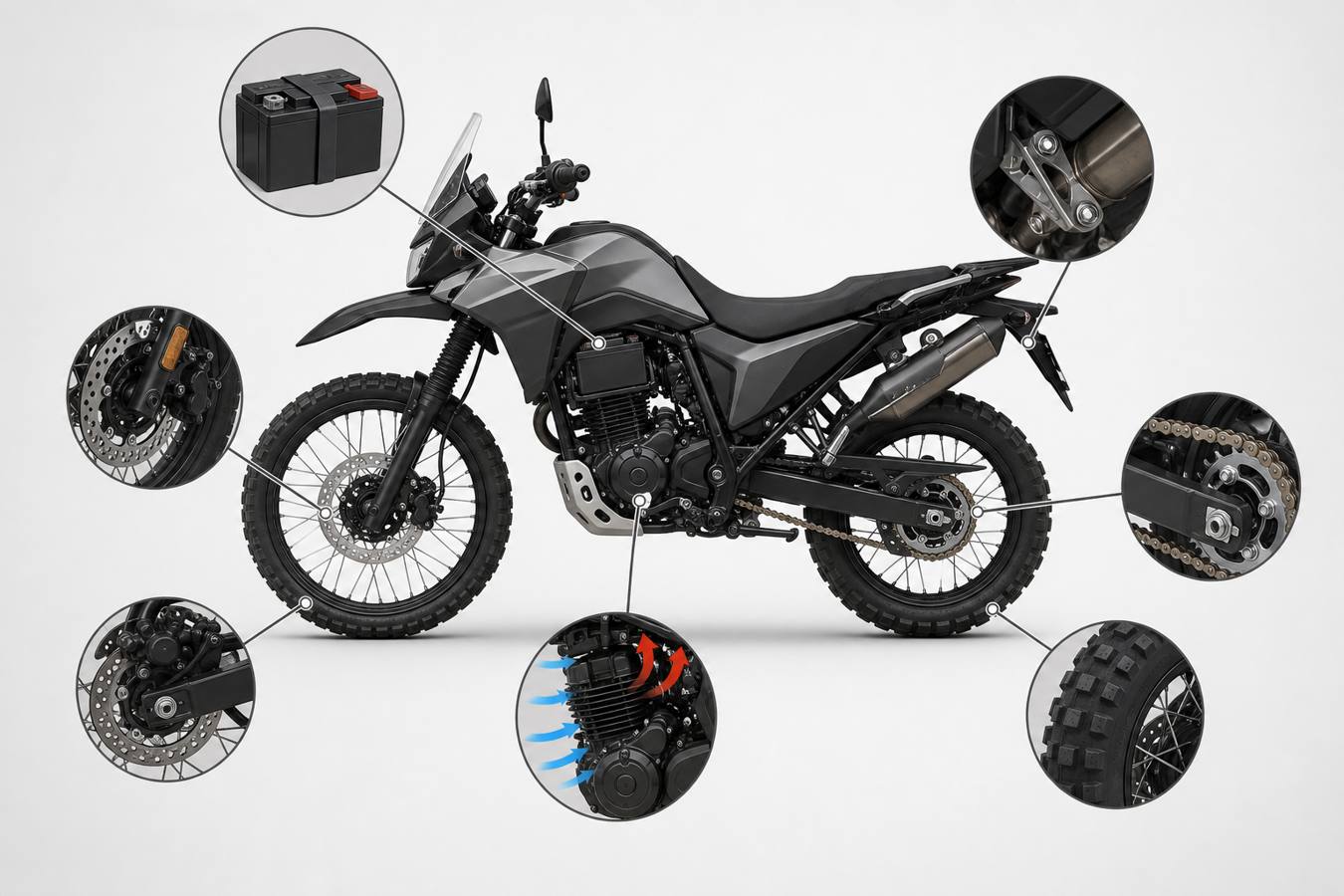
  • Motron X-Nord 125 problems

    Motron X-Nord 125 problems

    Motron X-Nord 125 problems

    Motron X-Nord 125 problems are usually less mysterious when the bike is checked like a small adventure 125 rather than treated like a large touring motorcycle. Most complaints come from ordinary weak points: battery voltage, chain condition, tyre pressure, loose fasteners, brake feel, fuelling behaviour, poor service history, weather exposure and expectations that are too high for a learner-legal 125cc engine. The X-Nord can be a practical commuter and light touring bike, but it needs methodical checks because a small single-cylinder engine, long-travel styling and mixed-use tyres can make small faults feel bigger than they really are.

    This guide is written for owners, buyers and workshop-minded riders who want a practical diagnosis before ordering parts or booking labour. It does not assume every bike has the same fault. Instead, it explains how to separate normal 125cc behaviour from a real defect, what to inspect first, which upgrades should be approached carefully, and when a mechanic should take over.

    Motron X-Nord 125 problems
    Motron X-Nord 125 problems are easier to diagnose when the bike is inspected systematically in a workshop rather than judged from one symptom.

    Quick answer

    Motron X-Nord 125 problems most often start with maintenance basics: a tired battery, dirty terminals, old fuel, a loose chain, uneven tyre pressure, contaminated brake pads, poor cable adjustment or fasteners that have worked loose after winter riding. A 125 adventure-style bike has limited torque, so small mechanical drag from the chain, brakes or tyres can make it feel underpowered even when the engine itself is healthy.

    The best first step is not to buy random parts. Begin with a cold-start observation, battery voltage check, charging check, visual inspection for rubbed wiring, chain slack measurement, brake drag test and a short road test once the engine is warm. If the bike cuts out, misfires, refuses to idle, shows warning lights or loses power under load, read any stored fault codes and inspect the intake, injector connectors and earth points before replacing expensive components.

    Anyone comparing repairs with sensible upgrades should also read the Motron X-Nord 125 tuning guide, the motorcycle chain tension adjustment guide and the X Moto Parts motorcycle parts shop before placing an order. The right part helps only when the actual fault has been identified.

    Main symptoms owners report

    Motron X-Nord 125 problems can feel like one big reliability issue, but the symptoms usually fall into groups. Starting trouble points towards battery, starter circuit, side-stand switch, clutch switch or fuel delivery. Poor acceleration can be normal 125cc output, but it can also be caused by chain drag, incorrect tyre pressure, restricted airflow, poor fuel, brake binding or a sensor signal that is outside range. Vibration may be normal for a small single, yet harsh vibration through the pegs or bars often deserves a fastener, engine mount and chain inspection.

    Owners should also separate one-time annoyance from repeatable behaviour. A bike that hesitates once after being washed is different from one that stalls every hot restart. A rear brake that squeaks after rain is different from a brake that drags and heats the disc. A chain that rattles on rough roads is different from a chain with tight spots. Good diagnosis comes from repeating the symptom under controlled conditions.

    SymptomLikely area to inspect firstWhat confirms the faultUrgency
    Slow crankingBattery, terminals, starter relay, earth strapLow voltage under load or green/loose terminalsHigh if repeated
    Cuts out at idleIdle control, intake leak, fuel quality, sensor connectorStall repeats when hot or after throttle is closedMedium to high
    Feels weak uphillNormal 125cc output, chain drag, tyre pressure, air filterTop gear bogging improves after downshifting or serviceMedium
    Brake squeal or dragPads, caliper slider, disc condition, lever free playWheel does not spin freely or disc gets hotHigh
    Chain noiseSlack, lubrication, sprocket wear, alignmentTight spots, hooked teeth or uneven adjuster marksMedium

    Starting and electrical checks

    Motron X-Nord 125 problems involving starting should be approached with a multimeter before guessing at the starter motor. A small 125cc motorcycle battery can show a believable voltage at rest and still collapse when the starter button is pressed. Check static voltage after the bike has sat for a few hours, then check cranking voltage, then check charging voltage once the engine is running. If the battery is weak, the ECU and fuel injection can behave strangely even when the starter still turns.

    Look at the simple things first. Battery terminals should be tight and clean. The main earth should be secure. The clutch and side-stand switches should operate cleanly. The fuse box should be dry. Any alarm, USB charger, heated grip wiring or accessory light added by a previous owner should be inspected because poorly crimped accessory wiring is a common source of intermittent faults on lightweight motorcycles.

    Electrical checks for Motron X-Nord 125 starting and sensor faults
    Battery voltage, earth points and sensor connectors should be checked before replacing parts for a starting or cutting-out fault.

    Cold start versus hot restart

    Motron X-Nord 125 problems that appear only when cold often point towards battery condition, fuel quality or idle strategy. Faults that appear only after a hot ride may involve heat-soaked connectors, coil weakness, fuel delivery, tight valve clearances or a component that fails as resistance changes with temperature. Write down when the issue happens. That note saves diagnostic time.

    Warning lights and fault codes

    If the engine warning light appears, do not ignore it just because the bike still runs. Modern 125cc fuel-injected motorcycles rely on temperature, throttle and intake signals. A poor connector can make the ECU choose a protective fuel strategy, which may feel like hesitation, rough idle or poor throttle response. A workshop scan or careful sensor inspection is worth more than replacing random parts, especially when Motron X-Nord 125 problems return after the bike has been ridden in rain.

    Engine, idle and fuelling behaviour

    Motron X-Nord 125 problems with idle, hesitation or flat acceleration need a calm check of service items. Start with the air filter, spark plug, fuel age, intake clamps and throttle cable free play. A 125 single does not have much spare torque, so a dirty filter or dragging brake can feel like a serious engine issue. If the motorcycle has been stored, old petrol can create poor starting, uneven idle and hesitation under load.

    Owners sometimes expect a dramatic power gain from one simple part. On a learner-legal 125, the smarter target is clean response, reliable running and reduced mechanical drag. If you are considering a fuelling module or exhaust after diagnosing the bike, compare the approach with the motorcycle power unit guide and the best motorcycle exhaust brands guide. A useful upgrade should support the engine setup, not hide a basic service fault.

    Loss of power under load

    Motron X-Nord 125 problems described as “no power” often need a road-test question: does the engine rev freely in lower gears, or does it flatten everywhere? If it revs in lower gears but struggles in top gear, the bike may simply be geared tall for hills, headwind or a heavy rider with luggage. If it refuses to rev in every gear, look closer at fuel delivery, air intake, exhaust blockage, brake drag or sensor input.

    Throttle response after rain or washing

    Adventure-styled 125s get used in rain, town grime and winter roads. Water in connectors, corroded terminals and damp plug caps can create intermittent misfire. Do not blast the engine and wiring with a pressure washer. Dry the bike carefully, inspect connector seals and use proper electrical contact cleaner where appropriate. Silicone spray on the outside of rubber boots can help repel moisture, but it should not be used as a cure for damaged wiring.

    Chain, brakes, tyres and road feel

    Motron X-Nord 125 problems often come from the chassis rather than the engine. Chain slack that is too tight can make the bike harsh, stress the output shaft bearing and reduce performance. Chain slack that is too loose can slap, snatch and make gear changes feel crude. Rear axle alignment matters because a small motorcycle with dual-purpose tyres can feel nervous if the wheel is not straight.

    Brake drag is another common hidden problem. Put the bike securely on a stand, spin each wheel and listen. A light pad brush can be normal, but the wheel should not stop immediately or create heat after a short ride. Tyres also deserve attention. The X-Nord style encourages mixed road and trail use, but underinflated tyres, squared-off tread or aggressive knobbly patterns can make steering heavy and reduce speed.

    Checking chain slack and rear brake condition on a 125 adventure motorcycle
    Chain slack, axle alignment, sprocket wear and rear brake drag can create symptoms that feel like engine trouble.
    CheckWorkshop methodWhy it mattersTypical mistake
    Chain slackMeasure at the recommended point with rider load consideredPrevents snatch, drag and bearing stressAdjusting too tight on the side stand
    SprocketsLook for hooked teeth and uneven wearWorn sprockets damage a new chain quicklyReplacing only the chain
    Tyre pressureUse a reliable gauge when coldAffects steering, braking and accelerationGuessing by eye
    Brake dragSpin wheels after a ride and check disc heatDrag can reduce performance and safetyIgnoring a hot disc
    FastenersInspect rack, exhaust, fairing and engine-mount boltsLoose fittings create vibration and noiseAssuming every rattle is internal engine damage

    Compatibility before buying parts

    Motron X-Nord 125 problems should not be fixed by ordering parts from a photo alone. The X-Nord name can appear across markets with small equipment differences, and aftermarket listings may mention Touring, standard trim, Euro version or model-year detail. Before buying a battery, chain kit, exhaust, sensor, lever, brake pads or tuning part, confirm the exact model year, engine version and the part dimensions fitted to your own bike.

    Part or systemCompatibility approachImportant note
    BatteryMatch case size, terminal layout and capacityA battery that fits electrically may not fit securely under the seat
    Chain and sprocketsCheck pitch, link count and tooth countChanging gearing can affect acceleration, cruising rpm and insurance disclosure
    Brake padsMatch caliper shape and pad backing plateNever rely only on model name when calipers changed by market
    Exhaust or silencerCheck pipe diameter, mounting points and legal markingAn adapter may still be required even if the bike name is listed
    Electrical tuning moduleConfirm fuel-injection version and connector locationDo not fit a module to a bike with unresolved sensor or charging faults
    Motron X-Nord 125 inspection points for battery chain brakes tyres and exhaust
    A good compatibility check covers the battery, chain, brakes, tyres, exhaust mounts and electrical connectors before parts are ordered.

    Common mistakes that make diagnosis harder

    Motron X-Nord 125 problems become expensive when riders replace parts before measuring anything. The first mistake is assuming every slow bike needs a tuning part. A dragging rear brake, dry chain or clogged air filter can remove more real-world performance than a small fuelling correction can add. The second mistake is buying universal parts without checking dimensions. Universal does not mean plug-and-play.

    Another common mistake is ignoring road-legal requirements. A loud silencer without certification may make the bike more noticeable, but it can create MOT, insurance and roadside issues. Riders also forget to inspect the basic mounting hardware. A loose exhaust bracket, cracked rubber mount or missing spacer can sound like engine damage. Finally, many owners judge the bike when cold. Always warm the engine fully before deciding that fuelling or throttle response is wrong.

    Motron X-Nord 125 problems sometimes appear after a rider tries to make the bike behave like a larger motorcycle. In the UK, learner and A1-category use is closely tied to engine capacity and power limits. The official UK licence guidance is available from GOV.UK motorcycle and moped riding rules. Exhaust condition, excessive noise and roadworthiness also matter at MOT time; the official testing guidance is available through GOV.UK MOT inspection manual for motorcycles.

    Rules vary outside the UK. In Ireland, Canada, Australia, New Zealand and the United States, licensing, emissions, noise and equipment rules can differ by state, province, vehicle age and road-use category. A part sold for track, private land or off-road use should not be assumed road legal. If a product affects emissions equipment, catalytic converter function, DB-killer use, exhaust noise or declared power, check local law and insurance conditions before using it on public roads.

    Practical workshop approach

    Motron X-Nord 125 problems should be diagnosed in layers. A mechanic will usually begin with condition, not theory: tyre pressures, chain slack, brake drag, oil level, coolant or cooling-air condition if applicable, air filter, spark plug, battery and charging voltage. Only after those checks does it make sense to move into sensors, injector signal, compression testing or ECU-related work.

    There is also a difference between theoretical compatibility and real compatibility. A lever may be listed for the model but still foul a handguard. A silencer may fit the pipe but sit too close to luggage. A chain kit may use the right pitch but the gearing may not suit UK commuting. After fitting any part, check clearance through steering movement, suspension travel, heat expansion and vibration. A short test ride followed by a second fastener check is not optional on a small adventure-style bike that sees rough roads.

    Repair, upgrade or leave it alone?

    Motron X-Nord 125 problems do not always need a performance solution. If the bike starts well, idles cleanly, charges correctly, rides straight and stops safely, a rider wanting more speed may simply be reaching the normal limit of a 125. In that case, the best “upgrade” may be a clean service, correct chain adjustment, good tyres and realistic luggage weight. If the bike has repeated stalls, warning lights, hot-start trouble, brake drag or unstable handling, repair comes before tuning. That decision is where Motron X-Nord 125 problems should be treated like workshop evidence, not frustration.

    Owner goalBest first stepPossible next stepWhat to avoid
    More reliable startingBattery and charging testInspect starter circuit and earthsReplacing sensors before voltage checks
    Cleaner accelerationService air filter, spark plug, fuel and chainConsider fuelling support only after serviceExpecting big power from one part
    Better road feelTyres, pressures, wheel bearings and alignmentSuspension setup or tyre changeIgnoring squared-off tyres
    Less noise or vibrationCheck fasteners, exhaust mounts and chainReplace worn rubber mounts or bearingsAssuming all vibration is engine failure
    Touring setupCheck luggage weight and electrical loadUse quality racks and fused accessoriesOverloading a 125 charging system

    FAQ

    Are Motron X-Nord 125 problems usually serious?

    Motron X-Nord 125 problems are not automatically serious. Many are maintenance-related: weak battery, loose terminals, chain wear, tyre pressure, brake drag or poor storage. Repeated warning lights, hot stalling, brake overheating or structural damage should be treated seriously and checked by a qualified mechanic.

    Why does my Motron X-Nord 125 feel slow uphill?

    Motron X-Nord 125 problems that feel like poor uphill performance may simply reflect the limits of a 125cc engine, especially with luggage, a tall rider or headwind. If the bike also hesitates in lower gears, inspect fuel, air filter, spark plug, brake drag and chain condition before assuming the engine is faulty.

    Can a weak battery cause running issues?

    Motron X-Nord 125 problems can absolutely be caused by a weak battery or poor earth, especially on a fuel-injected bike. Low voltage can affect starting, sensor behaviour and charging stability. Test voltage under load rather than judging the battery only by whether the lights come on.

    Is an aftermarket exhaust a good fix?

    Motron X-Nord 125 problems should not be fixed with an exhaust unless the original system is damaged, blocked or unsuitable for a carefully planned setup. An aftermarket silencer must match pipe diameter, mounting points, clearance and road-legal requirements. For road use, check noise, emissions equipment and certification.

    Do I need to remap or fit a module after changing parts?

    Motron X-Nord 125 problems after intake or exhaust changes can come from fuelling mismatch, leaks or poor installation. Some mild changes may run acceptably, while others need fuelling correction. The bike should be serviced and fault-free before adding a module, and settings should be conservative.

    What should I check before buying used?

    Motron X-Nord 125 problems on a used bike are easiest to spot with a cold start, charging test, chain and sprocket inspection, brake drag check, tyre inspection and short test ride. Look for crash damage, missing fasteners, hacked wiring, rough idle, smoke, warning lights and uneven steering.

    Can I use universal motorcycle parts?

    Motron X-Nord 125 problems can get worse if universal parts are chosen only by appearance. Universal parts still need correct dimensions, mounting points, electrical ratings, pipe diameter, lever pivot style or chain specification. Measure before ordering and ask for compatibility details when unsure.

    When should I stop diagnosing at home?

    Motron X-Nord 125 problems should go to a workshop when brakes overheat, the bike cuts out in traffic, the engine warning light remains on, wiring is damaged, compression is suspect or steering feels unstable. Safety-related faults are not a place to save money with guesses.

    Final advice before spending money

    Motron X-Nord 125 problems are best solved by measuring first, buying second and testing after every change. Before ordering, confirm the exact model year, inspect the battery and charging system, measure chain slack, check brake drag, verify tyre condition, inspect wiring and decide whether the symptom is engine, chassis, electrical or expectation-related. Choose a universal part only when its measurements are proven. Choose a model-specific part when fitment and support matter more than saving a few pounds. If an adapter, wiring repair or exhaust alignment is needed, use a competent mechanic rather than forcing the part to fit.

    For owners who have already completed the basic checks and want to compare realistic next steps, the motorcycle exhaust category, the Motron X-Nord 125 tuning guide and the chain tension guide are the most useful places to continue without turning a simple fault into an expensive parts chase.

    {
    “@context”: “https://schema.org”,
    “@type”: “Article”,
    “headline”: “Motron X-Nord 125 problems”,
    “description”: “Motron X-Nord 125 problems diagnostic guide covering starting, electrical checks, chain, brakes, tyres, compatibility, UK road rules and repair decisions.”,
    “image”: “https://xmotoparts.com/wp-content/uploads/2026/07/https://xmotoparts.com/wp-content/uploads/2026/07/motron-x-nord-125-problems.jpg”,
    “author”: {
    “@type”: “Organization”,
    “name”: “X Moto Parts”
    },
    “publisher”: {
    “@type”: “Organization”,
    “name”: “X Moto Parts”,
    “logo”: {
    “@type”: “ImageObject”,
    “url”: “https://xmotoparts.com/wp-content/uploads/2026/07/xmotoparts-logo.png”
    }
    },
    “mainEntityOfPage”: “https://xmotoparts.com/motron-x-nord-125-problems/”
    }

    {
    “@context”: “https://schema.org”,
    “@type”: “FAQPage”,
    “mainEntity”: [
    {“@type”: “Question”, “name”: “Are Motron X-Nord 125 issues usually serious?”, “acceptedAnswer”: {“@type”: “Answer”, “text”: “Many Motron X-Nord 125 issues are maintenance-related, including battery, chain, brake, tyre and connector faults. Repeated warning lights, stalling, brake overheating or unstable handling should be checked by a qualified mechanic.”}},
    {“@type”: “Question”, “name”: “Why does a Motron X-Nord 125 feel slow uphill?”, “acceptedAnswer”: {“@type”: “Answer”, “text”: “A 125cc engine has limited torque, especially with luggage, hills or headwind. If the bike also hesitates in lower gears, inspect service items, brake drag, tyre pressure, chain condition and fuelling before assuming engine damage.”}},
    {“@type”: “Question”, “name”: “Can a weak battery cause running faults?”, “acceptedAnswer”: {“@type”: “Answer”, “text”: “Yes. A weak battery or poor earth can affect starting, charging stability and sensor behaviour on a fuel-injected 125cc motorcycle. Voltage should be checked at rest, while cranking and with the engine running.”}},
    {“@type”: “Question”, “name”: “Is an aftermarket exhaust a good repair?”, “acceptedAnswer”: {“@type”: “Answer”, “text”: “An aftermarket exhaust is not a substitute for diagnosis. It may be useful if the original system is damaged or if the setup is planned correctly, but fitment, noise, emissions equipment and road legality must be checked.”}},
    {“@type”: “Question”, “name”: “Should a tuning module be fitted after modifications?”, “acceptedAnswer”: {“@type”: “Answer”, “text”: “A tuning module should only be considered after the motorcycle is serviced and fault-free. Intake, exhaust and fuelling changes should be matched carefully and adjusted conservatively.”}},
    {“@type”: “Question”, “name”: “What should be checked before buying used?”, “acceptedAnswer”: {“@type”: “Answer”, “text”: “Check cold starting, charging voltage, warning lights, chain and sprockets, tyre condition, brake drag, crash damage, loose fasteners, hacked wiring and road-test behaviour before buying.”}}
    ]
    }
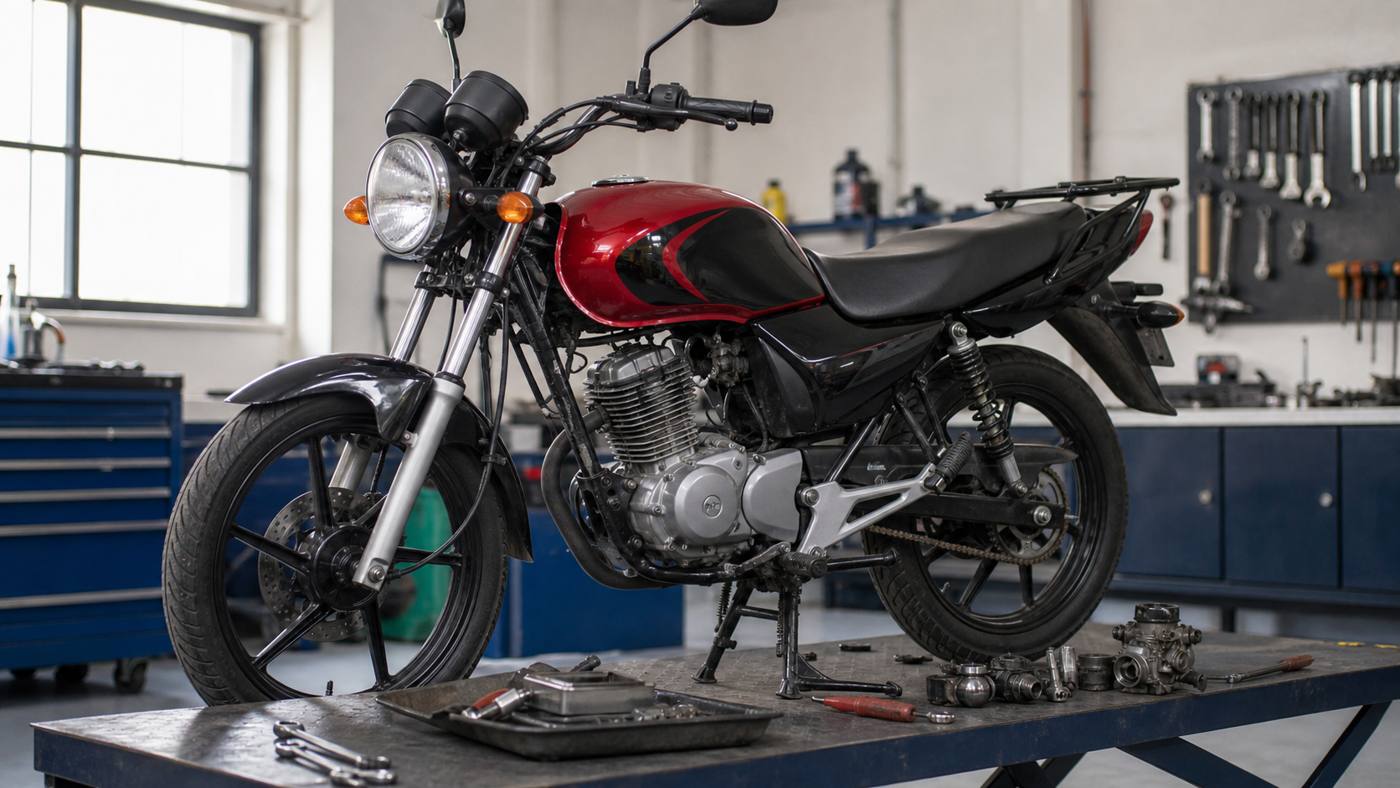
  • Yamaha YBR 125 power increase

    Yamaha YBR 125 power increase

    Yamaha YBR 125 power increase

    Yamaha YBR 125 power increase is a realistic goal only when the motorcycle is treated as a light, economical 125 rather than a small bike trying to become a 300. The YBR is popular because it is simple, cheap to run, easy to ride and forgiving. That also means the best improvements usually come from restoring lost performance, reducing mechanical drag, choosing sensible gearing and matching intake, exhaust and fuelling carefully. Big promises rarely survive the first proper road test.

    For most owners, Yamaha YBR 125 power increase really means better response in town, easier hill climbing, cleaner acceleration from low revs and less struggle holding speed into wind or with luggage. It does not mean turning the motorcycle into a fast bike. The engine is small, the legal class matters in many countries, and reliability is worth protecting. A YBR that starts instantly, idles cleanly, pulls smoothly and carries speed efficiently is more useful than one that is loud, over-geared and unpleasant.

    Yamaha YBR 125 power increase
    A sensible YBR 125 setup starts with service condition, chain drive, tyres, brakes, intake sealing and exhaust fitment before power parts.

    If you are comparing small-capacity tuning ideas, read the motorcycle chain tension adjustment guide, the Honda CB125R power increase guide and the Suzuki Intruder 125 power increase guide. The models differ, but the same workshop truth applies: on a 125, small losses matter.

    Start by finding lost power

    Yamaha YBR 125 power increase should start with the motorcycle as it is, not with an online parts basket. Many YBRs are used for commuting, training, delivery work or budget transport. They often have tired chains, old tyres, worn sprockets, dirty air filters, neglected valve clearances, stiff brakes, old fuel or poorly adjusted clutches. Each fault is small. Together they make the bike feel slow.

    A full baseline service can feel like a performance upgrade because a 125 does not have spare torque to hide neglect. Check oil, plug, air filter, valve clearance where applicable, fuel quality, carburettor cleanliness or EFI sensor condition, chain tension, sprocket wear, brake drag and tyre pressure. If the motorcycle rolls badly or the engine breathes poorly, no tuning part will give a fair result.

    Baseline checkWhat to look forHow it affects performance
    Air filterDust, oil contamination, poor sealingRestricted or dirty air makes the engine lazy
    Spark plugWorn electrode, wrong heat range, rich/lean signsWeak spark hurts starting and throttle response
    Chain and sprocketsTight spots, hooked teeth, dry linksFinal-drive drag steals power at the rear wheel
    BrakesDragging pads, sticky caliper, rear drum adjustmentBrake drag can feel like engine weakness
    TyresLow pressure, squared profile, wrong sizeRolling resistance and handling both suffer

    A good plan for Yamaha YBR 125 power increase begins with a test route. Use the same hill, same tyre pressures and same fuel load before and after each change. If you cannot repeat the test, you cannot tell whether the bike improved or the weather simply changed.

    Another reason Yamaha YBR 125 power increase should start with measurement is that wind, rider position, luggage and tyre pressure can change the result more than a small bolt-on part.

    Engine, intake and fuelling checks

    Yamaha YBR 125 power increase depends on the version you own. Earlier and market-specific bikes may be carburetted, while later or regional versions may use fuel injection. Do not buy tuning parts until you know which system your bike has. A carburettor jetting discussion does not apply directly to an EFI motorcycle, and an electronic module will not help a carburetted bike unless the product is designed for a different function.

    Carburetted YBR 125 models

    On a carburetted motorcycle, throttle response depends on clean jets, float height, mixture setting, airbox seal, intake rubber condition and exhaust back pressure. A partially blocked pilot jet can make the bike hard to start and weak at small throttle openings. A split intake boot can create lean running. A poorly fitted pod filter can make the bike louder and worse in rain. For Yamaha YBR 125 power increase, carburettor work should be measured, not guessed.

    Fuel-injected YBR 125 models

    On EFI versions, the ECU uses sensor information to control fuelling. A dirty air filter, weak battery, poor ground, intake leak or exhaust leak can still cause poor running. A fuel module may be considered only after the motorcycle is healthy and compatibility is confirmed. For product-style research, the chip tuning modules category is relevant, but the correct part must match the exact year, connector and fuel system.

    YBR 125 intake carburettor airbox spark plug and valve clearance checks
    Intake sealing, clean fuelling and basic engine health should be checked before asking a small 125 for more response.

    Valve clearance and compression

    Yamaha YBR 125 power increase can be impossible if the engine has lost compression or the valve clearances are wrong. Tight valves can make starting harder and reduce performance when hot. A tired engine may feel flat no matter what exhaust or sprocket is fitted. If the bike has high mileage or unknown service history, compression and valve checks are more valuable than styling upgrades.

    Engine-side changeMain benefitPossible downsideBest use
    Full serviceRestores lost responseFeels less exciting than tuning partsEvery YBR before modifications
    Clean standard airboxReliable airflow and weather protectionLess intake noiseRoad use and commuting
    Performance filterMay improve airflow if correctly matchedCan weaken fuelling if poorly fittedHealthy engine with checked fuelling
    Fuel module or jettingCan refine response after airflow changesWrong settings can hurt reliabilityAfter confirming carburettor or EFI version
    Big-bore conversionLargest potential changeCost, legality, insurance and reliability questionsPrivate-road or specialist builds only

    Exhaust upgrades and realistic gains

    Yamaha YBR 125 power increase is often associated with exhaust upgrades, but the exhaust should be treated honestly. On a small four-stroke commuter, a better exhaust can improve sound, reduce weight and sometimes sharpen response if the original system is restrictive or damaged. It will not create a dramatic horsepower jump by itself.

    A road exhaust must fit properly: header diameter, mounting bracket, gasket, silencer support, heat shield clearance and footrest position all matter. A leak at the header can make the bike pop, run poorly and sound rough. A silencer with no proper support can crack mounts. A pipe that is too loud can become tiring and legally troublesome.

    DB-killer, catalyst and road use

    For Yamaha YBR 125 power increase, removing a DB-killer or catalytic converter where fitted is not a casual road modification. The motorcycle may become louder, less compliant and harder to insure. If the exhaust was approved with a baffle installed, using it without that part can change its legal status. Always keep paperwork and choose a road-sensible system for public roads.

    Chain, sprockets and gearing choices

    Yamaha YBR 125 power increase is often felt most clearly through gearing rather than engine output. Changing sprocket sizes does not create power, but it changes how the available power is used. Shorter gearing can improve pull-away and hill response. Taller gearing can reduce revs at cruising speed, but if the engine cannot pull it, the bike becomes slower and more frustrating.

    YBR 125 chain slack sprocket gearing and alignment checks
    Before changing sprockets, inspect chain condition, alignment, slack, tyre size and the type of riding you actually do.

    Shorter gearing for town and hills

    A slightly smaller front sprocket or larger rear sprocket can make the YBR feel more eager at low speed. This helps riders in traffic, on hills or with heavier loads. The trade-off is higher rpm at cruising speed and possibly lower comfortable top speed. For Yamaha YBR 125 power increase, that trade-off may be worth it if the bike spends most of its life in town.

    Taller gearing for cruising

    Taller gearing sounds attractive because it promises lower revs, but a 125 needs revs to make power. If the engine cannot pull the gearing into wind or uphill, the rider changes down more often and loses speed. Taller gearing should be mild and tested carefully. A relaxed speedometer reading is not useful if the motorcycle cannot hold real road speed.

    Gearing choiceMain advantagePossible disadvantageBest for
    Standard gearingBalanced factory behaviourMay feel weak with hills or luggageMixed commuting
    Slightly shorter gearingBetter acceleration feelHigher cruising rpmTown, hills and heavier riders
    Slightly taller gearingLower rpm at steady speedCan feel weaker into windFlat roads and light riders
    Fresh chain kitReduces drag and vibrationNeeds correct adjustmentWorn final-drive systems
    Extreme ratio changeFeels dramatic at firstUsually creates new problemsSpecialist/private projects only

    Compatibility before ordering parts

    Yamaha YBR 125 power increase depends heavily on model year and market. The YBR family has been sold across many countries, and details such as carburettor, fuel injection, emissions equipment, exhaust shape, front brake type, wheel design and electrical connectors may vary. A part that fits one YBR 125 is not automatically correct for another.

    YBR 125 compatibility checks for air filter carburettor exhaust chain tyres brakes and battery
    Real compatibility means matching the exact model, fuel system, exhaust mounting, chain size, tyres, brakes and road-use requirements.
    Part typeCompatibility checkImportant note
    ExhaustHeader diameter, bracket, gasket and yearUniversal silencers may need fabrication
    Air filterAirbox shape and carb/EFI versionPoor sealing lets dust into the engine
    SprocketsTooth count, chain pitch and hub patternWrong parts can damage the chain drive
    Fuel moduleEFI connector and sensor layoutNot relevant to carburetted versions in the same way
    TyresCorrect size, load and speed ratingOversizing can hurt handling and gearing
    Big-bore kitEngine version, cylinder, head and legal useUsually needs specialist installation and disclosure

    Anyone considering Yamaha YBR 125 power increase should ask for photos, measurements and model-year confirmation before ordering. If the part listing only says “YBR 125” without year, fuel system or mounting details, ask questions before paying.

    For a road bike used every week, Yamaha YBR 125 power increase should never make service access, cold starting or wet-weather reliability worse.

    Yamaha YBR 125 power increase must be separated into road use, private land and competition-style projects. In the UK, a learner-legal 125 must stay within the licence and insurance context that applies to the rider. Exhaust noise, emissions equipment, number plate visibility, mirrors, indicators, tyres and general roadworthiness also matter. Check current official guidance such as the GOV.UK motorcycle MOT inspection manual. For model-specific owner information and service documents, use the official Yamaha owner manuals portal.

    Road rules differ across the United States, Canada, Australia, New Zealand and Ireland. A part sold for off-road use, racing use or private land may physically fit the motorcycle but still be wrong for public roads. Insurance disclosure is also important. A small engine modification can become a problem after an accident if the insurer was not told.

    Common mistakes

    Yamaha YBR 125 power increase goes wrong when owners start with the loudest part or the biggest claim. A 125 rewards precision. It punishes shortcuts because there is so little power to waste.

    • Fitting an open filter without correcting fuelling or protecting it from rain.
    • Changing sprockets without replacing a worn chain.
    • Choosing taller gearing because it sounds faster, then losing hill speed.
    • Ignoring valve clearance, compression and spark-plug condition.
    • Buying parts for an EFI bike when the motorcycle is carburetted, or the reverse.
    • Removing baffles or emissions equipment for road use without checking legality.
    • Expecting exhaust sound to equal measurable performance.
    • Using poor tyres and brakes after making the bike more eager.
    • Not declaring modifications to insurance.
    • Testing changes on different roads and calling the result proof.

    Workshop method for a better YBR

    Yamaha YBR 125 power increase should follow a calm order: service first, rolling resistance second, gearing third, breathing and fuelling fourth. Start with the bike cold. Check starting, idle and throttle response. Warm it fully. Ride a known route. Record what it does. Then make one change. Ride the same route again.

    After any exhaust change, recheck mounting bolts and gasket sealing after heat cycles. After sprocket changes, recheck chain slack and rear axle torque. After intake work, inspect for air leaks and wet-weather behaviour. After fuelling changes, check plug colour, idle stability, hot restarting and whether the bike runs cleanly at steady throttle. This is the part of Yamaha YBR 125 power increase that separates a useful build from a noisy guess.

    When Yamaha YBR 125 power increase is tested this way, the owner can tell the difference between a genuine improvement and a louder motorcycle that only feels quicker.

    Which upgrade path makes sense?

    Owner goalBest first stepWhat to avoidWhy
    Better town responseService, chain kit and slightly shorter gearingVery loud exhaust firstTown riding rewards response, not noise
    Hill climbingBaseline engine health and gearing checkTaller gearingThe engine needs revs under load
    Cleaner soundQuality road-legal exhaustUnsupported universal silencerFitment and legality matter
    ReliabilityStandard airbox, fresh service and good tyresOpen intake in wet useReliable airflow beats noisy intake drama
    Private projectSpecialist engine work and proper fuellingRoad use without disclosureLegal and insurance issues can outweigh gains

    If you want a natural next step, browse X Moto Parts motorcycle parts and compare any part against your exact YBR version before ordering. A useful part is one that solves a real limitation on your motorcycle.

    FAQ

    Is Yamaha YBR 125 power increase worth it?

    Yamaha YBR 125 power increase is worth it if your goal is better response, cleaner running and easier hill work. It is not worth it if you expect big horsepower from cheap bolt-on parts.

    What is the best first modification?

    The best first modification is usually not a modification at all: full service, chain and sprocket inspection, tyre pressure, brake check, clean air filter and correct valve clearance. Then choose gearing or exhaust based on the result.

    Will an exhaust make a YBR 125 faster?

    An exhaust may improve sound, reduce weight and sometimes sharpen response, but it rarely transforms a small four-stroke by itself. For Yamaha YBR 125 power increase, exhaust work should be matched with fuelling and legal fitment.

    Should I change the sprockets?

    Sprocket changes are useful if you understand the trade-off. Shorter gearing improves pull-away and hill response but raises cruising rpm. Taller gearing can feel weaker if the engine cannot pull it.

    Can I fit a big-bore kit?

    A big-bore kit may be possible on some engines, but it changes cost, reliability, insurance, licence and road-legal questions. It is not a casual commuter upgrade and should be handled by a specialist.

    Is an open air filter a good idea?

    Usually not for everyday road use unless fuelling, weather protection and filtration are handled properly. A clean standard airbox is often better for reliability and smooth response.

    Do carburetted and fuel-injected YBRs tune the same way?

    No. Carburetted bikes involve jets, mixture, float height and intake sealing. Fuel-injected bikes involve sensors, ECU logic and compatible modules. Always confirm the exact version before buying parts.

    Is tuning a YBR 125 legal in the UK?

    Road legality depends on the modification, noise, emissions equipment, insurance, MOT condition and rider licence context. Keep road-use parts compliant and disclose modifications to your insurer.

    Final verdict

    Yamaha YBR 125 power increase is best approached as refinement. Make the bike healthy, reduce drag, choose gearing that suits your roads, keep the intake sealed, use a sensible exhaust and match fuelling only when needed. Do not chase fantasy numbers. The YBR is at its best when it remains easy to start, cheap to run and pleasant to ride.

    A carefully prepared YBR can feel much livelier without becoming unreliable. Check the exact model year, fuel system, chain size, exhaust fitment, tyre size and legal requirements before ordering anything. Done well, Yamaha YBR 125 power increase gives you a cleaner, sharper and more confident small motorcycle rather than a loud collection of mismatched parts.

    {
    “@context”: “https://schema.org”,
    “@type”: “Article”,
    “headline”: “Yamaha YBR 125 power increase”,
    “description”: “A practical guide to improving a Yamaha YBR 125 through service, gearing, intake, exhaust, fuelling, compatibility checks and legal road-use decisions.”,
    “image”: “https://xmotoparts.comhttps://xmotoparts.com/wp-content/uploads/2026/07/yamaha-ybr-125-power-increase.jpg”,
    “author”: {
    “@type”: “Organization”,
    “name”: “X Moto Parts”
    },
    “publisher”: {
    “@type”: “Organization”,
    “name”: “X Moto Parts”,
    “logo”: {
    “@type”: “ImageObject”,
    “url”: “https://xmotoparts.com/wp-content/uploads/x-moto-parts-logo.png”
    }
    },
    “mainEntityOfPage”: {
    “@type”: “WebPage”,
    “@id”: “https://xmotoparts.com/yamaha-ybr-125-power-increase/”
    }
    }

    {
    “@context”: “https://schema.org”,
    “@type”: “FAQPage”,
    “mainEntity”: [
    {
    “@type”: “Question”,
    “name”: “Is Yamaha YBR 125 power increase worth it?”,
    “acceptedAnswer”: {
    “@type”: “Answer”,
    “text”: “It is worth it if the goal is better response, cleaner running and easier hill work, but not if the rider expects big horsepower from cheap bolt-on parts.”
    }
    },
    {
    “@type”: “Question”,
    “name”: “What is the best first modification?”,
    “acceptedAnswer”: {
    “@type”: “Answer”,
    “text”: “The best first step is a full service, chain and sprocket inspection, tyre pressure check, brake check, clean air filter and correct valve clearance.”
    }
    },
    {
    “@type”: “Question”,
    “name”: “Will an exhaust make a YBR 125 faster?”,
    “acceptedAnswer”: {
    “@type”: “Answer”,
    “text”: “An exhaust may improve sound, reduce weight and sometimes sharpen response, but it rarely transforms a small four-stroke by itself.”
    }
    },
    {
    “@type”: “Question”,
    “name”: “Should I change the sprockets?”,
    “acceptedAnswer”: {
    “@type”: “Answer”,
    “text”: “Sprocket changes can help if the rider understands the trade-off. Shorter gearing improves pull-away and hill response but raises cruising rpm.”
    }
    },
    {
    “@type”: “Question”,
    “name”: “Can I fit a big-bore kit?”,
    “acceptedAnswer”: {
    “@type”: “Answer”,
    “text”: “A big-bore kit may be possible on some engines, but it changes cost, reliability, insurance, licence and road-legal questions.”
    }
    },
    {
    “@type”: “Question”,
    “name”: “Is an open air filter a good idea?”,
    “acceptedAnswer”: {
    “@type”: “Answer”,
    “text”: “Usually not for everyday road use unless fuelling, weather protection and filtration are handled properly.”
    }
    },
    {
    “@type”: “Question”,
    “name”: “Do carburetted and fuel-injected YBRs tune the same way?”,
    “acceptedAnswer”: {
    “@type”: “Answer”,
    “text”: “No. Carburetted bikes involve jets, mixture, float height and intake sealing, while fuel-injected bikes involve sensors, ECU logic and compatible modules.”
    }
    },
    {
    “@type”: “Question”,
    “name”: “Is tuning a YBR 125 legal in the UK?”,
    “acceptedAnswer”: {
    “@type”: “Answer”,
    “text”: “Road legality depends on the modification, noise, emissions equipment, insurance, MOT condition and rider licence context.”
    }
    }
    ]
    }